June 9, 2026
When the World's Largest Commodity Trader Comes Knocking
In the world of junior mining development, few signals carry as much weight as the decision by a major global commodity trading house to commit capital and logistics infrastructure to a project before a single tonne of ore has been processed commercially. This dynamic is not driven by sentiment. It is driven by hard-nosed commercial calculus, and when a company the scale of Glencore participates in a competitive tender and emerges as the preferred buyer, the market takes notice.
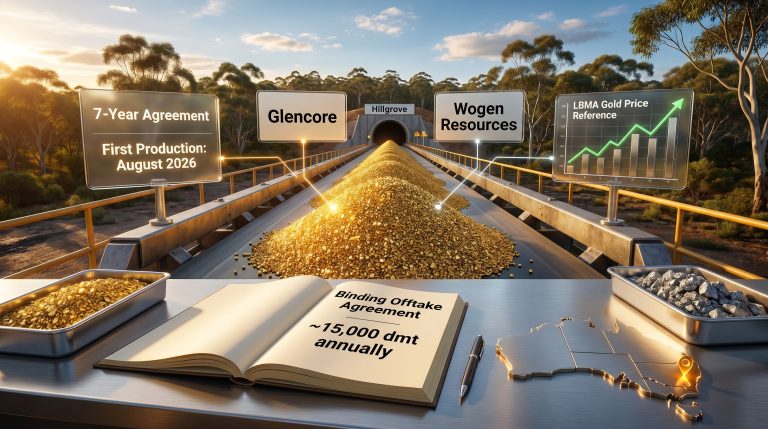
The Larvotto Hillgrove gold offtake deal with Glencore is precisely this kind of signal. It represents the culmination of a structured marketing process, competitive in nature, that ultimately produced a binding seven-year commercial agreement covering the primary gold concentrate output of the Hillgrove Antimony-Gold Project in New South Wales, Australia. Understanding what this agreement actually means, how it works, and what it reveals about the project's commercial maturity requires more than a surface reading of the headline.
When big ASX news breaks, our subscribers know first
What the Glencore Offtake Agreement Actually Entails
Structure, Pricing, and Logistics Mechanics
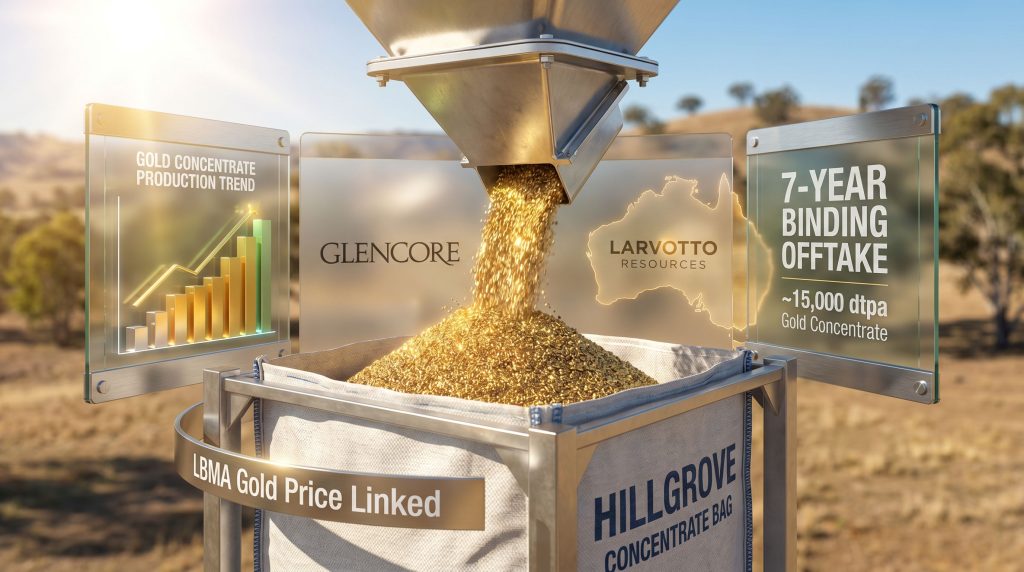
At its core, the Larvotto Hillgrove gold offtake deal with Glencore is a binding commitment for Glencore to purchase approximately 15,000 dry tonnes per annum (dtpa) of gold concentrate from Hillgrove across the project's first seven years of commercial operation. The agreement is structured on a mine-gate basis, meaning Larvotto's obligations end at the site boundary. From that point, Glencore assumes full responsibility for transportation, insurance, freight, and delivery to downstream smelters and refiners.
This structural feature is more significant than it might initially appear. For a junior developer approaching first production, eliminating the complexity and cost variability of concentrate logistics is a material operational advantage. Mine-gate arrangements remove exposure to shipping rate volatility, port congestion risks, and the capital requirements associated with building or contracting logistics chains independently.
Pricing under the agreement is referenced against the LBMA gold markets benchmark, adjusted for the contained gold content within each shipment of concentrate. In practice, this means the actual cash received per tonne of concentrate is determined by:
- The prevailing LBMA gold price at the time of settlement
- The assayed gold grade within the concentrate (typically expressed in grams per dry metric tonne)
- Payability terms, which determine what percentage of contained gold is actually paid to the producer
- Treatment charges (TCs) and refining charges (RCs) deducted by the smelter or refiner
Because the LBMA benchmark is set twice daily through a transparent electronic auction process involving major global banks and trading houses, it provides a widely accepted reference that reduces pricing disputes between counterparties. For investors modelling Larvotto's future revenue, movements in the LBMA gold price flow directly through to realised revenue, creating a straightforward sensitivity framework.
The agreement remains subject to execution of final documentation, which is standard practice following the signing of binding heads-of-agreement terms. In commercial concentrate marketing, binding agreements are typically negotiated in principle before final legal documentation is completed, with the commercial terms locked in during the binding phase.
The Competitive Tender Process and Why It Matters
What Multiple Bidders Reveal About Market Conditions
The selection of Glencore did not occur through a bilateral negotiation. Larvotto conducted a competitive tender process that attracted participation from multiple major international commodity trading houses. The level of interest across the tender field was attributed to prevailing strength in global gold prices, which had elevated the attractiveness of long-duration gold concentrate supply commitments.
This is an important but often overlooked dimension of offtake agreements. When gold prices are elevated, trading houses with downstream customer relationships, including smelters and refiners seeking reliable feed, compete aggressively for long-term supply. This dynamic gives well-positioned junior developers genuine negotiating leverage, something that is far less available during commodity price troughs.
Glencore's selection reflected its combination of global concentrate marketing infrastructure, established downstream customer networks, and financial scale. The company is dual-listed on the London Stock Exchange and the Johannesburg Stock Exchange, carrying a market capitalisation of approximately £70 billion (~USD $93 billion) as of mid-2026. For counterparty credit quality, this scale is directly relevant: Larvotto is entering a seven-year commercial relationship, and the financial standing of the buyer matters as much as the commercial terms.
Glencore's concentrate marketing division operates across base and precious metals globally, connecting mine-gate supply to smelters and refiners across Asia, Europe, and the Americas. Its ability to place Hillgrove's gold concentrate into established downstream channels reduces the risk of off-spec or volume-related disputes that can arise when junior producers deal with less experienced buyers.
Hillgrove's Dual-Commodity Revenue Architecture
Gold and Antimony: Two Offtakes, Two Counterparties
The Larvotto Hillgrove gold offtake deal with Glencore does not exist in isolation. It sits alongside a separately negotiated antimony concentrate offtake agreement with Wogen Resources, covering Hillgrove's second primary revenue stream. Furthermore, the decision to use different counterparties for each product reflects a sophisticated approach to commercial risk management.
| Product | Offtake Partner | Structure | Duration |
|---|---|---|---|
| Gold concentrate | Glencore | Mine-gate, LBMA-linked | 7 years |
| Antimony concentrate | Wogen Resources | Separate agreement | Not publicly specified |
| Tungsten concentrate | TBD | Under investigation | Subject to testwork |
By splitting offtake responsibilities across two trading houses rather than consolidating with a single counterparty, Larvotto avoids concentration risk in its commercial arrangements. No single entity controls the entire revenue stream, which provides optionality if market conditions shift or relationship dynamics change over the project's operational life.
Antimony itself deserves closer examination. Historically associated with flame retardants and lead-acid battery alloys, the critical mineral benefits of antimony have attracted renewed strategic attention due to its emerging role in antimony-based energy storage systems, including sodium-ion and liquid metal battery technologies. This evolving demand profile adds a layer of forward-looking value to Hillgrove's antimony production that goes beyond traditional pricing models.
The Tungsten Optionality Layer
An Emerging Third Revenue Stream
Beyond the two confirmed offtake agreements, Hillgrove carries a potential third revenue stream in the form of tungsten concentrate. In May 2026, Larvotto completed initial metallurgical flotation testwork on Tailings Storage Facility 1 at the Hillgrove site, investigating the viability of recovering tungsten from existing tailings material.
Tungsten as a strategic metal is classified as a critical mineral across multiple jurisdictions due to its applications in cutting tools, armour-penetrating munitions, and high-temperature industrial components. The global supply chain for tungsten is heavily concentrated, with China historically accounting for the majority of primary production. This concentration dynamic creates structural pricing support for non-Chinese tungsten sources.
If metallurgical testwork confirms economically viable tungsten recovery from Hillgrove's tailings, the project would transition from a dual-commodity operation to a triple-commodity one, with each revenue stream serving distinct end markets and exhibiting different price cycle characteristics.
Offtake discussions for tungsten are expected to progress as testwork advances and development activities move forward, according to company statements. The optionality value of this potential stream is not currently priced into most analyst frameworks, consequently representing a speculative but plausible upside scenario for investors monitoring the project.
Production Timeline, Commissioning, and Ramp-Up Risks
August 2026 Target: On Budget, On Schedule
As of June 2026, Larvotto confirmed that commissioning and first production at Hillgrove remain on track for August 2026, with the project adhering to both budget and timeline. This confirmation is commercially significant because it validates the practical foundation underlying the offtake commitment.
However, the transition from development-stage to producing asset introduces execution risks that investors should understand:
- Throughput variability during initial ramp-up periods is common in underground gold-antimony operations, particularly where ore characterisation at depth may differ from resource model assumptions
- Concentrate quality consistency is critical to meeting offtake volume commitments of approximately 15,000 dtpa, as off-specification material can trigger penalty clauses or volume shortfalls
- Metallurgical recovery rates determine how much payable gold is present in each tonne of concentrate, directly affecting realised revenue against the LBMA benchmark
- Underground access and development rates can influence ore feed availability during the first 12 to 18 months of operation
The mine-gate structure of the Glencore offtake reduces logistical execution risk for Larvotto, but it does not eliminate the upstream production risks inherent in any new mine commissioning. In addition, a definitive feasibility study process underpins the operational planning and cost assumptions that will govern the ramp-up phase.
The next major ASX story will hit our subscribers first
How the Hillgrove Offtake Strategy Compares to Industry Practice
Benchmarking Against Junior Developer Norms
Industry convention for junior developers typically involves securing offtake agreements within 12 to 24 months of anticipated first production. Larvotto's execution of binding agreements for both primary products ahead of the August 2026 commissioning target aligns with best-practice timing. For context, antimony shortage risks in defence and industrial sectors have further reinforced the strategic urgency of securing reliable, long-term supply commitments for projects like Hillgrove.
| Strategy Type | Revenue Diversification | Counterparty Concentration | Financing Appeal |
|---|---|---|---|
| Single-product, single offtake | Low | High | Moderate |
| Multi-product, single counterparty | Moderate | High | Moderate to High |
| Multi-product, multiple counterparties | High | Low | High |
Larvotto's dual-counterparty model mirrors the commercial structuring used by more advanced polymetallic producers. The practical benefit extends beyond risk management: lenders and equity providers evaluating project finance facilities view diversified offtake coverage as evidence of commercial maturity and management capability.
For junior developers specifically, long-duration binding offtake agreements can function as quasi-collateral in project financing discussions. While an offtake does not replace traditional security arrangements, it provides lenders with visibility over the revenue pathway against which debt serviceability can be assessed. Furthermore, a detailed breakdown of the Hillgrove project's commercial profile is available for investors seeking deeper technical and financial context.
Key Takeaways: Larvotto Hillgrove Gold Offtake Deal with Glencore
- Binding seven-year agreement covering approximately 15,000 dtpa of gold concentrate from Hillgrove, New South Wales
- Mine-gate structure transfers all logistics responsibility to Glencore from the site boundary
- LBMA-linked pricing provides transparent, market-referenced revenue calculation adjusted for contained gold content
- Competitive tender process involved multiple major international trading houses, reflecting strong gold market conditions
- Dual offtake coverage with Glencore for gold and Wogen Resources for antimony completes Larvotto's core marketing strategy
- August 2026 commissioning confirmed as on budget and on schedule as of June 2026
- Tungsten concentrate represents a potential third revenue stream currently under metallurgical investigation
Frequently Asked Questions
What is the Larvotto Hillgrove gold offtake deal with Glencore?
It is a binding seven-year commercial agreement under which Glencore will purchase approximately 15,000 dtpa of gold concentrate from Larvotto's Hillgrove Antimony-Gold Project in New South Wales, Australia, structured on a mine-gate basis with LBMA-linked pricing.
When does Hillgrove begin production?
Commissioning and first production are scheduled for August 2026, with the project confirmed as on budget and on schedule as of June 2026.
Does Larvotto have offtake coverage for all of Hillgrove's products?
Binding offtake agreements are in place for both gold concentrate (Glencore) and antimony concentrate (Wogen Resources). Potential tungsten concentrate production remains subject to ongoing metallurgical testwork, with offtake discussions expected to follow.
Why does mine-gate pricing benefit Larvotto?
Under a mine-gate arrangement, the buyer assumes all responsibility for transport, insurance, and logistics beyond the site boundary. This reduces operational complexity and cost exposure for the producer during the critical ramp-up phase.
What makes Glencore a strategically suitable offtake partner?
Glencore's global concentrate marketing infrastructure, established downstream customer relationships across multiple continents, financial scale of approximately £70 billion in market capitalisation, and dual-listed public company structure collectively position it as a high-quality commercial counterparty for a long-duration offtake commitment.
Disclaimer: This article is intended for informational purposes only and does not constitute financial advice. References to revenue scenarios, commodity price sensitivities, and production timelines involve forward-looking estimates subject to material risks and uncertainties. Readers should conduct independent due diligence before making any investment decisions.
Want to Catch the Next Major ASX Mineral Discovery Before the Market Does?
Discovery Alert's proprietary Discovery IQ model delivers real-time alerts on significant ASX mineral discoveries, turning complex mineral data into actionable insights for both short-term traders and long-term investors — explore the historic returns major discoveries have generated to understand the opportunity, and begin your 14-day free trial at Discovery Alert to position yourself ahead of the broader market.