May 19, 2026
When the Grid Meets the Climate: India's 2026 Power Emergency in Context
Every energy system carries within it a hidden assumption: that the climate it was designed for will remain broadly stable. India's power infrastructure, built and expanded over decades of planning cycles calibrated to historical seasonal norms, is now confronting a reality that has outpaced those assumptions at speed. The 2026 pre-monsoon season has not simply arrived hotter than usual. It has arrived as a convergence event, where atmospheric extremes and geopolitical fracture lines intersect at precisely the moment the grid has least capacity to absorb them.
Understanding the India heatwave power grid crisis requires more than cataloguing temperature records. It demands an examination of structural architecture, fuel supply chains, maintenance scheduling logic, and the cascading consequences when each of these systems fails simultaneously.
When big ASX news breaks, our subscribers know first
Record Demand, Record Heat: The Numbers Driving the Crisis
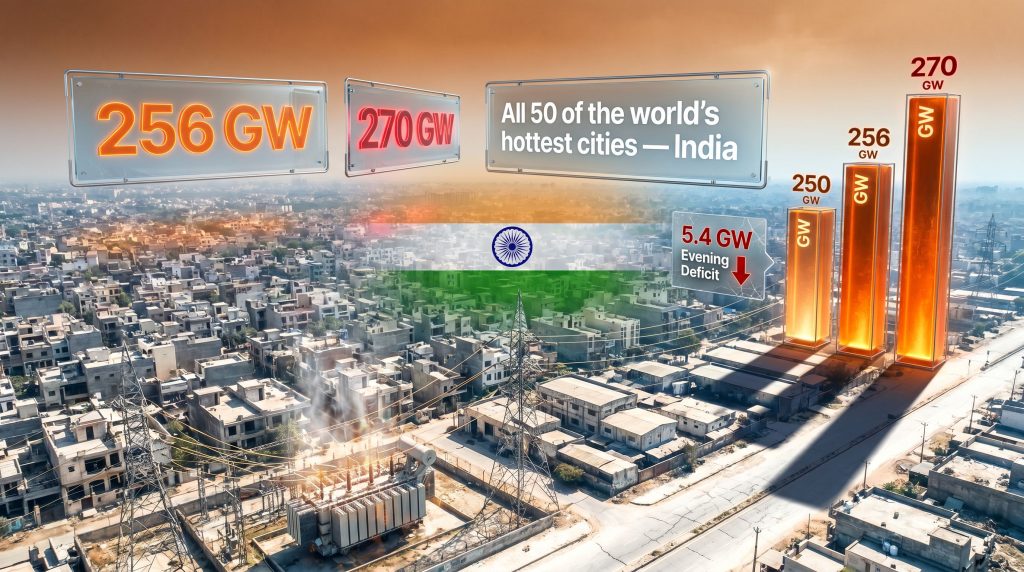
India's peak electricity demand surpassed 256 GW in April 2026, exceeding the previous annual record of 250 GW set in 2025, according to reporting by Bloomberg published via ET EnergyWorld. Forward projections suggest this figure could climb toward 270 GW as the season intensifies through May before monsoon relief arrives in June.
These are not marginal increases. Each gigawatt of additional demand represents an incremental stress test on a system already operating near its design limits. The timing compounds the problem: the demand surge has arrived weeks ahead of historical seasonal norms, catching grid operators and distribution companies in a partial-readiness state.
Temperature Extremes Across the Subcontinent
The geographic breadth of the 2026 heat event distinguishes it from prior years. Cities typically insulated from early-season extremes have been pulled into the high-temperature zone:
| City / Location | Peak Temperature (°C) | Overnight Low (°C) | Region |
|---|---|---|---|
| Banda, Uttar Pradesh | 46.2–47.6 | 34.7 | Bundelkhand |
| Jaisalmer, Rajasthan | 43.0 | Not specified | Northwest India |
| Delhi | 41.0 | Not specified | National Capital |
| Pune / Bengaluru / Hyderabad | 37.0+ | Not specified | Peninsular India |
Digital air-quality monitoring platform AQI reported that every one of the world's 50 hottest cities on April 27, 2026 was located within India. The platform noted in its published report that this result was not a normal April occurrence and that the data demanded a serious, grounded assessment of what was taking place.
Critically, AQI's methodology ranks cities based on sustained 24-hour heat, not afternoon peak readings alone. A city can record a high daytime maximum but rank lower if temperatures fall significantly overnight. Cities that fail to cool after dark rank disproportionately high, reflecting the true physiological burden on residents who cannot rely on nighttime recovery to reduce heat stress.
Banda in Uttar Pradesh's Bundelkhand region topped the global ranking. AQI recorded its daytime maximum at 46.2°C, while the India Meteorological Department placed the figure even higher at 47.6°C. Its overnight minimum remained at 34.7°C, a temperature that would constitute a dangerous heatwave threshold across most of Europe, where metabolic recovery during cooler nighttime hours is a standard assumption in heat-health risk frameworks.
The overnight low in Banda exceeded what most of Europe classifies as a dangerous daytime heatwave peak. For residents without access to mechanical cooling, there was no physiological recovery window across the full 24-hour cycle.
A Three-Layer Supply Crisis: Why Generation Is Falling Short
The India heatwave power grid crisis cannot be attributed to a single cause. Three independent constraints have converged during evening peak hours, creating a compounding supply gap that the grid's existing architecture cannot bridge.
Layer One: The Solar Cliff After Sunset
Solar energy now accounts for approximately 30% of India's total installed generation capacity, cementing its role as the backbone of daytime supply management. This represents a significant achievement from India's renewable energy solutions buildout over the past decade.
The structural consequence, however, is that as solar's installed share has grown, the size of the evening demand cliff has grown proportionally with it. When solar generation drops to zero after sunset, the volume of replacement capacity required from thermal and gas-fired sources is larger than at any prior point in the grid's history. Post-sunset supply deficits in 2026 have reached as high as 5.4 GW, a shortfall equivalent to the electricity needs of approximately 2.7 million rural households, according to Bloomberg's reporting.
Grid frequency has dipped below the critical 50 Hz baseline threshold, triggering instability warnings across distribution networks. Frequency deviations below this level are a direct indicator of supply-demand imbalance and can cause cascading equipment failures if not corrected rapidly.
Layer Two: Gas Plant Fuel Starvation from the Persian Gulf Conflict
Gas-fired power plants occupy a specific and irreplaceable role in India's grid: they can be ramped up and down rapidly, making them the primary instrument for filling the evening gap that solar leaves behind. When these plants face fuel constraints, grid operators lose their most flexible response tool at the precise moment it is needed most.
The ongoing Persian Gulf conflict has disrupted India's liquefied natural gas import volumes through a combination of shipping route disruption and supplier availability constraints. Furthermore, the LNG supply pressures facing India are compounded by the India LNG import structure, which has historically concentrated sourcing among a narrow group of Persian Gulf suppliers. The causal chain connecting geopolitical disruption to blackouts runs directly:
- Persian Gulf conflict disrupts shipping routes and supplier access
- India's LNG import volumes decline
- Gas-fired peaking plants face fuel availability constraints
- Evening supply capacity shrinks precisely when demand peaks
- Supply deficits widen and blackout frequency increases
The same conflict has constrained India's crude oil and liquefied petroleum gas imports, compounding energy security risks across transportation, industry, and household cooking fuel supply simultaneously.
Layer Three: Maintenance Scheduling Collides with Peak Season
As of late April 2026, approximately 21 GW of coal and nuclear generation capacity was offline due to maintenance shutdowns, with a significant proportion classified as forced outages rather than planned maintenance cycles, according to government data cited by Bloomberg.
Forced outages, by definition, are unplanned. They reflect equipment failures or reliability failures rather than scheduled downtime windows. Their concentration during the onset of extreme heat reveals a systemic gap in India's grid management calendar: the maintenance planning cycle has not been sufficiently recalibrated to account for a heat season that now arrives earlier and more intensely than the historical assumptions embedded in scheduling protocols.
India's power crisis is fundamentally a timing mismatch problem. The country has sufficient total installed capacity on paper. The critical failure is that the right generation types are unavailable during the specific hours when demand reaches its peak.
Infrastructure Under Thermal Stress: Beyond Generation Deficits
Generation shortfalls explain only part of the blackout picture. A separate and compounding failure mode operates within the distribution infrastructure itself.
High ambient temperatures accelerate transformer overloading through a dual mechanism. Elevated external temperatures reduce the cooling efficiency of transformer equipment, while simultaneous electrical overloading creates additional internal heat stress. The two forces compound each other, accelerating equipment degradation and increasing failure risk independent of whether sufficient generation capacity exists upstream.
Sarnath Ganguly, Senior Vice President at Noida Power Co. Ltd., which distributes power in Noida, an industrial city bordering New Delhi, has highlighted that distribution companies must identify overloaded transformers and build capacity well before summer peaks rather than responding to failures after they occur. Ganguly further stated that preventing outages requires discipline from both utilities in managing infrastructure proactively and from consumers in moderating demand-side behaviour during extreme conditions.
This perspective reflects a broader structural reality: distribution companies (DISCOMs) across India have historically operated under significant financial pressure, constraining their capacity to invest in grid modernisation, transformer upgrades, and demand-response technologies. Underinvestment in ageing distribution infrastructure creates a compounding vulnerability because even when upstream generation capacity is technically available, last-mile delivery failures produce consumer-level blackouts.
The Human Cost of Grid Failure
Sustained temperatures above 40°C with high humidity have transformed cooling appliances from comfort items into physiological necessities, driving continuous round-the-clock electricity consumption that compounds evening grid stress. Scheduled and unscheduled blackouts are disproportionately affecting rural, peri-urban, and lower-income urban areas, where distribution infrastructure is oldest and most overloaded.
In Punjab, one of the first states to implement formalised load-shedding schedules, the political consequences have been significant. The Shiromani Akali Dal, the main opposition party, organised public protests against power cuts, reflecting the intensity of public frustration with utility failures during a health-threatening heat emergency.
Structural Vulnerabilities the Crisis Has Exposed
The 2026 India heatwave power grid crisis has surfaced a set of architectural weaknesses that extend well beyond any single summer season.
Renewable Capacity Without Storage Remains Incomplete
India's rapid solar buildout has created a generation mix that is highly effective during daylight hours but structurally exposed after dark. Without large-scale battery storage or pumped hydro storage capacity to shift solar generation into evening peak windows, the grid remains dependent on thermal and gas-fired plants for every post-sunset demand surge. Wind generation, while theoretically complementary to solar, has provided inconsistent relief during the current heat event.
The Lengthening Heat Season and Fixed Planning Assumptions
Climate data increasingly indicates that India's extreme heat season is beginning earlier, lasting longer, and achieving higher peak temperatures than historical baselines. A grid calibrated for a six-to-eight-week summer peak faces fundamentally different operational demands when that peak window extends to three or four months. This temporal expansion has not been matched by equivalent growth in flexible generation capacity or storage deployment.
Import Dependency as a Strategic Exposure
India's structural dependence on Persian Gulf energy suppliers creates a direct transmission mechanism between regional geopolitical instability and domestic power availability. Consequently, the 2026 crisis has made this exposure visible in operational terms, not merely theoretical ones. The India LNG import structure and strategic reserve position represent risk mitigations that have not been developed at a scale commensurate with the exposure.
Pathways Forward: Short, Medium, and Long-Term Responses
Addressing the India heatwave power grid crisis requires interventions across multiple time horizons simultaneously.
Immediate operational priorities include:
- Proactive transformer capacity audits before summer onset, prioritising high-load urban and peri-urban zones
- Demand-response programs incentivising large industrial and commercial consumers to shift load away from evening peak hours
- Emergency LNG spot market procurement to partially offset supply chain disruptions
- Transparent and equitable load-shedding schedule communication to minimise burden concentration on vulnerable populations
Medium-term structural reforms require:
- Accelerated deployment of grid-scale battery storage co-located with existing solar installations to shift daytime generation capacity into evening peaks
- DISCOM financial restructuring to enable infrastructure investment rather than perpetual reactive maintenance cycles
- Diversification of LNG import sources and development of strategic fuel reserves
Long-term energy security architecture demands:
- Pumped hydro storage development at scale to provide multi-hour renewable generation shifting
- Transmission infrastructure investment to reduce geographic bottlenecks between generation-surplus and demand-heavy regions
- Climate-adjusted grid planning frameworks that replace historical peak-period assumptions with forward-looking heat season projections
- Demand-side efficiency programs targeting cooling appliances to structurally reduce demand growth rates during extreme heat periods
The next major ASX story will hit our subscribers first
Key Data Summary: India's Power Grid Crisis at a Glance
| Metric | Data Point |
|---|---|
| Current peak demand (April 2026) | 256 GW |
| Previous peak demand record (2025) | 250 GW |
| Projected summer peak | 270 GW |
| Maximum evening supply deficit | 5.4 GW |
| Equivalent household impact | ~2.7 million rural homes |
| Offline generation capacity | ~21 GW (coal and nuclear) |
| Hottest recorded city temperature | 46.2–47.6°C (Banda, Uttar Pradesh) |
| Overnight low in hottest city | 34.7°C |
| Cities in global top 50 hottest | All 50 located within India (April 27) |
| Solar share of installed capacity | ~30% |
The data framing above makes clear that the India heatwave power grid crisis is not a temporary anomaly to be absorbed and forgotten once monsoon rains arrive. It is a diagnostic event, revealing where the infrastructure assumptions of the past decade have failed to keep pace with the climatic and geopolitical realities of the present one. The monsoon will provide temporary relief. However, the structural vulnerabilities it has exposed will remain until deliberate and sustained investment addresses them.
Disclaimer: This article contains forward-looking projections regarding electricity demand, temperature forecasts, and infrastructure timelines. These projections are based on available reporting at the time of publication and are subject to change. Nothing in this article constitutes financial, investment, or policy advice. Readers should consult primary sources and qualified professionals for decisions based on this information.
Want to Stay Ahead of the Resource Opportunities Shaping the Energy Transition?
India's power grid crisis is accelerating demand for critical minerals, battery storage infrastructure, and diversified energy supply chains — and Discovery Alert's proprietary Discovery IQ model delivers real-time alerts the moment significant ASX mineral discoveries are announced, turning complex data across 30+ commodities into clear, actionable insights. Explore how historic mineral discoveries have generated substantial returns on Discovery Alert's dedicated discoveries page, and begin your 14-day free trial today to position yourself ahead of the market.