
July 29, 2026
The Hidden Mechanics Behind India's Iron Ore Compliance Crisis
Every major commodity market has structural fault lines that only become visible when enforcement catches up with practice. In the global iron ore trade, one such fault line has quietly widened over years of regulatory gaps, creating a system where the economics of misreporting proved more compelling than the risks of getting caught. What is now unfolding in Odisha, India's dominant iron ore-producing state, is not simply a tax crackdown. It is a collision between a deeply embedded compliance culture and a government determined to recover hundreds of millions of dollars in lost royalty revenue. The India low-grade iron ore export crackdown is already rippling through seaborne iron ore markets, and the full impact remains far from certain.
When big ASX news breaks, our subscribers know first
Understanding the Grade Threshold That Made Fraud Profitable
To understand why the India low-grade iron ore export crackdown matters beyond India's borders, it helps to start with the mechanics of how iron ore royalties are structured.
India calculates iron ore royalties at 15% of the average sale price. This sounds straightforward, but it creates a powerful distortion when applied across different ore grades. Iron ore price trends reveal that material with a metal content below 55% iron (Fe) trades at a significant discount to higher-grade material above 65% Fe. Because the royalty is a percentage of price rather than a flat per-tonne fee, a mine that reports lower-grade ore will owe proportionally less to the state, even if the material being extracted and sold is richer than declared.
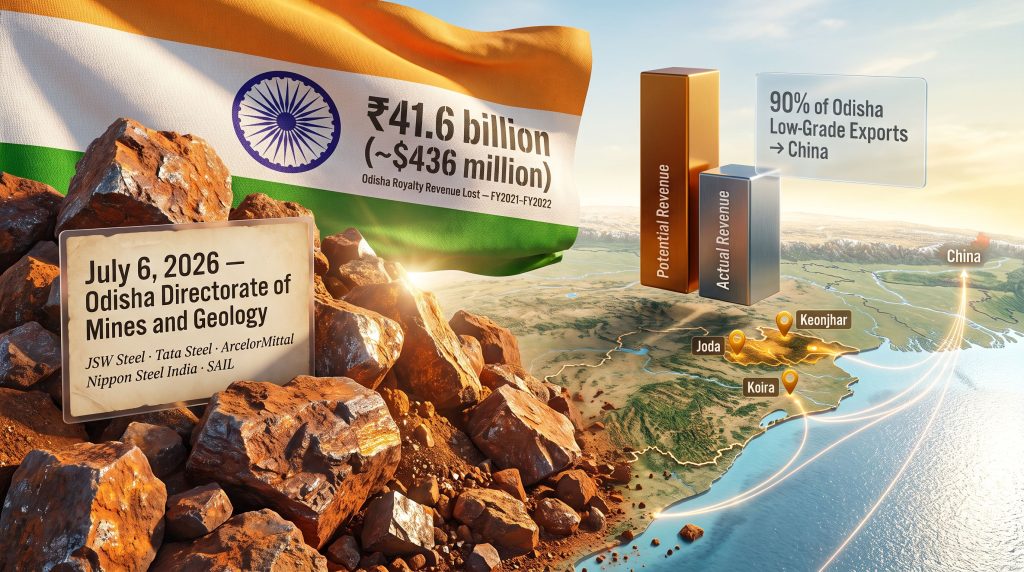
This is the structural loophole that India's Comptroller and Auditor General (CAG) identified in its March audit report. The CAG found that Odisha lost an estimated ₹41.6 billion (approximately USD $436 million) in royalty revenue during the fiscal years ending March 2021 and 2022 alone, directly attributable to the systematic undervaluation of iron ore grades. Auditors flagged an abnormal downward shift in reported grades across six mines, three of which are leased to JSW Steel.
What makes this particularly striking is not just the scale of the revenue loss, but how long the pattern appears to have persisted undetected or unaddressed at the enforcement level.
How Grade Falsification Works in Practice
Iron ore grade is typically determined through a combination of sampling, laboratory assay, and independent verification at the mine gate or loading point. In theory, multiple checkpoints exist to catch misreporting. In practice, the process has significant vulnerabilities, particularly where third-party verification is limited and local oversight is under-resourced.
Misrepresentation can occur at several points in the chain:
- At the mine face, where sampling protocols may be selectively applied to draw down average reported grade.
- At the crusher or processing stage, where blending of material can shift the declared grade of a stockpile.
- At dispatch, where documentation may not reflect the actual physical composition of the shipment.
The result is ore that arrives at port, or at a domestic steel plant, declared as sub-55% Fe material when it may in fact contain significantly more iron. The royalty is calculated on the declared grade. The buyer, often a Chinese steel mill with its own assay capability, receives material that matches or exceeds expectations. The Indian state receives less than its entitlement.
Furthermore, understanding iron ore grades and types helps contextualise just how meaningful the price differential between grade thresholds can be in practice.
The systemic nature of this practice across multiple mines and multiple leaseholders suggests it was not the work of isolated bad actors, but rather a broadly understood workaround embedded in operational norms across parts of Odisha's mining sector.
The July 2026 Enforcement Memo: What Odisha's Directorate Actually Did
On July 6, 2026, Odisha's Directorate of Mines and Geology issued a directive to local officials across the state's key mining districts, including Joda, Koira, and Keonjhar. The memo required officials to account for lapses in grade verification within three days, with disciplinary action flagged as a consequence for non-compliance.
The directive listed mines leased to some of India's largest steelmakers:
| Company | Status |
|---|---|
| JSW Steel | Flagged; three leased mines cited in CAG abnormal grade drop findings |
| Tata Steel | Flagged in enforcement directive |
| ArcelorMittal Nippon Steel India | Flagged in enforcement directive |
| Steel Authority of India (SAIL) | Flagged in enforcement directive |
| Jindal Steel | Flagged in enforcement directive |
| Odisha Mining Corporation | State-owned entity, also flagged |
It is important to note that being flagged in this context means the mines are under review for alleged misreporting, not that formal charges have been laid or penalties confirmed. No company has been publicly found guilty of wrongdoing at this stage. The directive is directed at local officials responsible for verification, not solely at the mine operators themselves, which is a revealing detail about where accountability has been assigned.
Why China Is Watching Odisha Closely
India accounts for only around 2% of China's total iron ore imports by volume, a figure that might suggest limited relevance to global markets. However, that aggregate statistic obscures a more targeted dependency. The China steel and iron ore market dynamic tells a more nuanced story about how specific ore grades fill distinct operational niches.
Chinese blast furnace operators have developed sophisticated ore blending strategies over the past decade, driven by persistent pressure to reduce input costs. High-grade Australian and Brazilian ore provides the backbone of most Chinese steelmaking feedstock, but it commands a price premium. Sub-55% Fe Indian ore from Odisha fills a very specific niche: it is cheap enough to dilute the average cost of a blast furnace charge without critically degrading metallurgical performance, provided it is blended carefully with higher-grade material.
Commodity intelligence firm BigMint has reported that approximately 90% of low-grade ore shipments from Odisha (excluding pellets) are directed to Chinese buyers. This concentration means that any disruption to Odisha's low-grade export flow has an outsized impact on the specific segment of China's iron ore supply chain where cost minimisation is the primary objective.
Low-grade Indian ore is not a like-for-like substitute for mainstream iron ore streams. It serves a distinct blending function, and replacing it at scale requires either accepting higher per-tonne input costs or sourcing alternative low-grade material from origins with less established logistics corridors into Chinese ports.
The Blending Economics That Drive Chinese Demand
How Do Chinese Mills Calculate Low-Grade Ore Value?
Understanding why Chinese mills specifically seek sub-55% Fe Indian material requires a brief look at blast furnace economics. A standard blast furnace charge is a carefully calibrated mix of iron ore fines, lump ore, sinter feed, and pellets, optimised for iron recovery rates, coke consumption, and slag management.
Introducing a proportion of lower-grade ore into this mix reduces average iron content per tonne of charge, which increases the volume of material needed to produce a tonne of hot metal. However, if the price differential between low-grade and high-grade ore is wide enough, the total cost per tonne of iron can still fall. Chinese mills have become expert at calculating the exact blending ratio that maximises this cost advantage without pushing slag volumes or coke rates beyond acceptable operational limits.
This is a technically demanding optimisation exercise, and it explains why the market for sub-55% Fe ore is not simply a residual or waste product market. It is a purposefully managed feedstock category with real demand elasticity and price discovery. Consequently, the China iron ore surplus conditions already weighing on the market make any further disruption to supply flows particularly sensitive.
The next major ASX story will hit our subscribers first
Supply Disruption Already Visible in Spot Markets
Even before any formal production restrictions, the enforcement action has already tightened physical supply. Following the July 2026 directive, some Odisha mine operators began holding back fresh ore sales, either to avoid scrutiny during the verification process or to wait for clarity on what new compliance standards will mean operationally.
According to BigMint data, this hesitation has produced a buildup of ore stockpiles at producer sites and a tightening of spot availability for low-grade material. This is a classic supply-side uncertainty response, and it mirrors the kind of short-term disruption that often precedes either a market normalisation or a more sustained structural shift, depending on how enforcement evolves.
Wood Mackenzie's assessment, as reported across commodity media, characterises the crackdown as primarily focused on compliance and revenue recovery rather than production restriction. The firm notes that tighter grade inspections could cause logistical delays and shift the reported grade mix reaching the market, with supply impact expected to be temporary as operators adjust their practices.
This is a reasonable base case, but it depends on enforcement remaining targeted rather than escalating into a broader operational shutdown mechanism.
The Policy Reversal History That Shapes Market Interpretation
India's track record on iron ore export policy is not a story of consistent direction. In 2022, the government imposed significant export duties on iron ore to prioritise domestic steel supply during a period of elevated global prices. By November 2022, those duties had been reversed following sustained lobbying from the mining sector, which argued that export access was critical to project economics and investment confidence.
This reversal history is directly relevant to how markets are pricing the current crackdown. The risk of policy backsliding is not hypothetical.
A snapshot of the competing lobbying pressures currently in play:
| Stakeholder | Position | Core Argument |
|---|---|---|
| Indian Steel Association | Wants 20% export duty on low-grade ore; 10% on pellets | Exports tighten domestic supply and inflate input costs |
| Mining operators | Oppose export restrictions | Restrict export revenue and deter capital investment |
| Odisha State Government | Focused on compliance and royalty recovery | Revenue recovery without curtailing production volumes |
| Chinese steel mills | Prefer unrestricted access to Indian low-grade supply | Cost-competitive feedstock essential for blending strategies |
As recently as September 2025, India's central government was assessed by commodity analysts as unlikely to impose new export duties, given miner resistance. In February 2024, the steel ministry explicitly ruled out a ban on low-grade ore exports. The current enforcement action is state-level, not a national export policy change, and this distinction matters significantly for assessing its durability and scope.
Scenario Analysis: Three Possible Outcomes
Markets rarely move in straight lines, and the eventual outcome of the India low-grade iron ore export crackdown will depend on how several variables interact over the coming months. For instance, the global iron ore market impact from other geopolitical pressures adds an additional layer of complexity to scenario planning.
| Scenario | Enforcement Intensity | Probable Market Outcome |
|---|---|---|
| Compliance Reset Only | Grade verification tightened; reporting practices adjusted | Short-term logistics delays; grade mix shifts at margin; supply normalises within months |
| Sustained Enforcement | Ongoing inspections across all flagged mines | Prolonged spot tightening; Chinese buyers explore alternative low-grade sources |
| National Export Duty Imposed | 20-30% levy applied at the national level | Meaningful volume reduction in exports; Australian and Brazilian mid-grade gains incremental share |
The scenario that commodity markets appear to be pricing is closest to the first option, a compliance reset with temporary disruption. However, the presence of significant institutional lobbying for an export duty, combined with the government's stated interest in royalty recovery, means the tail risk of policy escalation cannot be dismissed entirely.
The Broader Pattern: Resource Nationalism and Revenue Recovery
Is Odisha Part of a Global Trend?
What is happening in Odisha fits within a broader global trend. Across multiple emerging market resource producers, the period since 2020 has seen governments revisit mining fiscal frameworks, tighten royalty collection, and seek to capture a larger share of commodity revenues that were previously leaking through compliance gaps, transfer pricing arrangements, or outdated royalty structures.
India's situation is distinctive in one respect: the fiscal leakage identified by the CAG was not primarily a function of aggressive tax planning by multinationals, but of operational-level grade misreporting by domestic and joint-venture operators in a state with recognised oversight capacity gaps. The corrective mechanism is therefore enforcement-led rather than legislative, which typically produces faster initial effects but less predictable long-term outcomes.
For global supply chain planners, the lesson is that compliance risk in sub-sovereign resource jurisdictions can generate market disruption that is disproportionate to the volume involved. As reported by Mining Technology, Odisha's low-grade ore represents a small share of global iron ore trade, but its specific role in Chinese blast furnace blending strategies gives it an outsized influence on the cost structures of mills that have built their operating models around its continued availability.
Whether the current enforcement action marks the beginning of a more structurally transparent Indian iron ore export sector, or simply a temporary tightening that resolves once political pressures reassert themselves, remains the defining question for commodity market participants tracking this situation.
FAQ: India Low-Grade Iron Ore Export Crackdown
What Triggered the India Low-Grade Iron Ore Export Crackdown?
Odisha's Directorate of Mines and Geology issued a July 2026 directive following inspections that found repeated instances of iron ore grade misrepresentation, which allowed miners to pay lower royalties by declaring lower-grade material than was actually being extracted and sold.
How Much Revenue Did Odisha Lose to Grade Misreporting?
India's CAG estimated a royalty revenue shortfall of approximately ₹41.6 billion (around USD $436 million) across the fiscal years ending March 2021 and 2022, directly linked to iron ore undervaluation.
Why Does This Matter to China's Steel Industry?
Around 90% of Odisha's low-grade ore exports go to China, where mills use the material as a cost-reduction blending input. While India accounts for only about 2% of China's total iron ore imports, its share of the specific sub-55% Fe blending market is far more significant.
Will India Impose a National Export Duty on Low-Grade Ore?
No national export duty has been confirmed as of mid-2026. The Indian Steel Association has lobbied for a 20% levy on low-grade ore and 10% on pellets, but the government reversed similar measures in November 2022 and has since signalled reluctance to repeat that approach.
Which Companies Are Named in the Enforcement Directive?
The July 2026 memo flagged mines leased to JSW Steel, Tata Steel, ArcelorMittal Nippon Steel India, Steel Authority of India, Jindal Steel, and Odisha Mining Corporation. No formal penalties or charges have been confirmed at this stage.
Disclaimer: This article is for informational purposes only and does not constitute financial or investment advice. Forecasts, scenario modelling, and market assessments referenced herein involve inherent uncertainty. Readers should conduct independent research before making any investment or commercial decisions related to the iron ore sector or companies mentioned.
Want to Stay Ahead of the Next Major Mineral Discovery on the ASX?
While iron ore compliance dynamics continue reshaping global commodity supply chains, Discovery Alert's proprietary Discovery IQ model delivers real-time notifications on significant ASX mineral discoveries — instantly translating complex mineral data into actionable investment insights for both short-term traders and long-term investors. Explore historic discovery returns on Discovery Alert's dedicated discoveries page and begin your 14-day free trial today to position yourself ahead of the broader market.