May 23, 2026
Understanding India's Economic Architecture for Metals Dominance
Global economic forces are reshaping commodity markets through unprecedented structural transformations. While traditional industrialisation cycles focused on single-country urbanisation patterns, today's metals demand emerges from multiple simultaneous drivers: electrification infrastructure, digital transformation, and strategic supply chain diversification. This convergence creates fundamentally different market dynamics compared to previous commodity supercycles.
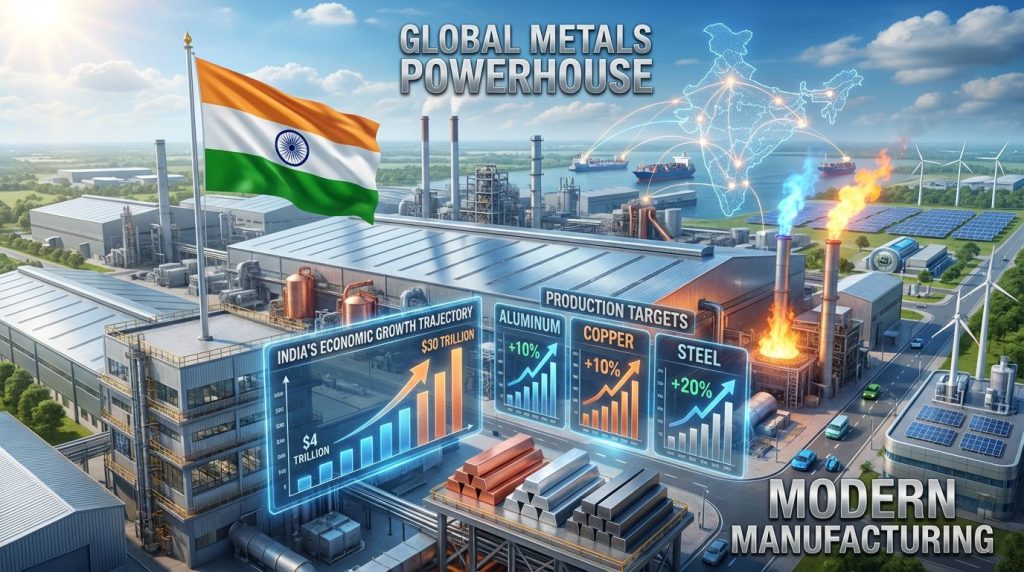
India's position within this transformation represents more than another emerging market story. The nation combines a $4 trillion economy targeting $30 trillion by 2047 with massive infrastructure gaps that require metals-intensive solutions. Unlike China's 2000-2010 urbanisation cycle, the India metals market powerhouse combines urbanisation, electrification, and technology adoption simultaneously, creating compounded demand intensity across base and critical metals categories.
The structural foundation supporting this expansion includes government policy frameworks designed to increase manufacturing GDP from 17% to 25% by 2035. Production-linked incentive schemes, critical minerals energy security missions, and foreign direct investment facilitation mechanisms create an enabling environment for sustained metals consumption growth. This policy architecture differs from market-driven cycles by providing predictable, long-term demand visibility.
When big ASX news breaks, our subscribers know first
Demographic and Infrastructure Multipliers Driving Demand
India's demographic dividend provides unique advantages for metals market development. The population of 1.4 billion people, with an average age of 27 years and growing English-speaking workforce capabilities, creates both consumption potential and production capacity advantages. Urban population expansion from 35% to over 50% by 2047 translates to 250+ million additional urban residents requiring metals-intensive infrastructure.
Current infrastructure investment patterns demonstrate the scale of opportunity. The government's allocation of ₹10.7 trillion ($128 billion) for capital expenditure in FY 2024-25 represents sustained commitment to infrastructure development. The National Infrastructure Pipeline identifies projects worth $1.4 trillion spanning 2020-2030, with current execution rates achieving 72% of targeted capacity additions.
Infrastructure Investment Multiplier Effects:
- Transportation Networks: Highway expansion from 1.4 million km to 2+ million km by 2030 requires 150+ million tonnes of steel annually
- Renewable Energy: 500 GW capacity target by 2030 demands 8-10 million tonnes of steel and 2-3 million tonnes of aluminum for transmission infrastructure
- Railway Development: 10,000+ km of new railway lines require 2+ million tonnes of rail steel annually
- Urban Development: Metro systems and smart city initiatives across 100+ cities drive sustained metals consumption
Each rupee of government infrastructure spending generates ₹1.50-₹1.80 in total economic output, with metals-intensive industries representing 35-40% of the value chain. This multiplier effect amplifies the impact of government capital allocation decisions on metals demand patterns.
India's Structural Differentiation from China's Growth Model
The fundamental distinction between India's current trajectory and China's historical development lies in demand composition and geographic positioning. China's 2000-2010 supercycle centred on urbanisation-driven infrastructure development, creating concentrated demand patterns. However, India's transformation combines traditional urbanisation with simultaneous electrification and digitalisation requirements.
Per Capita Metal Consumption Analysis:
| Metal | India (kg/capita) | China (kg/capita) | Global Average | India Growth Potential |
|---|---|---|---|---|
| Aluminum | 3.0 | 18.5 | 12.0 | 500% to China level |
| Copper | 0.6 | 8.2 | 3.2 | 1,367% to China level |
| Steel | 100 | 650 | 200+ | 650% to China level |
| Zinc | 0.8 | 6.5 | 1.2 | 812% to China level |
These consumption gaps represent structural demand potential rather than cyclical opportunities. India's per capita aluminium consumption of 3 kg compared to the global average of 12 kg indicates sustained growth runway independent of cyclical factors. Furthermore, the scale of this opportunity becomes apparent when considering India's population base of 1.4 billion people.
Policy-driven market architecture creates additional differentiation through strategic frameworks. The mining industry evolution has been characterised by the National Critical Minerals Mission identifying 30 strategic minerals for domestic development, while production-linked incentive schemes provide sector-specific growth catalysts.
Multi-Sector Demand Drivers:
- Electronics Manufacturing: Production-linked incentives targeting $160 billion in electronics production value by 2025
- Electric Vehicle Adoption: Focus on two-wheeler electrification serving 1.4 billion population base
- Data Centre Expansion: Digital infrastructure requirements for AI and technology services growth
- Renewable Energy Integration: Solar and wind installations requiring transmission infrastructure
Critical Minerals and Strategic Positioning
India's approach to critical minerals reflects strategic import substitution rather than resource nationalism. Current dependencies include 100% imports for lithium, nickel, and cobalt, creating vulnerability to geopolitical disruptions. The government's response includes auction-based mineral block allocation and foreign investment facilitation.
Through auction systems, major producers have acquired critical mineral blocks spanning rare earths, vanadium, tungsten, and graphite. For instance, securing lithium supply represents a shift toward domestic production capabilities across strategic mineral categories. The scale of these acquisitions demonstrates private sector confidence in government policy frameworks and long-term demand projections.
Strategic Mineral Development Areas:
- Rare Earth Elements: Multiple blocks acquired for domestic production development
- Battery Materials: Vanadium and graphite resources for energy storage applications
- Industrial Minerals: Tungsten reserves for defence and aerospace applications
- Copper Resources: High-grade deposits with 2.5-3% copper content for electrification infrastructure
Geopolitical considerations enhance India's strategic value as supply chain diversification accelerates. Moreover, the ongoing US-China trade war impact on global markets has positioned Western economies seeking alternatives to China-dependent supply chains to view India as a democratic partner with English-speaking workforce capabilities and established rule of law frameworks.
Manufacturing Renaissance and Supply Chain Integration
India's manufacturing transformation extends beyond domestic consumption to global supply chain participation. The "Make in India" initiative has attracted $200+ billion in manufacturing foreign direct investment since 2014, with specific growth in electronics, automotive, and renewable energy sectors.
Electronics and EV Manufacturing Development
Major original equipment manufacturers, including Apple, have expanded manufacturing capacity in India to serve both domestic and export markets. This creates direct metals demand through manufacturing processes and indirect demand through supporting infrastructure development. The strategy leverages India's cost advantages while building technological capabilities.
Battery manufacturing ecosystem development represents a strategic priority given electric vehicle adoption patterns. Focus on two-wheeler electrification serves India's unique transportation needs while building manufacturing capabilities for global markets. This approach differs from four-wheeler focus in Western markets by addressing local consumption patterns.
Supply Chain Integration Strategy:
- Domestic Market Consolidation: Serve 1.4 billion population base with locally produced goods
- Regional Export Development: Leverage geographic positioning for Southeast Asia and Middle East markets
- Global Manufacturing Integration: Compete with established producers through cost and technology advantages
- Technology Leadership: Develop innovation capabilities in sustainable production methods
Investment Opportunities and Capital Deployment
Major producer expansion programmes demonstrate private sector commitment to India's metals market development. Vedanta's $10 billion capital pipeline execution includes aluminium capacity expansion to 3 million tonnes by FY28 and zinc production scaling to 2 million tonnes by FY29.
The mining consolidation trends have resulted in significant capacity targets across various companies and sectors:
Major Production Capacity Targets:
| Company/Sector | Current Capacity | 2030 Target | Investment Pipeline |
|---|---|---|---|
| Vedanta Aluminium | 2.5M tonnes | 3M+ tonnes | $4B+ |
| Vedanta Zinc | 1.1M tonnes | 2M tonnes | $3B+ |
| National Steel | 149.6M tonnes | 300M tonnes | $50B+ |
Capital allocation strategies reflect multi-commodity diversification with sector-specific prioritisation. Aluminium receives 40% of annual capital expenditure, zinc attracts 30%, and oil and gas operations receive 20%. This allocation pattern aligns with electrification infrastructure demand growth projections.
Critical minerals exploration acceleration includes government auction systems creating transparent allocation mechanisms. In addition, private sector partnerships and technology transfer opportunities provide pathways for foreign participation in strategic mineral development.
India's metals transformation represents a multi-decade structural shift combining urbanisation demand with electrification requirements, creating sustained growth momentum across base and critical metal categories.
The next major ASX story will hit our subscribers first
What Makes India a Geopolitical Advantage in Trade Integration?
China dependency reduction initiatives create strategic opportunities for Indian metals producers. Western supply chain diversification strategies seek alternatives to China-dominated production networks, positioning India as a preferred partner given democratic governance structures and established legal frameworks.
Mineral Security Partnership participation provides additional validation of India's strategic importance. This multilateral initiative aims to strengthen critical mineral supply chains among democratic partners, creating preferential access to Western markets for Indian producers.
Regional Trade Integration Benefits:
- UAE Free Trade Agreement: Facilitates Middle East market access for metals exports
- UK Trade Partnership: Leverages historical connections for technology transfer and market access
- Australia Cooperation: Mineral processing collaboration and resource sharing agreements
- EFTA Partnership: European market access for downstream manufactured products
Trade relationship diversification reduces vulnerability to bilateral tensions while creating multiple market access pathways. Furthermore, India's memorandums of understanding with 11 countries since 2018 demonstrate systematic approach to international partnership development.
Domestic consumption patterns provide additional strategic advantages. Vedanta's production allocation shows 67-70% of aluminium and 75% of zinc remaining within India, creating resilience against export market volatility while serving growing domestic demand.
How Do Infrastructure Challenges Impact Development?
Regulatory framework optimisation represents the primary bottleneck for metals market development. Environmental and forestry clearance processes, land acquisition procedures, and taxation competitiveness require systematic improvement to match production capacity with demand growth.
Current regulatory challenges include extended timelines for project approvals and complex multi-agency coordination requirements. Industry analysis indicates streamlined approval processes could reduce project development timelines by 30%, accelerating capacity additions to meet demand growth.
Physical Infrastructure Requirements:
- Port Capacity Expansion: Current constraints limit aluminium export potential by 30-40% relative to production capacity
- Railway Connectivity: Mining regions require improved transportation links to processing facilities and export terminals
- Power Grid Reliability: Energy-intensive production requires stable power supply for consistent operations
- Water Resource Management: Mining and processing operations need sustainable water access and treatment capabilities
Government initiatives address these challenges through National Infrastructure Pipeline investments and public-private partnership models. The approach recognises that mining companies cannot develop all necessary supporting infrastructure independently.
Scenario Analysis for Infrastructure Impact:
- Optimistic Case: Streamlined approvals and infrastructure investment reduce development timelines by 30%
- Base Case: Gradual improvements maintain current growth trajectory with incremental efficiency gains
- Conservative Case: Regulatory bottlenecks and infrastructure constraints limit expansion pace below demand growth
Technology Innovation and Sustainable Production
India's demographic advantages extend to technology adoption capabilities. Young, educated workforce with strong technology backgrounds positions the nation for leadership in digital mining techniques and artificial intelligence integration.
Research and development culture development represents a strategic priority for long-term competitiveness. Government initiatives promote technology transfer partnerships while building domestic innovation capabilities. This approach aims to leapfrog traditional mining methods through advanced technology adoption.
Digital Mining and AI Integration Opportunities:
- Predictive Maintenance: Reduce equipment downtime and operational costs through AI-powered monitoring
- Resource Optimisation: Improve ore recovery rates and reduce waste through precision extraction techniques
- Environmental Management: Real-time monitoring and mitigation of environmental impacts
- Supply Chain Optimisation: Demand forecasting and inventory management through data analytics
Sustainable production leadership creates competitive advantages in ESG-focused global markets. India's renewable energy capacity expansion enables green aluminium and steel production, positioning domestic producers as preferred suppliers for environmentally conscious buyers.
Green Metals Production Advantages:
- Renewable Energy Integration: Solar and wind capacity growth reduces carbon intensity of metals production
- Electric Arc Furnace Adoption: Steel production modernisation improves efficiency and reduces emissions
- Circular Economy Development: Scrap utilisation and recycling capabilities reduce primary resource requirements
- Technology Transfer: International partnerships facilitate adoption of best practices and advanced technologies
What Does the Long-Term Vision Look Like?
Success metrics for India's metals market ambitions extend beyond production capacity to comprehensive economic transformation indicators. The 2030 vision encompasses becoming a global manufacturing hub while achieving critical minerals independence through domestic production capabilities.
Manufacturing GDP contribution growth from 17% to 25% requires sustained metals supply chain development. This transformation supports employment generation across mining and downstream manufacturing sectors, absorbing India's annual workforce addition of 8-10 million people.
According to India's metals moment, the country is accelerating its critical minerals strategy. Additionally, industry analysis shows that the mining sector represents a powerhouse in making within India's broader economic development framework.
Economic Transformation Targets:
- Manufacturing Hub Status: Electronics and automotive production serving global markets
- Critical Minerals Independence: Domestic production meeting strategic requirements
- Technology Leadership: Innovation in sustainable metals production methods
- Export Revenue Growth: Metals export revenue reaching $100+ billion annually by 2030
Global supply chain integration represents the ultimate validation of India's metals market development. Achieving recognition as an indispensable partner in international supply networks while serving massive domestic demand creates a foundation for sustained economic growth.
The metals market transformation embodies India's broader economic restructuring from services-focused to manufacturing-intensive development. Consequently, this transition requires coordinated policy implementation, private sector investment, and international partnership development across multiple timeframes and sectors.
India's emergence as an India metals market powerhouse reflects structural economic forces rather than cyclical opportunities. The combination of demographic advantages, resource endowments, policy frameworks, and geopolitical positioning creates sustained competitive advantages in global metals markets. Success depends on execution capabilities across infrastructure development, regulatory optimisation, and technology adoption while maintaining focus on serving the world's largest consumer market.
Are You Positioned to Capitalise on India's Metals Market Transformation?
Discovery Alert's proprietary Discovery IQ model delivers real-time notifications on significant ASX mineral discoveries, instantly empowering subscribers to identify actionable opportunities ahead of the broader market. Discover how historic mineral discoveries can generate substantial returns by exploring major success stories, then begin your 30-day free trial today to position yourself strategically in this evolving metals landscape.