
August 7, 2026
The Hidden Mineral Frontier Reshaping Asia's Critical Supply Chains
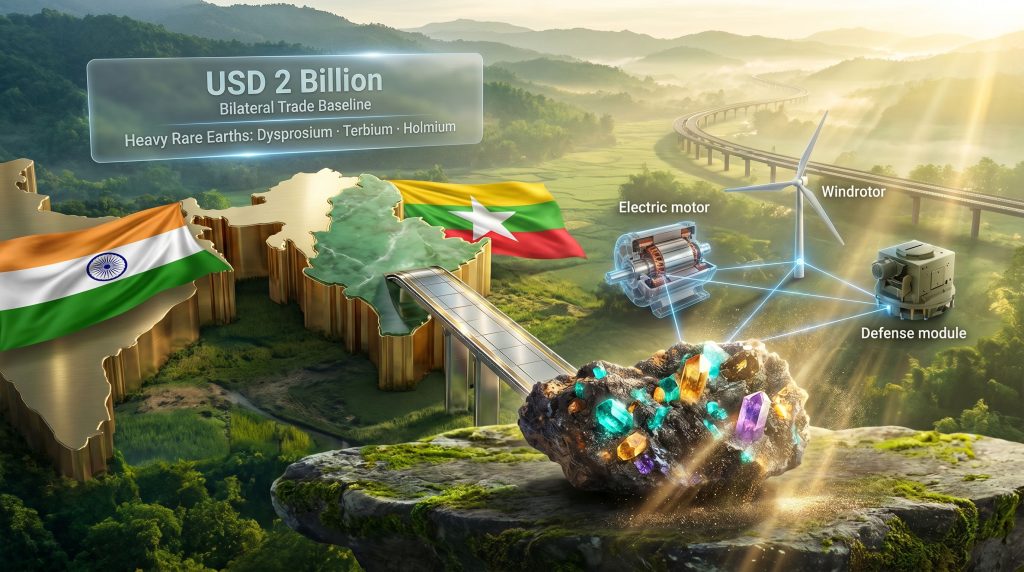
The global transition toward electric vehicles, advanced defence systems, and clean energy infrastructure has created an insatiable appetite for a category of materials most people have never heard of: heavy rare earth elements. Unlike their lighter counterparts, heavy rare earths such as dysprosium, terbium, and holmium cannot be easily substituted in the high-performance permanent magnets that power EV drivetrains and military guidance systems. This technological specificity has turned the geography of heavy rare earth deposits into one of the most contested arenas in 21st-century resource diplomacy, and it is precisely this dynamic that is drawing India's strategic gaze toward the mineral-rich borderlands of northern Myanmar. India and Myanmar rare earth cooperation has consequently emerged as one of the more consequential, if underreported, bilateral developments in Asia's critical minerals landscape.
When big ASX news breaks, our subscribers know first
China's Processing Grip and the Global Scramble to Break It
Understanding why India and Myanmar rare earth cooperation matters requires first understanding the structural imbalance that defines the entire sector. China controls an estimated 85 to 90 percent of global rare earth refining and processing capacity, according to data published by the U.S. Geological Survey. This dominance extends beyond mining output into the value-added stages of separation, alloying, and magnet manufacturing, meaning that even nations with domestic ore reserves frequently depend on Chinese processing infrastructure to convert raw material into usable industrial inputs.
Furthermore, for India, this dependency represents a compounding vulnerability. The country's accelerating EV manufacturing ambitions, its expanding domestic defence production programme, and its growing renewable energy capacity all require reliable access to heavy rare earth elements that currently flow predominantly through Chinese supply chains. Resource-hungry economies facing identical pressures, including Japan, South Korea, and EU member states, have spent the past decade building frameworks for overseas mineral acquisition specifically designed to circumvent this bottleneck.
India is now following a recognisable playbook, but its geographic proximity to Myanmar gives its strategy a distinctive regional dimension. Understanding China's rare earth strategy helps contextualise just how deliberately Beijing has constructed its dominance and why diversification is so urgently needed.
Why Myanmar's Kachin State Occupies a Unique Position in Global Rare Earth Markets
Myanmar's emergence as a significant rare earth source is a relatively recent phenomenon, and its importance is frequently underestimated in mainstream coverage. Kachin State, situated in the country's far north along the Chinese border, hosts ion-adsorption clay deposits, a geological formation type that has become strategically critical precisely because of its heavy rare earth composition.
What Makes Ion-Adsorption Clay Deposits So Valuable?
Ion-adsorption clay deposits are weathered granite formations in which rare earth elements accumulate in ionic form within the clay mineral matrix. They are economically significant because the rare earths can be extracted at relatively low cost using simple leaching methods, and because the deposit type is disproportionately rich in heavy rare earths compared to other ore types. Southern China's Jiangxi Province hosts the world's most famous examples of this deposit type, and Myanmar's Kachin deposits share similar geological characteristics.
The mineral composition of these deposits is what makes them strategically irreplaceable rather than merely commercially interesting. Dysprosium and terbium, two of the most sought-after heavy rare earths, are used to enhance the coercivity of neodymium-iron-boron permanent magnets, allowing them to operate at elevated temperatures without losing magnetic strength. Without adequate dysprosium content, EV motors and wind turbine generators risk demagnetisation under operating conditions.
Myanmar's output of heavy rare earths grew substantially during the early 2020s, with Chinese companies operating extraction sites across Kachin State under informal commercial arrangements. By some industry estimates, Myanmar had become the world's largest supplier of heavy rare earth ore to Chinese processing facilities, surpassing China's own domestic heavy rare earth production in volume terms during peak years. Analysts tracking heavy rare earth supply chains have noted that this makes the disruption of those supply lines a genuinely significant event for global markets, not merely a localised geopolitical development.
The KIA Disruption and Its Market Consequences
The Kachin Independence Army's territorial control over large portions of northern Myanmar has fundamentally altered the access calculus for rare earth extraction. Armed conflict has disrupted Chinese extraction operations, restricted transport routes, and created a security environment that makes large-scale commercial operations extremely difficult to sustain.
| Factor | Impact on Rare Earth Access |
|---|---|
| KIA territorial control | Disrupted Chinese extraction in northern mining zones |
| Conflict-affected transport routes | Limits commercial viability of large-scale exports |
| Absence of formal regulatory framework | Increases procurement risk for all foreign buyers |
| Proximity to Indian border | Creates a potential alternative supply corridor |
This disruption has had measurable consequences for Chinese rare earth feedstock availability, contributing to periodic tightening in heavy rare earth supply. For India, the KIA's displacement of Chinese commercial interests represents a structural opening, but one that comes attached to the same security constraints that are impeding Chinese operators. According to analysis from mining.com, India has been actively exploring supply arrangements that account for the KIA's de facto control over key mineral zones.
How Far Has India-Myanmar Rare Earth Cooperation Actually Progressed?
The bilateral engagement between India and Myanmar on critical minerals has moved through several identifiable stages, though it remains well short of any commercially operational arrangement. The following represents the confirmed trajectory of cooperation as of mid-2026:
- Indian government officials have engaged in formal consultations with Myanmar's natural resources ministry specifically focused on rare earth and critical minerals access.
- State-owned Indian entities have collected geological samples from Myanmar territory for the purpose of conducting cost-benefit and feasibility assessments.
- India's Ministry of Mines has directed both public sector undertakings and private sector firms to evaluate viable procurement pathways connected to Kachin-region mineral sources.
- During a bilateral summit between Prime Minister Narendra Modi and Myanmar's President in New Delhi, India's Foreign Secretary confirmed that critical minerals and rare earths featured explicitly in the formal agenda of discussions, signalling an elevation from background technical dialogue to official bilateral priority status.
It is important to contextualise what diplomatic language around mineral discussions actually signals. When a senior official confirms that rare earths were part of summit-level talks, this represents a meaningful step beyond exploratory technical exchanges. It indicates the topic has entered the formal bilateral agenda, even if no binding agreement has been signed. This distinction matters for assessing the pace of the relationship's development.
No formal supply contract or binding mineral cooperation agreement had been publicly confirmed as of mid-2026. The partnership remains at the consultation, sampling, and feasibility assessment stage, which analysts broadly classify as early-stage strategic outreach rather than commercially operational procurement.
India's Strategic Drivers: Why Myanmar Is Worth the Complexity
The motivations pushing India toward Myanmar's mineral resources are deeply structural rather than opportunistic. Three overlapping demand pressures are converging simultaneously, and the critical minerals demand surge underpinning all three shows no signs of abating.
1. EV Manufacturing Scale-Up: India's domestic electric vehicle sector is expanding rapidly, with the government targeting significant EV penetration across passenger and commercial vehicle categories. Permanent magnet motors, which require heavy rare earth inputs, dominate the drivetrain architectures of mainstream EV platforms.
2. Defence Modernisation: India's indigenisation programme for advanced defence systems, including missile guidance, radar, and electronic warfare equipment, creates sustained institutional demand for heavy rare earth elements that cannot easily be sourced through open commercial markets.
3. Supply Chain Resilience: India's broader critical minerals diversification strategy explicitly targets the reduction of single-source dependency. Engagement with Myanmar sits alongside parallel initiatives involving Australia, Argentina, and partner nations in Africa, collectively designed to build supply resilience ahead of projected demand peaks in the late 2020s and 2030s.
India's approach mirrors strategies developed by Japan through JOGMEC-backed overseas mineral acquisitions, South Korea's resource diplomacy across African jurisdictions, and the EU's Critical Raw Materials Act partnership framework. All of these share the same underlying logic: locking in non-Chinese rare earth supply before downstream demand saturates available alternatives. India's dependence on Chinese rare earths mirrors a challenge faced by many advanced economies, making the Myanmar pivot all the more strategically significant.
The Infrastructure Deficit: What Stands Between Ambition and Reality
Perhaps the most underappreciated dimension of the India-Myanmar rare earth story is the severity of the infrastructure gap. Even setting aside security conditions, the physical logistics of moving rare earth feedstock from Kachin State to Indian processing facilities present a formidable challenge.
| Infrastructure Project | Current Status | Strategic Relevance |
|---|---|---|
| Kaladan Multi-Modal Transit | Partially complete; security-affected sections pending | Key India-Southeast Asia connectivity corridor |
| India-Myanmar-Thailand Highway | Long-delayed; operational in limited safe zones only | Potential rare earth export route if completed |
| Kachin mining access roads | Conflict-restricted | Direct bottleneck for extraction and transport |
The Kaladan Multi-Modal Transit Transport Project, designed to connect India's northeastern states to Myanmar's Sittwe port via river and road, has faced repeated delays attributable to security conditions along its route. Progress has only been made in areas where the safety of construction workers could be verified, a constraint that India's Foreign Secretary explicitly acknowledged during the June 2026 summit readout.
Myanmar provided assurances during the summit that it would continue facilitating progress on connectivity projects and that its territory would not be used in ways that compromise India's security interests. However, assurances from a government with incomplete territorial control carry inherent limitations, and analysts note that infrastructure completion timelines remain highly sensitive to ground-level security conditions that neither government fully controls.
The next major ASX story will hit our subscribers first
The Geopolitical Triangle: India, China, and Myanmar's Mineral Balancing Act
Myanmar occupies an extraordinarily delicate position in the geopolitical competition over rare earth resources. China's deep commercial and strategic investment in Myanmar's mining sector predates the current conflict by decades, and Beijing continues to view Myanmar as part of its resource security architecture under the Belt and Road Initiative framework.
India's engagement introduces a competing gravitational pull. Myanmar's military government, navigating its own international isolation following the 2021 coup, has an incentive to diversify its external relationships and reduce exclusive dependence on Chinese patronage. Rare earth cooperation with India offers a pathway for doing precisely that without requiring a fundamental reorientation of Myanmar's foreign policy.
For India, the opportunity is real but the risks are substantial. Engaging with Myanmar's military government carries diplomatic and reputational complexity. The absence of a stable regulatory environment means that any commercial arrangements reached today could be undermined by future political changes. Furthermore, rare earth processing challenges add another layer of complexity, as India would need to develop or expand domestic refining capacity to capture the full value of any raw material sourced from Myanmar.
The Stimson Center's analysis of rare earths and realpolitik highlights how the KIA's role as a de facto gatekeeper over the most mineral-rich zones introduces a non-state actor variable that conventional bilateral diplomacy cannot easily manage.
What a Mature Supply Chain Would Actually Require
For India and Myanmar rare earth cooperation to transition from strategic aspiration to operational reality, a sequential set of preconditions must be met:
- Feasibility Confirmation: Cost-benefit analysis completed by Indian state-owned entities, with extraction zones identified that sit outside active conflict areas.
- Framework Agreement: A bilateral mineral cooperation memorandum of understanding establishing procurement terms, royalty structures, and dispute resolution mechanisms.
- Infrastructure Activation: Operationalisation of the Kaladan corridor or sections of the Trilateral Highway sufficient to enable physical transport of rare earth feedstock.
- Processing Integration: Raw rare earth material routed to Indian processing facilities to reduce dependence on Chinese value-added refining, the stage where China's dominance is most entrenched.
- Commercial Scale: Long-term offtake agreements with Indian downstream manufacturers in EV, defence, and renewables sectors receiving certified non-Chinese rare earth inputs.
Most analysts place realistic commercial-scale achievement in the 2028 to 2035 window, with the timeline heavily contingent on conflict resolution in Kachin State and progress on connectivity infrastructure. This is a medium-to-long-term strategic play, not a near-term supply solution.
The Broader Bilateral Context Anchoring the Mineral Dialogue
Rare earth cooperation does not exist in isolation within the India-Myanmar relationship. The two countries maintain approximately USD 2 billion in annual bilateral trade, and the June 2026 summit confirmed deepening cooperation across healthcare, education, energy, artificial intelligence, and space technology.
A notably concrete dimension of the relationship involves the ongoing repatriation of Indian nationals trafficked into cyber scam operations inside Myanmar. India has already recovered more than 2,400 citizens from these compounds, with over 180 individuals still believed to be held. This humanitarian dimension provides practical urgency to bilateral engagement and demonstrates that the relationship functions across multiple registers simultaneously.
Defence cooperation and capacity building programmes also form part of the relationship architecture, serving as trust-building mechanisms that underpin the broader strategic dialogue, including on sensitive topics like mineral access.
Frequently Asked Questions
What rare earth minerals does Myanmar produce that India needs?
Myanmar's Kachin State is particularly rich in heavy rare earth elements including dysprosium, terbium, and holmium. These minerals are critical for high-strength permanent magnets used in electric vehicle motors, wind turbines, and military guidance systems, and cannot be easily substituted with alternative materials.
Has India signed any formal rare earth agreement with Myanmar?
As of mid-2026, no formal supply contract or binding mineral cooperation agreement has been publicly confirmed. The relationship remains at the consultation, sampling, and feasibility assessment stage.
Why is China's position in Myanmar's rare earth sector under pressure?
Conflict involving the Kachin Independence Army has disrupted access to mining zones previously operated under Chinese commercial arrangements, creating a partial supply vacuum that alternative buyers including India are seeking to fill.
What is the biggest obstacle to India sourcing rare earths from Myanmar?
The combination of active armed conflict, underdeveloped transport infrastructure, absence of formal regulatory frameworks, and broader political instability represents the primary barrier to commercially viable rare earth procurement from Myanmar.
Key Status Summary
| Dimension | Current Status |
|---|---|
| Diplomatic engagement level | Active, confirmed at bilateral summit level |
| Formal supply agreement | None signed as of mid-2026 |
| Ground-level activity | Sample collection and feasibility studies underway |
| Infrastructure readiness | Partially developed; security-constrained |
| Commercial viability timeline | Medium-to-long term (2028–2035 realistic window) |
| Geopolitical significance | High; directly challenges Chinese supply chain dominance |
| Primary risk factor | Ongoing armed conflict in Kachin State and broader instability |
Disclaimer: This article contains forward-looking assessments regarding supply chain development timelines, geopolitical outcomes, and commercial viability. These assessments are based on publicly available information and should not be interpreted as investment advice. Readers are encouraged to consult primary sources including the International Energy Agency, U.S. Geological Survey, and the Ministry of External Affairs of India for authoritative data on rare earth supply dynamics and bilateral diplomatic developments.
Want to Stay Ahead of the Next Major Rare Earth Discovery on the ASX?
Discovery Alert's proprietary Discovery IQ model scans ASX announcements in real time, delivering instant alerts on significant rare earth and critical mineral discoveries — turning complex geological data into clear, actionable investment insights for traders and long-term investors alike. Explore how historic mineral discoveries have generated substantial returns on Discovery Alert's dedicated discoveries page, and begin your 14-day free trial today to position yourself ahead of the market.