May 17, 2026
When Chokepoints Become Structural Constraints: India's Energy Exposure at the Strait of Hormuz
Every decade or so, a geopolitical event transforms what was once treated as a manageable risk into a permanent feature of the strategic landscape. Energy markets have long priced in a theoretical Hormuz disruption scenario, but the actual mechanics of how an import-dependent economy absorbs and adapts to that scenario in real time reveal a far more complex and fragile system than most risk models anticipated. For India, India oil imports from Iran through Strait of Hormuz transit corridors have exposed the limits of diversification strategies that were never truly tested under sustained pressure.
When big ASX news breaks, our subscribers know first
The Scale of India's Geographic Energy Concentration
Understanding why the Strait of Hormuz disruption hits India harder than most major economies requires mapping the precise architecture of India's crude import supply chain. Approximately 46% of India's crude oil imports originate from Middle Eastern suppliers, a concentration that reflects decades of cost-optimised procurement decisions rather than deliberate strategic design.
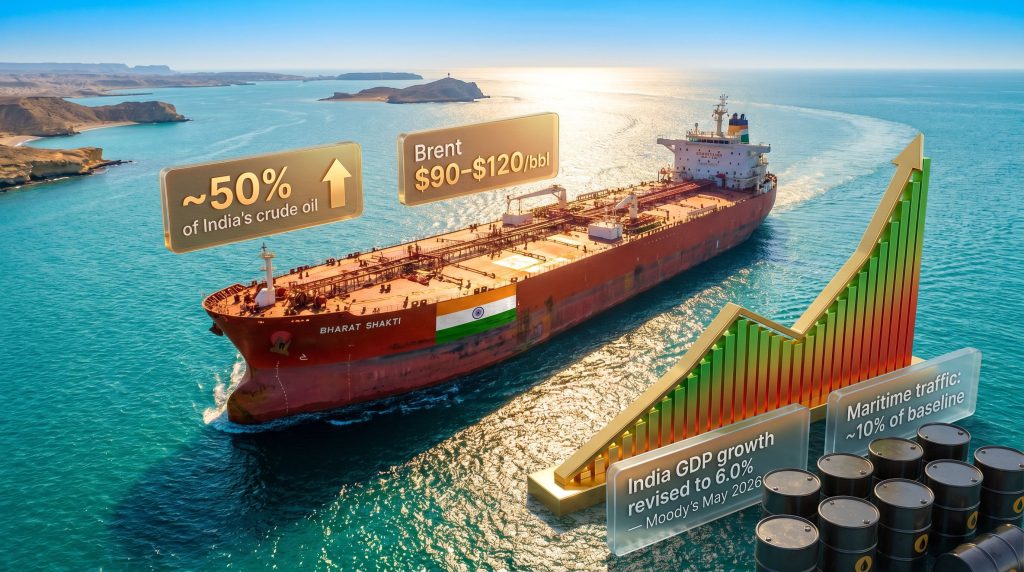
The Strait itself serves as the transit gateway for roughly half of India's crude oil, more than 50% of its LNG imports, and an estimated 90% of its LPG supply. These are not marginal volumes. LPG, in particular, underpins cooking energy access for hundreds of millions of Indian households, meaning disruptions propagate rapidly from refinery gates into domestic social policy territory.
India's crude import volumes reached approximately 4.4 million barrels per day (BPD) in April 2026, reflecting a demand base that continues to expand even as the supply corridor it depends on contracts. The arithmetic of this mismatch is severe.
What distinguishes the Strait from other geographic chokepoints is the absence of any credible bypass mechanism at comparable cost or throughput capacity. The Cape of Good Hope routing adds significant transit time and freight cost. Pipeline alternatives connecting Gulf producers to non-Hormuz export terminals exist in limited form but cannot absorb the volume displaced by a near-complete closure. Maritime traffic through the Strait has declined by more than 90% from pre-conflict baseline levels, driven by risk aversion, prohibitive insurance premiums, and the presence of sea mines. Furthermore, the crude oil trade geopolitics underpinning this disruption have been building for years, making the current crisis less of a surprise and more of an inevitable pressure point.
Structural Reality Check: The Strait of Hormuz is not simply a physical passage. It is an embedded feature of global energy trade architecture. Its disruption does not just reroute volumes; it eliminates them, because no equivalent infrastructure exists to absorb the displacement.
What Triggered the Crisis and Why Resolution Remains Distant
The current disruption originated with joint US-Israel air strikes on Iran, which triggered retaliatory action including the effective closure of the Strait. As of mid-May 2026, the conflict has entered its third month with no credible ceasefire architecture under construction.
Moody's Ratings, in its May 12, 2026 global geopolitical risk assessment, noted that there is negligible probability of a rapid and lasting settlement between the US and Iran in the near term. The agency's conclusion carries significant weight: it projects that a return to pre-conflict traffic volumes through the Strait is unlikely within calendar year 2026, and expects disruptions to persist through autumn 2026 at minimum.
Even if physical passage through the Strait were restored within six months, the oil market would remain structurally supply-constrained. Insurance underwriters, who largely withdrew coverage for Hormuz-transiting vessels following the sea mine incidents, would not reinstate capacity overnight. Tanker operators recalibrated their routing and deployment strategies in response to the closure, and reversing that operational repositioning takes time measured in quarters, not weeks.
| Metric | Pre-Conflict Baseline | Current Status (May 2026) |
|---|---|---|
| Strait of Hormuz maritime traffic | 100% | ~10% of baseline |
| Brent crude price range | ~$70-80/bbl (estimated) | $90-$120/bbl |
| India's Middle East crude share | ~46% | Under active diversification |
| Global seaborne oil/LNG via Strait | ~20% of world supply | Severely constrained |
India Oil Imports from Iran Through Strait of Hormuz Transit Corridors: The Bilateral Negotiation Dynamic
With multilateral resolution politically implausible in the near term, major oil-importing nations have shifted to a country-by-country negotiation strategy. Moody's specifically identified China, India, Japan, and South Korea as the economies most likely to pursue direct bilateral talks with Iran to secure passage rights for their tankers.
This approach is analytically important because it fundamentally changes the structure of global energy trade. Rather than a rules-based open waterway accessible to all commercial traffic, the emerging system resembles a negotiated access regime, where passage is conditioned on bilateral diplomatic relationships, implicit concessions, and ongoing political goodwill. Consequently, oil price movements are now being shaped as much by diplomatic outcomes as by supply and demand fundamentals.
Reports indicate that coordinated transit corridors are materialising near Larak Island and through Omani territorial waters, representing pragmatic workarounds operating at the periphery of the contested zone rather than through the central Strait lanes.
Key characteristics of these corridor arrangements include:
- Access negotiated on a country-by-country basis, creating asymmetric competitive conditions among importing nations
- Passage subject to political interruption if any bilateral relationship deteriorates
- Likely involvement of undisclosed transit concessions or diplomatic trade-offs that add hidden cost to import bills
- Routing through peripheral rather than central Strait lanes, which introduces additional logistical complexity and vessel positioning costs
- No formal multilateral framework guaranteeing continuity or dispute resolution
Critical Distinction: Coordinated transit corridors near Larak Island and through Omani waters are not a reopening of the Strait. They represent conditional, fragile, and non-guaranteed passage arrangements that function entirely outside any established international maritime law framework. Nations without sufficient diplomatic leverage with Tehran simply do not benefit from these arrangements.
India's Re-Engagement with Iranian Crude After Seven Years
One of the more significant and underreported developments embedded in this crisis is India's apparent resumption of Iranian crude imports after a gap of roughly seven years. Indian refiners have reportedly re-entered the Iranian supply market following a temporary US sanctions waiver, with the Indian government signalling that companies face no procedural payment barriers when sourcing from a diversified range of suppliers.
Reports also suggest that Iran may be extending preferential passage consideration to India-flagged tankers transiting the Strait, though no formal bilateral agreement has been publicly confirmed by Iranian authorities. This ambiguity is deliberate: both governments benefit from operational flexibility that formal agreements would constrain.
The resumption of Iranian crude imports reflects a pragmatic energy security calculation. Iranian crude tends to be heavy and sour in grade, well-suited to Indian refineries that were historically configured to process it during the pre-2019 sanctions era. The re-engagement reactivates refinery configurations and procurement relationships that were mothballed but never entirely dismantled, giving Indian refiners a meaningful operational advantage over competitors without that institutional memory.
However, the sanctions waiver framing introduces material uncertainty. If the waiver lapses or US foreign policy priorities shift, Indian refiners face compliance risk that makes Iranian supply an unreliable long-term anchor, regardless of short-term commercial attractiveness.
Brent Crude Forecasts and the Macroeconomic Pressure on India
Moody's central scenario for Brent crude prices in 2026 sits in the $90-110 per barrel range, with acknowledged potential for excursions above this band in response to new geopolitical developments. Since the conflict escalated, Brent has already moved between $90 and $120 per barrel, confirming the volatility character of Moody's forecast.
The macroeconomic transmission of these price levels into India's economy operates through several simultaneous channels:
1. GDP Growth Reduction
Moody's revised India's 2026 GDP growth forecast downward by 0.8 percentage points to 6.0%, from an earlier estimate of approximately 6.8%. This revision reflects the compound effect of energy cost inflation, current account deterioration, and the indirect demand destruction that elevated input costs generate across manufacturing and services sectors.
2. Inflation Overshoot
India's inflation is now projected to average 4.5% in 2026, representing a 1 percentage point upward revision from earlier estimates. Critically, the inflation pressure operates through both headline and core channels simultaneously, because elevated energy prices push up transport costs, agricultural input costs, and industrial production costs concurrently.
3. Currency Depreciation Feedback
India's rupee faces depreciation pressure as elevated crude prices widen the current account deficit. A weaker rupee then amplifies the domestic cost of dollar-denominated oil imports, creating a self-reinforcing dynamic where import price increases and currency weakness compound each other.
| Economy | Estimated GDP Growth Reduction ($90-110/bbl Brent) |
|---|---|
| Major oil-importing economies (general range) | 0.2-0.8 percentage points |
| India (specifically) | 0.8 percentage points |
| India's 2026 growth forecast (revised) | 6.0% (from ~6.8%) |
| India's 2026 inflation forecast (revised) | 4.5% (from ~3.5%) |
How India Is Restructuring Its Oil Supply Chain
The crisis has functioned as an accelerant for supply diversification strategies that existed in pre-conflict planning documents but lacked sufficient urgency to drive structural change. India is now actively expanding procurement from Russia, Venezuela, Brazil, and other non-Gulf producers, building on the discount-driven Russian crude purchasing that began in 2022. In addition, the LNG supply outlook remains deeply uncertain as long-term contract structures are being renegotiated against a backdrop of constrained Strait access.
| Supply Source | Key Advantage | Key Risk |
|---|---|---|
| Russia | Established discount flows, refinery compatibility | Sanctions exposure, secondary risk |
| Iran (bilateral) | Geographic proximity, refinery configuration fit | Sanctions uncertainty, passage risk |
| Venezuela | Western Hemisphere diversification | Production reliability, sanctions history |
| Brazil | Stable, sanctions-free, growing volumes | Higher freight costs, longer lead times |
| United States | Geopolitical alignment, reliability | Price premium over discounted alternatives |
Russian crude warrants particular analytical attention. India's rapid expansion of Russian crude purchasing post-2022 was driven primarily by price discount opportunism, but it has evolved into a structural fixture of India's supply mix. Russian crude now functions as a built-in hedge against Middle Eastern supply disruption, though it carries its own geopolitical risk profile related to secondary sanctions enforcement and banking channel complications.
The deeper supply chain insight that rarely surfaces in mainstream analysis is the refinery configuration constraint. Indian refineries were built or retrofitted over decades to process specific crude grades from specific origin regions. Switching origin rapidly is technically possible but operationally inefficient, generating yield losses and processing cost increases that offset some portion of the procurement price advantage. This refinery-crude matching dynamic is a hidden friction cost that aggregate import statistics do not capture.
The next major ASX story will hit our subscribers first
Monetary Policy Complications and Broader Sectoral Impacts
For the Reserve Bank of India, the inflation dynamics created by sustained energy price elevation present a genuine policy dilemma. The simultaneous upward pressure on headline and core inflation limits the RBI's ability to pursue accommodative monetary policy to support growth, even as the GDP forecast deterioration argues for demand support measures.
This tension is not unique to India. The same structural bind confronts central banks across Japan, South Korea, and other major Asian oil importers navigating an identical supply shock with country-specific variations in exposure severity. Moreover, supply chain disruption across energy and manufacturing sectors is compounding these pressures beyond what monetary policy alone can address.
Beyond central bank dynamics, the sectoral transmission of elevated energy prices generates cascading effects:
- Manufacturing sectors with high energy intensity face margin compression that reduces capital expenditure appetite and employment growth
- Agricultural supply chains absorb higher fertiliser and irrigation energy costs, feeding into food price inflation with a lag of several months
- Logistics and transport cost increases propagate across virtually every goods-producing sector simultaneously
- Household purchasing power deteriorates as fuel and cooking gas costs absorb a larger share of disposable income, particularly for lower-income cohorts with limited capacity to substitute
Investor Consideration: Markets pricing India's growth story in 2026 need to incorporate not just the headline GDP revision, but the sectoral and distributional consequences of sustained energy price elevation. Consumer discretionary spending, energy-intensive industrials, and import-dependent businesses face a materially different operating environment than pre-crisis projections assumed. This is speculative by nature and does not constitute financial advice.
The Structural vs. Cyclical Framework: Why the Distinction Matters
The most consequential analytical judgment embedded in Moody's assessment is the characterisation of the Strait of Hormuz disruption as a structural supply constraint rather than a temporary supply shock. This distinction determines how governments, corporations, and financial markets should calibrate their response horizon.
A cyclical disruption implies mean reversion: prices spike, supply reroutes, insurance markets adapt, and traffic normalises within a predictable timeframe. A structural constraint implies that the underlying architecture of energy trade has been altered in ways that require active policy intervention, infrastructure investment, and strategic repositioning to resolve.
The evidence increasingly supports the structural characterisation. Maritime traffic has not just declined; it has collapsed to approximately 10% of baseline levels, a magnitude that reflects wholesale withdrawal rather than cautious reduction. Insurance markets have not repriced risk upward; they have largely withdrawn coverage entirely. These are not the responses of a market expecting near-term normalisation.
For India specifically, the structural reading argues for urgent investment in strategic petroleum reserve expansion, acceleration of long-term supply agreement diversification, and serious examination of alternative import infrastructure. The geopolitical risk landscape affecting energy and commodities more broadly reinforces the case for structural rather than tactical responses. The bilateral corridor negotiations currently underway are a tactical response to an immediate crisis. The strategic response requires a longer time horizon and significantly greater institutional commitment.
Frequently Asked Questions
Why does the Strait of Hormuz create disproportionate risk for India compared to other importers?
India's refinery infrastructure, procurement relationships, and logistical systems were optimised over decades around Gulf crude. Approximately 46% of crude imports originate from Middle Eastern suppliers, and the Strait serves as the gateway for roughly half of total crude intake. No alternative corridor can replicate this at equivalent cost or volume, making the exposure both concentrated and difficult to substitute quickly.
What makes Larak Island and Omani waters significant as transit corridor locations?
These locations sit at the periphery of the Strait rather than its central contested lanes, allowing tankers to potentially transit with reduced exposure to the risk factors that have driven the 90% traffic decline. However, these routes function only under bilateral negotiated arrangements and carry no formal legal protections under international maritime law. Analysis of India's strategic maritime corridors suggests these workarounds remain fragile and politically contingent.
How does India's re-engagement with Iranian crude interact with US sanctions policy?
The re-engagement is reportedly facilitated by a temporary US sanctions waiver, creating a channel that is commercially useful but legally contingent. According to reporting on India's Hormuz exposure, India's oil stocks have already declined by 15% since the conflict began, underscoring the urgency of the re-engagement. If the waiver lapses or US policy priorities shift, Indian refiners face compliance constraints that could force rapid supply reallocation, making Iranian crude a tactical rather than strategic procurement option.
What does the $90-110/bbl Brent scenario mean for India's fiscal position?
Sustained elevated crude prices expand India's import bill in dollar terms, widen the current account deficit, exert depreciation pressure on the rupee, and generate fiscal pressure if the government attempts to cushion domestic fuel price increases through subsidy mechanisms. The combined effect represents a material deterioration in India's external accounts relative to pre-conflict projections.
Disclaimer: This article contains forward-looking projections and analysis sourced from Moody's Ratings and other publicly available research. All forecasts involve inherent uncertainty. Nothing in this article constitutes financial or investment advice. Readers should conduct independent due diligence before making any investment or policy decisions.
Want To Stay Ahead of the Next Major Resource Discovery Before the Market Reacts?
While India's energy vulnerability underscores how commodity supply chains can shift dramatically overnight, Discovery Alert's proprietary Discovery IQ model delivers real-time alerts on significant ASX mineral discoveries, transforming complex resource data into actionable investment insights the moment they're announced. Explore Discovery Alert's discoveries page to understand how historic mineral discoveries have generated substantial returns — and begin your 14-day free trial today to position yourself ahead of the broader market.