
July 14, 2026
The Maritime Chokepoint That Changed Everything
For most of modern history, energy security has been measured in reserves, refining capacity, and supply diversification. Yet there exists a category of risk that reserve volumes and diversified suppliers cannot fully address: the vulnerability of transit corridors. When a single maritime passage connects a nation to the majority of its gas supply, the distinction between energy policy and national security effectively collapses.
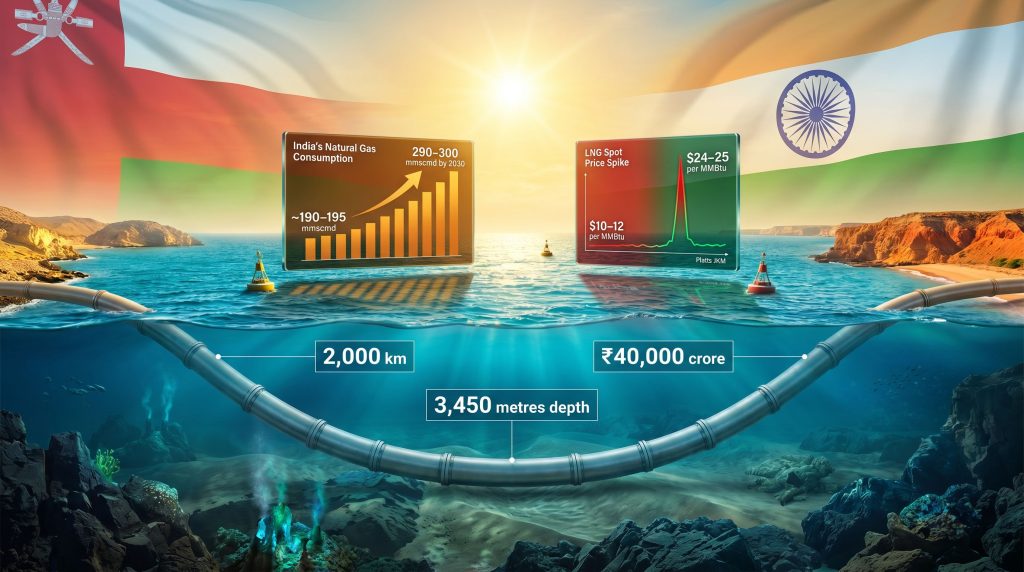
That reality became impossible to ignore across Asia in early 2025, when escalating conflict between the United States, Israel, and Iran led to the effective closure of the Strait of Hormuz in late February. The ripple effects were immediate and severe. Global LNG supply fell by more than 20%, and Asian spot prices, tracked via the Platts JKM benchmark, surged from a relatively stable range of $10 to $12 per MMBtu to $24 to $25 per MMBtu within weeks. For India, a country routing nearly two-thirds of its LNG import volumes through that same corridor, the episode was not merely a market disruption. It was a structural warning.
The accelerating momentum behind the India Oman subsea gas pipeline must be understood in that context. This is not a routine infrastructure proposal. It represents India's most substantive attempt to rewrite its energy security architecture at a moment when the cost of complacency has become undeniable. Furthermore, understanding the broader LNG supply outlook helps contextualise precisely why this pipeline has moved from concept to priority.
When big ASX news breaks, our subscribers know first
India's LNG Dependency: A Structural Problem Decades in the Making
How Consumption Growth Created a Supply Concentration Risk
India's natural gas sector has long operated in the shadow of a fundamental tension: rapidly growing demand against a domestic production base that has consistently failed to keep pace. Current national gas consumption sits at approximately 190 to 195 million standard cubic metres per day (mmscmd), a figure that reflects years of industrial expansion, urban gas network rollout, and fertiliser sector growth.
By 2030, that demand is projected to reach 290 to 300 mmscmd, representing roughly a 50% increase from current levels. The gap between domestic production and total demand has been filled almost entirely by liquefied natural gas imports. Estimates now suggest LNG imports alone could reach 180 to 200 mmscmd by the end of the decade, meaning the overwhelming majority of India's projected gas needs would be sourced from seaborne LNG cargoes.
This matters for reasons that go beyond simple import dependency. Pipeline gas and LNG carry fundamentally different risk profiles:
-
Price predictability: Pipeline gas typically operates under long-term, take-or-pay contracts with pricing linked to agreed formulae, insulating buyers from spot market volatility. LNG, particularly when sourced through spot or short-term markets, exposes buyers directly to benchmark price movements.
-
Supply continuity: A pipeline, once constructed, provides continuous physical flow subject only to upstream production and technical factors. LNG supply can be diverted, withheld, or disrupted at multiple points in the shipping chain.
-
Geopolitical exposure: LNG cargoes transiting maritime chokepoints are exposed to shipping lane disruptions, insurance cost surges, and carrier availability constraints during periods of regional conflict.
The Hormuz disruption crystallised a dual vulnerability that India had long acknowledged but never urgently addressed: physical supply interruption and price spike risk arriving simultaneously, from a single geographic trigger point.
Monitoring natural gas price trends throughout this period revealed just how acutely exposed India's import-dependent sectors had become. The fertiliser sector alone consumes approximately 46 to 50 mmscmd of natural gas to sustain domestic production levels. City gas distribution networks are expanding across Indian urban centres, adding further structural demand layers. Industrial and power generation users face ongoing cost pressure from LNG price volatility that pipeline gas could substantially moderate.
What the India Oman Subsea Gas Pipeline Actually Involves
Project Specifications and the MEIDP Framework
The proposed Middle East-India Deep-water Pipeline (MEIDP) is a 2,000-kilometre undersea infrastructure corridor designed to connect Oman's coast directly to the Gujarat seaboard on India's western flank. The project is estimated to cost approximately ₹40,000 crore, equivalent to roughly $4.7 to $4.8 billion USD, and would deliver approximately 31 mmscmd of natural gas at full operational capacity.
Construction is projected to require five to seven years from the point of formal project approval, contingent on the completion of a detailed feasibility report currently being directed by India's Ministry of Petroleum and Natural Gas. The ministry has indicated that state-owned entities including GAIL, Engineers India, and Indian Oil Corporation will be tasked with preparing that report, building on a pre-feasibility study already submitted by the South Asia Gas Enterprise (SAGE), a New Delhi-based private sector consortium, according to reporting by ET EnergyWorld.
The pipeline's proposed route is designed to traverse the Arabian Sea via Oman and the UAE, deliberately bypassing geopolitically sensitive maritime corridors. At its deepest operational points, the infrastructure would descend to depths of up to 3,450 metres, positioning it among the most technically demanding undersea pipeline projects ever attempted globally.
SAGE reportedly conducted early-stage technical validation by laying approximately 3,000 metres of test pipeline along the proposed route at a cost of around ₹25 crore, with the purpose of assessing seabed conditions and validating engineering assumptions. Note that ET EnergyWorld confirmed it was unable to independently verify this specific figure at time of publication.
A Proposal Decades Old, Now With Genuine Urgency
The concept of an undersea pipeline connecting India to Gulf gas reserves is not new. Various forms of this proposal have surfaced periodically since the 1990s, consistently encountering the same obstacles: bilateral negotiation complexity, financing uncertainty, and insufficient political urgency. The table below maps the project's historical arc:
| Development Phase | Status | Primary Constraint |
|---|---|---|
| 1990s initial concept | Conceptual discussion | Financing and geopolitical uncertainty |
| 2014 revival interest | Feasibility discussions | Bilateral negotiation complexity |
| SAGE pre-feasibility submission | Private sector study submitted to government | Awaiting state mandate for detailed report |
| 2025 to 2026 acceleration | Active government review underway | Detailed feasibility report in preparation |
What distinguishes the current phase from previous cycles is the convergence of three factors: demonstrated technical feasibility from advances in deepwater pipe-laying technology, a geopolitical shock severe enough to generate political will, and a formal government directive to state-owned entities to move the project from conceptual to technical validation.
Recent engineering advances in deep-sea pipe-laying systems and subsea repair technology have made the MEIDP viable in ways that were simply not achievable during earlier proposal cycles. The project is no longer a theoretical aspiration. It is an active engineering and diplomatic undertaking.
The Energy Reserves This Pipeline Would Unlock
A Multi-Supplier Corridor Into the World's Gas Heartland
The pipeline's strategic value extends well beyond its bilateral Oman-India framing. The route's design would position India to access natural gas from Oman, the UAE, Saudi Arabia, Iran, Turkmenistan, and Qatar, a region collectively holding an estimated 2,500 trillion cubic feet of natural gas reserves. To contextualise that figure, Qatar alone holds approximately 868 trillion cubic feet in proven reserves, while Iran sits on roughly 1,649 trillion cubic feet, the world's second-largest reserve base.
This transforms the MEIDP from a point-to-point supply solution into a potential multi-supplier energy corridor, capable of underpinning long-term gas supply agreements with multiple upstream producers through a single piece of physical infrastructure. The diplomatic and commercial flexibility this creates is substantial.
Key sectors positioned to benefit most directly from stable pipeline gas supply include:
-
Fertiliser manufacturing: Requires approximately 46 to 50 mmscmd of gas for domestic production, making it highly sensitive to price volatility and supply continuity.
-
City gas distribution: Urban gas networks are expanding rapidly across Indian metropolitan and tier-two cities, creating growing structural demand for reliable, cost-competitive supply.
-
Industrial manufacturing: Energy-intensive industries face ongoing competitiveness pressures from LNG price cycles, which directly affect production cost structures.
-
Power generation: Gas-fired peaker capacity and baseload generation require predictable fuel pricing to remain economically viable alongside competing generation sources.
India vs China: The Pipeline Gas Gap That Defines Strategic Vulnerability
How Two Decades of Chinese Infrastructure Investment Created an Insulation Advantage
Perhaps the most striking dimension of India's energy security challenge is the contrast with China's position. While India has remained almost entirely dependent on seaborne LNG, China has systematically constructed a network of overland and regional pipeline corridors that effectively insulated it from the Hormuz disruption entirely.
| Metric | China | India |
|---|---|---|
| Operational overland pipeline corridors | Multiple (Russia, Central Asia) | None operational |
| Power of Siberia 1 annual capacity | Up to 38 bcm/year | Not applicable |
| Power of Siberia 2 proposed capacity | 50 bcm/year (via Mongolia, under negotiation) | Not applicable |
| Turkmenistan pipeline current capacity | 55 bcm/year (fourth line under construction to reach 85 bcm) | Not applicable |
| Strategic gas storage capacity | ||
| LNG spot market dependency | Moderate | High |
China's Power of Siberia pipeline, operational since December 2019, delivers up to 38 bcm per year from Siberian gas fields at full capacity. A second pipeline, Power of Siberia 2, with a proposed capacity of 50 bcm per year routed via Mongolia, remains under active negotiation. China's Central Asian pipeline network from Turkmenistan currently carries 55 bcm per year across three parallel lines, with a fourth line under construction that would expand total capacity to 85 bcm per year.
The storage differential is equally stark. India currently holds approximately 2 to 2.5 billion cubic metres of gas across 22 to 24 LNG storage tanks at regasification terminals, a buffer representing roughly 10 to 12 days of national gas consumption. China is on track for approximately 80 billion cubic metres of storage capacity by end-2026, representing roughly 20% of its annual consumption needs.
Unlike crude oil, where India maintains a Strategic Petroleum Reserve framework, no comparable strategic gas storage infrastructure exists at national scale. This means India cannot absorb supply shocks through stored inventory in the way it can with oil, making physical supply continuity through pipeline infrastructure not just economically attractive but structurally essential.
The energy security risks exposed by this infrastructure gap are compounded further by the broader US-China trade war impacts reshaping global energy trade flows, adding another layer of complexity to India's strategic planning. Ashutosh Karnatak, the former chairman and managing director of GAIL, has publicly observed that the debate over an Oman pipeline has persisted for decades without resolution, and that the Hormuz crisis has now forced action where discussion previously sufficed, noting that pipeline infrastructure offers the kind of price predictability and supply security that LNG-based systems structurally cannot replicate. (Source: ET EnergyWorld, May 14, 2026)
Three Scenarios for the India Oman Subsea Gas Pipeline's Future
Scenario Modelling: What Execution, Delay, and Stagnation Each Mean
Scenario 1: Full Execution
A completed MEIDP delivers 31 mmscmd of stable, cost-competitive gas directly to Gujarat within the projected construction window. India's Hormuz transit exposure for gas supply drops materially as pipeline-sourced volumes displace LNG spot purchases. Fertiliser, city gas distribution, and industrial sectors gain predictable input cost structures that enhance long-term competitiveness. India establishes a foundation for broader Gulf pipeline diplomacy, potentially extending supply agreements to UAE, Saudi Arabia, and Qatar through the same infrastructure corridor.
Scenario 2: Partial Progress
The detailed feasibility report confirms technical viability but surfaces complexity in bilateral pricing negotiations, environmental permitting across the Arabian Sea corridor, or project financing architecture. The pipeline enters a prolonged government-level negotiation phase. India simultaneously expands LNG regasification capacity as a parallel hedge, moderating but not eliminating spot market exposure. Construction commences beyond the initial five to seven-year projection.
Scenario 3: Strategic Stall
Bilateral negotiations with Oman stall over gas pricing formulae, cost-sharing arrangements, or transit governance frameworks. The MEIDP joins a long history of proposed but unrealised cross-border energy infrastructure in South Asia. India responds by accelerating domestic deepwater gas production, expanding LNG storage capacity, and diversifying LNG import sources by supplier geography. The pipeline concept re-emerges in the next cycle of regional geopolitical disruption.
Historical precedent supports treating Scenario 3 as a genuine risk, not merely a theoretical downside. Multiple earlier attempts at Gulf-to-India pipeline concepts have stalled at precisely the bilateral negotiation stage that the MEIDP must now navigate successfully.
The next major ASX story will hit our subscribers first
The Five-Layer Execution Challenge
What Successful Delivery Actually Requires
The gap between a positive feasibility report and a completed pipeline involves five distinct execution layers, each carrying its own risk profile:
-
Technical Validation: Completion of the detailed feasibility report by GAIL, Engineers India, and Indian Oil Corporation, confirming seabed conditions, pipeline design specifications, and engineering risk parameters.
-
Bilateral Framework: Government-level negotiations with Oman covering gas supply volumes, pricing mechanisms, contract duration, and force majeure frameworks that satisfy both parties' commercial and sovereign requirements.
-
Financing Architecture: Structuring a $4.7 to $4.8 billion capital project across sovereign, multilateral development bank, and commercial financing channels in a configuration that manages currency, construction, and offtake risk.
-
Regulatory Alignment: Obtaining environmental approvals, seabed usage rights, and maritime jurisdiction agreements governing the pipeline's traverse across the Arabian Sea, including compliance with relevant provisions of the United Nations Convention on the Law of the Sea.
-
Execution Governance: Defining the operational roles and commercial responsibilities of state-owned entities versus private sector participants in both the construction phase and long-term operational management.
A successful outcome at the feasibility report stage unlocks formal bilateral negotiations, with Oman's position as a politically stable Gulf producer and established LNG exporter making it a credible and capable anchor partner for the project's initial phase. Detailed subsea engineering assessments from comparable deepwater pipeline projects provide useful technical benchmarks for the MEIDP's engineering validation process.
India's Broader Gas Security Reform Agenda
The Pipeline Is Necessary but Not Sufficient
The MEIDP represents the most high-profile element of India's energy security response, but it sits within a broader reform agenda that addresses structural vulnerabilities the pipeline alone cannot resolve. In addition, broader resource and energy exports from major producing nations will also shape the competitive landscape for long-term gas supply agreements.
The absence of strategic gas storage infrastructure is perhaps the most acute parallel vulnerability. With only 2 to 2.5 bcm in storage across the national regasification terminal network, India has no meaningful buffer against supply shocks. Developing underground gas storage facilities, a technology widely deployed in Europe and Central Asia, would extend the national buffer materially and complement the pipeline's supply continuity benefits.
Additional policy reforms that would strengthen India's overall gas security architecture include:
-
Accelerating domestic deepwater gas production from awarded exploration blocks to reduce total import dependency
-
Diversifying LNG import sources at the supplier geography level to reduce concentration risk within the LNG portfolio itself
-
Integrating renewable energy capacity scaling to reduce the absolute volume of gas required in the power generation mix over the medium term
-
Developing a strategic gas reserve framework analogous to the Strategic Petroleum Reserve, potentially beginning with expanded LNG tank capacity at existing regasification terminals
Each of these measures addresses a specific dimension of the structural vulnerability that the Hormuz disruption exposed. The pipeline addresses physical supply route diversification. Storage addresses shock absorption capacity. Domestic production reduces total import exposure. Renewable scaling reduces absolute demand. No single intervention solves the problem in isolation.
Frequently Asked Questions: India Oman Subsea Gas Pipeline
What is the India Oman subsea gas pipeline project?
The Middle East-India Deep-water Pipeline (MEIDP) is a proposed 2,000-kilometre undersea gas pipeline connecting Oman's coast to India's Gujarat seaboard. Estimated to cost approximately ₹40,000 crore ($4.7 to $4.8 billion USD), it would deliver around 31 mmscmd of natural gas and is designed to operate at depths of up to 3,450 metres.
Why is the India Oman pipeline receiving urgent attention now?
The Strait of Hormuz disruption in late February 2025, triggered by conflict involving the United States, Israel, and Iran, caused global LNG supply to fall by more than 20% and drove Asian spot gas prices from $10 to $12 per MMBtu to $24 to $25 per MMBtu. With nearly two-thirds of India's LNG imports transiting that same corridor, the crisis elevated the pipeline from a long-standing proposal to an active national security priority.
How technically challenging would this pipeline be to build?
Operating at depths of up to 3,450 metres, the MEIDP would rank among the deepest undersea pipeline projects ever attempted globally. Recent advances in deepwater pipe-laying technology and subsea repair systems have made the project technically viable, and SAGE reportedly conducted early seabed testing along the proposed route to validate engineering assumptions.
How long will the pipeline take to construct?
India's Ministry of Petroleum and Natural Gas has indicated a construction timeline of five to seven years from formal project approval, subject to the completion of a detailed feasibility report and the successful conclusion of bilateral negotiations with Oman.
What gas reserves would this pipeline access?
The corridor's design would connect India to gas supply from Oman, UAE, Saudi Arabia, Iran, Turkmenistan, and Qatar, a region collectively holding an estimated 2,500 trillion cubic feet of natural gas reserves.
How does India's gas storage position compare to China's?
India holds approximately 2 to 2.5 billion cubic metres of gas across 22 to 24 LNG storage tanks, representing roughly 10 to 12 days of national consumption. China is targeting approximately 80 billion cubic metres of storage capacity by end-2026, covering roughly 20% of its annual needs.
Has this pipeline been proposed before?
Yes. Variants of an Oman-to-India pipeline concept have circulated since the 1990s and have periodically resurfaced without progressing to a funded construction phase. The Hormuz disruption represents the most significant catalyst for action that the proposal has encountered across three decades of debate. Consequently, India's renewed pipeline push carries considerably more institutional momentum than any previous iteration.
From Energy Infrastructure to Geopolitical Asset
Why the MEIDP's Strategic Value Exceeds Its Energy Economics
Framed purely as an energy infrastructure investment, the MEIDP's economics are compelling but not unprecedented. A $4.7 to $4.8 billion investment delivering 31 mmscmd of stable, cost-competitive gas to a market projected to need 290 to 300 mmscmd by 2030 represents solid strategic value. The fertiliser sector benefit alone, addressing a 46 to 50 mmscmd structural demand gap with predictable pricing, would generate substantial economic returns.
However, the project's true strategic value operates at a different level. A completed pipeline would reduce India's physical exposure to any single maritime chokepoint for gas supply, establish a direct and sovereign-adjacent energy corridor to one of the world's most gas-rich regions, and signal India's intent to pursue pipeline gas security through deep-sea infrastructure rather than solely through overland corridors.
The cost of inaction is equally specific. Without the pipeline, India's projected LNG import requirement of 180 to 200 mmscmd by 2030 will remain almost entirely concentrated in Hormuz transit exposure. Gas demand growth across fertilisers, city gas, and industry will continue to outpace domestic production capacity. India's competitive disadvantage relative to China in gas cost predictability will consequently widen, affecting industrial competitiveness across every energy-intensive sector of the economy.
The Hormuz shock transformed the Oman pipeline from a decades-old proposal into a policy imperative. The central question is no longer whether India requires pipeline gas infrastructure. It is whether the institutional capacity, diplomatic resources, and financing architecture can be assembled within a timeframe that is strategically relevant, rather than historically familiar.
Disclaimer: This article is intended for informational purposes only and does not constitute financial, investment, or energy policy advice. Projections, scenario analyses, and market forecasts referenced herein are drawn from publicly available reporting and institutional estimates and are subject to change based on geopolitical, technical, and commercial developments. Readers should conduct independent analysis before drawing conclusions about energy market dynamics or infrastructure project timelines.
Want to Stay Ahead of the Next Major Resource Discovery?
While India's pipeline ambitions reshape global energy flows, the ripple effects on critical minerals and resource equities create real-time opportunities for informed investors — and Discovery Alert's proprietary Discovery IQ model scans the ASX daily to deliver instant notifications on significant mineral discoveries, turning complex data across 30-plus commodities into clear, actionable insights. Explore how historic discoveries have generated substantial market returns and begin your 14-day free trial to ensure you're positioned ahead of the market.