May 14, 2026
When Exchange Governance Becomes a Market Signal
Commodity markets are deeply sensitive to institutional confidence. Long before a single trade is executed, participants evaluate whether the infrastructure underpinning price discovery is trustworthy, stable, and governed by consistent leadership. In industrial metals particularly, where trillions of dollars in contracts reference commodity price benchmarks daily, the quality of exchange governance is not a background consideration — it is a foundational market variable.
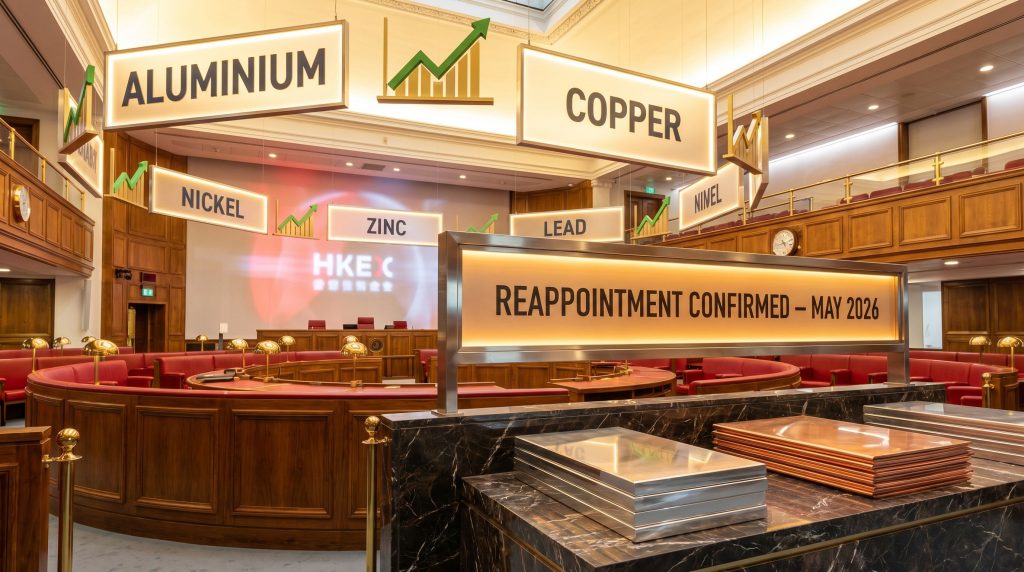
This dynamic helps explain why the John Williamson London Metal Exchange chairman reappointment in May 2026 carries significance well beyond a routine administrative renewal. For an exchange still navigating the institutional aftershocks of the 2022 nickel crisis analysis and simultaneously managing structural modernisation under HKEX ownership, leadership continuity at the board level functions as a deliberate market signal.
When big ASX news breaks, our subscribers know first
The Strategic Logic of Board-Level Continuity at the LME
Why Stability Matters More Than Disruption During Reform Cycles
In commodity exchange governance, there is a counterintuitive principle at work: the periods that most demand transformational change are also the periods least suited to leadership disruption. When an exchange is mid-reform — rebuilding trust, restructuring risk management frameworks, and realigning member relationships — a change in board leadership can introduce uncertainty that unravels months of institutional progress.
The LME entered 2023 in precisely this condition. Following the extraordinary market dislocation of March 2022, the exchange faced scrutiny from regulators, criticism from market participants, and questions from the broader financial community about whether its governance architecture was adequate for the scale of its global responsibilities.
Replacing the chairman at the conclusion of an initial reform-focused term would have signalled either dissatisfaction with progress or a willingness to tolerate fresh uncertainty — neither message consistent with credibility rebuilding.
The reappointment of John Williamson does the opposite. It communicates that the LME Board and its parent company, Hong Kong Exchanges and Clearing Limited (HKEX), assessed the progress made under Williamson's leadership and concluded that continuity served the exchange's long-term interests better than transition.
Board-level stability in exchange governance is rarely just about the individual. It is a forward-looking signal that the reform trajectory will not be disrupted, that existing stakeholder relationships will be maintained, and that strategic priorities will continue to be executed.
What Continuity Actually Delivers for Exchange Participants
For global members, institutional counterparties, and hedging participants active on the LME, leadership continuity translates into several concrete benefits:
- Predictability in governance decisions and regulatory engagement strategies
- Preservation of established relationships between the chairman's office and key international market participants
- Confidence that risk management reforms introduced during the current term will not be deprioritised by a successor with different priorities
- Reduced administrative uncertainty for members navigating compliance obligations tied to LME market rules
For the LME specifically, where membership spans more than 150 countries and price benchmarks influence upstream producers, downstream manufacturers, and financial institutions simultaneously, these benefits are not abstract. They affect hedging behaviour, contract structuring, and the volumes of open interest that give LME contracts their depth and liquidity.
John Williamson's Tenure: From Crisis Inheritance to Strategic Delivery
A Leadership Mandate Shaped by Exceptional Circumstances
John Williamson first assumed the LME chairmanship on an interim basis in April 2023, stepping into a role that carried the full weight of the exchange's post-crisis institutional pressure. The timing was significant. The March 2022 nickel event had exposed structural vulnerabilities in LME's risk management and oversight architecture, triggering regulatory scrutiny from the Financial Conduct Authority (FCA) and prompting a comprehensive governance review whose findings directly shaped the priorities Williamson was expected to address.
His permanent confirmation later in 2023 formalised a mandate centred on governance strengthening, stakeholder engagement, and market modernisation. His initial contract term concluded in April 2026, at which point the LME nickel crisis handling review outcomes were still shaping policy, and the Board confirmed his reappointment, extending his leadership as the exchange continues its multi-year transformation programme.
Key milestones in Williamson's LME leadership timeline:
| Milestone | Date |
|---|---|
| Interim Chairman appointment | April 2023 |
| Permanent appointment confirmed | Mid-2023 |
| Initial contract term concludes | April 2026 |
| Reappointment confirmed by LME Board | May 2026 |
Three Years of Transformation: What the Assessment Reflects
Williamson has publicly characterised the period since he assumed the chairmanship as one of significant institutional change and transformation. His assessment emphasises that progress was achieved not through strategic announcements alone but through the conversion of strategic intent into operational delivery — a distinction that matters considerably in an exchange environment where credibility is rebuilt through demonstrated action rather than stated ambition.
The three areas in which meaningful development appears to have occurred during his tenure are:
- Governance frameworks: Strengthening board accountability structures and enhancing oversight mechanisms in alignment with post-crisis review recommendations
- Stakeholder engagement: Rebuilding and deepening relationships with international market participants, including members whose confidence in the LME was damaged by the 2022 events
- Market development: Advancing the exchange's competitive positioning and infrastructure as global commodity markets grow more complex
HKEX Global Commodities Chairman Apurv Bagri has indicated that Williamson's leadership contributed to strengthening both governance practices and stakeholder relationships while sustaining the LME's standing in global metals markets. HKEX Chairman Carlson Tong has affirmed that the LME remains a central component of HKEX's global commodities strategy and that the reappointment is designed to ensure board-level continuity as the exchange advances its long-term agenda.
The 2022 Nickel Crisis: Understanding What Williamson Inherited
A Market Dislocation Without Modern Precedent
To understand the scale of the challenge Williamson's chairmanship was designed to address, it is necessary to examine what occurred in March 2022 with precision. The nickel market experienced an extreme short-squeeze event in which prices surged by more than 250% within a single trading session, driven by a highly concentrated short position held by a major market participant facing catastrophic margin calls as prices rose.
The LME's response — suspending nickel trading and cancelling billions of dollars in executed trades — was unprecedented in modern exchange history. The decision to void completed transactions was particularly controversial. It raised fundamental questions about the sanctity of exchange contracts, the adequacy of the LME's position limits and margin frameworks, and whether the exchange's risk management systems were calibrated appropriately for the scale of concentrated exposure that had accumulated.
The consequences cascaded across multiple dimensions:
- Regulatory consequence: The FCA and the Bank of England conducted a joint review of the LME's oversight frameworks and market resilience mechanisms
- Legal consequence: Multiple market participants initiated legal proceedings challenging the decision to cancel completed trades, arguing it caused substantial financial losses
- Reputational consequence: Institutional participants and hedgers questioned whether LME contracts could be relied upon as dependable financial instruments
- Liquidity consequence: Trading volumes and open interest in LME nickel contracts declined materially in the months following the crisis as participants reduced exposure
How the Crisis Defined the Governance Reform Agenda
The governance review that followed the March 2022 dislocation produced a set of recommendations that became the structural backbone of the LME's reform programme. These addressed position limit frameworks, margin adequacy, circuit breaker mechanisms, and the protocols governing trading suspension decisions.
Critically, they also addressed board-level oversight — the degree to which the LME's governance structure provided adequate challenge and accountability to management on risk management decisions. It is this reform agenda that Williamson was appointed to lead, making his reappointment a statement that the programme is ongoing and requires leadership continuity to see it through to completion.
The LME's Role in Global Industrial Metals Markets
Understanding the Exchange's Core Market Function
The London Metal Exchange occupies a unique position in global commodity markets. Unlike financial exchanges that primarily serve investment and speculative purposes, the LME was designed from its origins in the nineteenth century to serve the practical hedging needs of physical metals producers, traders, and consumers.
Its contracts are structured around physical delivery, its pricing benchmarks are referenced in billions of dollars of physical supply contracts globally, and its member base spans the full spectrum of industrial metals market participants.
| Metal | LME's Global Role |
|---|---|
| Aluminium | Primary global benchmark for primary metal pricing |
| Copper | World's leading copper futures and options venue |
| Nickel | Largest global nickel futures market by volume |
| Zinc | Dominant international price discovery reference |
| Lead | Established global hedging and settlement market |
| Tin | Key global pricing reference for electronics supply chains |
The exchange's pricing benchmarks are not merely financial abstractions. An aluminium smelter in Australia pricing long-term supply contracts with automotive manufacturers in Germany will reference LME benchmark prices. A copper mining company in Chile financing a new project will negotiate offtake agreements priced against LME copper. The reliability of these benchmarks is consequently a prerequisite for industrial investment decisions worldwide.
HKEX Ownership and the Strategic Architecture
HKEX acquired the LME in 2012 for approximately £1.4 billion, a transaction that positioned the exchange within a broader global commodities strategy connecting Asian capital flows with Western commodity pricing infrastructure. The acquisition reflected HKEX's recognition that industrial metals pricing was migrating toward a world in which Asian demand — particularly from China — would increasingly determine global commodity price levels.
The governance structure that emerged from the acquisition preserves an independent LME board with an independent chairman, a design intended to maintain the exchange's credibility with its international membership while aligning its long-term strategic direction with HKEX's global commodities priorities.
Williamson's continued tenure demonstrates that HKEX views the current balance between exchange independence and strategic alignment as functioning appropriately — an important signal for LME members globally who monitor the relationship between parent company priorities and exchange governance.
Comparing LME Governance to Global Commodity Exchange Structures
How the LME's Independent Chairman Model Stands Apart
The governance architecture of major global commodity exchanges reflects very different ownership, regulatory, and cultural frameworks. The LME's independent chairman model is relatively distinctive in the global exchange landscape.
| Exchange | Ownership | Regulatory Jurisdiction | Chairman Structure |
|---|---|---|---|
| London Metal Exchange | HKEX-owned subsidiary | FCA (UK) | Independent non-executive chairman |
| CME Group / COMEX | Publicly listed corporation | CFTC (US) | Executive chairman integrated with management |
| Shanghai Futures Exchange | State-supervised | CSRC (China) | Governance aligned with state oversight |
| ICE Futures Europe | ICE Inc. subsidiary | FCA (UK) | Governance integrated with parent structure |
The LME's model preserves a formal independence between the chairman's governance responsibilities and the operational management of the exchange. This structure is particularly important given HKEX's ownership, as it provides a mechanism through which member interests and market integrity considerations can receive formal board-level representation independent of the parent company's commercial priorities.
The Open-Outcry Heritage and Its Governance Implications
One dimension of LME governance that distinguishes it from virtually all other major exchanges globally is the survival of open-outcry ring trading — a physical trading format in which members trade metals contracts face to face in a circular setting. Ring trading prices serve as official LME settlement references used in physical supply contracts globally.
The persistence of ring trading reflects a fundamental tension within the LME's governance culture: the exchange must modernise its infrastructure, technology, and risk management frameworks to remain competitive in a digital trading environment, while also preserving the physical trading mechanisms that underpin the legitimacy and global recognition of its benchmark prices. Navigating this tension is part of the chairman's governance mandate.
The next major ASX story will hit our subscribers first
What the Reappointment Signals for Energy Transition Metals
The Expanding Strategic Relevance of LME Price Discovery
The global energy transition is reshaping industrial metals demand in ways that directly amplify the strategic importance of reliable exchange price discovery. Furthermore, critical minerals demand continues to grow as copper, aluminium, and nickel — all core LME markets — become central to electric vehicle production, renewable energy infrastructure, and grid modernisation programmes worldwide.
Aluminium demand in particular is accelerating across several energy transition applications:
- Electric vehicle battery enclosures and structural components
- Solar panel frames and mounting structures
- High-voltage transmission cable conductors
- Wind turbine nacelle and hub components
As capital investment in these sectors grows, the reliability of LME aluminium price benchmarks becomes a more critical input into project economics, supply contract structuring, and hedging programme design.
The Critical Minerals Expansion Opportunity
Beyond its established metals markets, the LME's long-term strategic development includes potential expansion into critical minerals that underpin battery supply chains — including cobalt and lithium. The challenges around critical minerals processing add further complexity to developing credible, liquid futures markets for these materials, which would require exactly the kind of governance credibility and institutional trust that Williamson's tenure has been working to rebuild.
The John Williamson London Metal Exchange chairman reappointment therefore carries forward-looking significance beyond the immediate continuity it represents. A chairman who has spent three years rebuilding governance credibility is well positioned to lead the institutional relationships and regulatory engagements necessary to bring new, complex products to market.
As global industrial demand pivots increasingly toward energy transition metals, the LME's ability to develop credible benchmarks for emerging critical minerals will depend directly on the governance foundation being built under Williamson's continued leadership.
Frequently Asked Questions: John Williamson and the London Metal Exchange
Who is John Williamson and what is his role at the LME?
John Williamson serves as Chairman of the Board of the London Metal Exchange. He assumed the role on an interim basis in April 2023 and was subsequently confirmed on a permanent basis later that year. The official LME reappointment announcement confirmed in May 2026 extends his chairmanship as the exchange advances its ongoing strategic transformation programme.
Why was the John Williamson London Metal Exchange chairman reappointment confirmed now?
The reappointment follows the conclusion of Williamson's initial contract term in April 2026. The LME Board and HKEX assessed his performance across governance strengthening, stakeholder engagement, and market development, and concluded that continuity in leadership serves the exchange's long-term strategic interests during an ongoing transformation period.
What is the London Metal Exchange and why does it matter?
The LME is one of the world's largest and most significant industrial metals trading exchanges, providing globally referenced price benchmarks for aluminium, copper, nickel, zinc, lead, and tin. Its pricing references are embedded in physical supply contracts across more than 150 countries, making its governance integrity a foundational requirement for global industrial supply chain confidence.
What was the 2022 nickel crisis and how does it relate to Williamson's appointment?
The March 2022 nickel crisis involved an extreme short-squeeze event that drove nickel prices up by more than 250% within a single session, prompting the LME to suspend trading and cancel billions of dollars in executed trades. The event triggered regulatory scrutiny, legal challenges, and a comprehensive governance review. Williamson was appointed in April 2023 to lead the reform agenda that followed, making governance restoration the central mandate of his chairmanship.
How does HKEX ownership affect LME governance?
HKEX, which acquired the LME in 2012 for approximately £1.4 billion, sets the strategic framework within which the LME operates. The LME maintains an independent board structure, with the chairman responsible for balancing HKEX's global commodities strategy with the operational independence and member-service obligations of the exchange itself.
Key Takeaways for Market Participants and Industry Observers
The John Williamson London Metal Exchange chairman reappointment in May 2026 is not an isolated governance event. It is a deliberate institutional signal with implications across multiple dimensions of global metals market infrastructure:
- Governance reform is a multi-year programme, not a completed exercise — the reappointment confirms that the LME Board views the transformation agenda as requiring sustained, consistent leadership to reach its objectives
- HKEX's endorsement reflects an assessment that progress under Williamson's tenure justifies continuity over disruption at a moment when the exchange cannot afford further institutional uncertainty
- Price discovery reliability has been elevated as the central strategic imperative — Williamson's own characterisation of the current environment underscores that credible market infrastructure is becoming more, not less, important as global commodity markets grow more complex
- Energy transition dynamics are amplifying the strategic relevance of LME's core markets, making governance credibility a prerequisite for the exchange's ability to expand its role in critical minerals pricing
- The independent chairman model provides an important governance mechanism for balancing HKEX ownership priorities with the interests of the LME's global membership base
Disclaimer: This article is intended for informational purposes only and does not constitute financial advice or investment guidance. Forward-looking statements regarding exchange strategy, market development priorities, and energy transition dynamics involve inherent uncertainty and should not be relied upon as definitive forecasts. Readers are encouraged to consult official LME, HKEX, and FCA publications for authoritative governance and regulatory information.
Want to Stay Ahead of Significant ASX Mineral Discoveries in Real Time?
While the LME's governance reforms underscore how institutional integrity drives market confidence, Discovery Alert's proprietary Discovery IQ model delivers that same edge to ASX investors — scanning daily announcements across 30-plus commodities to surface actionable mineral discoveries the moment they are announced. Explore historic discoveries and their exceptional returns or start your 14-day free trial today to position yourself ahead of the broader market.