

May 11, 2026
Copper's Coming Crisis and the Trade Deal That Could Define It
The global copper market is quietly entering one of the most consequential supply-demand inflection points in modern industrial history. The India Peru free trade pact has emerged as a focal point in this broader shift, as demand projections tied to electric vehicle manufacturing, renewable energy infrastructure, and grid modernisation represent structural transformations requiring volumes of copper that existing supply chains are fundamentally unprepared to deliver. For nations without significant domestic reserves, the scramble to lock in long-term supply relationships is no longer a future consideration. It is an urgent policy priority happening right now, in diplomatic offices and trade negotiation rooms across the world.
India sits at the sharpest edge of this challenge. As the world's fastest-growing major economy and the second-largest importer of refined copper globally, India faces a supply deficit of staggering proportions. Official government projections estimate that India may need to source between 91% and 97% of its copper concentrate requirements from overseas markets by 2047, according to government estimates reported by Reuters in May 2026. That figure reframes the India Peru free trade pact not as a standard bilateral trade negotiation, but as a strategic infrastructure project for India's industrial future.
When big ASX news breaks, our subscribers know first
The Scale of India's Copper Import Challenge
Understanding why the India Peru free trade pact carries such strategic weight requires first grasping the sheer magnitude of what India's copper demand trajectory looks like. Furthermore, the copper supply crunch already visible in global markets only intensifies the urgency of securing long-term bilateral agreements.
In the fiscal year ending March 2025, India imported approximately 1.2 million metric tons of copper, a figure that already represented a 4% year-on-year increase from the prior period. That number, significant as it is, represents only the starting point of a demand curve that climbs steeply over the coming decades.
| Timeframe | Projected Copper Demand |
|---|---|
| 2024-25 (Actual Imports) | 1.2 million metric tons (+4% YoY) |
| 2030 (Government Projection) | 3.0 to 3.3 million metric tons |
| 2047 (Government Projection) | 8.9 to 9.8 million metric tons |
The arithmetic here is striking. India's copper import requirements are projected to grow by roughly 7.4 to 8.2 times within a generation. No domestic reserve base can bridge that gap. India's geological copper endowment, while not negligible, is insufficient to service an industrial economy scaling at this velocity.
What Is Driving India's Copper Demand?
The copper demand drivers are well understood within the mining sector but deserve explicit framing. Electric vehicles require approximately three to four times more copper than conventional internal combustion vehicles. Solar photovoltaic systems, wind turbines, and the transmission infrastructure needed to connect them to grids all consume copper at volumes that dwarf traditional industrial applications.
As India accelerates its energy transition, each gigawatt of renewable capacity added creates compounding copper requirements that ripple through the entire supply chain. Recognising this structural exposure, the Indian government published a policy document directing its mining companies to actively pursue overseas supply chain investments to manage potential disruptions, as confirmed by Reuters reporting in May 2026. This represents a notable shift from reactive procurement to proactive supply chain diplomacy.
India's copper strategy has consequently evolved to encompass multiple geographic relationships simultaneously, with Peru representing one of the most strategically significant of these emerging partnerships.
Peru's Strategic Position in Global Copper Markets
Against this backdrop, Peru's significance to India's supply chain calculus becomes immediately apparent. Peru ranks as the world's third-largest copper producer, having generated approximately 2.7 million metric tons of copper in 2024. The country attracted $4.96 billion in foreign direct investment in its copper sector that same year, reflecting the sustained confidence of global mining capital in Peru's productive capacity.
What makes Peru particularly valuable as a supply partner extends beyond raw production volumes. Peru's copper mining sector spans a range of geological settings, including porphyry copper systems in the Andes that are among the largest and most cost-effective deposits globally. These systems typically produce copper in concentrated form, making them well-suited to the kind of long-term offtake arrangements that Indian industrial conglomerates would require for supply security.
Peru's copper production geography is concentrated in Andean porphyry systems, a geological formation type characterised by large, low-grade but economically viable deposits that support decades-long mine life expectations. This contrasts with higher-grade but shorter-duration deposits more common in parts of Africa and Asia, making Peruvian copper assets particularly attractive for buyers seeking supply certainty over 20-plus year horizons.
The combination of production scale, geological longevity, institutional stability for foreign investment, and existing trade momentum makes Peru arguably the most logical South American supply partner for India's copper ambitions. Furthermore, the Chile copper outlook provides useful context for how regional mineral diplomacy is reshaping trade relationships across Latin America more broadly.
How the India-Peru Free Trade Pact Has Evolved
Formal negotiations between India and Peru began in June 2017, with the first substantive round held in New Delhi in August of that year. Progress through successive rounds established framework architecture across goods, services, and technical barriers, though the negotiations were paused following Round 5 in August 2019 and did not resume until February 2024.
| Negotiation Round | Location | Date |
|---|---|---|
| Round 1 | New Delhi | August 2017 |
| Round 2 | Lima | April 2018 |
| Round 3 | New Delhi | December 2018 |
| Round 4 | Lima | March 2019 |
| Round 5 | New Delhi | August 2019 |
| Round 6 | Lima | February 2024 |
| Round 9 | Not Disclosed | November 2025 |
| Round 10 | New Delhi | January 2026 |
The resumption in 2024 and rapid acceleration through Rounds 6 to 10 within roughly 18 months signals a fundamentally different political and strategic environment compared to the pre-pause period. By November 2025, both parties had characterised progress as substantive, a term that in diplomatic trade language generally indicates movement from procedural debate toward actual concession exchange.
Round 10 followed in January 2026, and Peru's Ambassador to India, Javier Paulinich, confirmed in May 2026 that talks are expected to resume in June 2026 with a potential deal signing before year-end, according to Reuters. If that timeline holds, the India Peru free trade pact would represent one of India's fastest-concluded bilateral trade agreements with a Latin American nation.
What the Agreement Actually Covers
Beyond the headline copper narrative, the India Peru free trade pact encompasses a broad range of trade in goods and services where both nations hold comparative advantages.
Indian export sectors seeking preferential access in Peru:
- Pharmaceuticals and generic medicines
- Motorcycles, three-wheelers, and automotive components
- Iron and steel products
- Polyester and cotton textile yarns
- Plastics, rubber, and industrial manufactures
Peruvian export sectors seeking preferential access in India:
- Copper and copper concentrate
- Gold and precious metals
- Calcium phosphates and agricultural fertiliser inputs
- Fresh agricultural produce including grapes
- Fish flour and marine protein products
One of the more technically significant elements of the current negotiations is the dedicated critical minerals chapter that Peru is pursuing alongside standard goods trade provisions. Ambassador Paulinich confirmed this directly in May 2026 reporting. The inclusion of a standalone critical minerals chapter represents an evolution in bilateral trade architecture.
Traditional FTAs address tariff schedules and rules of origin; however, a critical minerals chapter can potentially encompass supply commitment mechanisms, processing investment obligations, traceability standards, and strategic reserve provisions. Negotiating a critical minerals chapter is substantially more complex than standard goods liberalisation, which partially explains why the negotiations have extended over multiple rounds without yet reaching conclusion.
Rules of Origin: The Technical Barrier That Shapes Copper Trade
One underappreciated dimension of the India Peru free trade pact involves rules of origin provisions for copper and related minerals. In copper trade, rules of origin determine what level of processing or value addition must occur in the exporting country for goods to qualify for preferential tariff treatment.
For copper concentrate specifically, the distinction matters considerably. Concentrate is partially processed copper ore, typically containing 20% to 30% copper content by weight, along with various byproducts including gold, silver, and molybdenum. Whether Indian importers can access Peruvian concentrate at preferential rates, or whether preferential treatment applies only to refined copper cathode, has direct implications for India's domestic smelting and refining sector.
If the FTA enables preferential access to concentrate, Indian smelters gain competitive raw material inputs and domestic value-adding capacity is protected. If, however, the agreement favours refined copper imports, Peruvian refineries capture more of the value chain. This negotiation within a negotiation will shape industrial policy outcomes in both countries independently of headline tariff rates. Comparable dynamics are visible in copper supply financing arrangements elsewhere, where the structure of financing determines which party captures downstream value.
Bilateral Trade Growth: The Foundation Beneath the Negotiations
The bilateral trade relationship has expanded dramatically over recent years, providing commercial momentum that reinforces the diplomatic case for a concluded agreement.
| Metric | 2022-23 | 2024-25 | Change |
|---|---|---|---|
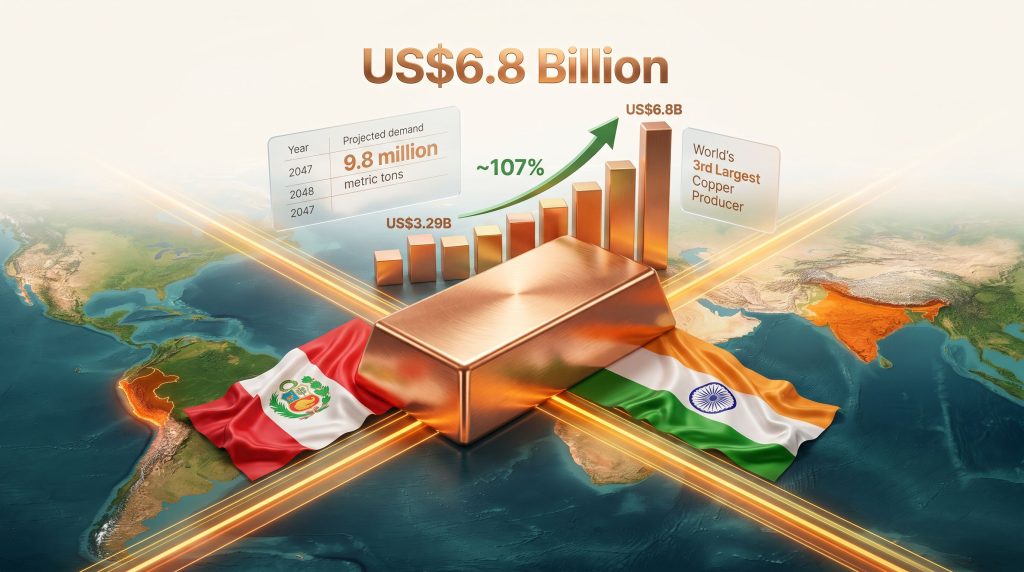
| Total Bilateral Trade | ~US$3.29 billion | ~US$6.8 billion | +107% |
| India Exports to Peru | ~US$1.16 billion | ~US$1.0 billion | Broadly stable |
| India Imports from Peru | ~US$2.13 billion | ~US$4.98 billion | +134% |
The composition of this growth tells an important story. India's exports to Peru have remained relatively flat, while India's imports from Peru have more than doubled in two years. This growing imbalance reflects the surge in Indian mineral procurement from Peru, and it creates a structural logic for the FTA.
India needs the agreement to generate preferential access for its manufactured exports, which can begin to rebalance a trade relationship currently dominated by one-directional mineral flows. Peru, meanwhile, benefits from formalising the relationship through an FTA framework that provides greater supply chain predictability, investor certainty, and access to Indian manufactured goods. According to Gateway House analysis, Peru is increasingly regarded as India's most significant new billion-dollar trade partner in Latin America.
The next major ASX story will hit our subscribers first
Corporate Engagement: Private Sector Signals Ahead of Signing
A notable indicator of how seriously both sides regard the prospect of a concluded agreement is the private sector engagement already underway. Hindalco Industries, one of India's largest integrated aluminium and copper companies and a key subsidiary of the Aditya Birla Group, was confirmed by Ambassador Paulinich in May 2026 to be in active copper procurement negotiations with Peruvian counterparts, according to Reuters.
This kind of corporate-level engagement is analytically significant for several reasons. Companies allocate commercial negotiation resources based on probability-weighted expectations of success. The fact that Hindalco is committing to Peruvian copper procurement discussions ahead of formal FTA conclusion suggests that private sector assessment of deal completion probability is high.
Corporate procurement often precedes and reinforces government trade frameworks, creating commercial realities that make formal trade agreements politically easier to conclude and ratify. For Hindalco specifically, securing Peruvian copper supply would diversify its raw material sourcing away from existing supply corridors and reduce exposure to geopolitical concentration risk, a concern that has grown as competition for copper concentrate intensifies globally.
India's Broader Latin America Trade Architecture
The India Peru free trade pact does not exist in isolation. India is simultaneously pursuing a Comprehensive Economic Partnership Agreement with Chile, another South American nation with significant mineral endowments, particularly in lithium and copper. At least three rounds of India-Chile CEPA negotiations have concluded.
| Region | Key Agreement | Strategic Focus |
|---|---|---|
| Latin America (Peru) | FTA, Round 10 complete | Copper, critical minerals |
| Latin America (Chile) | CEPA, multiple rounds complete | Lithium, agriculture |
| Southeast Asia | ASEAN FTA under review | Manufacturing, technology |
| Middle East (UAE) | CEPA signed 2022 | Energy, trade hub access |
Peru ranks as India's third-largest trade partner in the Latin American and Caribbean region, behind Brazil and Mexico by most estimates. If concluded, the agreement would become India's most significant bilateral agreement with a Latin American mineral producer and could serve as a template for structuring subsequent agreements across the region.
The China Factor and Supply Chain Geopolitics
Any analysis of India's copper sourcing strategy that ignores China's role in global copper processing would be incomplete. China currently dominates global copper smelting and refining capacity, processing a substantial share of global copper concentrate output even when that concentrate originates in countries like Peru or Chile. This creates an indirect dependency for copper-importing nations.
For India, which is actively seeking to reduce strategic dependencies on Chinese industrial capacity across multiple sectors, securing not just copper supply but copper processing capability independent of Chinese intermediation represents a distinct policy objective. A deepened India-Peru trade relationship that includes investment provisions for processing infrastructure could theoretically address this, though no specific provisions of this nature have been publicly confirmed in current negotiations.
What Could Delay a Conclusion
Despite the accelerated pace of recent negotiations, several structural obstacles could extend the timeline beyond 2026. The critical minerals chapter, while strategically important, introduces technical complexity that standard goods negotiations do not encounter. Domestic political considerations in both countries, including Peru's historically complex relationship between central government and mining-affected communities, could influence the scope of concessions on the Peruvian side.
Rules of origin disputes remain among the most historically persistent barriers to FTA completion across India's bilateral negotiation history. India has a track record of extended negotiations across multiple agreement types, and the pace of acceleration seen through 2025 and early 2026 is not guaranteed to be maintained through final text agreement and ratification.
Key Signals to Watch as June 2026 Talks Approach
For those tracking the India Peru free trade pact, the following indicators will be most informative in assessing progress toward a concluded agreement:
- Whether the June 2026 round publicly confirms a framework agreement on the critical minerals chapter
- Evidence of tariff concession exchange across pharmaceutical, automotive, and textile goods chapters
- Additional corporate-level procurement agreements beyond Hindalco that signal private sector confidence
- Parallel developments in India-Chile CEPA talks that may accelerate or constrain the regional template
- Any public statements from India's Ministry of Commerce and Industry confirming negotiation status
- Peru's domestic political environment and its implications for mining sector export commitments
The structural forces driving both parties toward conclusion are substantial: India's copper deficit is not a policy choice but a geological and industrial reality, and Peru's production capacity represents one of the most logical answers to that reality available within the current global supply landscape. Consequently, the commercial and diplomatic momentum currently surrounding this agreement is arguably stronger than at any previous point in the negotiation's history.
This article contains forward-looking projections based on government policy documents and diplomatic statements reported by Reuters as of May 2026. Readers should be aware that trade negotiation timelines, commodity demand forecasts, and corporate procurement outcomes involve inherent uncertainty and are subject to change based on political, economic, and geological factors beyond current visibility.
Want to Identify ASX Copper Discoveries Before the Market Catches On?
As India's copper import requirements are projected to grow more than sevenfold by 2047, the structural demand pressures reshaping global supply chains make early identification of significant copper discoveries more critical than ever — Discovery Alert's proprietary Discovery IQ model delivers real-time ASX mineral discovery alerts, instantly turning complex data across 30-plus commodities into actionable insights, so subscribers can position themselves ahead of the broader market. Explore how historic mineral discoveries have generated exceptional returns and begin your 14-day free trial today to secure a market-leading advantage.

