May 23, 2026
Why India-Russia Energy Cooperation Has Grown Into Something Far Bigger Than Oil
Global energy markets operate in cycles, and few episodes in recent history have reshaped trade flows as dramatically as the post-2022 sanctions environment. When Western nations moved to isolate Russia's energy economy following the invasion of Ukraine, the expectation in some quarters was that Moscow would face a debilitating revenue squeeze. What emerged instead was a significant rerouting of hydrocarbon flows toward price-sensitive, non-aligned economies, with India sitting at the centre of that shift.
What began as an opportunistic trade relationship anchored in discounted crude has since evolved into something considerably more complex. India-Russia energy cooperation now spans upstream equity stakes, downstream refinery ownership, civil nuclear infrastructure, and active negotiations on gas distribution, LPG procurement, and petrochemical facility development. Understanding this architecture requires moving well beyond the headline crude oil figures.
When big ASX news breaks, our subscribers know first
Russia's Share of India's Energy Supply: The Numbers Behind the Shift
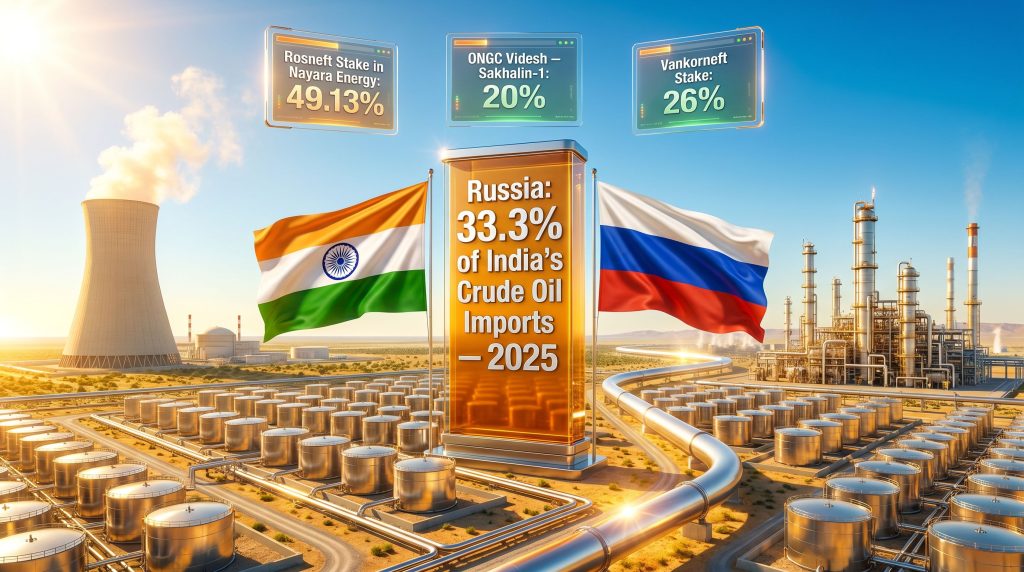
The scale of the transformation in India's crude import profile over just a few years is striking. Before 2022, Russian crude accounted for less than 1% of India's total oil imports. By 2025, that figure had reached 33.3%, cementing Russia's position as India's single largest crude oil supplier by a considerable margin.
The trajectory of this growth is equally revealing:
| Year | Russia's Share of India's Crude Imports |
|---|---|
| Pre-2022 | Less than 1% |
| 2022-23 | 21.6% |
| 2023-24 | 35.9% |
| 2024-25 | 35.8% |
| 2025 | 33.3% |
This rapid consolidation of market share reflects a convergence of commercial logic and strategic positioning. Russia offered substantially discounted crude to secure alternative buyers, while India, as a large non-aligned energy importer with significant refining capacity, was well-placed to absorb those volumes while improving its own energy cost structure. Furthermore, the broader dynamics of oil trade geopolitics have played a decisive role in shaping how these flows have been structured.
The downstream dimension is equally significant. Russian energy major Rosneft holds a 49.13% stake in Nayara Energy, which operates a refinery at Vadinar in Gujarat with a processing capacity of 20 million tonnes per year. This makes Russia not just a raw material supplier but an equity participant in India's refining infrastructure. On the upstream side, ONGC Videsh holds a 20% participating interest in Sakhalin-1 and a 26% stake in Vankorneft, both located in Russia, meaning the investment relationship runs in both directions.
As former foreign secretary and Rajya Sabha member Harsh Vardhan Shringla noted at a recent gathering organised by the Indo-Russia Innopratika Technology Hub, the bilateral energy relationship encompasses investment, equity participation, refining capacity, and physical infrastructure, not simply the transfer of barrels from one country to another.
The Four Pillars of Expanded India-Russia Energy Cooperation
Pillar 1: Natural Gas, LNG, and Urban Distribution Infrastructure
One of the less-discussed but commercially significant areas of expanding India-Russia energy cooperation involves natural gas. Active high-level discussions are underway on the supply of Russian gas to Indian cities, with particular emphasis on expanding compressed natural gas (CNG) filling station networks as a near-term infrastructure priority.
High-level talks have also taken place on LPG procurement from Russia, a market segment where India's import requirements are substantial. For India, diversifying its gas supply base offers a dual benefit: reducing dependence on any single source region and supporting its longer-term energy transition goals by expanding cleaner-burning fuel penetration across urban centres.
India's current LNG import mix is dominated by Qatar, Australia, and the United States. However, India LNG import taxes remain a structural factor shaping procurement decisions, and the addition of Russian pipeline-adjacent or liquefied gas supply would represent a meaningful diversification. The absence of direct pipeline connectivity between the two countries remains a structural constraint that would likely require LNG infrastructure investment to bridge.
Pillar 2: Upstream Hydrocarbon Development and Joint Ventures
The existing upstream equity positions held by ONGC Videsh in Russian fields provide a working template for a deeper co-investment model. Both governments are now exploring new joint venture frameworks for hydrocarbon field development within India, with reports indicating particular interest in exploring assets in India's eastern regions.
This shift from a buyer-seller dynamic to a co-investor relationship fundamentally changes the strategic calculus. When both parties hold equity in each other's production infrastructure, the incentive to maintain stable, long-term supply relationships increases significantly. Disruptions become costly for both sides rather than just one.
The Indo-Russia Innopratika Technology Hub, which works closely with Niti Aayog, has been identified as a coordination mechanism for facilitating joint project development across these upstream and technology-oriented initiatives.
Pillar 3: Refining, Petrochemicals, and Downstream Investment
The Rosneft-Nayara Energy relationship at Vadinar already represents one of the most integrated examples of India-Russia energy cooperation in the downstream sector. The refinery's 20 million tonne per year capacity makes it one of India's largest single-site processing facilities, and its configuration is optimised to handle the heavier crude grades that characterise a significant portion of Russian export barrels.
Beyond the existing refinery footprint, new petrochemical facility development is now on the agenda as a value-addition priority. Rather than simply refining crude into transportation fuels for domestic consumption or export, both sides are exploring whether India's refining infrastructure can serve as a foundation for a more sophisticated petrochemical manufacturing base, moving further up the value chain.
A less commonly discussed dimension of this arrangement is the indirect role India has played in redistributing Russian energy products to third markets. Discounted Russian crude processed at Indian refineries has contributed to petroleum product exports that, in some documented cases, have flowed toward European markets, creating a complex triangulation that has drawn attention from Western policymakers.
Pillar 4: Civil Nuclear Energy and the Long-Term Technology Dimension
Civil nuclear cooperation may be the most strategically consequential and least commercially visible dimension of the relationship. The Kudankulam Nuclear Power Project in Tamil Nadu is, as Shringla highlighted, India's only nuclear power facility developed in partnership with a foreign nation. It uses Russian reactor technology and has provided India with operational experience in managing large-scale nuclear infrastructure.
What makes this particularly relevant to India's future energy planning is the applicability of Russian reactor designs to small modular reactors (SMRs), which are increasingly viewed globally as a viable pathway to scalable, low-carbon baseload power generation. In addition, broader Russia nuclear partnerships across the developing world demonstrate Moscow's strategic intent to leverage nuclear technology as a long-term diplomatic and commercial instrument.
The recently enacted Sustainable Harnessing and Advancement of Nuclear Energy for Transforming India (SHANTI) Act creates a more permissive regulatory environment for civil nuclear partnerships, potentially accelerating joint project development timelines and enabling a broader range of foreign technology partners to participate in India's nuclear expansion programme.
Geopolitical Architecture: Sanctions, Waivers, and Strategic Non-Alignment
India's ability to sustain and deepen its energy relationship with Russia has been partly enabled by the US decision to extend sanctions waivers on Russian oil exports to India. This has provided a legal and commercial framework within which Indian refiners can continue purchasing Russian crude without triggering secondary sanctions consequences.
India's broader strategic posture of non-alignment gives it a form of geopolitical flexibility that most major economies cannot easily exercise. As analysis from the Council on Foreign Relations on India-US relations and the Russia energy question notes, India's position as a large non-aligned buyer creates leverage in multiple directions simultaneously, allowing New Delhi to maintain productive relationships with both sanctioning and sanctioned parties. The evolving dynamics around sanctions and oil trade more broadly illustrate just how commercially and diplomatically consequential these policy decisions can be.
A key structural tension persists within the financial architecture of the relationship. Despite both governments expressing interest in local currency settlement mechanisms, the rupee-rouble arrangement has faced persistent practical limitations. Russia runs a significant trade surplus with India, meaning accumulated rouble balances have limited utility for Moscow. This structural imbalance has pushed actual settlements toward third-currency arrangements, frequently involving euros or UAE dirhams, with dollar-linked transactions remaining a practical reality despite broader de-dollarisation rhetoric.
India-Russia Energy Cooperation vs. Other Key Supply Relationships
| Dimension | Russia | Middle East (UAE, Saudi Arabia) | United States | Qatar |
|---|---|---|---|---|
| Crude oil share (2025) | ~33-36% | Significant | Growing | Primarily LNG |
| Price competitiveness | High (discounted) | Market-linked | Premium | LNG contract-based |
| Upstream equity presence | Yes (Sakhalin-1, Vankorneft) | Limited | Limited | Limited |
| Downstream investment | Yes (Nayara Energy/Rosneft) | Emerging | Limited | Limited |
| Nuclear cooperation | Yes (Kudankulam) | No | No | No |
| Payment complexity | High (sanctions friction) | Low | Low | Low |
| Strategic alignment risk | Geopolitical sensitivity | Moderate | Diplomatic pressure | Low |
Russia's combination of discounted crude pricing, existing upstream equity positions, and downstream ownership makes it structurally distinct from India's other major supply relationships. No other single country partner offers the same breadth of integration across the energy value chain, though that integration also carries concentrated geopolitical risk.
Beyond Energy: Agricultural Trade and Technology Cooperation
Russia's growing role in India's supply chains extends beyond hydrocarbons. According to information shared at the Indo-Russia Innopratika Technology Hub meeting, Russia now supplies 51% of India's sunflower oil imports, 25% of its fertiliser imports, and 10% of its bean imports. Furthermore, fertiliser import reliance is a strategic vulnerability that multiple large economies are now actively working to address, and India's diversification toward Russian supply represents one response to that challenge.
Joint ventures are actively being established in the agricultural sector, creating a diversified trade architecture that reinforces the resilience of the overall bilateral relationship. On the technology front, India has approved 10 semiconductor projects with combined envisaged investment of approximately USD 19.16 billion, and early-stage discussions around AI cooperation between the two countries have been initiated. These emerging dimensions, while less mature than the energy relationship, signal an intent to broaden cooperation across multiple strategic sectors simultaneously.
The next major ASX story will hit our subscribers first
Structural Risks and Constraints
Dependency Concentration and Sanctions Escalation
Russia now accounts for more than a third of India's crude oil imports. While this concentration has delivered near-term cost benefits, it also creates vulnerability. A sudden disruption to Russian crude supply, whether from sanctions escalation, logistical constraints, or geopolitical shifts, would require India to source significant volumes from alternative suppliers at potentially higher cost and with compressed lead times.
The sanctions escalation scenario is particularly relevant. A tightening of US or EU restrictions targeting Indian entities that transact with sanctioned Russian counterparties could place Indian refiners in a difficult commercial and legal position, particularly those with the deepest integration into Russian supply chains.
Infrastructure Gaps and Logistics Dependencies
Unlike India's relationships with Gulf producers, the India-Russia energy corridor has no direct pipeline infrastructure. All Russian crude delivered to India travels by sea, creating dependency on specific shipping routes and the availability of vessels willing to operate within the constraints of the sanctions environment.
The so-called shadow fleet of tankers that has emerged to service this trade represents a logistical workaround rather than a robust infrastructure solution. As Gateway House analysis on India-Russia energy and economic security highlights, expanded LNG and LPG imports from Russia would require dedicated terminal infrastructure on the Indian side, adding capital expenditure requirements and planning timelines to an otherwise commercially attractive supply opportunity.
The Strategic Outlook: Key Questions for the Years Ahead
Near-term priorities likely to progress within the next 12 to 24 months include:
- Finalisation of LPG supply agreements currently under high-level negotiation
- Expansion of CNG infrastructure in Indian cities supported by Russian gas
- Progress on new hydrocarbon joint ventures in eastern India
- Continuation of crude supply under existing sanctions waiver arrangements
Medium-term development vectors over three to five years include:
- Scaling of civil nuclear cooperation under the SHANTI Act framework
- Feasibility studies and potential technology transfer arrangements for SMR deployment
- Investment decisions on new petrochemical facilities linked to the Vadinar refinery complex
- Agricultural joint venture expansion as a complementary trade layer
Long-term structural questions that will shape the ultimate trajectory of the partnership include:
- Whether a functional bilateral payment mechanism can be built at scale that avoids third-currency dependence
- How US sanctions policy evolves and what flexibility India retains in maintaining Russian energy ties
- How India manages the balance between its Russian energy dependency and its strategic relationships with Western nations and Gulf producers
- Whether Russian SMR and nuclear technology becomes a meaningful contributor to India's long-term clean energy baseload strategy
Disclaimer: This article contains forward-looking analysis and projections based on publicly available information and reported discussions. Geopolitical developments, sanctions policy changes, and market conditions can change materially and rapidly. Nothing in this article should be construed as investment advice. Readers should conduct their own due diligence and consult qualified advisers before making decisions based on any analysis contained herein.
Want To Stay Ahead of the Next Major Resource Discovery Shaping Global Energy Markets?
As energy trade routes and commodity dependencies continue to reshape the global investment landscape, Discovery Alert's proprietary Discovery IQ model delivers real-time alerts on significant ASX mineral discoveries — instantly translating complex data across 30+ commodities into clear, actionable insights. Explore historic discoveries and their market returns, or start your 14-day free trial today to position yourself ahead of the market.