August 1, 2026
When the Tanker Has Nowhere to Go: India's Calculated Stand on Sanctioned Russian LNG
The global LNG market has long operated on a fundamental tension between supply security and geopolitical risk management. Unlike crude oil, which flows through a vast network of pipelines, tankers, and intermediate storage facilities that create natural ambiguity around origin and ownership, liquefied natural gas moves through a far more transparent supply chain. Every cargo can be tracked. Every vessel leaves a satellite footprint. In an era of intensifying US sanctions enforcement, that transparency is reshaping procurement decisions at the highest levels of government, nowhere more visibly than in New Delhi.
When big ASX news breaks, our subscribers know first
The Logistics of Compliance: Why LNG Is Fundamentally Harder to Obscure
To understand why India declines Russian LNG under US sanctions while simultaneously maintaining crude oil imports from the same country, it is necessary to understand the structural difference between these two commodities from a sanctions enforcement perspective.
Crude oil is a liquid commodity that can be transferred between vessels at sea through ship-to-ship (STS) operations. A tanker carrying Russian crude can rendezvous with a second vessel in international waters, offload its cargo, and the receiving tanker can proceed to its destination with documentation that reflects only the intermediate transfer point, not the original source. This mechanism, while not foolproof, creates sufficient documentary opacity to manage compliance exposure at the importer level.
LNG, however, operates under entirely different physical constraints:
- LNG is stored at approximately minus 162 degrees Celsius in specialised cryogenic containment systems
- Transferring LNG between vessels at sea is not operationally feasible under standard conditions
- The same vessel that loads at the liquefaction terminal must deliver to the receiving terminal
- Satellite-based Automatic Identification System (AIS) data and vessel monitoring services track the complete voyage in near real-time
- Documentation suggesting non-Russian origin cannot override physical tracking data
This technical reality means that any LNG cargo originating from a sanctioned Russian facility carries an unbroken evidentiary chain from loading to discharge, regardless of what shipping documentation states.
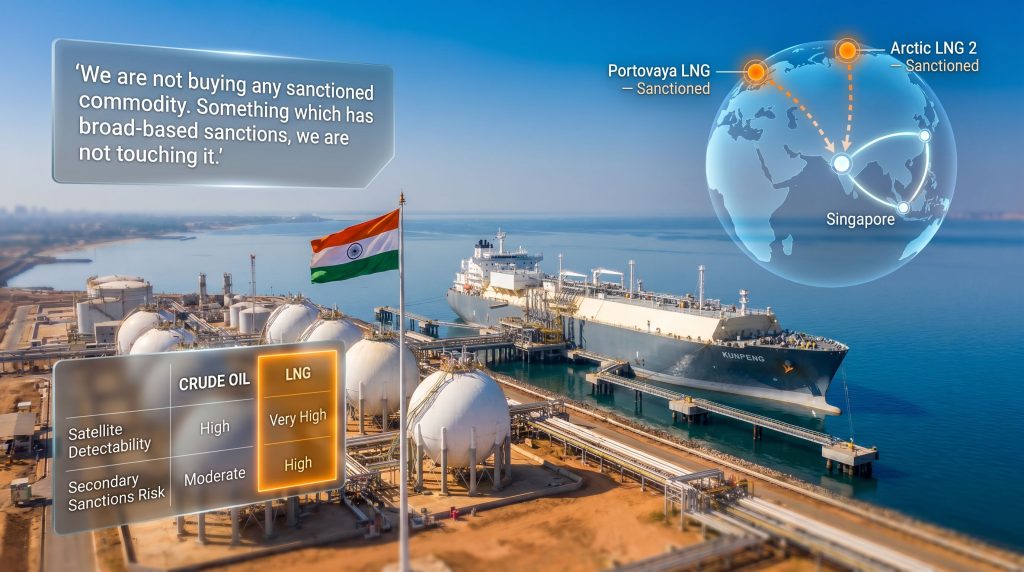
The case of the Kunpeng, a 138,200-cubic-metre LNG tanker, illustrates this dynamic precisely. Reported by Reuters on May 12, 2026, the vessel departed Russia's Portovaya plant in the Baltic Sea carrying a cargo with documentation that reportedly obscured its Russian origin. LSEG shipping data independently tracked the vessel heading toward India's Dahej LNG import terminal in western India in mid-April 2026. India declined to accept the cargo. As of May 2026, the Kunpeng was positioned near Singaporean waters with no destination broadcast, effectively stranded with a cargo that has no compliant buyer.
The Kunpeng situation is not simply a diplomatic disagreement over a single shipment. It is a proof-of-concept demonstration that satellite-based cargo tracking has made LNG sanctions enforcement structurally more effective than enforcement against crude oil, and that major importers understand this distinction.
Sanctioned Russian LNG Projects: A Comparative Overview
Two Russian LNG export facilities currently carry active US sanctions, and understanding the distinctions between them clarifies India's compliance calculus. Furthermore, the broader Russian oil sanctions impact across energy markets reinforces why India is drawing a firm line at the asset level.
| Project | Location | Sanctioned Since | Current Operational Status |
|---|---|---|---|
| Portovaya LNG | Baltic Sea, Russia | Early 2025 | Cargo rejected by India (May 2026); Kunpeng stranded |
| Arctic LNG 2 | Gydan Peninsula, Arctic Russia | November 2023 | Foreign partners withdrawn; production severely curtailed |
Arctic LNG 2 was sanctioned by the United States in November 2023 in connection with Russia's ongoing war in Ukraine. The project, originally designed to produce 19.8 million tonnes per annum across three production trains, has been significantly impaired by the withdrawal of foreign partners and equipment suppliers following sanctions designation. India's Oil Secretary publicly confirmed in May 2026 that India would not purchase supply from Arctic LNG 2, citing its sanctioned status as an absolute barrier regardless of supply need or pricing.
Portovaya LNG, sanctioned in early 2025 as part of Washington's escalating pressure on Russian energy infrastructure, is the origin point of the Kunpeng cargo. This smaller Baltic Sea facility had been attempting to find Asian buyers following European market closure, and India represented a logical target given the supply pressures created by Strait of Hormuz disruptions.
Washington stepped up sanctions on both LNG plants in early 2025, specifically over Russia's continued military campaign in Ukraine, according to Reuters reporting dated May 12, 2026.
The Strait of Hormuz Crisis: How Supply Disruption Created a Compliance Test
The geopolitical context behind India's engagement with Russian LNG offers critical insight into how supply crises generate compliance pressure. Before the conflict that disrupted Strait of Hormuz shipping beginning February 28, 2026, India's energy import architecture was heavily concentrated around a single maritime chokepoint:
- Approximately 50% of India's total gas consumption was met through LNG imports
- Around 60% of those LNG imports transited through the Strait of Hormuz
- More than half of India's crude oil supply also moved through the same waterway
When conflict disrupted Strait transit, India faced simultaneous pressure on both its gas and crude supply chains. The resulting shortfall created urgency that Russia moved quickly to exploit. Russia's Deputy Energy Minister Pavel Sorokin visited India on April 30, 2026, his second such visit within approximately two months, meeting with Indian officials including Oil Minister Hardeep Singh Puri. A third visit was anticipated as early as June 2026, reflecting the pace of diplomatic engagement.
The discussions extended well beyond LNG. Russia was simultaneously pursuing long-term supply agreements covering fertilisers, specifically potash, phosphorus, and urea, reflecting a broader commodities diplomacy strategy designed to deepen bilateral trade interdependence across multiple sectors. This bundled approach suggests Moscow was attempting to make the overall trade relationship sufficiently valuable that compliance concerns around LNG would be overridden by aggregate economic incentives.
They were not. India conveyed its decision not to purchase sanctioned LNG directly to Sorokin during his April 30 visit, according to two sources with direct knowledge cited by Reuters.
The macroeconomic severity of the supply disruption was visible in Prime Minister Narendra Modi's public statement in May 2026, which urged citizens to conserve fuel, work from home where possible, limit foreign travel, and reduce imports of gold and edible oil. Such conservation messaging at the prime ministerial level reflects supply-side pressure significant enough to warrant economy-wide behavioural responses.
India's Dual-Track Energy Policy: Different Rules for Different Commodities
India's refusal of sanctioned Russian LNG exists alongside continued, uninterrupted purchases of Russian crude oil. This apparent contradiction resolves clearly once the compliance architecture is understood. In addition, considering the global LNG supply outlook for 2025 and beyond, India's cautious procurement posture reflects a longer-term strategic calculation rather than a short-term reaction.
As the world's third-largest oil importer and consumer, and the largest buyer of Russian seaborne crude, India has significant strategic and economic reasons to maintain Russian crude relationships. These purchases have continued during 2026, supported by a temporary US sanctions waiver introduced in response to the energy crisis generated by the Iran conflict. However, US Treasury Secretary Scott Bessent confirmed that no extension of these waivers would be granted beyond the initial waiver period. During that window, India imported approximately 30 million barrels of Russian and Iranian crude, according to Reuters.
The compliance asymmetry between crude and LNG is not merely political preference but reflects measurable risk differentials:
| Compliance Factor | Crude Oil | Sanctioned LNG |
|---|---|---|
| Physical concealment | Feasible via STS transfers | Not operationally feasible |
| Satellite traceability | Moderate | High |
| Documentation opacity | Achievable | Contradicted by physical tracking |
| Secondary sanctions exposure | Manageable | Elevated |
| India's current policy position | Continuing (with waiver) | Refusing sanctioned cargoes |
| Banking and trade finance risk | Lower | Higher |
Even within crude oil, India has implemented asset-level compliance thresholds. Indian refiners have ceased accepting Russian crude carried by US-sanctioned Sovcomflot tankers, establishing that India's compliance boundary is drawn around specific sanctioned assets rather than at the country level. This is a legally sophisticated distinction: India is not boycotting Russia as a trade partner; it is refusing transactions involving facilities and vessels specifically designated under US sanctions.
India's stated procurement philosophy, as articulated by its Oil Secretary, focuses on sourcing from the most cost-effective supplier that does not carry sanctions exposure. This framing preserves strategic flexibility while creating a clear compliance threshold that applies consistently regardless of supply pressure.
The Structural Limits of Russia's Asian LNG Pivot
Russia has been attempting to redirect LNG exports toward Asian markets since European buyers began reducing Russian energy purchases following the 2022 Ukraine invasion. However, India's refusal of sanctioned cargoes exposes several structural constraints on this pivot strategy. Consequently, the trade war implications between major powers are further complicating the realignment of global energy flows.
Volume availability: Most authorised, unsanctioned Russian LNG volumes are already committed to European buyers under long-term contracts. The spot volumes available for redirection to India are therefore limited, meaning Russia cannot simply substitute Asian demand for European demand on a large scale.
China's role: China currently absorbs the largest share of both sanctioned and unsanctioned Russian LNG, according to Reuters reporting. This concentration means that China has become Russia's primary Asian LNG market by default, and its appetite is finite. India represents a significant potential market, but only for compliant volumes that do not currently exist in sufficient free quantities.
Detection constraints: The satellite tracking reality that applies to the Kunpeng applies universally to Russian LNG exports. Russia cannot route sanctioned LNG to major institutional buyers in India, Japan, or South Korea without creating traceable compliance exposure that those buyers will not accept.
Scenario analysis for stranded volumes:
| Scenario | Assessment | Likely Outcome |
|---|---|---|
| India accepts sanctioned Kunpeng cargo | Very low probability | Secondary sanctions risk to banking and finance sector |
| India purchases unsanctioned Russian LNG | Moderate, if volumes freed from Europe | Feasible but constrained by contract commitments |
| India accelerates US or Qatari LNG contracts | Moderate to high probability | Higher cost, zero sanctions exposure |
| Kunpeng redirects cargo to China | High probability | Most likely near-term resolution for stranded tanker |
Disclaimer: The scenario probabilities above represent analytical assessments based on publicly reported information and should not be construed as investment advice or definitive forecasts. Energy market outcomes are subject to rapid change based on geopolitical developments, regulatory actions, and commercial negotiations.
The next major ASX story will hit our subscribers first
India's Energy Security Architecture Requires Structural Rethinking
The 2026 supply disruption has exposed a concentration risk in India's import infrastructure that predates the current crisis. A country sourcing 60% of its LNG imports and more than half of its crude supply through a single maritime chokepoint has built structural vulnerability into its energy security framework.
The current situation is pushing India toward supply diversification pathways that each carry distinct trade-offs:
- US LNG: Maximum sanctions safety, but carries price premiums over spot Russian volumes and requires long-term contract commitments
- Qatari LNG: Historically a major Indian supplier, but faces Strait of Hormuz transit constraints that remain relevant during regional conflict periods
- Australian LNG: Provides geographic diversification away from Middle Eastern transit routes, but requires contract renegotiation and higher shipping costs
- Authorised Russian LNG: Compliant if sourced from non-sanctioned facilities, but volume availability is constrained by European contract commitments
The crisis is accelerating India's evaluation of supply contracts outside both Russian and Middle Eastern corridors, a diversification imperative that may structurally reduce India's dependence on the Strait of Hormuz over the medium term. Furthermore, the India LNG import taxes framework will play a meaningful role in shaping which alternative supply sources become commercially viable for Indian buyers.
A particularly underappreciated dimension of India's compliance posture is its precedent-setting character. India's earlier decision to halt crude imports carried by US-sanctioned Venezuelan tankers, a pattern consistent with the broader Venezuela sanctions policy shifts in Washington, established an asset-level compliance approach that has now extended to Russian LNG. This consistency demonstrates that India's sanctions compliance framework operates on enforceable principles rather than case-by-case political judgments, creating predictability for Western trading partners while preserving India's relationship with Russia on non-sanctioned commodity flows.
India's refusal of sanctioned Russian LNG, even under acute supply pressure, signals a meaningful evolution in New Delhi's sanctions exposure calibration. The country is not pivoting away from Russia as a trade partner. It is demonstrating that it understands, and will enforce, the technical compliance boundary between sanctioned and non-sanctioned Russian assets.
Frequently Asked Questions
Why does India decline Russian LNG under US sanctions but continue buying Russian crude oil?
The physical logistics of LNG make sanctions enforcement far more effective than for crude oil. Crude cargoes can be transferred between vessels at sea to obscure origin, while LNG cannot be transferred in transit due to cryogenic storage requirements. This means every LNG cargo carries a traceable link from loading terminal to discharge port via satellite monitoring, making the compliance and secondary sanctions risk attached to sanctioned LNG materially higher than for crude oil.
What is the difference between primary and secondary sanctions in this context?
Primary US sanctions directly prohibit designated entities from certain transactions. Secondary sanctions extend consequences to third-party entities, including non-US companies, banks, and importers that transact with sanctioned entities. For India, the secondary sanctions risk means that accepting a sanctioned LNG cargo could expose Indian financial institutions, shipping companies, and state-owned enterprises to restrictions on their access to US-aligned banking systems, trade finance, and insurance, creating operational disruptions well beyond the energy transaction itself.
What is the current status of the Kunpeng tanker?
As of May 2026, the Kunpeng, a 138,200-cubic-metre LNG vessel, was positioned near Singaporean waters with no declared destination, according to LSEG shipping data reported by Reuters. The vessel had been tracked heading toward India's Dahej terminal in mid-April 2026 with cargo from the sanctioned Portovaya plant before India declines Russian LNG under US sanctions became the definitive outcome of those negotiations.
Is India open to purchasing any Russian LNG?
According to sources cited by Reuters, India has indicated willingness to purchase authorised, unsanctioned Russian LNG volumes. However, most of those volumes are currently contracted to European buyers, leaving limited availability for Indian importers in the near term.
How has the Strait of Hormuz disruption affected India's energy supply?
Prior to the February 28, 2026 conflict disruption, India sourced approximately 50% of its gas consumption through LNG imports, with around 60% of those imports transiting the Strait of Hormuz. More than half of India's crude supply also moved through the same waterway. The disruption created simultaneous pressure on both supply chains, prompting exploration of alternative sources including Russian LNG.
Key Takeaways
- India's decision to decline sanctioned Russian LNG reflects a deliberate compliance strategy applied consistently across asset-level sanctions, not a broader geopolitical realignment away from Russia
- The physical impossibility of LNG ship-to-ship transfers creates fundamentally higher sanctions detectability compared to crude oil, driving India's differential treatment of the two commodities
- Russia's LNG pivot to Asia faces structural constraints: limited unsanctioned spot volumes, China's dominant absorption of available supply, and satellite tracking that prevents major institutional buyers from accepting sanctioned cargoes
- The Kunpeng tanker case is a precise illustration of these dynamics — a vessel that could not discharge despite documentation efforts because physical tracking contradicted its paperwork
- India's Strait of Hormuz concentration risk is now a live policy problem, and the crisis is accelerating evaluation of supply diversification across US, Australian, and non-Middle Eastern LNG corridors
- The waiver period for Russian crude oil purchases has a defined end point, with US Treasury confirming no extensions, creating a separate compliance pressure point that will require further navigation
This article is based on reporting by Reuters published via ET EnergyWorld on May 12, 2026. All figures, dates, and source attributions reflect information available at time of publication. This content is intended for informational purposes only and does not constitute investment, financial, or legal advice. Energy market conditions and sanctions frameworks are subject to change.
Want to Stay Ahead of the Next Major Resource Discovery Reshaping Global Markets?
While energy geopolitics continues to redraw commodity trade flows, Discovery Alert's proprietary Discovery IQ model scans ASX announcements in real time, instantly identifying significant mineral discoveries across more than 30 commodities and translating complex data into actionable investment insights — start your 14-day free trial today and see why historic discoveries have delivered extraordinary returns.