
May 13, 2026
When Sanctions Architecture Collides With Energy Market Reality
Global oil markets have always operated at the intersection of economics and geopolitics, but rarely do those forces converge as visibly as they do today. The India Russian oil imports waiver debate offers a case study in how rapidly geopolitical shocks can override even the most deliberate sanctions frameworks. What began as a US policy instrument designed to pressure Moscow over Ukraine has, within months, been bent by the gravitational pull of a separate and more acute conflict, forcing Washington into uncomfortable compromises that reveal the structural limits of using energy sanctions as foreign policy tools.
When big ASX news breaks, our subscribers know first
India's Energy Position and Why It Makes This Moment Consequential
India occupies a unique position in the global oil market as the world's third-largest crude importer, a status that gives its procurement decisions outsized influence on Asian and global price benchmarks. The country's refining sector, anchored by large state-owned processors, requires a continuous and diverse supply of crude grades to maintain throughput. Any sudden disruption to established supply channels creates both economic and political pressure to find alternatives quickly.
The current crude oil prices debate sits at the centre of this pressure. It is not merely a bilateral US-India diplomatic issue. It is a live experiment in whether Washington can simultaneously maintain credible sanctions pressure on Moscow while managing the inflationary consequences of a separate war that has choked off the Persian Gulf's most critical shipping artery.
Why Does India's Procurement Strategy Matter Globally?
India's procurement choices ripple outward across Asian benchmark pricing, tanker routing decisions, and the broader effectiveness of sanctions regimes. Consequently, what happens with the India Russian oil imports waiver affects markets far beyond the subcontinent. Understanding the geopolitical oil market factors at play is therefore essential for any serious market observer.
What the Waiver Is and How It Came to Exist
The waiver in question is a temporary exemption issued by the US Treasury Department that permits Indian refiners to purchase Russian crude oil without triggering secondary sanctions penalties. These secondary sanctions, which were introduced as part of Washington's broader economic pressure campaign against Moscow following Russia's invasion of Ukraine, are designed to discourage third-party nations from facilitating Russian oil revenues.
The sequence of events that produced the waiver is directly traceable to the Iran war, which began in February 2026 and rapidly escalated into a conflict that caused the near-total closure of crude flows through the Strait of Hormuz. That waterway serves as a transit corridor for close to half of India's total crude oil and gas imports. When Hormuz effectively shut down, India faced an acute and immediate supply gap that required a structural response, not just a short-term patch.
The timeline of the waiver's evolution is as follows:
| Date | Development |
|---|---|
| February 2026 | Iran war begins; Strait of Hormuz near-total closure disrupts Persian Gulf flows |
| March 5, 2026 | US issues India-specific waiver for stranded Russian cargoes |
| ~March 12, 2026 | Waiver broadened to a global relaxation covering all buyers |
| May 3, 2026 | US Treasury issues one-month extension |
| May 16, 2026 | Current expiry deadline for the waiver |
The initial India-specific measure was designed to allow refiners to absorb so-called stranded cargoes: Russian oil already loaded onto tankers and at sea, which could not find buyers due to secondary sanctions restrictions. Within a week, Washington recognised that the problem extended beyond India and broadened the relaxation globally.
The waiver's transformation from a targeted India-specific measure to a global relaxation within seven days reveals just how quickly a localised supply disruption can destabilise an entire sanctions framework.
The Strait of Hormuz Factor and the Record Import Surge
The Iran war's impact on India's crude supply chain cannot be overstated. The near-total closure of Hormuz did not merely inconvenience refiners; it created a structural vacuum in supply that required immediate redirection of global crude flows. Russian crude, already available at a discount to Brent crude benchmarks due to the existing Russian oil sanctions impact, was uniquely positioned to fill that vacuum.
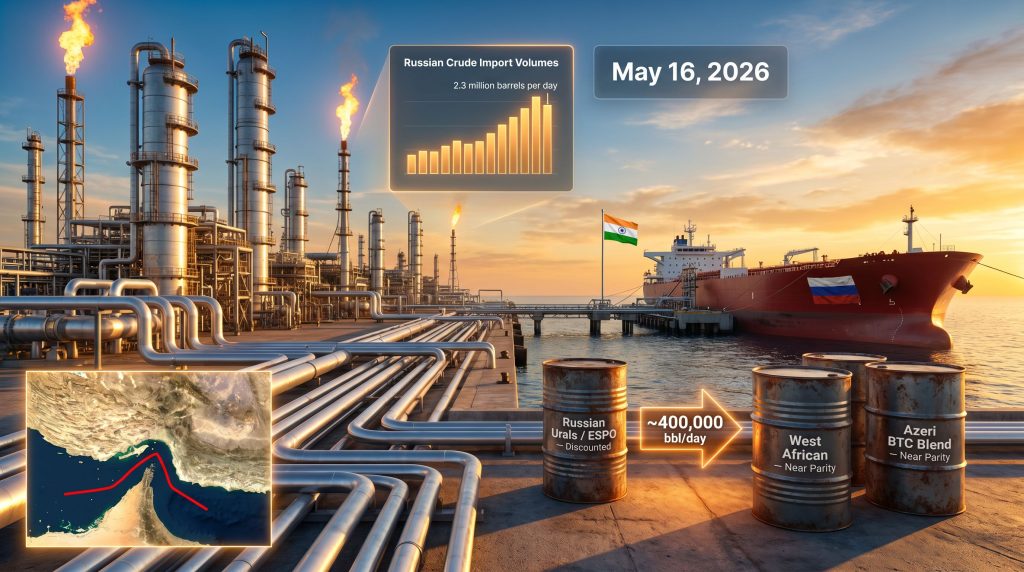
The response in import volumes was dramatic. According to Kpler shipping data, India's Russian crude imports reached a record 2.3 million barrels per day in early May 2026, a figure that reflects both the availability of Russian barrels and the economic logic of sourcing discounted crude during a period of broader market price pressure.
To understand the scale of this shift, consider the following volume projections:
| Period | Russian Crude Import Volume |
|---|---|
| Early May 2026 (record, Kpler data) | 2.3 million barrels per day |
| Projected full-month May if waiver lapses | ~1.9 million barrels per day |
| Potential volume loss | ~400,000 barrels per day |
The tanker dynamics behind this surge are also notable. As Chinese crude demand moderated during the same period, vessels that had been committed to Chinese destinations became available for redeployment. Combined with the stranded cargo situation created by sanctions uncertainty, the spot market was able to absorb a substantial reorientation of Russian crude flows toward Indian destinations in a relatively short timeframe.
This reflects a technical feature of the crude tanker market: vessel repositioning can occur within weeks, not months, particularly when price arbitrage is sufficiently attractive. Furthermore, the broader trade war and oil prices dynamic has only amplified these logistical pressures across Asian markets.
Three Scenarios for What Happens After May 16
The absence of any US clarification regarding whether the waiver will be extended beyond May 16 has left Indian refiners in a planning vacuum. Depending on Washington's decision, three distinct market outcomes are possible.
Scenario 1: Waiver Is Extended
- Russian crude flows into India maintain near-record levels approaching 2.3 million barrels per day
- Indian refiners avoid the cost premium associated with spot market purchases from West Africa and the United States
- Price stability in India's downstream processing sector is preserved, reducing inflationary pressure on petroleum products
Scenario 2: Waiver Lapses Without Renewal
- Russian import volumes potentially decline from 2.3 million to approximately 1.9 million barrels per day
- State refiners are forced to source alternative prompt cargoes at spot market prices, carrying a premium over Russian discounted crude
- The approximately 400,000 barrel-per-day supply gap entering spot markets creates upward pressure on Brent, Dubai, and Oman crude benchmarks
- Short-term supply agreements for Azeri and West African grades become operationally critical
Scenario 3: Conditional Extension With Restrictions
- Waiver renewed with volume caps or destination-of-use restrictions
- India accelerates structural diversification of its crude basket, reducing dependency on both Russian and Gulf supplies
- Longer-term procurement architecture shifts as refiners lock in multi-month agreements with alternative suppliers
According to reporting from S&P Global, India's Russian crude imports were already set to rise following the most recent waiver extension, underscoring how quickly market participants respond to even temporary policy signals.
A 400,000 barrel-per-day displacement into spot markets is not trivial. Historical analysis of similar-scale supply disruptions suggests such volumes are capable of moving Asian crude benchmarks by several dollars per barrel, depending on refinery utilisation rates and inventory levels at the time.
Note: Forward-looking projections and scenario analyses carry inherent uncertainty. Market outcomes depend on multiple interacting variables including OPEC policy, tanker routing decisions, and US diplomatic developments that cannot be predicted with certainty.
India's Refiners Are Already Hedging Against the Worst Case
Well ahead of the May 16 deadline, India's two largest state-owned refiners have not been passive observers. Both Indian Oil Corporation (IOC) and Bharat Petroleum Corporation (BPCL) began purchasing prompt crude cargoes from West Africa and the United States in the week of May 13, 2026, according to market participants familiar with the transactions. These are so-called prompt loadings, meaning the barrels are scheduled to load and arrive in India within the current calendar month.
BPCL has taken a further step by exploring short-term supply agreements for Azerbaijani BTC Blend and African crude grades, reflecting a deliberate effort to reduce the refiner's structural dependency on Persian Gulf supply channels that have been destabilised by the Hormuz closure. However, the cost implications of this diversification are significant and often underappreciated:
| Crude Source | Price vs. Brent Benchmark | Refinery Compatibility | Procurement Route |
|---|---|---|---|
| Russian Urals / ESPO Blend | Discounted (sanctions-era) | High (refineries configured) | Waiver-dependent |
| West African grades | Near parity to slight premium | Moderate | Spot market |
| Azeri BTC Blend | Near parity | Moderate | Short-term contract |
| US WTI / Eagle Ford | Slight premium | Moderate | Spot market |
Why Refinery Compatibility Matters More Than Headlines Suggest
A critical technical point that receives insufficient attention in mainstream commentary is refinery grade compatibility. Indian refineries, particularly those in the IOC and BPCL networks, have invested in configurations optimised to process Russian crude. The hydrocracking units, desulfurisation equipment, and blending ratios at these facilities have been calibrated over years to handle the specific sulfur content, API gravity, and viscosity characteristics of Russian Urals and ESPO Blend crude.
Switching to alternative grades is not a seamless substitution. It may require operational adjustments that reduce throughput efficiency and temporarily increase per-barrel processing costs. This is why replacement barrels from West Africa or the United States carry a double cost burden: the higher spot market price premium and the reduced processing efficiency during the transition period.
The next major ASX story will hit our subscribers first
India's Strategic Autonomy Doctrine and the Rejection of "Waiver" Framing
One of the most analytically interesting dimensions of this episode is India's formal rejection of the premise that its crude oil purchases from Russia are contingent on US authorisation. The Indian government has consistently framed its procurement decisions as expressions of sovereign energy policy rather than activities requiring external permission.
This posture is not merely rhetorical. It reflects a deliberate and consistent diplomatic positioning that India has maintained across successive governments, rooted in its historical non-alignment tradition and reinforced by its simultaneous engagement across competing geopolitical blocs. This includes its membership in BRICS and the Shanghai Cooperation Organisation alongside its deepening strategic partnership with the United States.
The practical implication of this doctrine is significant: India's policymakers are not framing the May 16 deadline as a moment where they must seek Washington's permission to continue their energy procurement strategy. Instead, they are positioning any US decision to extend or terminate the waiver as Washington's problem to solve. Analysts at The Hindu BusinessLine have noted that a lapse would indeed prompt a meaningful scale-back, reinforcing just how consequential this deadline is for both sides.
India's energy diplomacy reflects a sophisticated multi-vector strategy: maintaining constructive relations with the US while simultaneously preserving commercial relationships with Russia and Gulf partners. The refusal to accept the waiver framing is a deliberate signal that India will not allow its energy security calculus to be subordinated to any single external power's sanctions architecture.
The Deeper Policy Contradiction Washington Must Resolve
The waiver's existence exposes a fundamental contradiction within US foreign policy as it currently stands. The sanctions regime against Russian oil was constructed to maximise economic pressure on Moscow over Ukraine. The waiver was issued to manage the inflationary and supply-security consequences of a completely separate conflict with Iran.
In granting the waiver and then extending it, Washington has effectively acknowledged that its ability to maintain Russia sanctions pressure is constrained by the real-world consequences of its own military engagement in the Middle East. The two policy objectives, squeezing Russian oil revenues and preventing an oil price shock from the Iran war, are pulling in opposite directions. Furthermore, the potential for an oil price rally driven by tightening supply only intensifies the pressure on policymakers to find a workable compromise.
This precedent has long-term implications for the credibility of secondary sanctions as a policy tool. If major importers such as India can observe that sufficiently adverse market conditions will produce US sanctions relaxations, the deterrent effect of future sanctions regimes is weakened. The question of whether the May 16 deadline represents a firm policy line or a negotiating posture is therefore not just a short-term market question. It is a test of the structural integrity of the US sanctions architecture itself.
Key Takeaways for Market Observers and Investors
-
India's surge in Russian crude imports is a rational, commercially-driven response to simultaneous supply disruption and price economics, not an ideologically motivated policy choice
-
The Strait of Hormuz closure created a structural supply vacuum that Russian crude, discounted and available, was positioned to fill faster than alternative supply channels could respond
-
The India Russian oil imports waiver debate exposes a fundamental tension between Washington's Ukraine policy objectives and the energy market consequences of its Iran war engagement
-
A waiver lapse creating a 400,000 barrel-per-day spot market displacement would likely exert measurable upward pressure on Brent and Asian crude benchmarks, with downstream consequences for refined product prices across Asia
-
Refinery configuration compatibility is a technically underappreciated constraint that increases the real cost of crude grade substitution beyond the headline price differential
-
India's sovereign energy doctrine ensures that its procurement decisions will continue to be made on commercial and strategic grounds, regardless of how Washington frames the waiver framework
Disclaimer: This article contains forward-looking statements, scenario analyses, and market projections that are inherently uncertain. Nothing in this article constitutes investment advice. Readers should conduct independent research before making any financial or commercial decisions. Market conditions, policy decisions, and geopolitical developments can change rapidly and may render forward-looking statements materially inaccurate.
Want to Stay Ahead of Commodity Discoveries Driven by Geopolitical Shifts?
Discovery Alert's proprietary Discovery IQ model scans ASX announcements in real time, instantly identifying significant mineral discoveries across 30+ commodities — turning complex market data into clear, actionable opportunities for both short-term traders and long-term investors. Explore how major discoveries have historically generated substantial returns on Discovery Alert's dedicated discoveries page, and begin your 14-day free trial today to position yourself ahead of the market.