May 17, 2026
When the Sea Becomes a Battlefield: Understanding Gulf Maritime Risk in 2026
For centuries, the Arabian Sea has functioned as one of humanity's most consequential trading corridors. Ancient dhow routes connecting East Africa, the Indian subcontinent, and the Persian Gulf predate modern nation-states by millennia. Yet in 2026, that same corridor has been transformed into something far more dangerous: an active conflict zone where commercial vessels, regardless of size, cargo, or flag, face threats that were once the exclusive domain of wartime naval operations.
The Indian-flagged ship attack off Oman on May 14, 2026, is not simply a maritime incident. It is a diagnostic event, one that reveals the structural fragility of global trade infrastructure when geopolitical fault lines rupture beneath the world's most critical energy chokepoint.
When big ASX news breaks, our subscribers know first
The Geography of Risk: Why the Oman Corridor Matters
To understand why this attack carries such outsized significance, it helps to first appreciate the geographic reality of the waters surrounding the Strait of Hormuz. The strait itself is a narrow passage, roughly 33 kilometres wide at its most constrained point, connecting the Persian Gulf to the Gulf of Oman and, from there, to the broader Arabian Sea and global shipping lanes.
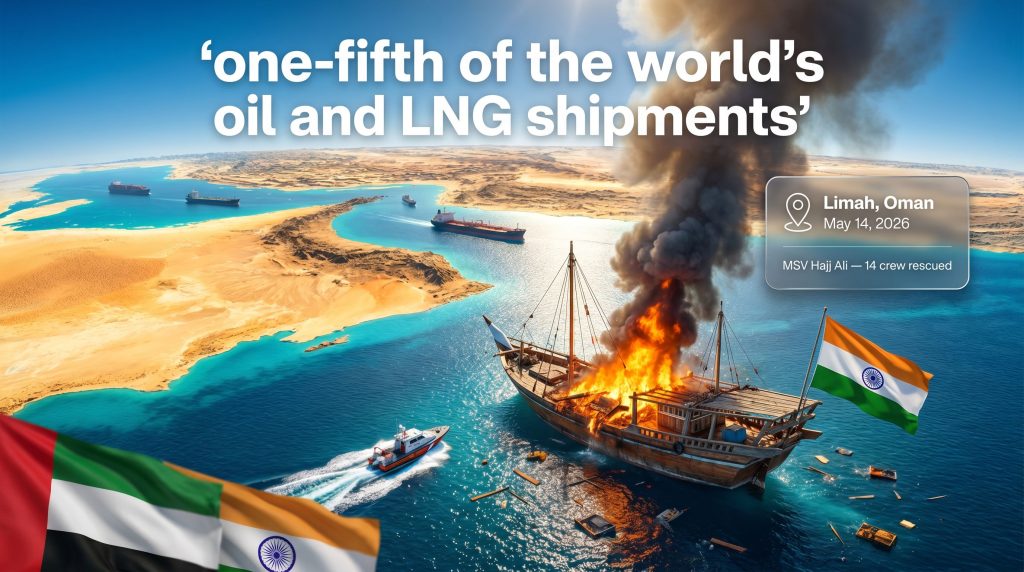
Under normal peacetime conditions, this corridor channels approximately one-fifth of the world's oil and LNG shipments, according to widely cited figures from the US Energy Information Administration. That makes it, by volume and strategic weight, the single most consequential maritime chokepoint on Earth. Shifts in the global LNG supply dynamic make this corridor even more strategically sensitive.
The coastal zone around Limah, Oman, positioned just south of the strait's exit point, sits at the precise junction where vessels transitioning from the Persian Gulf enter open ocean routes toward South Asia, East Africa, and beyond. It is a concentration point for commercial traffic, and in the current security environment, that concentration creates acute vulnerability.
From Chokepoint to Conflict Zone: The 2026 Security Collapse
The deterioration of maritime security in this corridor did not happen overnight. Its roots lie in the outbreak of direct military conflict involving the United States and Israel beginning February 28, 2026, a development that fundamentally reconfigured the strategic calculus for every commercial operator with exposure to Gulf waters.
Iran's response to this conflict included the large-scale restriction of Strait of Hormuz transit access for vessels it deemed non-cooperative with its naval directives. A fragile ceasefire was established on April 8, 2026, but it did not resolve the underlying access dispute. The United States maintained its naval blockade on Iranian ports even after the ceasefire, creating a dual-layer enforcement environment that placed commercial shipping operators in an almost impossible position.
The operational reality that emerged from this sequence is worth examining carefully:
- Vessels transiting the Strait of Hormuz now face Iranian conditional access requirements, where compliance with Iranian naval directives is treated as a prerequisite for safe passage
- Simultaneously, those same vessels must navigate US naval blockade enforcement targeting Iranian port access
- The legal ambiguity created by these overlapping restrictions sits in direct tension with the UN Convention on the Law of the Sea (UNCLOS), which establishes freedom of navigation as a foundational principle of international maritime law
- Third-party shipping nations, including India, have no direct stake in the US-Iran-Israel conflict but bear disproportionate operational and economic consequences from it
Iran's foreign minister Abbas Araghchi, speaking in New Delhi on the very day of India's condemnation of the attack, stated that the strait remains accessible to commercial vessels that cooperate with Iran's navy. This conditional framing represents a significant departure from the UNCLOS framework and, if accepted by the international community as a new operating norm, would set a deeply problematic precedent for maritime law enforcement globally.
The MSV Hajj Ali: Profile of a Vulnerable Vessel
The vessel at the centre of the Indian-flagged ship attack off Oman was the MSV Hajj Ali, a 54-metre (177-foot) wooden dhow registered under an Indian flag. Ship tracking platform MarineTraffic lists the vessel within this classification, and maritime security firm Vanguard provided the most detailed early reporting on the incident.
The MSV Hajj Ali was carrying livestock from Berbera in Somaliland to Sharjah in the United Arab Emirates at the time of the attack, operating a trade route that has functioned for generations as a critical artery for food supply chains connecting the Horn of Africa to Gulf consumer markets.
The vessel's profile is worth examining in detail, because it illustrates precisely why wooden dhows and small regional cargo vessels are disproportionately exposed in the current environment:
| Characteristic | MSV Hajj Ali | Large Crude Tanker |
|---|---|---|
| Length | 54 metres | 250-300+ metres |
| Construction | Wooden hull | Steel hull |
| Crew complement | 14 personnel | 20-30+ personnel |
| Defensive capability | Minimal | Some monitoring/escort options |
| AIS tracking | Basic | Advanced |
| War risk insurance | Typically minimal | Structured coverage |
| Naval escort eligibility | Unlikely | Possible under coalition arrangements |
This asymmetry matters enormously. While large crude tankers have access to naval escort arrangements, sophisticated communications infrastructure, and structured war risk insurance policies, small wooden cargo vessels like the MSV Hajj Ali operate with essentially none of these protective layers.
Sequence of Events: May 14, 2026
Based on reporting from maritime security monitors and India's Ministry of External Affairs, the sequence of events on May 14, 2026, unfolded as follows:
- The MSV Hajj Ali was operating in waters off the coast of Limah, Oman, positioned just south of the Strait of Hormuz, while transiting toward Sharjah
- A suspected explosion, believed to have been caused by a drone or missile strike, struck the vessel
- Fire broke out aboard the dhow following the initial explosion
- The fire spread sufficiently to force all 14 crew members to abandon ship
- The vessel subsequently sank as a result of the combined explosion and fire damage
- All 14 crew members were rescued safely by Omani maritime authorities
Despite the complete destruction of the vessel, the absence of crew fatalities stands as a direct reflection of Oman's maritime rescue capability and the speed of its coast guard response.
According to reports from marine industry analysts, the UAE condemned the incident as a terrorist attack, reinforcing the gravity with which regional powers are treating the escalating pattern of maritime strikes. India's Ministry of External Affairs confirmed crew safety and extended formal thanks to Omani authorities but declined to name the vessel or attribute responsibility to any specific actor in its initial statement.
India's Diplomatic Balancing Act: Condemnation Without Attribution
India's response to the Indian-flagged ship attack off Oman was carefully calibrated. The Ministry of External Affairs characterised the attack as unacceptable and made clear its position that commercial shipping and civilian mariners should not be targeted, and that freedom of navigation must be preserved.
What the statement conspicuously avoided was any identification of the vessel by name and, more significantly, any attribution of responsibility to a state or non-state actor.
This restraint was not accidental. It reflected the extraordinarily complex diplomatic context in which the attack occurred. On the same day India condemned the attack, New Delhi was hosting BRICS foreign ministers' talks, with Iran's Foreign Minister Abbas Araghchi present as a participant. The simultaneous hosting of Iranian diplomacy and the condemnation of an attack on an Indian vessel created a tension that New Delhi had no immediate political interest in resolving through public attribution.
This dynamic illustrates a broader strategic reality for India in 2026:
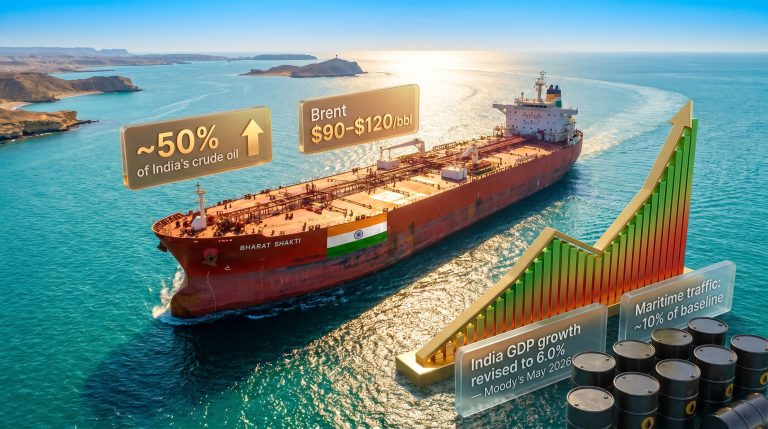
- India is among the world's largest crude oil importers, with a significant portion of its energy supply passing through or near the Strait of Hormuz
- Maintaining functional diplomatic channels with Iran is an energy security imperative, regardless of the legal and moral questions raised by Iran's conditional access doctrine
- Simultaneously, India has a direct national interest in freedom of navigation, as evidenced by its condemnation of the attack and its reiteration that civilian mariners must not be endangered
- The absence of attribution preserves India's room to manoeuvre diplomatically while maintaining its principled public position
The next major ASX story will hit our subscribers first
The UAE's Escalation of Diplomatic Language
The UAE's independent condemnation of the attack went further than India's in one important respect: it framed the incident not as a bilateral maritime matter but as a systemic threat to international maritime order and regional stability.
Gulf News reported that the UAE specifically characterised the strike as a terrorist attack, a framing that carries significant weight in the context of international maritime law and regional diplomatic signalling. This escalation in diplomatic register is significant.
The UAE is both a major energy re-export economy and a country with deep commercial exposure to Strait of Hormuz throughput. Its framing of individual vessel attacks as threats to global shipping routes reflects an awareness that each incident, regardless of the vessel's size or cargo, contributes to a broader erosion of the maritime security architecture on which Gulf trade depends.
Pattern Recognition: Is This an Isolated Attack or a Systemic Threat?
Examining the MSV Hajj Ali incident in isolation risks underestimating its significance. When mapped against the broader pattern of maritime incidents in Gulf waters during 2026, a more concerning picture emerges. Furthermore, the evolving geopolitical landscape of the region adds additional layers of complexity to maritime risk assessment.
| Incident | Vessel Type | Location | Outcome |
|---|---|---|---|
| MSV Hajj Ali attack | Indian-flagged wooden dhow | Off Limah, Oman | Sunk; 14 crew rescued |
| UAE-owned tanker strike | Fuel tanker | Off Oman coast | Fuel leak reported |
| Japan-linked crude tanker | Crude oil tanker | Strait of Hormuz passage | Passed through; monitored |
The clustering of these incidents around the Strait of Hormuz and the Oman coastline suggests a pattern of targeted maritime disruption rather than opportunistic or random attacks. Critically, the variety of vessel types affected, from large crude tankers to small regional dhows, indicates that risk is not confined to high-value energy cargoes.
The Overlooked Casualty: Regional Food Supply Chains
One dimension of this incident that receives far less analytical attention than oil market disruption is its impact on regional food supply chains. The MSV Hajj Ali was carrying livestock from Berbera, Somaliland, to Sharjah, UAE, a trade route deeply embedded in the food security architecture of the Gulf region.
The dhow trade connecting East Africa to Gulf consumer markets has historically served as a vital, low-cost protein supply channel for populations across the Arabian Peninsula. Disruption to this network, whether through vessel losses, insurance cost increases, or route abandonment by operators, has cascading effects on food availability and affordability for lower-income households dependent on affordable animal protein.
This dimension of maritime conflict's economic impact is structurally underweighted in most analytical frameworks, which tend to focus on oil price implications while overlooking the humanitarian cost embedded in disrupted regional trade routes.
Energy Market Implications: The Strait of Hormuz as a Price Pressure Mechanism
The Strait of Hormuz's role as a carrier of approximately one-fifth of global oil and LNG shipments means that even partial, persistent disruption to this corridor generates structural upward pressure on energy prices globally. A complete closure is not required to produce meaningful market volatility. Indeed, the oil market volatility already building across global energy markets amplifies the consequences of each new incident.
Even a modest reduction in Strait of Hormuz throughput, without full closure, is sufficient to generate significant price movements in Brent crude and LNG spot markets, given the corridor's role connecting Gulf producers to their largest Asian and European buyers.
For commercial shipping operators, the conflict has created a trilemma with no straightforward resolution:
- Absorb escalating war risk insurance premiums, which have risen sharply for Gulf of Oman and Strait of Hormuz transits since February 2026
- Pass costs through to cargo owners, compressing margins across supply chains and contributing to inflationary pressure on traded goods
- Reroute vessels via alternative passages, most significantly around the Cape of Good Hope, adding substantial time and fuel costs for voyages between East Africa, South Asia, and the Gulf
Operational Risk Framework for Vessels in the Strait of Hormuz Region
For shipping operators with exposure to the Gulf of Oman corridor, a structured risk assessment framework is now an operational necessity rather than a precautionary measure. In addition, the broader global trade tensions reshaping international commerce in 2026 make proactive risk management even more critical for operators in this region.
| Risk Factor | Lower Exposure | Higher Exposure |
|---|---|---|
| Vessel size | Large tanker with escort access | Small wooden dhow, unescorted |
| Cargo type | Non-strategic commodities | Livestock, food, regional goods |
| Route proximity | Atlantic or Pacific corridors | Gulf of Oman, Strait of Hormuz |
| Flag state | Major naval power | Smaller maritime nations |
| Insurance coverage | Full war risk coverage | Minimal or lapsed war risk policy |
| Communication infrastructure | Advanced AIS and monitoring | Basic tracking only |
Practical steps for operators currently active in the region include:
- Registering with maritime security monitoring services providing real-time incident alerts for the Gulf of Oman corridor
- Ensuring current war risk insurance coverage is in force, as standard marine policies typically exclude conflict-zone incidents
- Establishing pre-transit communication protocols with the nearest maritime rescue coordination authority, including Oman's maritime rescue services, the UAE coast guard, and India's Maritime Rescue Coordination Centre
- Reviewing routing alternatives for non-time-critical cargo, including Cape of Good Hope rerouting for East Africa to UAE voyages
- Updating crew safety briefings to include abandon-ship procedures specific to drone and missile strike scenarios, which differ materially from conventional collision or fire emergencies
Oman's Quiet but Critical Role as a Stabilising Actor
One of the less-discussed dimensions of the MSV Hajj Ali incident is what it reveals about Oman's continued function as a stabilising presence in an increasingly volatile regional environment. Oman's rapid and effective rescue of all 14 crew members demonstrates a commitment to humanitarian maritime obligations that has remained consistent despite the surrounding conflict.
Oman has historically maintained a distinctive neutral diplomatic posture in Gulf conflicts, serving at various points as a back-channel communication hub between Iran and Western powers. Its effective maritime rescue response in this incident reinforces its strategic value as a regional actor that prioritises operational humanitarian responsibility over political alignment. Furthermore, the oil price shock reverberating through global energy markets makes Oman's stabilising role in this corridor all the more consequential for international observers.
Frequently Asked Questions: Indian-Flagged Ship Attack Off Oman
What was the name of the Indian-flagged ship attacked off Oman?
The vessel was identified by maritime security monitors as the MSV Hajj Ali, a 54-metre wooden dhow registered under an Indian flag. India's Ministry of External Affairs did not name the vessel in its official statement.
Were there any casualties in the MSV Hajj Ali attack?
No fatalities were reported. All 14 crew members aboard were rescued safely by Omani maritime authorities following the sinking of the vessel.
What caused the MSV Hajj Ali to sink off Oman?
Maritime security monitors reported a suspected explosion, believed to have been caused by a drone or missile strike, which triggered a fire aboard the vessel. The crew abandoned ship before it sank off the coast of Limah, Oman.
Who was responsible for the attack?
As of the time of reporting, no party has claimed responsibility, and India's Ministry of External Affairs declined to attribute the attack to any specific actor.
Why is the Strait of Hormuz so critical to global energy markets?
The Strait of Hormuz carries approximately one-fifth of global oil and LNG shipments under normal operating conditions, making it the world's most strategically significant maritime chokepoint. Any sustained disruption to this corridor has direct consequences for global energy prices.
What was the vessel carrying at the time of the attack?
The MSV Hajj Ali was transporting livestock from Berbera in Somaliland to Sharjah in the UAE when the attack occurred.
Key Takeaways
- The Indian-flagged ship attack off Oman is part of a documented and escalating pattern of maritime disruption in the Gulf of Oman and Strait of Hormuz corridor since early 2026
- The targeting of a small livestock-carrying dhow signals that no vessel category is immune from the conflict's maritime spillover effects
- India's response reflects a structurally difficult balancing act between condemning maritime law violations and preserving strategic engagement with all regional actors
- The Strait of Hormuz's centrality to global energy flows means that even low-level, persistent maritime insecurity generates disproportionate economic consequences for energy-importing nations worldwide
- Oman's humanitarian response demonstrates that neutral regional actors retain critical stabilising functions even in highly escalated conflict environments
- The absence of attribution creates a dangerous accountability vacuum that, if unaddressed, may embolden further targeting of commercial vessels in the region
This article is based on information available as of May 14, 2026. The security situation in the Gulf of Oman and Strait of Hormuz corridor remains fluid, and readers are encouraged to consult real-time maritime security monitoring services for operational decisions. This content does not constitute legal, insurance, or navigational advice.
Want to Stay Ahead of the Resource Opportunities Emerging From Global Maritime Disruption?
Discovery Alert's proprietary Discovery IQ model instantly identifies significant ASX mineral discoveries that stand to benefit from shifting energy and commodity dynamics — including those driven by Strait of Hormuz instability — delivering real-time, actionable alerts to subscribers before the broader market reacts. Explore how historic mineral discoveries have generated substantial returns and begin your 14-day free trial today to position yourself ahead of the next major market-moving event.