May 20, 2026
When Geopolitical Fault Lines Become Energy Price Shocks
Energy markets have always been sensitive to geopolitical stress, but few events expose structural vulnerabilities quite like the sudden closure of a critical maritime chokepoint. When roughly one-fifth of the world's total energy trade passes through a single waterway, any disruption to that corridor triggers a cascading sequence of cost escalations, supply realignments, and financial losses that reverberate through national economies. India's current LPG crisis is a textbook illustration of exactly this dynamic, and the Indian Oil LPG revenue loss in May 2026 is the most visible symptom of a much deeper systemic problem.
When big ASX news breaks, our subscribers know first
The Structural Economics Behind India's LPG Pricing Problem
Understanding the Indian Oil LPG revenue loss in May 2026 requires grasping how the domestic pricing architecture for cooking fuel actually operates. Indian state-run oil marketing companies (OMCs) sell LPG cylinders to households at administratively determined prices that are set below market procurement costs. This is not a market-clearing mechanism. It is a deliberate policy instrument designed to keep cooking fuel affordable for India's vast population, particularly lower-income households that depend on LPG as their primary energy source for food preparation.
The gap between what OMCs charge consumers and what they actually pay to procure and distribute LPG is termed an under-recovery, a concept distinct from a conventional accounting loss. An under-recovery represents foregone revenue rather than cash expenditure in excess of income, though in practical terms the financial damage to a company's earnings is functionally equivalent. The government periodically compensates OMCs for a portion of these under-recoveries through direct budget transfers, but the compensation cycles are rarely synchronised with real-time procurement cost movements, creating persistent lag effects on company finances.
When global commodity markets are relatively stable, this arrangement is manageable. However, when an external supply shock of the magnitude now unfolding hits simultaneously, the architecture buckles. Furthermore, India's LNG import tax structure adds another layer of complexity to the overall cost burden facing OMCs during periods of acute supply stress.
The Numbers Behind the May 2026 Revenue Shortfall
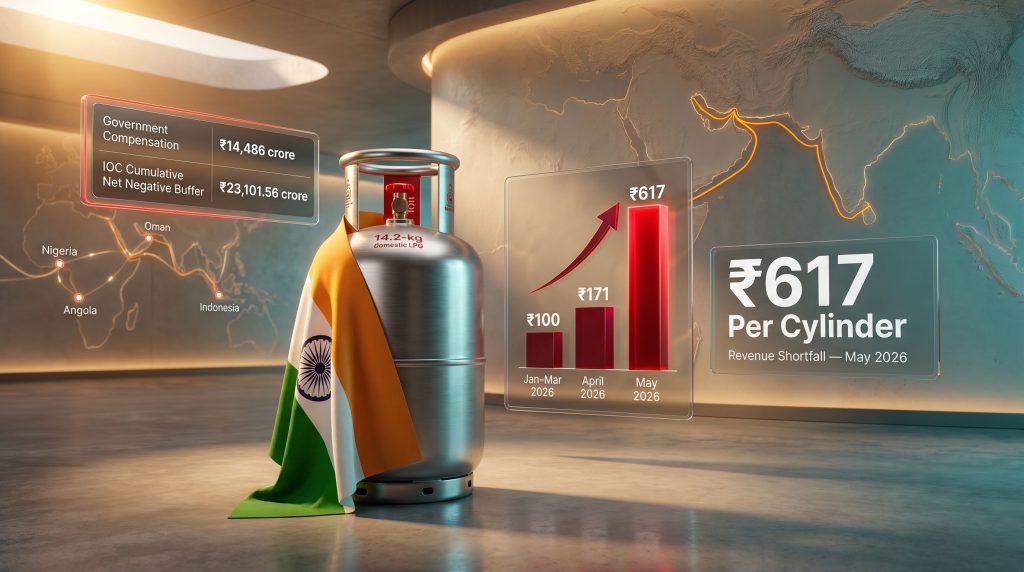
The trajectory of Indian Oil's per-cylinder revenue shortfall through the first half of fiscal year 2027 tells a stark story of accelerating financial stress.
| Period | Revenue Loss Per 14.2-kg LPG Cylinder |
|---|---|
| January to March 2026 (Q4 FY26) | ₹100 per cylinder |
| April 2026 | ₹171 per cylinder |
| May 2026 | ₹617 per cylinder |
The escalation from ₹171 in April to ₹617 in May represents a deterioration of more than 260% within a single month. To contextualise this figure further, the January-to-March average of ₹100 per cylinder was already considered an elevated level requiring government attention. The May figure is more than six times that baseline, signalling that something qualitatively different, not merely an incremental cost increase, has occurred in the supply environment.
The pace of this deterioration points unmistakably to an acute external supply-side shock rather than a gradual structural misalignment between domestic pricing policy and international market prices.
It is worth noting that under-recovery figures of this magnitude, if sustained over a full quarter, would have the capacity to entirely offset operating profits generated across other business segments, placing enormous pressure on IOC's Q1 FY27 earnings.
India's Middle East Dependency: Why the Strait of Hormuz Matters So Much
To understand why the closure of the Strait of Hormuz produced such an outsized impact on Indian LPG costs, it is necessary to appreciate the scale of India's structural import dependency on Middle Eastern supplies.
| Supply Metric | Figure |
|---|---|
| India's total LPG consumption (2025) | 33.15 million tonnes |
| Import share of total LPG demand | approximately 60% |
| Middle East share of total LPG imports | approximately 90% |
| India's global LPG import ranking | 2nd largest globally |
India imports roughly 60% of its total LPG requirements, and of those imports, nine out of ten tonnes originate from Middle Eastern producers transiting through the Strait of Hormuz. As the world's second-largest LPG importer after China, India's exposure to any disruption of this chokepoint is greater, in absolute tonnage terms, than almost any other nation on earth.
The Iran conflict and the subsequent closure of the Strait of Hormuz severed this supply artery at precisely the wrong moment. Major suppliers across the region declared force majeure, a contractual mechanism by which suppliers notify buyers that circumstances beyond their control prevent fulfilment of delivery obligations, effectively suspending contracted volumes at short notice. For IOC's procurement teams, this meant simultaneously losing access to their most cost-efficient supply base while facing urgent pressure to maintain uninterrupted domestic distribution.
The consequence was predictable in direction if not in magnitude: procurement from alternative, more distant, and structurally more expensive origins, compressing margins with every cargo lifted. In addition, the broader trade war impact on oil markets has further complicated India's ability to secure competitively priced cargoes from non-traditional suppliers.
How Indian Oil Is Responding to the Supply Crisis
IOC's operational response to the Hormuz disruption has unfolded across two distinct timeframes: immediate emergency sourcing to maintain supply continuity, and medium-term infrastructure expansion to reduce long-run import dependency.
Emergency Diversification of Supply Origins
Following the force majeure declarations from key Middle Eastern counterparties, Indian Oil moved quickly to establish alternative procurement channels. The company has sourced LNG and LPG cargoes from:
- Oman (geographically proximate, partially insulated from Hormuz disruption)
- Nigeria (West Africa, representing a significant increase in shipping distance and logistics cost)
- Angola (sub-Saharan Africa, similarly extending the supply chain materially)
- Indonesia (Southeast Asia, adding complexity to scheduling and vessel utilisation)
The shift toward these origins is not simply a matter of redirecting orders. Longer shipping routes translate directly into higher freight costs, greater voyage duration, larger vessel requirements, and more complex logistical coordination. Every component of this expanded supply chain adds to the landed cost of each tonne of LPG, which in turn widens the gap between procurement cost and the capped domestic selling price.
IOC has maintained its refineries at full operational capacity throughout this period, carrying approximately one month of crude inventory as a buffer. This is a deliberate risk management posture: running at full throughput ensures domestic fuel output is maximised while the inventory cushion provides time to manage sourcing transitions without supply interruptions.
Operating refineries at maximum throughput while simultaneously restructuring the entire input sourcing architecture is a dual-front operational challenge that compresses margins in the short term, even as it preserves long-term supply security.
Long-Term Refinery Expansion as a Structural Hedge
Beyond emergency sourcing, IOC has committed to a substantial domestic refinery expansion programme designed to reduce reliance on imported finished products over time.
| Refinery | Target Capacity | Timeline |
|---|---|---|
| Panipat Refinery | 500,000 barrels per day | By end of 2026 |
| Gujarat Refinery | 360,000 barrels per day | By end of 2026 |
| Barauni Plant | 180,000 barrels per day | By end of 2026 |
Expanding domestic refining capacity serves a dual strategic purpose. First, it allows India to process a wider variety of crude grades, including those now being sourced from non-Middle Eastern origins, without compromising yield economics. Second, it reduces the volume of finished LPG that must be imported directly, shifting the import exposure earlier in the supply chain to crude oil, where sourcing flexibility is considerably greater.
The Full Financial Picture: Compensation Gaps and Balance Sheet Risk
The financial burden on Indian Oil's balance sheet extends well beyond the per-cylinder loss figure. When cumulative under-recoveries are stacked against government compensation flows, a substantial unrecovered deficit emerges.
| Financial Metric | Amount |
|---|---|
| Government-approved LPG under-recovery compensation (to March 2026) | ₹14,486 crore |
| IOC's cumulative net negative LPG buffer | ₹23,101.56 crore |
| Uncompensated under-recovery gap | approximately ₹8,615 crore |
| Estimated total OMC LPG losses by end of May 2026 | ₹40,000+ crore |
The gap between government-approved compensation of ₹14,486 crore and IOC's cumulative negative buffer of ₹23,101 crore leaves an unrecovered shortfall of roughly ₹8,615 crore that sits unresolved on the company's books. Across all oil marketing companies, total LPG losses are estimated to approach or exceed ₹40,000 crore by the end of May 2026.
A key structural problem is that compensation mechanisms are inherently backward-looking. Government budget allocations for OMC under-recovery support are typically determined based on historical cost data and policy reviews that can lag real-time market movements by weeks or months. In a period of acute price escalation, this lag means OMCs are effectively providing subsidised fuel from their own balance sheets while awaiting fiscal reimbursement that may not arrive in the same financial period.
Broader market analysis suggests that if under-recovery rates remain near current levels through Q1 FY27, the full-year earnings trajectory for India's major oil marketing companies could be materially impaired, with LPG losses driving the deterioration independently of crude price movements.
Disclaimer: Forward-looking earnings assessments involve inherent uncertainty. Investors should conduct independent analysis and not rely solely on scenario projections when forming investment decisions.
The next major ASX story will hit our subscribers first
Benchmarking 2026 Against Previous Energy Shocks
India has navigated LPG subsidy crises before. The 2012 to 2014 period, when global crude prices were elevated and the rupee was weakening sharply, produced multi-year under-recovery cycles that required significant government intervention and ultimately contributed to the partial deregulation of diesel pricing. However, the current disruption differs from that episode in one critical respect: the 2012 to 2014 crisis was driven primarily by price levels, whereas the 2026 crisis combines a price shock with a physical supply disruption.
When procurement cost and supply availability are simultaneously stressed, the operational and financial challenges are qualitatively more severe. Consequently, the oil price rally dynamics seen earlier in the cycle have been compounded by genuine physical scarcity, creating a more complex policy environment than past subsidy cycles presented.
The government's decision to prioritise household cooking fuel over industrial LPG supply allocations reflects a deliberate triage of available volumes. This trade-off carries its own economic costs in the form of industrial output constraints, but it reflects a rational prioritisation of social welfare protection over short-term commercial considerations.
What This Signals for India's Long-Term Energy Security Architecture
The 2026 LPG crisis has exposed two long-standing vulnerabilities in India's energy supply architecture that policy discussions have circled for years without producing sufficient structural change.
Concentration risk in import geography is the more immediate of the two. A 90% dependency on a single regional supply corridor for a commodity as essential as cooking fuel is an extreme concentration by any risk management standard. The emergency diversification underway represents crisis-driven adaptation rather than proactive portfolio construction, and the cost premium associated with alternative origins illustrates precisely why advance diversification would have been economically rational.
Domestic refining capacity constraints represent the second structural gap. The refinery expansion targets announced for 2026 are significant, but the timing underscores that capacity build-out has not kept pace with demand growth or geopolitical risk assessment. Furthermore, Australia's own resource and energy export challenges offer a useful comparative lens, illustrating how commodity-dependent economies struggle to insulate themselves from sudden demand shifts when key trading partners face supply disruptions of this kind.
The policy question that remains unresolved is whether the current crisis will generate sufficient political momentum to address the third structural issue: the pricing mechanism itself. LPG price deregulation has been discussed at various points in Indian energy policy history, but household fuel pricing carries substantial political sensitivity. A full deregulation that passes global cost volatility through to consumers would eliminate under-recovery losses entirely but would transfer price risk to households with limited capacity to absorb it. OPEC's influence on oil markets remains a critical variable in this equation, as any coordinated production adjustment could either ease or intensify the cost pressures currently bearing down on Indian OMCs.
Frequently Asked Questions: Indian Oil LPG Revenue Loss in May 2026
What is the Indian Oil LPG revenue loss per cylinder in May 2026?
Indian Oil Corporation is recording a revenue shortfall of approximately ₹617 per 14.2-kilogram LPG cylinder in May 2026, compared to ₹171 in April and ₹100 during the January to March quarter.
Why has the per-cylinder loss escalated so sharply?
The primary driver is the disruption to Middle Eastern LPG supplies following the closure of the Strait of Hormuz, which has forced Indian Oil to procure from more distant and structurally more expensive alternative markets, widening the gap between actual procurement cost and the subsidised domestic retail price.
How much compensation has the government provided to Indian Oil for LPG under-recoveries?
The government approved ₹14,486 crore in LPG under-recovery compensation through March 2026, against a cumulative negative LPG buffer at IOC of approximately ₹23,101 crore, leaving a significant uncompensated gap.
Where is Indian Oil now sourcing its LPG and LNG following the Hormuz closure?
Following force majeure declarations from major Middle Eastern suppliers, IOC has diversified procurement to include Oman, Nigeria, Angola, and Indonesia.
What refinery expansions is Indian Oil targeting by the end of 2026?
IOC is working toward expanding the Panipat refinery to 500,000 bpd, the Gujarat refinery to 360,000 bpd, and the Barauni plant to 180,000 bpd as part of a long-term domestic capacity build-out strategy.
For ongoing coverage of India's oil and gas sector and energy security developments, ET EnergyWorld at energy.economictimes.indiatimes.com provides detailed reporting on the LPG supply crisis and related policy responses.
Want to Stay Ahead of the Next Major Commodity Market Disruption?
When geopolitical shocks expose structural vulnerabilities in global energy supply chains, the investors who act fastest on emerging opportunities gain the greatest advantage. Discovery Alert's proprietary Discovery IQ model delivers real-time alerts on significant ASX mineral discoveries, transforming complex commodity data into actionable insights — explore Discovery Alert's discoveries page to see how historic discoveries have generated substantial returns, and begin a 14-day free trial to position yourself ahead of the broader market.