July 21, 2026
Understanding India's Metallurgical Coal Dependency Crisis
Global steel production dynamics have fundamentally shifted as major consuming nations confront supply chain vulnerabilities embedded within commodity procurement strategies. The metallurgical coal market exemplifies these structural challenges, where geographic concentration of suppliers creates systemic risks that transcend simple commercial relationships. For nations pursuing rapid industrial expansion, these dependencies generate cascading vulnerabilities affecting energy security, economic competitiveness, and strategic autonomy.
India's position as the world's second-largest steel producer illuminates these broader market dynamics. The nation's steel sector requires approximately 57-73 million tonnes of coking coal annually, yet domestic production satisfies only 5-10% of total requirements despite substantial geological reserves. This dependency ratio exposes Indian manufacturers to external supply disruptions, price volatility cycles, and geopolitical risks that extend far beyond traditional market mechanics.
The strategic importance of India's procurement decisions extends beyond national borders. As a major consumer representing significant global demand, India's shift to US met coal influences international shipping routes, commodity pricing mechanisms, and supplier development strategies across multiple continents. When such large-scale consumers adjust procurement strategies, the ripple effects reshape entire market ecosystems.
When big ASX news breaks, our subscribers know first
Economic Drivers Behind Australia's Market Dominance Erosion
Market Concentration and Systemic Risk Creation
Australia's historical control over India's coking coal imports—previously commanding 78% of total volumes—created precisely the type of market concentration that commodity risk management principles warn against. This dominance became economically problematic when Queensland flooding events in January 2026 triggered benchmark premium hard coking coal prices to surge beyond $252.5 per tonne by February 4, representing an 18-month price high and over 50% appreciation from March 2025 levels.
The price discovery mechanism during this event revealed how single-supplier concentration amplifies volatility transmission. Rather than gradual price adjustments reflecting supply-demand rebalancing, markets experienced immediate price shocks as participants recognised scarcity premiums associated with reduced Australian production capacity. Furthermore, this dynamic demonstrates what economists term *"rent extraction"*—the ability to increase prices beyond competitive levels due to supply constraints.
Diversification Progress and Remaining Vulnerabilities
Recent procurement data illustrates India's systematic efforts to reduce Australian dependency while maintaining quality requirements. However, commodities trading volatility continues to challenge procurement strategies across global markets:
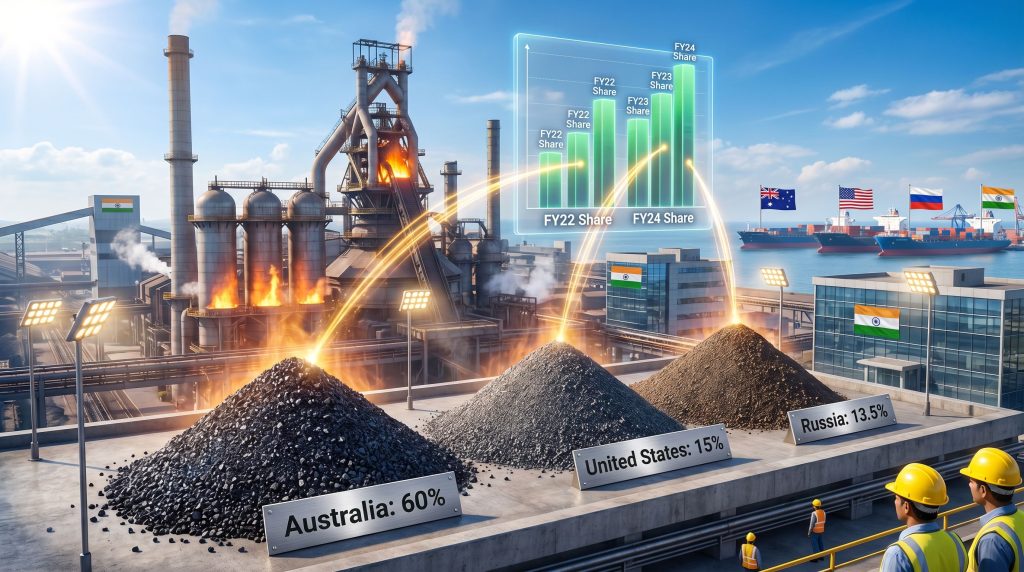
| Supplier | FY22 Share | FY24 Share | Volume Change | Strategic Rationale |
|---|---|---|---|---|
| Australia | 78% | 60% | Stable at 34.5 MT | Quality consistency maintenance |
| United States | 7.3% | 15%+ | +173% to 8.47 MT | Reserve depth diversification |
| Russia | 5% | 13.5% | +550% to 7.75 MT | Cost competitiveness benefits |
This rebalancing strategy demonstrates portfolio optimisation principles rather than opportunistic purchasing. India increased aggregate imports whilst redirecting incremental volumes toward non-Australian suppliers, maintaining absolute Australian purchase levels whilst reducing relative dependence.
Nevertheless, Australia's continued control of approximately 48% of global seaborne metallurgical coal exports ensures ongoing pricing influence. Supply disruptions in Queensland operations can trigger price movements across all markets, including US-origin coal, limiting the effectiveness of diversification strategies in providing price insulation.
Transportation Economics and Geographic Constraints
Freight Cost Multiplication Effects
Transportation economics create structural disadvantages for distant suppliers that mine-mouth price competitiveness alone cannot overcome. With freight costs representing 15-25% of delivered coal prices, shipping distance differentials directly impact total procurement economics:
- Australia to India: 4,500-6,000 nautical miles
- US West Coast to India: 8,500-10,000 nautical miles
- US East Coast to India: 12,000-14,000 nautical miles
US West Coast coal requires 1.75-2.0 times the shipping distance of Australian supplies, whilst US East Coast coal requires 2.5-3.0 times the distance. Assuming baseline freight costs of $12-15 per tonne for Australian routes, US suppliers face $21-45 per tonne transportation costs depending on origin location.
Geopolitical Disruption Transmission
The West Asian shipping disruptions that began affecting fuel prices in 2026 exemplify how regional geopolitical events create global commodity cost pressures. International shipping fuel costs—marine bunker fuel—exhibit high volatility during regional tensions. Shipping operators directly pass increased fuel costs through to cargo shippers as higher freight rates.
For US coal shipments requiring extended Pacific transits, a 25% increase in bunker fuel costs translates into approximately $6-8 per tonne additional freight charges. When applied to coal priced at $250-280 per tonne, these increases represent 2-3% cost escalation that erodes supplier competitiveness and demonstrates how distant geopolitical risks directly impact Indian steel producer economics.
Technical and Operational Integration Challenges
Metallurgical Compatibility Requirements
Indian steel plants predominantly employ stamp-charging processes optimised for specific coal blend characteristics developed around Australian and domestic coal properties. Whilst US metallurgical coal offers comparable quality specifications, operational integration requires blending modifications and process adjustments:
| Quality Parameter | Australian Coal | US Coal | Indian Standards |
|---|---|---|---|
| Ash Content | 8-10% | 7-9% | <10% maximum |
| Moisture Content | 8-9% | 6-8% | <10% maximum |
| Volatile Matter | 20-25% | 18-23% | 20-28% range |
| Coking Index | 7-8 | 6-8 | >5 minimum |
These specifications meet Indian requirements, but operational optimisation for US coal blends requires time-intensive testing and process modification. Steel producers must validate coke quality, blast furnace performance, and metallurgical outcomes before scaling US coal utilisation.
Infrastructure and Capacity Limitations
India's planned expansion to 300 million tonnes annual crude steel capacity by 2030 compounds coal procurement challenges. Approximately 64% of upcoming capacity relies on coal-based blast furnace technology, increasing metallurgical coal requirements during a period when suppliers face capacity constraints.
US metallurgical coal export capacity faces structural limitations from declining Appalachian production and infrastructure bottlenecks. Current US exports total approximately 50-60 million tonnes annually across all global markets, constraining India's ability to significantly increase import volumes even if economic and technical factors favour US suppliers.
Alternative Technology Pathways and Long-term Transitions
Green Hydrogen and Direct Reduction Potential
India's steel decarbonisation benefits strategy emphasises hydrogen-based direct reduction technologies that could reduce metallurgical coal requirements by 60-80% for participating facilities. Major producers including Tata Steel, JSW Steel, and Jindal Steel have announced net-zero commitments targeting 2045-2050 implementation.
Technology Investment Economics:
| Technology Pathway | Capital Investment | Timeline | Coal Reduction | Implementation Risk |
|---|---|---|---|---|
| Green H2-DRI | $2-3B per facility | 2028-2035 | 70-80% | Technology scaling |
| Blue H2-DRI | $1.5-2B per facility | 2026-2032 | 60-70% | Carbon capture costs |
| Electric Arc Furnace | $800M-1.2B | 2025-2030 | 85-95% | Scrap steel availability |
Green hydrogen production costs remain elevated compared to conventional reduction processes, but declining renewable energy costs and carbon pricing mechanisms could accelerate economic viability. Domestic green hydrogen development also addresses energy security considerations beyond steel sector applications.
Policy Framework and Investment Incentives
India's National Hydrogen Mission and Production Linked Incentive schemes create policy tailwinds supporting alternative technology development. However, commercial deployment timelines extend beyond current coal procurement planning horizons, necessitating parallel strategies for managing traditional supply chain risks during transition periods.
India's Shift to US Met Coal: Strategic Assessment and Market Realities
Bilateral Trade Framework Development
Recent US-India strategic partnership discussions include energy trade components targeting expanded bilateral commerce. Energy security considerations increasingly influence procurement decisions beyond pure economic optimisation, positioning metallurgical coal within broader strategic relationship frameworks.
The "friend-shoring" trend reflects growing emphasis on supplier relationships with strategically aligned nations. This approach balances economic efficiency with supply security considerations, particularly relevant given recent global supply chain disruptions across multiple commodity categories. Additionally, US-China trade impacts continue to reshape global commerce patterns.
Volume Growth Trajectories and Market Constraints
India's shift to US met coal demonstrated substantial percentage growth from FY22 to FY24—increasing from 7.3% to 15%+ market share. However, absolute volume constraints limit the scale of this diversification. US coal exports of 8.47 million tonnes to India represent significant market share gains but remain insufficient to substantially reduce Australian dependency.
Global metallurgical coal trade totals approximately 350-400 million tonnes annually. India's imports of 57-73 million tonnes represent 15-20% of global trade volumes. For India to achieve meaningful supplier diversification, alternative suppliers must possess both geological reserves and export infrastructure capable of handling tens of millions of tonnes additional annual capacity.
The next major ASX story will hit our subscribers first
Risk Management and Financial Market Implications
Commodity Price Volatility and Hedging Strategies
Despite supplier diversification efforts, Indian steel producers remain exposed to global metallurgical coal price cycles. The February 2026 price spike to $252.5 per tonne affected coal from all supplier origins, demonstrating limited diversification benefits during global supply constraint periods.
Financial Risk Mitigation Approaches:
- Long-term contracts: Reduce spot price exposure but limit flexibility
- Financial hedging: Derivatives markets provide price risk transfer mechanisms
- Strategic inventory: Higher carrying costs but supply disruption insurance
- Technology acceleration: Reduces long-term coal dependency but requires capital investment
Investment Capital Allocation Decisions
Steel sector participants face competing investment priorities between maintaining coal-based capacity expansion and transitioning toward low-carbon production technologies. India's 300 million tonne capacity target by 2030 requires substantial capital deployment, with technology selection determining long-term competitive positioning.
"The fundamental challenge facing Indian steel producers involves balancing immediate supply security requirements with long-term technological transition objectives whilst managing volatile commodity cost structures."
Market Psychology and Procurement Strategy
Supplier diversification provides psychological benefits for procurement teams and risk management frameworks even when economic benefits remain limited. The ability to source from multiple suppliers creates negotiating leverage and operational flexibility that extends beyond pure cost considerations.
However, diversification success requires realistic assessment of volume constraints, quality compatibility, and total cost structures including transportation and operational modification expenses.
Future Market Evolution and Strategic Positioning
Global Supply Capacity Development
Metallurgical coal supply development requires substantial capital investment and extended development timelines. New mining operations face environmental permitting challenges, infrastructure requirements, and geological risk factors that constrain rapid capacity expansion.
Existing supplier expansion faces similar constraints. Australian operations could potentially increase production, but infrastructure bottlenecks and environmental considerations limit growth potential. US suppliers face declining resource bases in traditional production regions alongside infrastructure constraints limiting seaborne export capacity. Consequently, Australia's resource exports challenges continue to influence global supply patterns.
Demand Evolution and Technology Adoption
Global steel industry decarbonisation trends will eventually reduce metallurgical coal demand across all markets. However, transition timelines extend over decades rather than years, ensuring continued relevance for traditional supply chain management strategies.
Emerging markets pursuing steel industry development will increase global demand during transition periods. Countries in Africa, Southeast Asia, and Latin America plan steel capacity expansion using conventional blast furnace technology, potentially offsetting demand reductions from technology transitions in developed markets. Furthermore, industry innovation trends continue to reshape production methodologies.
Strategic Recommendations for Stakeholders
For Steel Producers:
- Maintain diversified supplier relationships whilst recognising volume and cost constraints
- Accelerate technology transition planning to reduce long-term coal dependency
- Implement sophisticated risk management combining contracts, hedging, and inventory strategies
- Coordinate procurement planning with capacity expansion and technology investment timelines
For Policy Frameworks:
- Support domestic alternative technology development through targeted incentives and research funding
- Maintain strategic supplier relationships balancing economic and security considerations
- Develop emergency response protocols for supply disruption scenarios
- Coordinate industrial policy with decarbonisation objectives and trade relationships
India's metallurgical coal strategy reflects broader challenges facing major industrial consumers during global commodity market transitions. Whilst diversification provides incremental risk reduction benefits, fundamental exposure to global market dynamics persists until alternative technologies achieve commercial viability at scale.
The success of India's shift to US met coal depends on maintaining realistic expectations about diversification benefits whilst simultaneously accelerating long-term technology transitions that reduce commodity dependency. During this transition period, sophisticated risk management combining multiple strategies provides the most robust framework for managing supply chain vulnerabilities and cost volatility. Moreover, understanding India's changing import dynamics remains crucial for strategic planning.
Disclaimer: This analysis contains forward-looking assessments of commodity markets, technology development, and policy frameworks that involve inherent uncertainty. Actual outcomes may differ significantly from projections due to market volatility, technological developments, geopolitical events, and regulatory changes. Readers should conduct independent research and consult qualified advisors before making investment or strategic planning decisions based on this information.
Considering Investing in Commodity-Exposed ASX Companies?
Discovery Alert's proprietary Discovery IQ model delivers real-time notifications on significant ASX mineral discoveries across metallurgical coal, iron ore, and other critical commodities essential to global steel production. Start your 14-day free trial today and position yourself to capitalise on major discovery announcements before they move broader markets.