
May 19, 2026
Understanding Indonesia's Forest Protection Laws and Their Industry Impact
Southeast Asia's natural resource sectors are experiencing unprecedented regulatory transformation as governments balance economic development with environmental conservation. This shift represents more than policy adjustment; it signals fundamental changes in how extractive industries operate within protected ecosystems. Indonesia fines palm oil and mining companies in an enforcement campaign that extends far beyond national borders, affecting global commodity markets, supply chain stability, and investment strategies across multiple sectors.
Indonesia's approach to forest zone enforcement has evolved from traditional administrative oversight to military-backed implementation, creating new compliance frameworks that reshape industry operations. This transformation affects not only domestic companies but international investors and commodity markets worldwide, as Indonesia maintains dominant positions in palm oil, nickel, coal, and tin exports. Furthermore, these developments highlight the importance of understanding mining permit insights in today's evolving regulatory landscape.
When big ASX news breaks, our subscribers know first
How Indonesian Regulatory Enforcement Has Transformed Natural Resource Operations
Indonesia's military-backed task force, established under President Prabowo Subianto's administration, represents a fundamental shift in environmental law enforcement methodology. The task force combines military personnel with law enforcement officials, creating an unprecedented enforcement structure that has generated significant industry concern.
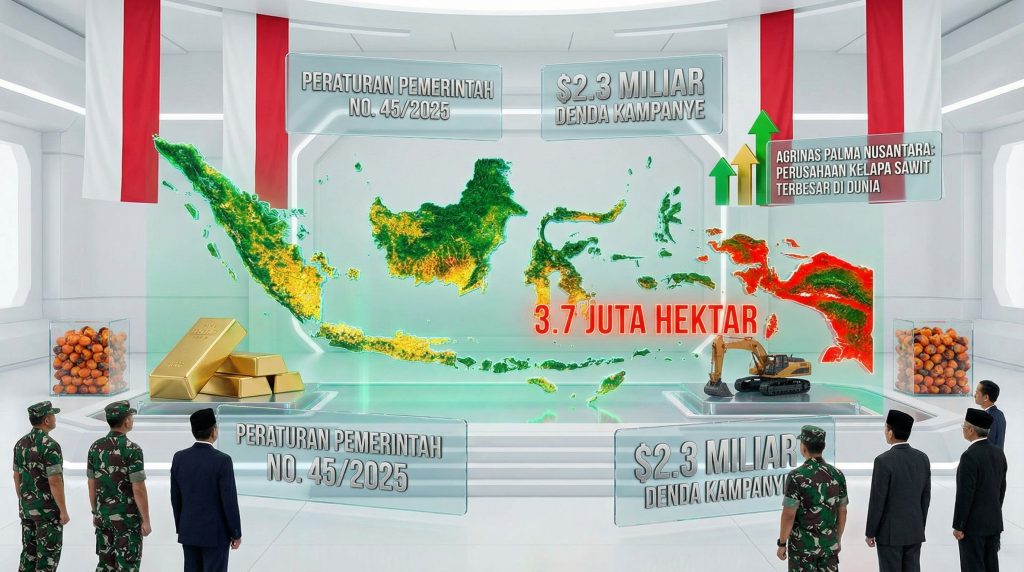
The enforcement campaign has resulted in 38.62 trillion Indonesian rupiah ($2.31 billion USD) in total fines, with the exchange rate calculated at 16,685 rupiah per dollar. This massive financial penalty demonstrates the government's commitment to forest zone protection through economic deterrence.
Key enforcement statistics include:
• 71 total companies penalised across both sectors
• 3.7 million hectares of plantation land seized
• 5,300+ hectares of mining operations confiscated
• Target expansion to 4 million hectares by year-end 2025
The fine structure reveals significant sectoral differences, with palm oil companies facing assessments of 25 million rupiah per hectare per year for forest zone violations. However, the methodology behind total fine calculations remains unclear, as enforcement officials have provided no explanation for how aggregate penalties were determined. Additionally, this enforcement action reflects broader industry evolution trends occurring globally.
Unprecedented Scale of Indonesia's $2.3 Billion Enforcement Campaign
The current enforcement action surpasses previous regulatory efforts in both scope and financial impact. The seized plantation area of 3.7 million hectares represents approximately 9.1 million acres, a land mass equivalent to several small countries. When combined with mining operation seizures, the total affected area demonstrates systematic rather than targeted enforcement.
Sectoral breakdown of financial penalties:
| Sector | Companies Affected | Total Fines (Trillion Rupiah) | Average Fine per Company |
|---|---|---|---|
| Palm Oil Plantations | 49 | 9.42 | 0.19 trillion |
| Mining Operations | 22 | 29.2 | 1.33 trillion |
The disparity in average fines per company suggests different violation categories or asset valuations between sectors. Mining operations face significantly higher individual penalties, potentially reflecting higher-value assets or more severe environmental impacts.
Market analysts have characterised the military-backed seizures as generating substantial concern within affected industries. The combination of large-scale asset confiscation with Indonesia's biodiesel expansion plans creates upward pressure on global palm oil prices through anticipated productivity disruptions. According to Reuters, the enforcement action represents one of the largest environmental penalty campaigns in Southeast Asian history.
Indonesia's position as the world's largest exporter of palm oil, thermal coal, nickel, and tin amplifies the global significance of domestic enforcement actions. Any production disruption in these sectors carries immediate implications for international commodity markets and downstream manufacturing industries.
Industries Facing Greatest Regulatory Risk Under Enhanced Enforcement
The enforcement campaign has affected multiple natural resource sectors, with palm oil and mining operations bearing the primary regulatory burden. The 190 mining permits suspended across coal, nickel, gold, and tin operations indicates comprehensive rather than selective enforcement targeting.
Mining sector enforcement details:
• 22 companies assessed total fines of 29.2 trillion rupiah
• 190 permits suspended pending compliance resolution
• 5,300+ hectares of mining land transferred to state control
• Multiple commodities affected including strategic minerals
Indonesia fines palm oil and mining companies through systematic enforcement that extends across all major extraction sectors. Palm oil operations have faced similarly extensive enforcement, with 49 companies receiving aggregate fines of 9.42 trillion rupiah. The sector's enforcement rate of 25 million rupiah per hectare annually provides a clear penalty structure, though historical comparison data remains unavailable.
Task force officials have indicated willingness to escalate enforcement measures, suggesting openness to dialogue while maintaining readiness for legal action against persistent violators. The characterisation of affected companies as "previous owners" of seized assets implies permanent rather than temporary transfers. Moreover, these developments parallel recent mining permit executive order discussions in other jurisdictions.
What Challenges Do Palm Oil Companies Face Under New Regulations?
Indonesia's palm oil sector faces unprecedented regulatory pressure through the enforcement campaign, with seized plantations totalling 3.7 million hectares representing significant global production capacity. The transfer of 1.5 million hectares to state-controlled Agrinas Palma Nusantara demonstrates systematic sector consolidation under government control.
Palm oil enforcement breakdown:
• 49 plantation companies penalised with forest zone violations
• 9.42 trillion rupiah in total sector fines
• 25 million rupiah per hectare annually as standard fine rate
• 1.5 million hectares transferred to state enterprise
The creation of Agrinas Palma Nusantara early in 2025 positions the state-controlled entity as potentially the world's largest palm oil company by land area. This consolidation represents fundamental ownership structure changes within Indonesia's dominant palm oil sector.
Industry analysts have predicted upward pressure on global palm oil prices due to anticipated productivity disruptions combined with Indonesia's domestic biodiesel expansion objectives. The dual pressure of reduced export availability and increased domestic feedstock demand creates supply constraints affecting international markets. In addition, Energy News reports that industry consolidation trends are accelerating across the region.
Some companies have reportedly paid assessed fines whilst others have objected to enforcement actions. Task force officials have emphasised cooperative dialogue whilst maintaining strict legal enforcement standards for non-compliant entities.
Mining Sector Permit Suspensions and Operational Disruption
The mining sector faces extensive permit suspensions affecting 190 operations across Indonesia's key mineral export commodities. With 22 companies assessed 29.2 trillion rupiah in total fines, individual mining operations face substantially higher penalties than plantation companies, reflecting asset valuations or violation severity differences.
Indonesia's dominance in global nickel and tin markets means permit suspensions carry strategic mineral supply implications. Given global technology industry dependence on these materials for semiconductor, battery, and renewable energy applications, market volatility extends beyond commodity traders to end-user manufacturers.
Critical mineral exposure includes:
• Coal operations affecting thermal energy exports
• Nickel mining impacting battery and stainless steel supply chains
• Gold extraction influencing precious metals markets
• Tin production affecting electronics and soldering industries
The suspension of 190 mining permits represents comprehensive enforcement rather than targeted action against specific violators. This systematic approach suggests regulatory framework changes rather than isolated compliance failures. However, these challenges also create opportunities for mining consolidation trends as companies adapt to new compliance requirements.
The next major ASX story will hit our subscribers first
State Asset Consolidation Through Agrinas Palma Nusantara
The establishment of Agrinas Palma Nusantara as a state-controlled enterprise receiving 1.5 million hectares of seized plantation land represents unprecedented government involvement in palm oil production. This entity's classification as potentially the world's largest palm oil company by land area fundamentally alters global industry dynamics.
State consolidation framework:
• 1.5 million hectares initially transferred to state control
• 2.2 million hectares from total seizures awaiting allocation
• Early 2025 establishment of consolidated state enterprise
• World's largest palm oil company by land holdings
The asset transfer mechanism from seized plantations to state ownership creates vertical integration opportunities for government-controlled palm oil production. Combined with Indonesia's biodiesel expansion plans, this consolidation enables direct feedstock allocation for domestic energy security objectives.
Market analysts anticipate that state asset consolidation, coupled with biodiesel mandates, will constrain global palm oil export availability whilst increasing domestic consumption. This dual pressure creates upward price momentum through supply-demand rebalancing. Indonesia fines palm oil and mining companies whilst simultaneously consolidating strategic assets under state control, demonstrating coordinated policy implementation.
How Will Long-Term Environmental Transformation Impact Industries?
Indonesia's enforcement campaign signals broader economic policy shifts toward state control of strategic natural resources. The combination of military-backed enforcement with state enterprise consolidation suggests systematic rather than temporary regulatory changes.
Environmental governance outcomes include:
• Forest conservation area expansion through land seizures
• Biodiversity protection in reclaimed forest zones
• Carbon sequestration potential from restored ecosystems
• Climate commitment integration with enforcement actions
The seizure of 3.7 million hectares of plantation land creates opportunities for ecosystem restoration whilst removing agricultural pressure from protected forest areas. This land use transition supports Indonesia's international climate commitments whilst establishing domestic precedent for forest zone protection.
Sectoral productivity adjustments will likely create lasting supply chain implications as remaining compliant operations adjust to enhanced regulatory oversight. The enforcement campaign establishes new compliance standards that affect operational costs and investment requirements for natural resource projects. Furthermore, these changes align with global mine reclamation insights emphasising environmental restoration.
International Investment Strategy Adaptations
The regulatory transformation requires fundamental adjustments to international investment strategies for Indonesia's natural resource sectors. Enhanced due diligence protocols must now verify forest zone compliance whilst assessing partnership opportunities with state-controlled entities.
Investment framework considerations:
• Enhanced compliance verification for forest zone operations
• State enterprise partnerships through Agrinas Palma Nusantara
• Regulatory monitoring systems for ongoing compliance
• Legal pathway analysis for permit applications
Foreign investors must now navigate partnership structures with government-controlled entities whilst maintaining compliance with enhanced environmental regulations. The consolidation of seized assets under state control creates joint venture opportunities but requires careful regulatory navigation.
Risk assessment priorities include:
| Investment Type | Opportunity Level | Regulatory Risk | Timeline Considerations |
|---|---|---|---|
| Palm Oil Joint Ventures | Medium | High | 2-3 years for integration |
| Mining Permit Acquisition | Low | Very High | 1-2 years pending suspension resolution |
| Sustainable Forestry | High | Low | 3-5 years for development |
Regional diversification strategies may become necessary as Indonesia's enhanced enforcement creates operational uncertainty for traditional natural resource investments. Alternative Southeast Asian destinations offer potential risk mitigation whilst Indonesian regulatory frameworks stabilise.
Presidential Administration Policy Evolution Under Prabowo Subianto
President Prabowo Subianto's administration has demonstrated commitment to environmental enforcement through military-civilian task force integration. This approach represents policy continuity with enhanced enforcement mechanisms rather than complete regulatory framework changes.
The involvement of military personnel in civilian environmental enforcement creates precedent for government resource mobilisation in regulatory compliance. This hybrid approach enables rapid deployment of enforcement capabilities whilst maintaining legal authority through civilian law enforcement participation.
Administration priorities include:
• Environmental enforcement through military-backed task forces
• State enterprise consolidation of strategic resource assets
• Forest zone protection with economic penalty structures
• International reputation management through enhanced oversight
Future regulatory expansion may extend beyond palm oil and mining to other natural resource sectors as enforcement capabilities and legal precedents develop. The systematic approach suggests long-term policy commitment rather than temporary enforcement campaigns. Indonesia fines palm oil and mining companies as part of comprehensive environmental governance reform under the current administration.
Future Regulatory Framework Development and Market Adaptation
Indonesia's enforcement campaign establishes precedent for enhanced regulatory oversight that may expand to additional sectors. The integration of military personnel with civilian enforcement creates scalable implementation capacity for broader natural resource governance.
Technology deployment for monitoring forest zone compliance will likely expand as enforcement capabilities develop. Satellite monitoring, geographic information systems, and remote sensing technologies enable comprehensive oversight of natural resource operations across Indonesia's vast territorial area.
Cross-border enforcement cooperation initiatives may emerge as Indonesian regulatory standards influence regional natural resource governance frameworks. The precedent of comprehensive enforcement may encourage similar approaches in other Southeast Asian countries with significant forest conservation objectives.
Integration with global sustainability reporting standards creates opportunities for Indonesian compliance frameworks to align with international environmental governance requirements. This alignment supports foreign investment whilst maintaining domestic regulatory autonomy.
The enforcement campaign's success in generating substantial financial penalties whilst achieving forest zone protection objectives may encourage permanent adoption of military-civilian enforcement integration. This approach provides government flexibility in resource allocation whilst maintaining legal authority structures. Indonesia fines palm oil and mining companies through systematic enforcement that may serve as a regional model for environmental governance.
Disclaimer: This analysis is based on reported enforcement actions and regulatory developments as of December 2025. Investment decisions should consider comprehensive due diligence including current regulatory status, legal compliance requirements, and market conditions. Forward-looking statements regarding policy development and market impacts represent analytical assessment rather than guaranteed outcomes.
Looking to Capitalise on Emerging Market Opportunities?
Discovery Alert's proprietary Discovery IQ model delivers real-time alerts on significant ASX mineral discoveries, empowering subscribers to identify actionable opportunities whilst global regulatory shifts create new market dynamics. Begin your 30-day free trial today to secure your market-leading advantage as international resource sectors adapt to changing compliance landscapes.