August 6, 2026
The Commodity Cycle No Producer Can Escape
Every commodity super-cycle eventually confronts the same structural paradox: the policies designed to maximise a nation's resource wealth often sow the seeds of their own undoing. When a producing country accelerates output to capture high prices, it amplifies the very oversupply conditions that eventually crush those same prices. Indonesia's nickel sector has lived through this cycle in compressed form, and the Indonesia nickel ore quota cuts now underway in 2026 represent something genuinely unusual in resource policy: a government attempting to engineer its way out of a surplus before the damage becomes irreversible.
When big ASX news breaks, our subscribers know first
Why Indonesia Moved First: The Logic of Pre-Emptive Supply Management
Understanding the mechanics behind the Indonesia nickel ore quota cuts requires stepping back from the immediate numbers and examining the underlying market architecture that made intervention necessary.
Indonesia's nickel policy evolution has followed a distinct arc. The 2020 raw ore export ban was a blunt instrument designed to force domestic value-addition by compelling global manufacturers to build smelters inside Indonesia rather than processing Indonesian ore elsewhere. The strategy worked, perhaps too well. Investment in rotary kiln electric furnace (RKEF) smelting capacity flooded into Sulawesi and surrounding regions, with multiple large-scale facilities reaching commercial production simultaneously in 2023 and 2024.
The problem is that smelter construction timelines run three to five years, meaning that the capacity responding to the high-price environment of 2021–2022 came online directly into an oversupplied market. Furthermore, as covered in analysis of Indonesian nickel industry challenges, the structural tensions within Indonesia's processing chain had been building well before 2026.
By early 2026, Indonesian officials had conducted a detailed assessment of the trajectory ahead. A senior member of Indonesia's National Economic Council warned publicly at the country's Critical Mineral Conference that failing to impose production controls in 2026 risked generating the most severe surplus in the history of the global nickel market (Reuters, 2026). That assessment drew on domestic production data showing that Indonesian ore output reached approximately 320 million metric tons in 2025, while downstream smelters were already operating below optimal utilisation rates even at that supply level.
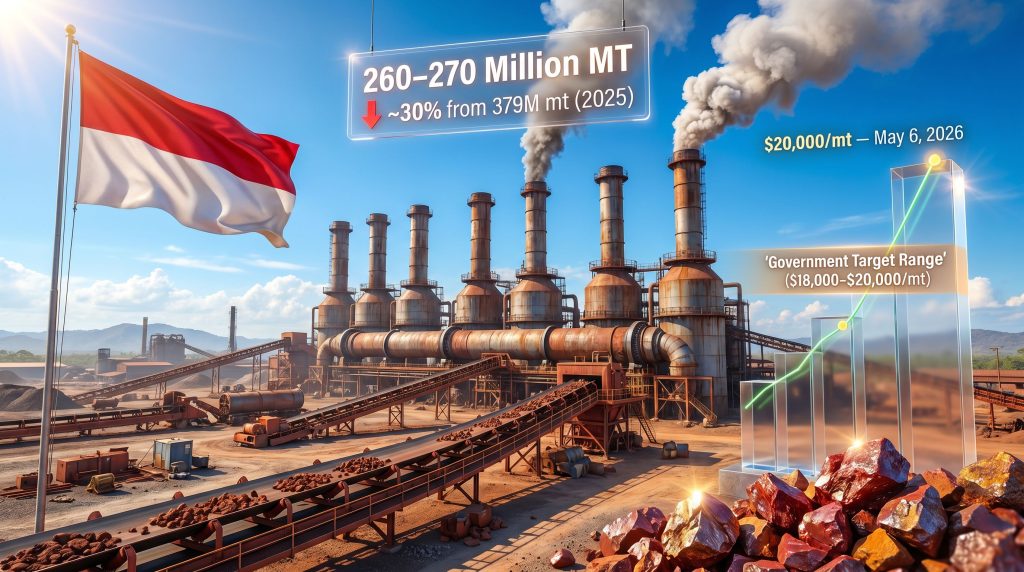
The policy response was calibrated, not reactive. Indonesia's Ministry of Energy and Mineral Resources set the 2026 nickel ore mining quota at 260 to 270 million metric tons, a reduction of roughly 30–32% from the 379 million tons approved the prior year (Reuters, 2026). Rather than framing this as a protectionist measure, officials positioned it explicitly as market stabilisation, identifying a price range of $18,000 to $20,000 per metric ton as the sustainable operating band for Indonesia's nickel industry (Reuters, 2026).
This articulation of a target price band by a senior government official represents a fundamentally new mode of commodity market communication. In effect, Indonesia is operating a sovereign price management mechanism, signalling to markets the intervention thresholds that will govern future supply decisions. This mirrors the forward guidance frameworks used by central banks and carries similar implications for how traders price in risk.
How Deep Are the Quota Cuts and Who Bears the Burden?
Quota Reduction by the Numbers
The headline figures from the Indonesia nickel ore quota cuts only partially capture the severity of the impact across different operations.
| Metric | 2025 Level | 2026 Quota | Change |
|---|---|---|---|
| National nickel ore quota | ~379 million mt | 260–270 million mt | Down ~30–32% |
| Actual 2025 ore production | ~320 million mt | Not applicable | Reference only |
| FINI estimated smelter demand | Not applicable | 340–350 million mt | Shortfall ~70–90M mt |
| Weda Bay Nickel allocation | ~42 million mt | ~12 million mt | Down ~71% |
| National RKEF utilisation | 84% | 76% | Down 8 percentage points |
| Sulawesi line utilisation | Normal range | Below 50% on some lines | Significant contraction |
The gap between the 260–270 million ton quota and FINI's projected domestic demand of 340–350 million tons is the critical stress point in the entire framework (Reuters, 2026). This shortfall of 70 to 90 million tons does not mean smelters will simply run short of ore and shut down. It means that smelters must compete for constrained ore supply, creating structural tightness that supports ore prices and compresses margins for processors that cannot secure sufficient feedstock.
The Weda Bay Case: Revealing the Allocation Calculus
The situation at Weda Bay Nickel provides the starkest illustration of how the quota reductions have been distributed. The operation, an Indonesian subsidiary of French mining group Eramet and one of the world's largest nickel mining complexes, saw its 2026 allocation reduced from approximately 42 million metric tons to just 12 million metric tons, a cut of roughly 71% that substantially exceeds the national average reduction. Indonesia's decision to order cuts at Weda Bay has attracted significant attention from global resource analysts.
The operational consequence was immediate: Weda Bay exhausted its entire annual quota by the end of May 2026, forcing a full halt to ore mining activity. The operation has since lodged an application for a supplementary allocation, positioning itself as the first major test case for Indonesia's quota revision mechanism (Reuters, 2026).
Several important market dynamics emerge from this development:
- The severity of Weda Bay's cut relative to the national average suggests quota allocations are not being distributed proportionally across producers, with some operations bearing disproportionate reduction burdens
- The speed at which a large operation can exhaust even a dramatically reduced quota (five months into the year) highlights the operational scale involved and the practical difficulty of enforcing annual caps within quarterly production cycles
- Whether Indonesia approves or denies Weda Bay's supplementary application will serve as a critical signal about the credibility and flexibility of the overall quota framework
- Eramet's public disclosure of the halt and the supplementary application represents important investor information about how French-listed mining majors with significant Indonesian exposure are navigating the new regulatory environment
South and Central Sulawesi: Indonesia's RKEF Heartland Under Pressure
The regional concentration of smelter stress matters significantly for understanding the full scope of the Indonesia nickel ore quota cuts. Processing facilities across South Sulawesi and Central Sulawesi, which represent Indonesia's primary RKEF smelter corridors, have reduced throughput to below 50% of rated capacity on certain production lines, according to FINI chairman Arif Perdana Kusuma speaking at the Critical Mineral Conference (Reuters, 2026).
Critically, smelter operators are not shutting down entirely. The decision to maintain partial operations rather than execute full furnace shutdowns reflects a specific technical and economic calculation: extinguishing electric arc furnaces used in RKEF processing carries substantial restart costs and requires months of recommissioning time (Reuters, 2026). Operators are absorbing the cost of running at minimal viable output to preserve furnace integrity rather than incur the far larger cost of a complete restart cycle.
This behaviour has important implications for market observers. It means that production figures will not fall as sharply as quota reductions might imply on paper, because operators will produce at minimum viable levels rather than zero. Consequently, energy consumption, labour costs, and fixed overhead continue to accumulate without generating proportionate revenue, compressing sector margins in ways that may not be immediately visible in aggregate output data.
What Is an RKEF Smelter and Why Does the Quota Cut Hit It So Hard?
Technical Profile: Rotary Kiln Electric Furnace Processing
For investors and market observers unfamiliar with the processing architecture underlying Indonesia's nickel industry, understanding RKEF technology is essential for interpreting the quota cut's downstream consequences.
Rotary kiln electric furnace processing is the dominant technology pathway for converting Indonesia's lateritic nickel ores into a usable industrial product. The process works in two stages:
- Rotary kiln pre-drying and calcination: Raw saprolite ore (typically containing 1.5–2.5% nickel) is fed into a rotating cylindrical kiln where it is heated to approximately 800–900 degrees Celsius, driving off moisture and beginning the chemical reduction process
- Electric furnace smelting: The calcined ore is transferred to a submerged arc electric furnace operating at temperatures above 1,500 degrees Celsius, where it is reduced to produce nickel pig iron (NPI) with nickel content typically in the range of 10–15%
The resulting NPI is not high-purity Class I nickel. It is a ferronickel alloy designed specifically as a feedstock for stainless steel production, primarily the 300-series austenitic grades that contain approximately 8–10% nickel and are the dominant stainless steel product in Chinese manufacturing.
The RKEF process has several characteristics that make it uniquely vulnerable to ore supply restrictions:
- High volume dependency: RKEF furnaces are designed for continuous, high-tonnage throughput. The thermal efficiency of the process depends on maintaining consistent ore feed rates; reducing throughput below approximately 60–70% of design capacity increases per-unit energy consumption significantly
- Feed chemistry sensitivity: RKEF processing requires relatively consistent ore grades and mineralogy. Mixing ore from different sources to compensate for quota restrictions can destabilise furnace chemistry and increase refractory wear
- Non-substitutable ore requirements: Unlike some processing technologies, RKEF cannot easily substitute lower-grade or different mineralogy feed sources without significant process adjustments, making it acutely sensitive to constraints on specific ore supply
A critical and often overlooked detail about RKEF economics is the relationship between ore grade and processing efficiency. Saprolite ores used in RKEF processing typically grade at 1.5–2.5% nickel, but the specific silica-to-magnesium ratio in the ore matrix is equally important for furnace stability. Indonesian saprolite from different geographic zones within the same island can have meaningfully different mineralogical characteristics that affect smelter performance, meaning quota cuts that restrict access to specific mine areas can have disproportionate operational impacts.
The Structural Vulnerability of Indonesia's NPI Supply Chain
Indonesia's RKEF-based NPI production represents the single largest component of global Class II nickel supply, feeding directly into Chinese stainless steel manufacturing that accounts for roughly half of global stainless production. This concentration creates profound supply chain vulnerability when ore quotas tighten.
The national decline in RKEF utilisation from 84% to 76%, with regional lines in Sulawesi operating below 50%, translates into measurable NPI output contraction with direct consequences for Chinese stainless steel feedstock availability (Reuters, 2026). Chinese mills that have structured their procurement around Indonesian NPI availability at prevailing price points now face both tighter supply and higher per-unit costs, squeezing margins across the stainless steel manufacturing chain.
An additional technical consideration that rarely receives attention in mainstream coverage involves the nickel content of NPI itself. When ore grades decline or feed rates are reduced sub-optimally, the nickel content of produced NPI can drift below target specifications, creating quality consistency issues for stainless steel manufacturers who have strict alloy composition requirements. This means the effective nickel supply reduction from quota cuts may be proportionally larger than the simple volume reduction implies.
How Are Global Nickel Prices Responding to Indonesia's Supply Intervention?
From Trough to Inflection: LME Nickel's 2026 Trajectory
The market's response to the Indonesia nickel ore quota cuts has been direct and measurable. LME nickel prices climbed to $20,000 per metric ton on May 6, 2026, the highest level recorded since May 2024, as market participants priced in the implications of tighter Indonesian ore supply and the operational disruptions emerging across the RKEF smelter belt (Reuters, 2026). Indeed, nickel price momentum in 2025 had already signalled that the market was primed for a supply-side catalyst.
The $20,000 threshold carries symbolic weight beyond its numerical value. It represents the upper boundary of the price range that Indonesian officials have publicly identified as the sustainable operating band for the country's nickel industry. The convergence of actual market prices with the government's stated target range within weeks of the quota system's enforcement suggests that the policy transmission mechanism is functioning largely as intended.
Several factors contributed simultaneously to the price surge:
- Quota enforcement visibility as the 260–270 million ton ceiling became operational from April 2026
- Disclosure of Weda Bay's production halt after quota exhaustion by end of May, confirming that enforcement was genuine rather than theoretical
- FINI's public disclosure of RKEF utilisation declining to 76% nationally, providing hard data on the processing chain impact
- Growing awareness that some Sulawesi production lines had reduced output to below 50% capacity, indicating a more severe near-term supply shock than headline quota figures implied
Furthermore, the nickel price jump following the Weda Bay production halt drew particular attention from commodity traders monitoring the pace of enforcement across Indonesia's mining regions.
The $18,000–$20,000 Target Band: Understanding the Policy Architecture
The explicit articulation of a price target band by a senior Indonesian government official is an unusual development in commodity market governance with significant implications for how traders, processors, and end users price risk.
| Price Level | Market Interpretation | Government Response Signal |
|---|---|---|
| Below $15,000/mt | Severe producer distress; project deferrals likely | Strong intervention pressure |
| $15,000–$18,000/mt | Below target; unsustainable for Indonesian producers | Further quota tightening probable |
| $18,000–$20,000/mt | Government-identified "sweet spot" | Current quota regime likely maintained |
| Above $20,000/mt | Demand destruction risk for stainless steel and EV sectors | Potential quota relief applications approved |
| Above $25,000/mt | Accelerated substitution and investment in competing sources | Risk of policy credibility erosion |
The market implication of this transparent price targeting is that investors now have a framework for anticipating policy responses at different price levels. If nickel prices fall back toward $15,000, the probability of additional quota reductions increases. If prices push well above $20,000, the probability of supplementary quota approvals for operations like Weda Bay increases. This creates an asymmetric policy put that functions as an implicit floor mechanism for nickel pricing.
This dynamic is reminiscent of commodity price band mechanisms attempted by various producers' associations historically, including OPEC's informal price targeting for crude oil. The key difference is that Indonesia's framework operates through domestic regulatory authority rather than multilateral agreement, making enforcement more unilateral but also potentially more credible in the near term.
What Does This Mean for Global Nickel Supply Chains?
Stainless Steel: The Highest-Probability Transmission Channel
The most immediate and quantifiable consequence of the Indonesia nickel ore quota cuts flows through the stainless steel supply chain. Indonesian RKEF-derived NPI is the primary raw material input for 300-series stainless steel manufacturing concentrated in Chinese mills, which collectively represent the single largest end-use for nickel globally.
A sustained reduction in Indonesian NPI output without equivalent substitution creates several compounding pressures:
- Feedstock tightening: Chinese stainless steel mills that rely on Indonesian NPI face reduced availability of their primary nickel input, forcing either production cuts, price increases, or substitution with higher-purity and more expensive nickel forms
- Import premium expansion: Stainless steel manufacturers willing to pay above-market prices for secured NPI supply will drive up Chinese NPI import premiums, adding cost across the manufacturing chain
- Scrap acceleration: Mills may increase utilisation of nickel-bearing stainless steel scrap as a partial substitute for NPI, but global scrap availability is constrained and the lead time for increased scrap collection is measured in quarters, not weeks
- Margin compression: Mills operating on thin processing margins may face input cost inflation that cannot be fully passed through to stainless product buyers, particularly if downstream demand remains soft
The key variable is timing. If quota restrictions ease in the second half of 2026 through supplementary allocations, stainless steel feedstock pressures may prove temporary. However, if the quota regime holds through year-end, the impact on Chinese stainless manufacturing costs could be substantial and sustained.
EV Battery Supply Chains: Secondary Sensitivity, Growing Importance
While RKEF-derived NPI is not directly used in battery-grade nickel production, the Indonesia nickel ore quota cuts create indirect pressure on the broader nickel ecosystem that is increasingly relevant to electric vehicle supply chains.
It is important to understand the technical distinction here:
- RKEF/NPI pathway: Saprolite ore processed through RKEF technology produces nickel pig iron used in stainless steel. This is Class II nickel and is not suitable for battery cathode materials without further refining
- HPAL pathway: High-pressure acid leach technology processes limonite ore to produce mixed hydroxide precipitate (MHP), which can be further refined into battery-grade nickel sulphate for use in high-nickel cathode chemistries such as NMC 811
Indonesia's HPAL projects, which target the battery supply chain directly, operate on separate ore quota allocations from RKEF-focused operations. However, any perception of sustained tightening in Indonesian nickel supply broadly influences Class I nickel prices and battery-grade nickel sulphate premiums, even when the physical flow impacts are concentrated in the NPI/stainless chain.
The longer-term strategic concern for battery supply chain planners is that Indonesia's demonstrated willingness to impose production restrictions creates sovereign policy risk that must now be factored into long-term procurement strategies. In addition, the broader impact of tariff dynamics on global nickel markets adds another layer of complexity for automotive manufacturers reassessing their sourcing assumptions.
Global Surplus Recalibration: Scenarios for H2 2026
The global nickel market has operated in structural surplus since 2022, a period that has weighed heavily on prices and dampened investment in new supply development outside Indonesia. The quota cuts introduce several possible trajectories for H2 2026:
Scenario A: Full enforcement, no major supplementary allocations
If Indonesia maintains the 260–270 million ton quota through year-end without approving significant supplementary allocations, the global nickel market could transition from structural surplus toward near-balance or mild deficit in H2 2026. This scenario is most positive for nickel prices and represents the policy intent.
Scenario B: Partial enforcement with selective supplementary approvals
The more probable scenario involves quota enforcement in aggregate while approving targeted supplementary allocations for specific operations, including potentially Weda Bay. This would maintain the price floor in the $18,000–$20,000 range without causing severe downstream disruption.
Scenario C: Quota revision upward under industry pressure
FINI's reported demand of 340–350 million tons relative to the 260–270 million ton quota creates substantial lobbying pressure from domestic smelter operators. If Indonesia raises the quota materially above 300 million tons in response to this pressure, the market surplus dynamic would re-establish and price gains could reverse.
The next major ASX story will hit our subscribers first
Indonesia's Broader Nickel Policy Architecture
From Volume Maximisation to Value Optimisation
The Indonesia nickel ore quota cuts of 2026 cannot be understood in isolation. They represent the latest phase in a policy arc that has fundamentally reshaped global nickel markets over the past six years. For context, Indonesian nickel price trends leading into 2026 illustrate how the market deterioration made active intervention increasingly unavoidable.
The trajectory breaks into distinct phases:
- 2020: Raw ore export ban. Indonesia prohibits the export of unprocessed nickel ore, forcing domestic value-addition and attracting massive smelter investment from Chinese and other foreign steel manufacturers
- 2021–2023: Smelter construction boom. RKEF capacity expands rapidly across Sulawesi, with dozens of new smelting lines coming online, driven by high nickel prices and the availability of cheap ore feedstock
- 2023–2025: Oversupply and price collapse. The combination of surging Indonesian NPI output, moderating stainless steel demand growth, and reduced EV demand forecasts creates structural market surplus, pushing nickel prices to multi-year lows below $15,000 per metric ton
- 2026: Active quota management. Indonesia shifts from volume-driven to value-driven policy, implementing production caps to engineer a price floor and prevent the market dynamics from devastating the domestic industry the export ban was designed to build
This policy evolution reflects an increasingly sophisticated understanding within Indonesian resource governance circles that maximising ore output does not maximise national economic value when it destroys the price environment that justifies downstream investment.
Risks That Could Undermine the Policy Framework
Despite the apparent early success of the Indonesia nickel ore quota cuts in pushing prices toward the $18,000–$20,000 target band, several structural risks could undermine the framework's effectiveness over time:
- Enforcement variability: Historical experience with Indonesian resource quotas reveals inconsistent compliance across producing regions, with informal and smaller-scale mining operations historically operating outside formal regulatory oversight across a vast archipelago
- Supplementary allocation escalation: The Weda Bay application is likely the first of many. If Indonesia approves supplementary allocations liberally in response to industry lobbying, the effective quota may drift substantially above the nominal ceiling, negating the market tightening effect
- Competitive supply response: Sustained nickel prices in the $18,000–$20,000 range will stimulate investment in nickel supply from alternative geographies, including the Philippines, Papua New Guinea, and emerging laterite projects in sub-Saharan Africa
- Demand-side substitution: At price levels above $18,000 per metric ton, stainless steel manufacturers may accelerate substitution away from 300-series grades toward lower-nickel or nickel-free alternatives, permanently reducing the demand base that Indonesian NPI production serves
- Domestic political pressure: The margin compression facing RKEF smelter operators due to ore feedstock shortfalls creates significant domestic political pressure on the government to ease restrictions, particularly if smelter operators with foreign ownership raise concerns through diplomatic channels
A less-discussed risk involves the ore grade dynamics that emerge under quota constraints. When producers face strict volume caps, there is a natural incentive to cherry-pick higher-grade ore zones to maximise the nickel content extracted from each permitted ton of mining. This high-grading strategy optimises short-term returns but accelerates the depletion of higher-quality ore zones, leaving a lower-grade resource base for future production periods.
What Other Resource Nations Will Take From Indonesia's Experiment
Perhaps the most significant long-term implication of Indonesia's 2026 nickel policy is its potential influence on how other resource-rich developing nations approach critical mineral governance. The explicit combination of domestic processing mandates, export restrictions, and active market management through production quotas represents a comprehensive resource nationalism toolkit that goes well beyond traditional royalty and tax frameworks.
Countries with significant lateritic nickel deposits in the Philippines, Papua New Guinea, Brazil, and several African nations are watching Indonesia's policy experiment closely. Moreover, Indonesia's navigation of output cuts and policy shifts has been closely studied by commodity analysts assessing whether the template is replicable in other critical mineral markets. If the quota regime successfully sustains nickel prices in the target band without triggering major supply substitution or demand destruction, it will provide a compelling model for other producers.
The geopolitical dimension is also significant. As critical minerals become increasingly central to the energy transition and technology supply chains, the ability to influence global commodity prices through production management confers strategic leverage that extends well beyond economic considerations into broader foreign policy and trade negotiation contexts.
Frequently Asked Questions: Indonesia Nickel Ore Quota Cuts
What is the 2026 nickel ore quota in Indonesia?
Indonesia's energy ministry has set the 2026 nickel ore mining quota at 260–270 million metric tons, down from approximately 379 million metric tons approved for 2025, representing a reduction of roughly 30–32% (Reuters, 2026).
Why did Indonesia cut nickel ore production quotas?
The cuts were implemented to address a multi-year supply glut that had suppressed nickel prices to levels deemed unsustainable for domestic producers. Indonesian officials identified the risk of generating the largest surplus in nickel market history in 2026 without intervention, and are actively targeting a price range of $18,000–$20,000 per metric ton (Reuters, 2026).
How does the quota cut affect RKEF smelters in Indonesia?
RKEF smelter capacity utilisation has declined from 84% to 76% nationally, with multiple production lines in South and Central Sulawesi operating at below 50% capacity (Reuters, 2026). Smelter operators are maintaining partial operations rather than shutting down entirely because extinguishing electric arc furnaces is costly and requires months of recommissioning work before production can resume.
What happened to Weda Bay Nickel's 2026 quota?
Weda Bay Nickel's 2026 allocation was reduced from approximately 42 million tons to just 12 million tons, a cut of roughly 71%. The operation exhausted its entire quota by the end of May 2026, forcing a complete halt to ore production. The company has since applied for a supplementary quota allocation (Reuters, 2026).
How have LME nickel prices responded to the quota cuts?
LME nickel prices reached $20,000 per metric ton on May 6, 2026, the highest level since May 2024, driven by supply reduction concerns stemming from Indonesia's quota enforcement and the operational disruptions emerging at major mining operations including Weda Bay (Reuters, 2026).
Could the quota cuts cause a global nickel deficit?
If enforced consistently through year-end without substantial supplementary allocations, the cuts could shift the global nickel market from structural surplus toward near-balance or mild deficit in H2 2026. However, quota revision pressure from domestic smelter operators, variable enforcement across Indonesia's mining regions, and potential demand-side substitution all represent meaningful uncertainties that could modify this outcome.
Key Takeaways: Indonesia's Nickel Quota Cuts at a Glance
- 2026 quota: 260–270 million mt, down approximately 30–32% from 379 million mt in 2025 (Reuters, 2026)
- Demand shortfall: FINI estimates domestic smelter demand of 340–350 million mt, creating a supply gap of 70–90 million tons (Reuters, 2026)
- Smelter utilisation: Fallen from 84% to 76% nationally; some Sulawesi lines below 50% capacity (Reuters, 2026)
- Weda Bay: Quota cut approximately 71%; ore production halted after quota exhaustion in May 2026 (Reuters, 2026)
- LME nickel: Reached $20,000/mt on May 6, 2026, the highest level since May 2024 (Reuters, 2026)
- Government price target: $18,000–$20,000/mt identified as the sustainable band for Indonesian producers (Reuters, 2026)
- Key risk: Supplementary quota applications from major operators could dilute the policy's market tightening effect if approved broadly
- Broader significance: Indonesia's policy represents a maturation from volume maximisation toward active commodity market management with potential implications for critical mineral governance globally
This article is for informational purposes only and does not constitute financial or investment advice. Nickel market conditions, quota levels, and policy frameworks are subject to change. Investors should conduct their own due diligence and consult qualified financial advisers before making investment decisions related to nickel, mining equities, or related instruments. Forward-looking statements and scenario analyses involve inherent uncertainty and actual outcomes may differ materially from projections.
Source: Reuters, 2026. Indonesian smelters cut production on lower nickel ore quota. Kitco News. Available at: kitco.com
Want to Identify the Next Major Mineral Discovery Before the Market Does?
Discovery Alert's proprietary Discovery IQ model scans ASX announcements in real time, transforming complex commodity data across more than 30 minerals — including nickel — into clear, actionable insights the moment a significant discovery is announced. Explore how historic mineral discoveries have generated extraordinary returns on Discovery Alert's dedicated discoveries page, and begin your 14-day free trial today to position yourself ahead of the broader market.