June 12, 2026
The Supply Shock That Changed Everything: Understanding the 2026 Sulphur Price Surge
Few commodities reveal the fragility of global food systems quite like sulphur. Invisible to most consumers yet embedded in virtually every kilogram of phosphate fertilizer applied to agricultural soils worldwide, sulphur occupies a uniquely precarious position in the global commodity hierarchy. It cannot be synthesised on demand, stockpiled indefinitely without degradation risk to logistics infrastructure, or sourced from alternative production pathways.
Every tonne of elemental sulphur traded globally is an involuntary byproduct of hydrocarbon processing, which means its supply is structurally tethered to refinery and gas processing output rather than to agricultural demand signals.
That fundamental asymmetry between supply and demand has always made sulphur pricing volatile. However, the conditions converging in mid-2026 have pushed the market into genuinely uncharted territory, with ADNOC raises June sulphur price serving as the clearest single indicator that the global fertilizer input cost environment has entered a new and more demanding phase.
When big ASX news breaks, our subscribers know first
Sulphur's Hidden Role in Global Food Production
To understand why a pricing announcement from an Abu Dhabi state producer carries such systemic weight, it helps to trace sulphur's journey from refinery gate to farm gate.
Elemental sulphur produced at oil and gas processing facilities is shipped primarily to sulphuric acid manufacturers, who convert it into the acidic reagent that drives phosphate rock dissolution. That sulphuric acid then reacts with phosphate rock to produce diammonium phosphate (DAP) and triple superphosphate (TSP), the two most widely applied phosphatic fertilizers across South and Southeast Asian agricultural systems.
In short, sulphur is not merely an industrial chemical. It is a foundational input in the nutrient chain that feeds more than two billion people across the Asian subcontinent. The critical minerals demand increasingly intersects with sulphur markets as energy transition industries compete for the same downstream acid supplies.
Key sulphur demand sectors beyond agriculture include:
- Copper hydrometallurgy: the copper leaching process relies on sulphuric acid as the primary leaching agent in heap leach operations, linking sulphur demand to global copper production ambitions
- Battery material processing: lithium and nickel refining increasingly rely on sulphuric acid as a processing reagent, creating a new demand vector from the energy transition
- Industrial chemicals: sulphur is embedded in the production of rayon, dyes, pharmaceuticals, and explosives manufacturing
- Mining reagents: beyond copper, acid-based ore processing across zinc, uranium, and rare earth operations contributes to baseline industrial demand
None of these sectors can easily substitute away from sulphur-derived inputs, which means demand is relatively price inelastic over short horizons. Consequently, supply disruptions translate directly into price spikes rather than demand destruction.
How Do Middle Eastern State Producers Set Global Sulphur Benchmarks?
The Official Selling Price Mechanism Explained
Unlike most commodities where spot markets and futures exchanges establish price discovery, sulphur pricing in the major Arabian Gulf-to-Asia trade route is anchored by monthly Official Selling Price announcements from state-owned producers. These OSPs function as administered price signals rather than market-clearing prices, setting the floor from which all subsequent freight, insurance, and delivered cost calculations flow.
ADNOC's Ruwais terminal on the western coast of Abu Dhabi is arguably the single most important sulphur pricing reference point globally. Its fob Ruwais OSP is the benchmark against which Indian subcontinent buyers — the world's largest sulphur-importing market collectively — negotiate their purchase terms. When ADNOC moves its OSP, the entire downstream fertilizer cost chain recalibrates within weeks. You can explore ADNOC's sulphur operations directly for further context on their production capabilities.
Comparative OSP Movements: Middle East Sulphur Producers in June 2026
| Producer | June 2026 OSP (fob) | Month-on-Month Change | Primary Destination Market |
|---|---|---|---|
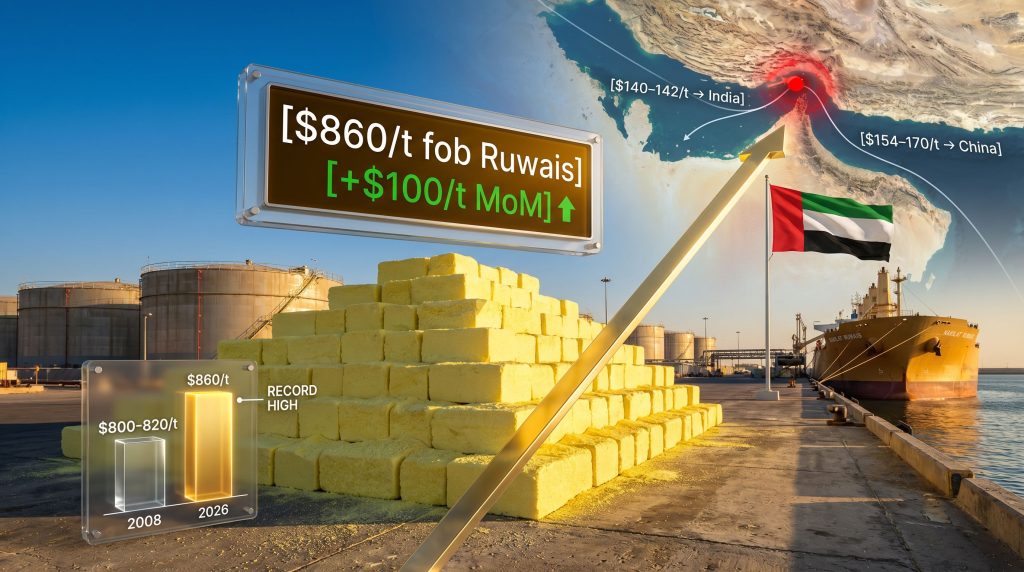
| ADNOC (Abu Dhabi) | $860/t fob Ruwais | +$100/t | Indian Subcontinent |
| KPC (Kuwait) | $805/t fob Kuwait | +$40/t | China |
| QatarEnergy | ~$805/t fob | +$65/t | Multiple Asian markets |
ADNOC's June 2026 OSP of $860/t fob Ruwais represents the highest level recorded in available price history, exceeding the previous peak of $800-820/t fob set during the commodity super-cycle of June-August 2008 by a margin of $40-60/t. (Source: Argus Media, June 2026)
The divergence between ADNOC's $100/t increase and KPC's $40/t rise is itself analytically significant. It reflects both differential exposure to Hormuz-related logistics disruption and differing assessments of demand strength in their respective primary destination markets. ADNOC's bolder pricing posture toward India suggests tighter near-term supply availability from UAE-origin cargoes than from Kuwaiti ones.
What Is Driving Sulphur Prices to Record Levels in 2026?
Factor 1: Strait of Hormuz Disruption and Gulf Supply Chain Fragmentation
The effective closure of the Strait of Hormuz following the US-Iran conflict in early 2026 has fundamentally altered the short-term supply landscape for Middle Eastern commodity exports, including sulphur. With no sulphur vessels having crossed the strait in the days immediately preceding Kuwait's June OSP announcement, the operational reality for buyers is one of material uncertainty around both cargo availability and shipment timing.
The disruption has created an asymmetry of impact across Gulf producers. Kuwaiti loadings have continued for June shipments but at a demonstrably reduced rate, while Omani producers loading from the port of Sur — which sits outside the Hormuz chokepoint entirely — have been positioned as relative beneficiaries. Furthermore, this supply chain disruption has compounded pre-existing logistical pressures across Asian import markets.
Beyond headline OSP figures, the war risk insurance premiums being layered onto Gulf-origin sulphur cargoes have materially elevated effective delivered costs. Elevated bunker surcharges reflecting fuel cost volatility compound this further, meaning the true landed cost of Arabian Gulf sulphur into India in June 2026 runs appreciably above even the already-record $1,000/t cfr implied by OSP plus standard freight. Argus Media's latest sulphur price reporting provides granular detail on how these incremental cost layers have accumulated month by month.
Factor 2: Structural Demand from South Asian Agricultural Markets
India's phosphate fertilizer manufacturing sector, the second largest in the world by production capacity, functions as a structural price floor for Middle Eastern sulphur. Indian state procurement agencies and large private importers, operating under the dual pressure of seasonal agricultural cycles and national food security mandates, absorb price increases that market participants in other regions would treat as demand-destructive.
The Kharif planting season (June-October) and Rabi season (November-March) create predictable sulphur demand surges tied to fertilizer application windows. Procurement of sulphur and downstream phosphate fertilizers ahead of these planting seasons reduces buyer flexibility in responding to price signals, giving sellers significant pricing power during the pre-season procurement window. June 2026 sits squarely within that high-leverage period for ADNOC.
Factor 3: The Phosphate Fertilizer Cost Transmission Effect
The mechanism through which sulphur price increases reach farmers is not instantaneous, but it is largely unavoidable. A $100/t increase in sulphur OSP adds directly to the production cost of sulphuric acid, which in turn flows into the cost structure of every tonne of DAP and TSP manufactured. With Indian importers already securing Moroccan DAP at $930-935/t cfr India and TSP at $710/t cfr in early June 2026, the fertilizer cost environment is already elevated.
The TSP market illustrates this dynamic particularly sharply. Indian Potash Limited's May tender for TSP attracted initial offers in the $770-850/t cfr range before counterbids pushed transaction prices to $710/t cfr, suggesting buyers retain some negotiating leverage. However, as sulphur input costs rise further, the floor under TSP pricing rises correspondingly, limiting the scope for future buyer-side compression. In addition, ongoing phosphate project development in non-Gulf regions underscores how producers globally are responding to this tightening cost environment.
Breaking Down the True Delivered Cost of Sulphur to India in 2026
From fob Ruwais to cfr India: A Full Cost Stack Analysis
Understanding what ADNOC's record OSP actually means for Indian buyers requires building the full cost stack from loading terminal to discharge port.
- Base OSP: $860/t fob Ruwais (ADNOC June 2026 announcement)
- Standard freight component: $140-142/t assessed for a 40,000-45,000t shipment to India's east coast (assessed late May/early June 2026)
- Implied cfr India base: $1,000-1,002/t cfr India before additional charges
- War risk insurance premium: an incremental cost layer reflecting Gulf conflict exposure, assessed separately from standard marine insurance
- Elevated bunker surcharges: reflecting fuel cost volatility associated with regional conflict conditions
- Effective fully-landed cost: materially above $1,000/t cfr on a total delivered basis
The psychological significance of the $1,000/t cfr threshold should not be underestimated. In commodity markets, round-number thresholds function as reference points for buyer resistance, contract renegotiation triggers, and government subsidy review mechanisms. Crossing this level for sulphur represents a qualitative shift in how downstream fertilizer economics are framed across the South Asian procurement chain.
How Does the 2026 Price Level Compare to Historical Benchmarks?
| Period | ADNOC OSP Range (fob) | Market Context |
|---|---|---|
| June-August 2008 | $800-820/t | Global commodity super-cycle peak |
| 2009-2020 (average) | $50-180/t | Post-GFC demand collapse and oversupply era |
| 2021-2022 | $200-400/t | Post-COVID supply chain recovery cycle |
| May 2026 | ~$760/t | Hormuz disruption begins tightening supply |
| June 2026 | $860/t | New all-time record per available price data |
The contrast between the 2008 record and the 2026 record is instructive. In 2008, record sulphur prices reflected a broad commodity demand super-cycle driven by Chinese industrial expansion. In 2026, however, the record has been set by geopolitical supply disruption rather than a fundamental demand acceleration, which creates a different risk profile for market participants.
The Multi-Vector Risk Environment Surrounding Sulphur in 2026
The Egyptian Phosphate Rock Complication
Compounding the sulphur price shock is a parallel supply uncertainty developing in the phosphate rock market. Egyptian exporters suspended fresh cargo offers for approximately one month following ministerial statements in early May 2026 suggesting the government would prioritise domestic supply. While exporters have since resumed submitting loading applications, uncertainty around 2027 availability remains unresolved.
Egypt is a significant supplier of phosphate rock to Asia-Pacific markets, with exports including lower-grade material from the Abu Tartour mines running at approximately 26-27% P2O5 content. Importantly, this lower-grade rock has historically found less favour with domestic Egyptian processors, who prefer higher-grade material from other mining zones. This grade differentiation means that export suspension does not automatically redirect Abu Tartour output to domestic consumers, creating genuine supply loss rather than simple trade flow redirection.
When sulphur cost escalation and phosphate rock supply uncertainty occur simultaneously, phosphate fertilizer producers face margin compression from both the acid input side and the rock input side — a dual squeeze that is relatively rare and particularly damaging to production economics.
The CBAM Policy Wildcard
A third risk layer is emerging from European regulatory developments that, while not directly linked to sulphur pricing, create additional uncertainty for the broader fertilizer trade complex. European supply chains are already under pressure as EU finance ministers work toward expanding the Carbon Border Adjustment Mechanism to additional downstream products, including fertilizers.
A notable technical specification under consideration relates to CBAM suspension conditions. The draft framework specifies that suspension could be triggered if average non-CBAM-related import price increases exceed 50% compared to the ten-year historical average and are sustained for at least six months. Given current sulphur and fertilizer price levels, this threshold is not theoretical. Finance ministers were scheduled to assess their negotiating position on 12 June 2026, with European Parliament committee votes expected in early July and September.
The next major ASX story will hit our subscribers first
How Are Global Sulphur Trade Flows Being Redirected in 2026?
The Hormuz Bypass Effect and Freight Rate Divergence
The geographic asymmetry of Hormuz disruption has produced measurable freight rate divergence across destination markets. India-bound freight from the Gulf has been assessed at $140-142/t for standard Handymax-sized shipments of 40,000-45,000 tonnes to east coast ports. China-bound freight has been running at $154-170/t for somewhat smaller 30,000-35,000 tonne shipments, reflecting both the longer voyage distance and elevated risk premiums on routes proximate to the disrupted strait.
Oman's position as a relative beneficiary of this disruption is geopolitically interesting. Omifco, the country's dominant fertilizer producer, exports from Sur, a port that sits on the Arabian Sea coast outside the Hormuz narrows entirely. This geographic advantage has allowed Oman-origin suppliers to capitalise on elevated nitrogen prices following the conflict disruption, with Omifco reportedly pursuing an IPO on the Muscat exchange to monetise this elevated earnings period.
Why Alternative Sulphur Supply Sources Cannot Fill the Gap
The structural dependency of Asian fertilizer manufacturers on Arabian Gulf sulphur cannot be rapidly diversified, for several interconnected reasons:
- Canadian sulphur from Alberta's oil sands operations represents a meaningful alternative supply source, but logistics from inland Canadian production sites to Asian-facing ports involve multiple transshipment steps and transit times that limit responsiveness to short-cycle demand spikes
- Central Asian sulphur from Kazakhstani and Turkmenistani gas processing facilities faces comparable logistical barriers, with overland rail routing to Pacific ports adding cost and transit time that reduces competitiveness against Gulf origin
- Russian sulphur exports face insurance and sanctions complications that restrict the participation of Western marine underwriters and major international shipping lines, effectively limiting accessible market depth regardless of headline price competitiveness
The result is a market where Asian buyers have limited practical alternatives to Arabian Gulf supply over any time horizon shorter than several months, reinforcing the pricing power that ADNOC raises June sulphur price decisions demonstrate so clearly.
Key Takeaways for Market Participants
The 2026 sulphur price surge is not a single-variable event. It represents the convergence of at least three distinct shock vectors occurring simultaneously:
- Geopolitical supply disruption via Hormuz closure, tightening cargo availability and adding insurance cost layers
- Structural agricultural demand from Indian subcontinent buyers operating under seasonal procurement pressure with limited price elasticity
- Compound input cost stress from simultaneous phosphate rock export uncertainty out of Egypt and sulphur cost escalation from the Gulf
The decision by ADNOC to raise its June sulphur OSP by a full $100/t in a single month, lifting the benchmark to an all-time record of $860/t fob Ruwais, signals that the state producer assessed demand conditions as sufficiently firm to absorb an unusually large increment without demand destruction. Whether that assessment proves accurate will be tested in the July OSP cycle.
For market participants, the critical forward-looking question is whether the June 2026 level represents a cyclical peak triggered by transient geopolitical disruption, or the opening of a sustained repricing period driven by structurally tighter supply conditions and growing multi-sector demand from agricultural, industrial, and energy transition consumers. The answer to that question has direct and material consequences for phosphate fertilizer pricing, agricultural input cost trajectories, and food security economics across South and Southeast Asia.
This article contains forward-looking analysis and market projections based on publicly available data current as of early June 2026. Commodity prices, geopolitical conditions, and regulatory frameworks can change rapidly. Nothing in this article constitutes financial or investment advice. Readers should conduct independent research before making any commercial or investment decisions based on the information presented here.
For ongoing market intelligence on global sulphur and fertilizer pricing, freight assessments, and OSP movements across key Arabian Gulf-to-Asia trade routes, Argus Media publishes specialised coverage through its sulphur and sulphuric acid market reporting service at argusmedia.com.
Want To Catch the Next Major Commodity Discovery Before the Market Does?
While sulphur supply shocks reshape global fertilizer economics, significant mineral discoveries on the ASX are creating compelling opportunities across copper, phosphate, and other critical commodities — and Discovery Alert's proprietary Discovery IQ model delivers real-time alerts the moment these discoveries are announced, turning complex geological data into actionable insights. Explore historic examples of what major mineral discoveries can return and begin your 14-day free trial to position yourself ahead of the broader market.