June 25, 2026
The Architecture of Scarcity: How Indonesia's Quota System Reshapes Global Nickel Markets
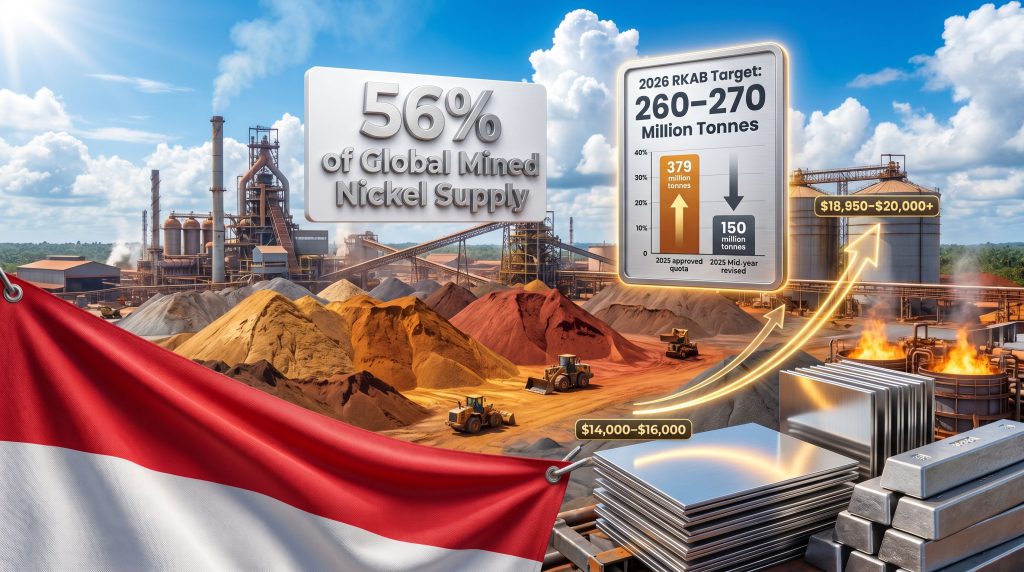
When a single country controls more than half of the world's mined supply of any critical mineral, the way it manages that supply becomes one of the most consequential variables in global commodity markets. This is precisely the position Indonesia occupies in nickel, and it is why the Indonesia nickel quota decision carries implications that extend far beyond Southeast Asia. As of late June 2026, Indonesia's Ministry of Energy and Mineral Resources has confirmed that no full-year production quota for nickel has yet been finalised, injecting a layer of strategic uncertainty into markets that were already navigating thin price margins and fragile demand signals.
Understanding what this means requires looking beyond the headline and into the machinery of how Indonesia actually controls its nickel output and why that control is growing more sophisticated with each passing year.
When big ASX news breaks, our subscribers know first
How the RKAB Framework Turns Bureaucracy Into Market Power
Indonesia's nickel quota system operates through the Rencana Kerja dan Anggaran Biaya, or RKAB, which translates roughly as the Work Plan and Budget framework. Every mining operator in Indonesia must submit an annual RKAB detailing planned production volumes, capital expenditure, and operational parameters. The Ministry of Energy and Mineral Resources then reviews these submissions and either approves, modifies, or rejects them based on a national-level assessment of downstream processing capacity and strategic supply targets.
The ministry does not issue blanket production approvals. Each revision request undergoes a structured assessment process specifically designed to align ore output with verified downstream processing capacity, giving Jakarta significant leverage over global nickel supply timing.
This is a critical distinction that many outside the industry miss. Indonesia is not simply capping production for conservation purposes. The RKAB system is calibrated to ensure that ore volumes do not exceed the absorption capacity of domestic smelters and processing facilities. When downstream capacity is constrained, upstream ore extraction is correspondingly limited. This linkage between mine output and refinery throughput creates a self-reinforcing industrial policy mechanism that simultaneously builds domestic processing infrastructure while controlling the global supply of raw material.
Furthermore, what makes this particularly powerful is that revision requests, whether seeking to increase or decrease permitted volumes, must pass through this formal review channel. There is no informal adjustment mechanism. This structural rigidity means that market rumours of quota increases, however widely circulated, remain speculative until the ministry formally confirms a change. Indonesian nickel market trends help contextualise just how consequential these administrative delays can be for global pricing.
Why Benchmark Minerals Flagged Significantly Lower Quotas
According to reporting from Benchmark Minerals, Indonesia announced significantly lower RKAB quotas in recent cycles, reinforcing the view that current restrictions represent a deliberate policy calibration rather than a temporary administrative backlog.
Mapping the Numbers: A Quota Trajectory Under Pressure
The numerical story of Indonesia's recent quota management is striking. To understand where markets stand in mid-2026, it helps to trace the trajectory of approved volumes over the preceding 18 months.
| Policy Period | Approved or Target Quota | Year-on-Year Change |
|---|---|---|
| 2025 Approved Quota | 379 million tonnes | Baseline reference |
| 2025 Revised Mid-Year | 150 million tonnes | -44% reduction from 272Mt |
| 2026 RKAB Target Range | 260–270 million tonnes | Approx. 30% below 2025 approved |
| Full-Year 2026 Quota | Not yet confirmed | Under ministry review |
The 2025 mid-year cut from 272 million tonnes to approximately 150 million tonnes represented one of the most abrupt supply-side adjustments the nickel market had seen in years. Even the 2026 target range of 260 to 270 million tonnes, which appears to represent a partial recovery, still sits roughly one-third below the 2025 approved ceiling of 379 million tonnes.
Even at the upper bound of Indonesia's 2026 target range, permitted production would remain approximately one-third below the 2025 approved quota of 379 million tonnes, a sustained compression that markets cannot absorb without price consequences.
This structural tightening matters because it signals a deliberate and durable shift in Indonesia's supply posture, not a temporary administrative correction. The fact that no full-year figure has been confirmed only adds to market tension, leaving buyers, traders, and downstream processors operating under conditions of meaningful supply ambiguity.
The Strategic Logic Behind the Restrictions
Indonesia's quota management is widely understood within specialist circles as an instrument of industrial policy rather than a simple conservation measure. Three interlocking objectives drive the current approach.
First, Indonesia is attempting to prevent the accelerated depletion of its laterite nickel ore reserves. Indonesia's nickel deposits are predominantly lateritic in nature, meaning they are found near the surface in weathered tropical soils rather than in deeper sulphide formations. Laterite ores are relatively easier to extract at scale but are not replenished on any human timescale.
Rapid extraction during the early 2020s contributed to an oversupply condition that compressed nickel prices into the $14,000 to $16,000 per tonne range, far below levels that incentivise new investment or reward existing operators. In addition, the Indonesia nickel industry challenges emerging from this era of overproduction have made quota discipline a structural necessity rather than merely a political preference.
Second, by restricting ore volumes, Jakarta compels miners and foreign investors to channel capital into domestic refining and processing infrastructure. This is the downstream industrialisation imperative that underpins Indonesia's entire natural resource strategy. Rather than exporting raw laterite ore, which has historically been subject to export bans since 2020, Indonesia is positioning itself as a value-added supplier of nickel matte, nickel pig iron, and mixed hydroxide precipitate (MHP) — a battery-grade intermediate that feeds directly into lithium-ion cathode manufacturing.
Third, quota discipline serves as a corrective mechanism against the oversupply problem. Between 2020 and 2024, Indonesia's rapid capacity expansion drove global nickel supply to levels that the market struggled to absorb, particularly as electric vehicle demand growth proved more gradual than early forecasts suggested. The result was a protracted price depression that damaged the economics of nickel projects globally, including high-cost sulphide operations in Canada and Australia.
MHP, Nickel Matte, and the Battery Supply Chain Connection
Does Quota Discipline Directly Affect Battery-Grade Nickel?
One dimension of the Indonesia nickel quota decision that rarely receives sufficient attention in mainstream coverage is the relationship between quota discipline and battery-grade nickel product availability. Indonesia's strategic pivot toward MHP and nickel matte is not incidental. These two output categories represent the critical interface between Indonesian mining and the global EV battery manufacturing ecosystem.
Mixed hydroxide precipitate is produced through high-pressure acid leaching (HPAL) of laterite ore, a technically demanding process that several major Indonesian industrial parks have been scaling up. MHP is then refined into nickel sulphate, which serves as the primary nickel input for nickel-manganese-cobalt (NMC) and nickel-cobalt-aluminium (NCA) battery cathodes. Consequently, as EV production scales globally, the availability of battery-grade MHP becomes an increasingly strategic commodity.
As global EV production scales toward projected demand targets, the availability of battery-grade nickel intermediates, particularly MHP, becomes a critical bottleneck. Indonesia's quota management directly controls how much of this material enters global markets and at what price point.
By restricting ore quotas, Indonesia indirectly controls MHP output as well, since HPAL facilities require consistent ore feed. This gives Jakarta a compounding form of leverage: it influences not just the nickel ore price but the price and availability of one of the most sought-after battery material intermediates in the world. Indonesia and the energy transition is therefore inseparable from this quota debate, as the country's supply decisions ripple directly into global EV manufacturing timelines.
Nickel Price Implications: From a Depressed Floor Toward Recovery
The supply mathematics of Indonesia's quota decisions translate directly into price trajectory scenarios. Analysts tracking the nickel supply-demand balance have observed that if Indonesia maintains quota discipline through 2026 and the global market moves into a verified deficit, prices could recover meaningfully from current depressed levels. Monitoring nickel price momentum has therefore become essential for both traders and downstream procurement teams.
Current spot prices remain in the $14,000 to $16,000 per tonne range, a level that renders many high-cost nickel operations globally uneconomic. Analysts monitoring supply-side dynamics have cited a potential recovery toward $18,950 to $20,000 or higher per tonne if sustained quota restriction drives inventory drawdowns on the London Metal Exchange (LME).
The LME inventory dynamic is a key variable that is sometimes underweighted in quota-focused analysis. Even if Indonesian ore output tightens, price recovery depends on whether above-ground LME stocks are drawn down faster than they are replenished from alternative sources. The Philippines, which produces approximately 10% of global mined nickel, could in theory partially offset Indonesian supply reductions, but lacks the processing infrastructure and scale to substitute meaningfully.
| Country | Global Nickel Share | Policy Approach | Strategic Orientation |
|---|---|---|---|
| Indonesia | ~56% | Active quota management via RKAB | Downstream industrialisation |
| Philippines | ~10% | Volume-based environmental controls | Raw ore export dependency |
| Russia | ~7% | State-influenced production targets | Integrated refining model |
| Canada | ~5% | Market-driven with environmental caps | Export-oriented |
| Australia | ~4% | Commercially driven, minimal quotas | Sulphide-focused production |
No other nation approaches Indonesia's combination of scale, laterite resource depth, and integrated industrial policy architecture. This structural uniqueness means the Indonesia nickel quota decision carries influence that no comparable regulatory event in any other producing country can replicate.
How Are Major Mines Responding?
It is also worth noting that individual mine-level cuts are amplifying the policy signal. According to Mining.com, Macquarie analysts have stated the nickel market could turn to deficit as a direct consequence of Indonesia's quota restrictions — a view that carries significant weight given the bank's commodity research track record.
The next major ASX story will hit our subscribers first
What Supply Chain Planners and Investors Should Be Watching
The absence of a confirmed full-year 2026 quota creates immediate operational challenges for downstream buyers. Stainless steel manufacturers, battery material processors, and nickel sulphate producers all require visibility on ore and intermediate supply volumes to manage procurement, pricing contracts, and production scheduling. Operating under sustained ambiguity forces conservative inventory positioning, which can itself create tightness in intermediate markets before any formal supply reduction materialises.
For those assessing the broader opportunity, the battery metals investment landscape in 2025 and beyond is being meaningfully shaped by these Indonesian supply dynamics, however, many investors are only beginning to price this in.
Key indicators that signal whether the market is moving toward deficit conditions:
- Official RKAB approval announcement from Indonesia's Ministry of Energy and Mineral Resources
- LME nickel inventory trend direction, specifically whether stock drawdowns are accelerating
- Downstream smelter utilisation rates at Indonesia's Morowali and Weda Bay industrial park complexes
- Price movement relative to the $16,000 to $18,000 per tonne technical resistance zone
- Any formally submitted revision requests and their review status within the ministry framework
- HPAL facility output data from Indonesia's major nickel processing hubs, which reveals how downstream capacity is actually tracking against ore availability
It is worth noting that the market's reaction to the mid-year 2025 quota cut was somewhat muted initially, partly because traders assumed the restriction would be temporary. If the 2026 quota confirmation also delays further into the second half of the year, sentiment could shift more sharply as buyers accept that structural tightening is the new baseline rather than an anomaly.
The Long Horizon: Restriction Now, Expansion Later
A less commonly appreciated dimension of Indonesia's strategy is that near-term quota discipline and long-term production expansion are not contradictory positions. Long-horizon projections for Indonesian nickel output suggest the country could more than double its production by 2035 as additional HPAL capacity, nickel pig iron facilities, and integrated industrial parks come fully online.
The current restrictive posture is best understood as a phased approach: compress supply now to stabilise prices, capture downstream value through refining investment, and then expand at a controlled pace from a higher-value base. This is a sophisticated resource management playbook that resource economists sometimes describe as a long-cycle commodity positioning strategy, where the resource owner sacrifices short-term volume for long-term price and structural influence.
For investors, this trajectory creates a narrowing window of supply shock opportunity. If Indonesia eventually expands output toward 2035 targets whilst global EV demand continues to build, the current period of quota discipline may represent one of the more significant supply-driven price recovery windows the nickel market will see this decade.
Disclaimer: This article contains forward-looking analysis, price projections, and scenario modelling based on publicly available data and market estimates. These projections are not financial advice and are subject to change based on regulatory decisions, demand conditions, and other macroeconomic variables. Investors should conduct their own research and seek independent financial advice before making investment decisions.
Want to Track the Next Major Mineral Discovery Before the Market Does?
Discovery Alert's proprietary Discovery IQ model delivers real-time ASX alerts on significant mineral discoveries — including battery metals critical to the global nickel and EV supply chain — transforming complex commodity data into actionable investment insights for traders and long-term investors alike. Explore how historic mineral discoveries have generated substantial returns and begin your 14-day free trial today to position yourself ahead of the broader market.