
August 2, 2026
The Geology Behind the Headlines: Why Indonesia Can No Longer Flood the Nickel Market
For most of the past decade, the global nickel market operated under a single governing assumption: Indonesia would produce as much as the world needed, Chinese-backed smelters would process it cheaply, and prices would remain suppressed indefinitely. That assumption was never really about policy. It was about geology, infrastructure economics, and the extraordinary pace at which Indonesia's laterite nickel belt was brought into production. What few analysts modelled carefully was the ceiling built into that system from the start.
Laterite deposits, which dominate Indonesian nickel geology, are fundamentally different from the sulphide ores found in Canada, Australia, and Tanzania. They are shallower, cheaper to mine in early years, but grade-depleting by nature. As the richest near-surface ore is extracted, grades fall, energy intensity rises, and processing economics deteriorate. That geological reality is now colliding with deliberate policy management in ways that forward price curves have not yet absorbed.
When big ASX news breaks, our subscribers know first
Three Converging Forces Behind Indonesia Nickel Supply Tightening
The Indonesia nickel supply tightening visible in 2026 is not the product of a single event. It reflects three distinct but reinforcing mechanisms operating simultaneously, each capable of moving supply volumes independently, and together capable of producing a market shift that consensus models are materially underestimating.
The Policy Layer: Quotas, Royalties, and Pricing Formulas
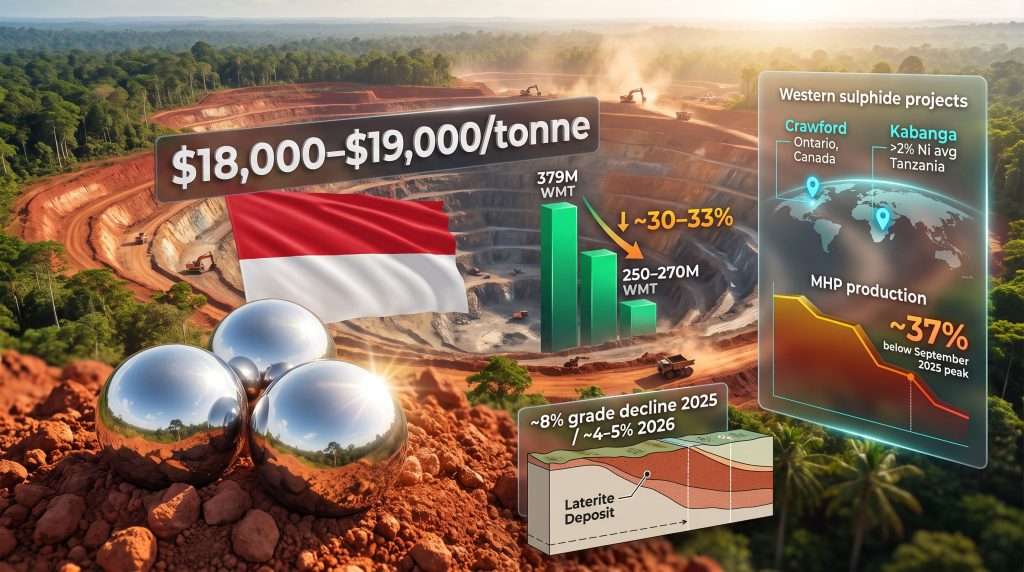
Jakarta's approach to nickel management has shifted from passive to active. The approved ore quota, which stood at approximately 379 million wet metric tonnes in 2025, has been reduced to a range of 250 to 270 million wet metric tonnes for 2026. That represents a year-on-year contraction of roughly 30 to 33%.
Critically, this is not simply a volume cut. The Indonesian government has simultaneously restructured royalty payments, revised the minimum price formula applied to exports, and shortened quota validity periods from three years to just one. That last change is particularly significant for market dynamics: annual renewal gives Jakarta maximum flexibility to tighten or loosen output based on prevailing conditions, with no multi-year commitments locking in supply volumes. Understanding the broader Indonesian nickel challenges helps contextualise why these structural reforms are proving so consequential.
The regulatory toolkit being deployed includes:
- Capped annual ore extraction quotas set below domestic smelter feedstock demand
- Revised royalty structures that raise the cost floor for production
- Updated minimum price formulas affecting ferronickel export economics
- Shortened quota validity periods replacing multi-year approvals
- Ferronickel export licensing requirements adding an additional regulatory layer
The net effect of this policy architecture is that Indonesia is no longer maximising output volume. It is managing price. The $18,000 to $19,000 per tonne range functions as something close to a policy-supported floor, aligned with Indonesian project break-even economics. Analysts who continue treating sub-$15,000 nickel as a realistic scenario are modelling a policy reversal that shows no signs of materialising.
The Geology Layer: Grade Decline That Compounds Independently of Policy
Even without any deliberate government intervention, Indonesian nickel supply would be tightening. Ore grades across Indonesia's laterite deposits declined an estimated 8% in 2025 and are tracking toward a further 4 to 5% deterioration in 2026. This is not a temporary fluctuation. It reflects the structural progression of maturing laterite deposits as higher-grade shallow ore is progressively exhausted.
Indonesian nickel price trends have responded accordingly, as grade decline in laterite deposits operates as a hidden supply cut. Each tonne of ore mined yields progressively less recoverable nickel, meaning the same extraction volume produces fewer units of payable metal. When this effect is layered on top of deliberate quota reductions, the combined impact on effective supply is substantially larger than headline tonne figures suggest.
The table below illustrates how these forces interact across key metrics:
| Metric | 2025 Level | 2026 Level | Change |
|---|---|---|---|
| Approved Ore Quota (wet metric tonnes) | ~379 million | ~250-270 million | Down ~30-33% |
| Domestic Smelter Feedstock Requirement | ~320-350 million | ~320-350 million | Unchanged |
| Quota Validity Period | 3 years | 1 year | Shortened |
| MHP Production vs. September 2025 Peak | Baseline | ~37% below peak | Down ~37% |
| Indonesian Ore Grade Decline (YoY) | Baseline | ~4-5% projected | Accelerating |
The domestic feedstock gap deserves particular attention. Indonesian smelters require an estimated 320 to 350 million tonnes of ore annually to operate at capacity. With quotas now set below that threshold, processors face a structural shortfall that is pushing some operations to reduce throughput and increasing dependency on ore imports, particularly from the Philippines.
The Geopolitical Layer: Sulphur, Hormuz, and MHP Output
The third mechanism is the least discussed and arguably the most underappreciated by mainstream nickel analysts. Mixed Hydroxide Precipitate, or MHP, is a critical intermediate product in the battery-grade nickel supply chain. Indonesian HPAL (High Pressure Acid Leach) facilities produce MHP using sulphuric acid generated domestically by burning imported elemental sulphur, rather than importing sulphuric acid directly.
That processing chain creates a specific geopolitical vulnerability: four of the five largest sulphur suppliers to Indonesia operate in regions whose shipping routes pass through or near the Strait of Hormuz. Any sustained disruption to that waterway does not merely affect oil markets. It directly constrains Indonesian MHP production by reducing sulphur availability.
MHP output has already fallen approximately 37% from its September 2025 peak through the most recent available data points. While multiple factors contribute to this decline, sulphur import logistics represent a structural exposure that is not yet fully reflected in analyst risk models or forward price curves. Furthermore, as StoneX's analysis on Indonesia's grip on global nickel markets highlights, these converging pressures have significant implications for global price formation.
Upside price risk in nickel is materially higher than forward curves imply, and the degree of that upside is at least partially dependent on conditions in the Strait of Hormuz. This is a geopolitical variable that most commodity analysts are not integrating into their nickel supply frameworks.
The Demand Story Analysts Keep Getting Wrong
Stainless Steel: The Largest and Most Overlooked Nickel Consumer
Media coverage consistently frames nickel as an EV battery metal. The data tells a different story. Stainless steel manufacturing remains the single largest global consumer of nickel, accounting for the majority of annual demand, and it has grown at 4.6 to 4.8% annually for an extended period. Furthermore, the breadth of nickel uses and importance across industrial applications spans corrosion-resistant industrial equipment, high-temperature processing environments, food manufacturing infrastructure, and architectural uses that have no meaningful EV connection.
The gap between actual demand growth and consensus modelling is striking. Nickel demand has expanded at close to 7% per year since 2019, while stainless steel consumption has compounded at 5 to 6% annually for decades. Yet most forward-looking demand models still default to approximately 3% annual growth, a figure that structurally understates the consumption baseline.
This persistent modelling error has real consequences. It means supply-demand balance projections that appear comfortable on paper are likely tighter in practice, and any supply-side shock lands against a demand environment that is more robust than consensus assumes.
Will a Green Premium Ever Emerge for Low-Carbon Nickel?
The question of whether battery manufacturers and EV producers will eventually pay a price premium for lower-carbon sulphide nickel over laterite-derived material is increasingly relevant as Western projects advance. The honest answer, based on current market dynamics, is not yet.
Intense price competition among EV manufacturers is suppressing near-term ESG pricing power across the battery supply chain. Automakers under margin pressure are optimising for cost, not carbon intensity. However, the absence of a direct price premium does not make green credentials irrelevant. Strong ESG positioning demonstrably improves access to strategic capital, reduces financing costs in some lending relationships, and expands the investor base available to project developers.
The conditions required for a genuine green premium to emerge include:
- Regulatory mandates requiring supply chain carbon disclosure and pricing at a material scale
- Sufficient tightening in battery-grade nickel supply to give buyers less pricing power
- Consumer demand for product-level carbon accountability strong enough to flow upstream to raw materials
- A competitive landscape in EV manufacturing that normalises rather than punishes premium supply sourcing
Western sulphide projects carry a structural carbon advantage over Indonesian laterite and HPAL processing routes. That advantage will eventually translate into commercial value. The timing remains uncertain.
Western Sulphide Projects: Repositioned by the New Supply Reality
Why Sulphide Geology Changes the Economics
Sulphide nickel deposits differ from laterite ores across multiple dimensions that matter for project economics. They typically carry higher grades, respond better to conventional flotation processing, generate lower energy intensity per unit of output, and produce a concentrate that is more amenable to established refining infrastructure. The carbon footprint of sulphide-to-refinery processing is substantially lower than the HPAL route required for most laterite material.
Years of below-cost nickel pricing, driven by Indonesian oversupply, prevented meaningful capital from reaching Western sulphide development. That capital starvation is now reversing as the structural supply shift from Indonesia becomes harder to dismiss. The broader nickel market recovery underway is consequently drawing renewed interest towards these previously overlooked assets.
Crawford and Kabanga: Two Projects at Different Gates
| Project | Location | Grade Profile | Strategic Investors | Current Gate |
|---|---|---|---|---|
| Crawford (Canada Nickel) | Ontario, Canada | Sulphide, Timmins district | Anglo American, Agnico Eagle, Samsung SDI, Taykwa Tagamou Nation | Final financing tranche (targeting early 2027) |
| Kabanga (Lifezone Metals) | Tanzania | >2% Ni average, up to 2.4% in peak feasibility years; Cu, Co, Ag credits | Strategic equity investors | Equity financing ahead of FID |
Crawford Nickel Project received a positive federal Decision Statement, making it the first mining project approved under Canada's amended Impact Assessment Act since 2019. That regulatory milestone clears the most significant permitting hurdle and leaves financing as the primary remaining gate before a targeted 2027 construction decision.
The financing structure already in place is substantive. Strategic anchor investors include Anglo American, Agnico Eagle, and Samsung SDI, representing industrial, mining, and battery supply chain interests respectively. The Taykwa Tagamou Nation committed $20 million of its own capital, a meaningful signal of community alignment that also strengthens the project's social licence positioning. The remaining gap has been characterised as approximately 10 to 20% of the total project or offtake financing package, with the complete structure targeted for closure in early 2027.
Kabanga Nickel Project in Tanzania presents a different risk-reward profile, anchored by a grade advantage that changes the fundamental economics. An average nickel grade above 2%, with individual years in the 18-year feasibility study reaching 2.4%, sits well above the effective grades achievable from maturing Indonesian laterite deposits even before the recent grade decline is applied. Copper, cobalt, and payable silver byproduct credits provide additional revenue diversification.
On execution readiness, the project has released more than $800 million in procurement packages to the market out of a total capital expenditure of approximately $930 million. Releasing the substantial majority of procurement packages before financial close is an unusual step that signals high confidence in project viability and an intent to compress the timeline between Final Investment Decision and first production. The company holds a $37 million cash position with a further $18.3 million available under a Taurus standby facility. Post-FID construction is estimated at approximately two and a half years.
Releasing over $800 million in procurement packages before financial close is an advanced preparation signal rarely seen at this stage of project development. It compresses the path from decision to production and demonstrates an unusual level of operational confidence relative to where the financing process currently stands.
Price Scenarios: What the Market Is and Is Not Pricing
| Price Scenario | Primary Driver | Market Implication |
|---|---|---|
| Below $15,000/tonne | Requires policy reversal plus grade recovery | Structurally unlikely under current multi-instrument framework |
| $18,000-$19,000/tonne | Indonesian break-even band, active quota management | Base case for 2026-2027 under sustained policy discipline |
| Above $19,000/tonne | Hormuz disruption combined with accelerating grade decline | Upside risk not yet reflected in forward curves |
The layered, reinforcing nature of Indonesia's supply management tools, deployed consistently since late 2025 and showing no signs of reversal, argues strongly for treating the $18,000 to $19,000 per tonne range as the new structural floor rather than a temporary price recovery. The multi-instrument approach encompassing royalties, annual quota caps, and revised pricing formulas represents a qualitatively different policy posture from anything seen in the previous decade.
The four-to-five-year horizon matters here. Indonesia's approach appears calibrated for sustained management, not a short-cycle market intervention. That duration is sufficient for Western sulphide projects currently in late-stage development to reach production within a price environment meaningfully more supportive than the conditions that suppressed investment through the early 2020s. In addition, reporting from Mining.com on nickel prices rising to two-year highs underscores how quickly the market has begun to reprice this structural shift.
Frequently Asked Questions: Indonesia Nickel Supply Tightening in 2026
Why Has Indonesia Cut Its Nickel Mining Quotas So Sharply in 2026?
Indonesian authorities reduced approved ore quotas from approximately 379 million tonnes in 2025 to roughly 250 to 270 million wet metric tonnes for 2026, a reduction of 30 to 33%. The underlying objective is to prevent global price collapse from oversupply and to align output volumes with domestic processing capacity while supporting a price floor consistent with Indonesian project break-even economics around $18,000 to $19,000 per tonne.
What Is the Domestic Smelter Feedstock Gap and Why Does It Create Additional Tightness?
Indonesian smelters require an estimated 320 to 350 million tonnes of ore annually to maintain full operating capacity. With approved quotas now set below that threshold, domestic processors face a structural shortfall, forcing some to reduce throughput and increasing dependency on ore imports from the Philippines as a partial substitute.
How Does the Strait of Hormuz Affect Indonesian Nickel Production Specifically?
Indonesia's HPAL processing facilities generate sulphuric acid domestically by burning imported elemental sulphur rather than importing sulphuric acid directly. Four of Indonesia's five largest sulphur suppliers are located in regions whose maritime shipping routes pass through or near the Strait of Hormuz, making MHP output directly vulnerable to disruptions in that waterway. MHP production has already fallen approximately 37% from its September 2025 peak.
Is Indonesian Nickel Grade Decline a Permanent Trend or a Cyclical Issue?
Grade decline in laterite deposits is a structural geological progression, not a cyclical phenomenon. As higher-grade near-surface ore is progressively depleted, grades fall and recovery rates deteriorate. An estimated 8% decline in 2025 followed by a projected further 4 to 5% in 2026 reflects this maturation dynamic. Without discovery and development of new higher-grade zones, the trend is expected to continue.
What Nickel Price Level Does Indonesia's Current Policy Framework Appear to Target?
The $18,000 to $19,000 per tonne range represents the approximate break-even threshold for Indonesian nickel projects under current cost structures, incorporating royalty obligations and revised pricing formulas. Policy instruments are being calibrated to defend this band as a floor, with meaningful upside risk if Strait of Hormuz disruptions or accelerating grade decline create additional supply pressure beyond what quota management alone implies.
The next major ASX story will hit our subscribers first
Key Takeaways
- Indonesian ore quotas have been reduced by approximately 30 to 33% year-on-year, from roughly 379 million to 250-270 million wet metric tonnes
- Domestic smelter feedstock demand of 320 to 350 million tonnes exceeds the approved quota, creating a structural supply gap within Indonesia itself
- Ore grade deterioration of approximately 8% in 2025 and 4 to 5% projected for 2026 compounds tightness entirely independent of policy action
- MHP production has declined roughly 37% from its September 2025 peak, driven by sulphur import logistics tied to Strait of Hormuz exposure
- The $18,000 to $19,000 per tonne band represents Indonesia's policy-supported floor, with upside risk not yet reflected in forward curves
- Stainless steel demand growing at 4.6 to 4.8% annually is the largest and most persistently underestimated pillar of global nickel consumption
- Western sulphide projects with superior grade profiles and lower carbon intensity are structurally better positioned than at any point in the past decade
- Crawford has cleared its federal Decision Statement and is primarily gated by finalising the last 10 to 20% of its financing package
- Kabanga carries a grade advantage exceeding 2% nickel and has released over $800 million in procurement packages ahead of FID
- The largest nickel mines globally are being reassessed as the Indonesian supply paradigm shifts fundamentally
Disclaimer: This article contains forward-looking statements, price forecasts, and market analysis based on information available at time of writing. These represent analytical perspectives and should not be construed as financial advice. Readers should conduct independent due diligence before making any investment decisions. Executives cited hold direct financial interests in the companies and projects discussed.
Want to Be First When the Next Major Nickel Discovery Hits the ASX?
Discovery Alert's proprietary Discovery IQ model delivers real-time alerts on significant ASX mineral discoveries — including nickel and other battery metals — instantly translating complex geological data into actionable investment insights for both short-term traders and long-term investors. Explore historic examples of major mineral discoveries and their extraordinary returns, then begin your 14-day free trial at Discovery Alert to position yourself ahead of the market as the nickel supply paradigm shifts fundamentally.