July 16, 2026
The Quiet Shift Reshaping Global Nickel Supply
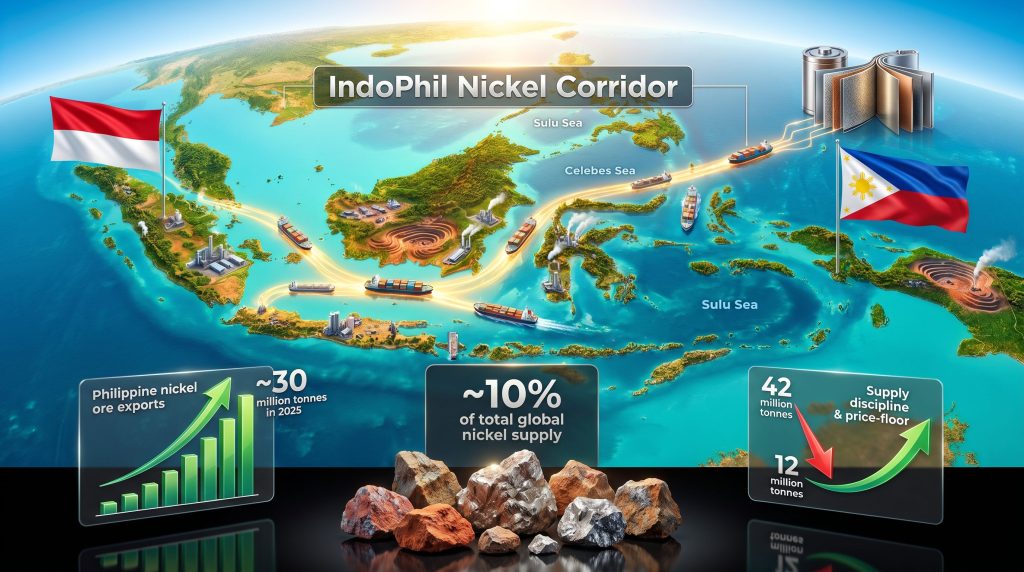
Few commodity dynamics carry as much structural weight as the relationship between the world's two largest nickel ore producers. Indonesia Philippines nickel cooperation, when moving in the same direction, sends consequences rippling across battery supply chains, downstream processors, and commodity pricing benchmarks on every continent. What is unfolding now between these two Southeast Asian giants is not simply a bilateral trade conversation. It represents a fundamental recalibration of how the world's dominant ore suppliers manage output, share technical knowledge, and position themselves within the global energy transition.
Understanding the significance of this shift requires stepping back from the headline announcement and examining the deeper structural forces that made formal cooperation between these two nations not just logical, but arguably inevitable. Furthermore, Indonesian nickel industry challenges have long signalled that unilateral strategies alone are insufficient to stabilise this volatile market.
When big ASX news breaks, our subscribers know first
Why Indonesia and the Philippines Are Coordinating Nickel Strategy Now
The Supply Squeeze Driving Bilateral Urgency
Indonesia holds the top position in global nickel ore production by a considerable margin. Yet a structural paradox has emerged: the country's domestic smelter capacity has, at various points, exceeded the ore volumes its own mining operations can reliably supply. When domestic shortfalls occur, whether from quota tightening, permitting constraints, or operational disruptions, Indonesian processors have historically turned to Philippine ore as a flexible supplementary input.
This dynamic was confirmed when Indonesia's Energy and Mineral Resources Minister Bahlil Lahadalia stated that Indonesia intends to discuss shipping more ore from the Philippines specifically for periods when domestic supply is under pressure. The arrangement is designed to function on a business-to-business basis rather than through fixed governmental quotas, preserving commercial flexibility while establishing a formal diplomatic foundation for the trade relationship.
A separate complicating factor has amplified the urgency. Indonesian nickel producers, particularly those operating High Pressure Acid Leach (HPAL) facilities that produce battery-grade nickel sulphate, have faced operational constraints tied to sulphur supply disruptions. Sulphur is a critical reagent in HPAL processing, and tightening availability has forced some producers to trim battery-feed output. This sulphur squeeze has added a processing-layer dimension to what might otherwise appear to be a straightforward mining supply issue, and Indonesia nickel smelter pressure has only intensified these operational challenges.
Where These Two Nations Stand in Global Nickel Production
Indonesia and the Philippines collectively represent the two largest sources of nickel ore globally, with Indonesia occupying the number one position and the Philippines ranking second. This concentration is unusual even by commodity market standards, where dominant producers typically number three or more. Consequently, Indonesia's role in nickel supply carries disproportionate influence over how the global energy transition unfolds.
| Country | Global Production Rank | Primary Ore Type | Downstream Maturity |
|---|---|---|---|
| Indonesia | #1 globally | Laterite (limonite and saprolite) | Advanced (NPI + HPAL infrastructure) |
| Philippines | #2 globally | Laterite (limonite-dominant) | Minimal (primarily raw ore exports) |
The concentration of global nickel ore production across just two neighbouring nations creates a supply-side dynamic with no close parallel in other industrial metals. Coordination between these producers, even without formal cartel mechanisms, structurally repositions the global market.
It is worth noting a technical distinction relevant to ore quality. Philippine nickel laterite deposits tend to be limonite-heavy, with relatively high iron content and moisture levels that suit hydrometallurgical processing routes such as HPAL. Indonesian deposits span both limonite and saprolite ore types, with saprolite-dominant material feeding pyrometallurgical routes such as nickel pig iron (NPI) smelting. The compatibility between Philippine ore grades and Indonesian HPAL facilities makes Philippine imports particularly valuable during periods of domestic HPAL feed shortfalls.
What the IndoPhil Nickel Corridor Actually Represents
A Structured Framework Beyond Simple Trade
The partnership being established between Indonesia's nickel industry association APNI and its Philippine counterpart PNIA extends considerably beyond an ore trading arrangement. As confirmed by APNI advisory board member Djoko Widajatno, discussions include cooperation on technology development and information exchange, signalling an intent to build institutional depth into the relationship rather than simply formalising existing commercial flows.
This institutional approach is significant for several reasons. It creates mechanisms for regulatory intelligence sharing, which benefits producers navigating different but increasingly convergent ESG compliance frameworks. It also establishes industry dialogue platforms that give producer associations a structured channel for communicating on market conditions, investment environments, and governance standards across both jurisdictions. For additional context on how this plays into regional ambitions, business discussions around the Philippines-Indonesia collaboration highlight the breadth of value chain ambitions underpinning this partnership.
The five operational pillars being developed under this framework include:
- Cross-border data and regulatory intelligence exchange between producer associations and relevant ministries
- Joint industry dialogue forums enabling direct producer-to-producer engagement on market conditions
- Reciprocal site exposure and technical learning programs facilitating knowledge transfer on mine operations
- Shared ESG and workforce development frameworks targeting alignment with international transparency standards
- Adaptive cooperation mechanisms designed to evolve as market conditions and regulatory environments shift
The inclusion of ESG alignment with frameworks such as the Extractive Industries Transparency Initiative reflects a strategic awareness that downstream buyers, particularly EV manufacturers and battery cell producers in Japan, South Korea, and Europe, are applying increasingly rigorous responsible sourcing criteria to their raw material procurement. Ore that meets or exceeds these standards commands pricing premiums that unverified supply cannot access.
Indonesia's Supply Discipline Strategy and What It Signals
Reading the Quota Reduction Signal
Indonesia's approach to managing its domestic nickel ore supply is one of the most closely watched policy levers in the global battery materials market. The country has employed quota mechanisms to regulate how much ore domestic smelters can access, and adjustments to these quotas carry immediate market implications. Moreover, Indonesian nickel price trends have closely tracked these quota decisions, underscoring the pricing power that comes with deliberate supply management.
A particularly instructive example involves significant reductions to ore quotas allocated to specific processing facilities, with some operators seeing their available tonnage cut by substantial margins. These reductions are not widely characterised as administrative corrections. Industry observers increasingly interpret them as deliberate instruments of supply discipline, designed to tighten ore availability, support ore pricing, and concentrate value-add activity within Indonesia's growing domestic processing sector.
When a nation controlling the world's largest nickel ore reserves strategically constrains domestic supply, the effect is not merely local. It reconfigures the global supply-demand balance and forces downstream processors in China and elsewhere to compete more aggressively for alternative ore sources.
The downstream consequence has been a reorientation of Philippine ore export flows. Where Chinese buyers historically dominated demand for Philippine nickel ore, Indonesian smelters facing domestic shortfalls are now competing for the same material. This demand pull from Indonesia represents a structural shift in who holds pricing leverage in the Southeast Asian ore market.
Projected Philippine Export Growth to Indonesia
Industry observers have noted the potential for significant growth in Philippine ore shipments directed toward Indonesian smelters. The convergence of Indonesian domestic supply constraints and the formalisation of bilateral cooperation frameworks creates conditions where Philippine exports to Indonesia could grow meaningfully from historical baselines.
Major Philippine nickel producers including Nickel Asia Corporation, Global Ferronickel Holdings, and DMCI Holdings operate across the country's main laterite-bearing regions in Palawan, Surigao, and Dinagat. Their combined production capacity positions the Philippines as a credible volume supplier capable of responding to increased Indonesian demand without requiring substantial new capital expenditure in the near term. This also supports the broader nickel market recovery narrative taking shape across Southeast Asia.
The Downstream Development Gap: The Philippines' Strategic Constraint
Why Raw Ore Exports Limit Long-Term Value Capture
One of the most structurally important asymmetries in the Indonesia-Philippines nickel relationship is the divergence in downstream processing maturity. Indonesia implemented an ore export ban in 2020 that forced domestic and foreign investors to build in-country smelting and refining infrastructure. The result has been a rapid expansion of NPI capacity and an emerging HPAL sector targeting battery-grade nickel sulphate production.
The Philippines attempted a similar export restriction but did not sustain it, continuing to export predominantly raw ore. The economic consequence is significant: a tonne of nickel ore generates far less export value than an equivalent nickel content delivered as NPI, mixed hydroxide precipitate (MHP), or refined nickel sulphate. The processing differential can represent several multiples of value depending on the output product.
| Product Form | Value per Tonne of Nickel Content (Relative) | Processing Route |
|---|---|---|
| Raw laterite ore | Baseline | None (direct export) |
| Nickel Pig Iron (NPI) | 3x to 5x | Pyrometallurgical (RKEF furnace) |
| Mixed Hydroxide Precipitate (MHP) | 6x to 8x | Hydrometallurgical (HPAL) |
| Battery-grade nickel sulphate | 8x to 12x | Chemical refining from MHP |
Note: Value multiples are indicative estimates based on general industry knowledge of processing economics and are not derived from a specific verified source. Readers should consult industry-specific pricing data for investment decisions.
The IndoPhil Corridor's technical cooperation pillar represents the first structured bilateral attempt to close this gap by facilitating knowledge transfer from Indonesia's more mature processing sector. Whether this translates into actual refinery investment in the Philippines will depend on capital availability, power infrastructure, and regulatory frameworks that extend beyond the scope of the current partnership announcement. Furthermore, analysts tracking this coordinated supply discipline have noted its potential to reshape how global nickel flows are allocated over the coming decade.
Geopolitical Alignment: ASEAN, the United States, and Critical Minerals
The Broader Strategic Architecture
The Indonesia Philippines nickel cooperation announcement does not exist in isolation. It sits within a broader reconfiguration of Southeast Asian mineral geopolitics driven by the global energy transition and increasing concern among Western economies about concentration of critical mineral processing in China.
The Philippines' engagement with a critical minerals framework agreement alongside the United States and multiple co-signing nations reflects a deliberate effort to diversify the country's mineral trade relationships and attract investment in in-country processing. This aligns directly with the IndoPhil Corridor's downstream development objectives and signals that Philippine mineral policy is oriented toward participating in diversified supply chains rather than remaining a single-destination ore exporter.
For investors tracking critical mineral supply chains, the interplay between bilateral producer cooperation and multilateral framework agreements creates a layered policy environment. The key distinction to maintain is that these frameworks establish enabling conditions rather than project-specific commitments. The commercial reality of whether processing investment actually flows into the Philippines will be determined by project economics, infrastructure readiness, and regulatory execution.
The next major ASX story will hit our subscribers first
Broader Market Implications for Nickel Investors
Supply-Side Effects That Merit Monitoring
The formalisation of Indonesia Philippines nickel cooperation introduces several structural dynamics that commodity market participants should track:
- Ore pricing support: Coordinated supply management between the world's two largest producers creates conditions for a structural price floor in nickel ore, particularly for laterite material feeding HPAL facilities
- ESG premium differentiation: As downstream battery manufacturers impose responsible sourcing requirements, ore verified against international transparency standards commands premiums over unverified supply, benefiting both Indonesian and Philippine producers operating under the corridor's governance framework
- Chinese processor exposure: Historical Chinese dominance in purchasing Philippine ore may erode if Indonesian demand for Philippine material grows, forcing Chinese processors to compete on price or seek alternative sources in less-established nickel jurisdictions
- Marginal producer displacement: Higher-cost, lower-governance nickel ore producers in other regions face competitive pressure as buyers prioritise supply from the two dominant producers operating under increasingly robust ESG frameworks
A scenario worth monitoring: if Philippine exports to Indonesia sustain growth from historical baselines over multiple years, the redistribution of ore flows away from Chinese buyers could meaningfully tighten the raw material environment for Chinese nickel pig iron and battery precursor producers, potentially accelerating Chinese investment in nickel projects across Africa, Central Asia, and Pacific Island nations.
This scenario remains speculative and is contingent on multiple variables including Indonesian domestic ore production levels, Philippine mining capacity utilisation, and the pace of EV demand growth. Investors should treat it as a directional signal rather than a base case. In addition, those seeking context on the ASEAN nickel supply dynamic will find that Indonesia and the Philippines together supply over 70% of the world's nickel, a concentration that amplifies every policy decision made by either nation.
Frequently Asked Questions: Indonesia Philippines Nickel Cooperation
What is the IndoPhil Nickel Corridor?
It is a bilateral partnership between Indonesian nickel producer association APNI and Philippine industry body PNIA, structured around five pillars covering data sharing, industry dialogue, technical education, ESG development, and adaptive cooperation mechanisms.
Why does Indonesia import nickel ore from the Philippines despite being the world's largest producer?
Indonesia's smelter capacity periodically exceeds domestically available ore supply, particularly during quota tightening cycles or mining disruptions. Philippine ore serves as a flexible supplementary input for Indonesian processors during these shortfall periods.
What is the significance of sulphur supply disruptions for Indonesian nickel producers?
Sulphur is a critical reagent in HPAL processing, the hydrometallurgical route used to produce battery-grade nickel sulphate. When sulphur availability tightens, HPAL operators must reduce output, creating battery-feed supply constraints that compound ore supply challenges.
How does the Philippines' downstream development gap affect the partnership's value?
The Philippines continues to export predominantly raw ore rather than processed nickel products, limiting its economic value capture relative to Indonesia's more advanced NPI and HPAL sector. The technical cooperation pillar of the IndoPhil Corridor is designed to begin addressing this gap through bilateral knowledge transfer.
Will this cooperation structurally affect nickel ore pricing?
Coordinated supply management between the world's two largest ore producers creates conditions for structural upward pressure on nickel ore pricing, particularly for ESG-compliant supply. This is a directional assessment rather than a confirmed forecast, and investors should not rely on it as investment advice.
Key Signals for 2026 and Beyond
The Indonesia Philippines nickel cooperation framework formalised during President Prabowo Subianto's visit to Cebu marks a measurable shift in how the world's two dominant ore producers manage their market relationship. Several structural signals deserve continued attention:
- The transition from informal B2B ore trading to institutionalised bilateral cooperation adds durability and predictability to an already significant supply relationship
- Indonesia's sulphur supply constraints affecting HPAL battery-feed production represent a near-term catalyst for increased Philippine ore demand that extends beyond the formal partnership announcement
- The downstream development asymmetry between Indonesia and the Philippines remains the most significant structural limitation on the partnership's long-term value creation potential
- ESG alignment through the IndoPhil framework creates a differentiated positioning opportunity for both nations in premium responsible sourcing markets
- The intersection of bilateral producer cooperation with the Philippines' broader critical minerals diplomacy signals a sustained policy orientation toward supply chain diversification
This article is intended for informational purposes only and does not constitute financial or investment advice. Projections, market scenarios, and forward-looking statements involve uncertainty and should not be relied upon as predictive of future outcomes. Readers are encouraged to consult qualified financial advisers before making investment decisions related to commodity markets.
Could The Next Major ASX Discovery Be Found Early?
Discovery Alert’s proprietary Discovery IQ model delivers real-time alerts on significant ASX mineral discoveries, helping investors cut through complex market noise and spot actionable opportunities sooner. See how major discoveries have historically driven exceptional returns on Discovery Alert’s discoveries page and start a 14-day free trial today.