Industrial Energy Storage Revolution Reshapes Heavy Resource Extraction
The global mining sector stands at a critical juncture where traditional fossil fuel dependency collides with accelerating demands for carbon-neutral operations. Industrial-scale battery deployments represent more than incremental technological upgrades; they signal fundamental shifts in how energy-intensive extraction processes integrate with renewable power systems. Furthermore, the sustainability transformation of mining companies worldwide creates mounting pressure from investors, regulators, and market forces to demonstrate measurable progress toward emission reduction targets while maintaining operational continuity in remote locations.
This transformation involves complex technical challenges that extend beyond simple equipment substitution. Battery storage systems must withstand extreme environmental conditions, provide reliable power for continuous operations, and integrate seamlessly with existing infrastructure. In addition, the intersection of automotive battery technology with industrial mining applications creates opportunities for cross-sector innovation while addressing unique operational requirements that traditional energy storage solutions cannot adequately serve.
Disclaimer: The following analysis contains forward-looking assessments and technological projections based on currently available information. Battery technology performance, cost projections, and mining industry adoption rates involve inherent uncertainties that may affect actual outcomes.
Battery Technology Integration Transforms Mining Power Infrastructure
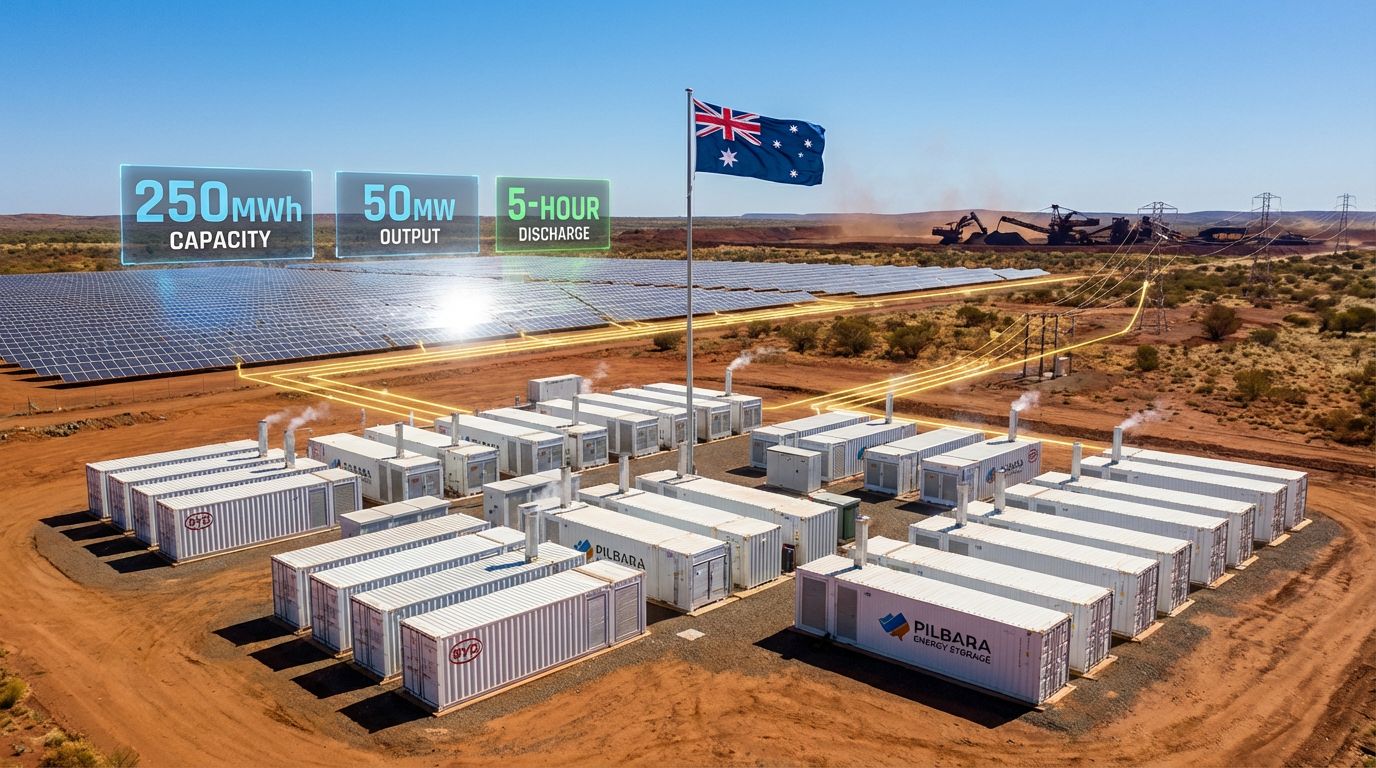
Fortescue's BYD battery delivery for Pilbara decarbonisation represents a significant milestone in industrial energy storage deployment. The North Star Junction installation demonstrates how large-scale battery systems can integrate into existing mining operations while supporting broader renewable energy strategies. This 250 MWh capacity system provides 50 MW sustained power output for five-hour discharge cycles, enabling overnight operations without diesel generator dependency.
Advanced Battery Architecture for Extreme Operating Conditions
The technical specifications reveal sophisticated engineering adaptations for harsh mining environments:
| Component | Specification | Operational Advantage |
|---|---|---|
| Storage Containers | 48 containerised units | Modular deployment and maintenance |
| Total Capacity | 250 MWh | Extended overnight power supply |
| Power Output | 50 MW sustained | Continuous industrial load support |
| Cooling System | Liquid cooling technology | Temperature management in 40°C+ conditions |
| Battery Chemistry | BYD Blade LiFePO₄ | Enhanced thermal stability |
BYD Blade Battery technology selection reflects specific considerations for mining applications. The lithium iron phosphate chemistry provides superior thermal stability compared to traditional cylindrical battery configurations, crucial for operations in the Pilbara's extreme temperature environment. However, liquid cooling systems maintain optimal battery cell temperatures during continuous mining operations, extending equipment lifespan while ensuring consistent performance output.
Strategic Energy Network Development
The Pilbara Energy Connect network architecture integrates multiple renewable energy components:
- Solar generation systems capturing daytime energy resources
- Battery storage networks enabling 24/7 power availability
- Grid integration protocols supporting mining equipment demands
- Backup power systems ensuring operational continuity
- Energy management software optimising resource allocation
Consequently, mining operations require continuous power availability with minimal interruption tolerance. The battery storage integration addresses this challenge by storing renewable energy generated during peak solar hours and distributing power during overnight operations when solar generation ceases.
Geographic Advantages Drive Renewable Energy Experimentation
Australia's Pilbara region provides unique conditions for large-scale energy storage testing and deployment. The combination of abundant solar resources, existing mining infrastructure, and remote location advantages creates an optimal environment for renewable energy innovation within industrial contexts.
Extreme Environment Testing Laboratory
The Pilbara's operational characteristics offer several strategic advantages:
- High solar irradiance: Approximately 2,200-2,400 peak sun hours annually
- Temperature extremes: Average summer temperatures exceeding 40°C
- Remote location benefits: Reduced grid integration constraints
- Existing infrastructure: Established mining operations and power distribution networks
- Regulatory flexibility: Reduced urban planning restrictions
These geographic factors enable comprehensive testing of battery storage systems under conditions that would be challenging to replicate in urban or suburban environments. For instance, the extreme temperature requirements particularly benefit battery thermal management system development.
Economic Transformation from Fossil Fuel Dependency
Remote mining operations traditionally rely heavily on diesel generators for backup power and off-grid electricity generation. The economic analysis reveals compelling advantages for battery metals investment adoption:
Cost Drivers Analysis:
- Diesel fuel transportation costs to remote locations
- Generator maintenance and replacement expenses
- Regulatory compliance costs for emission reporting
- Carbon pricing exposure in future regulatory frameworks
- Grid stability improvements reducing equipment damage
Industry benchmarks suggest battery storage systems typically range from $200-$400 USD per kWh installed capacity, though specific project costs vary significantly based on location, scale, and integration complexity. For Fortescue's planned 4-5 GWh rollout, this suggests capital requirements potentially ranging from $800 million to $2 billion USD.
Massive Scale Battery Deployments Signal Industry Transformation
The planned 4-5 GWh battery rollout across Fortescue's Pilbara operations represents one of the largest industrial battery deployments globally. This scale demonstrates the mining industry's commitment to renewable energy integration while providing valuable data for future installations across the global resource extraction sector.
Systematic Implementation Strategy
Fortescue's phased deployment approach provides operational learning integration:
- Phase One: 250 MWh North Star Junction (December 2025)
- Phase Two: 120 MWh Eliwana installation (Early 2026)
- Subsequent Phases: Additional installations reaching 4-5 GWh target
- Integration Learning: Performance data informing future deployments
- Technology Optimisation: Continuous improvement based on operational experience
Each installation phase generates critical operational data including thermal management validation, grid integration challenges, and maintenance requirements. Therefore, this systematic approach enables technology refinement while minimising deployment risks across multiple mining locations.
Global Mining Industry Implications
Furthermore, Fortescue's battery deployment strategy positions the company as a technology leader within the global mining sector. Other resource companies evaluate similar decarbonisation pathways as competitive pressure intensifies for carbon-neutral mining operations.
Key Industry Trends:
- Investor ESG requirements driving renewable energy adoption
- Regulatory compliance preparation for future emission standards
- International trade implications of decarbonised mining operations
- Competitive positioning against traditional fossil fuel-powered mines
- Technology cost-benefit analysis for large-scale operations
Consequently, the success or challenges experienced during Fortescue's deployment will significantly influence adoption decisions across the global mining industry. Technology validation in extreme operating conditions provides confidence for similar installations in other resource-rich regions whilst advancing industry innovation trends.
Renewable Energy Integration Enables Continuous Operations
The integration of battery storage systems with solar generation infrastructure addresses one of the most significant challenges in renewable energy adoption: providing consistent power supply for industrial operations that cannot tolerate interruptions.
Solar-Battery Energy Cycle Management
The 190 MW Cloudbreak Solar Farm development creates an integrated renewable energy ecosystem supporting continuous mining operations. As of December 2025, construction is approximately 50% complete, enabling the following operational sequence:
Daytime Operations (6:00 AM – 6:00 PM):
- Direct solar power supplies mining equipment
- Excess generation charges battery storage systems
- Peak solar output occurs during mid-day hours
- Grid balancing maintains stable frequency and voltage
Nighttime Operations (6:00 PM – 6:00 AM):
- Battery systems discharge stored renewable energy
- 50 MW sustained output supports mining equipment
- Five-hour discharge capability covers peak demand periods
- Backup systems ensure uninterrupted power availability
Technical Grid Integration Requirements
Industrial mining operations demand sophisticated power quality management:
| Technical Requirement | Battery System Response | Operational Benefit |
|---|---|---|
| Frequency Regulation | Maintain 50 Hz stability | Equipment protection |
| Voltage Support | Stabilise voltage levels | Consistent performance |
| Peak Shaving | Reduce demand spikes | Infrastructure protection |
| Load Following | Match variable demands | Operational flexibility |
The round-trip efficiency of battery storage systems typically ranges from 85-90% for complete charge-discharge cycles. This efficiency level, combined with the elimination of fuel transportation costs, creates compelling economic advantages for remote mining operations.
Strategic Technology Partnerships Accelerate Innovation
The collaboration between Fortescue and BYD demonstrates how global technology partnerships enable rapid advancement in industrial energy storage applications. This relationship represents technology transfer from automotive battery manufacturing to stationary industrial applications.
China-Australia Technology Collaboration
BYD's expansion from automotive to industrial energy storage reflects broader trends in battery technology commercialisation:
- Automotive-grade quality standards applied to stationary storage
- Manufacturing scale economies reducing per-unit costs
- Thermal management expertise from extreme-temperature EV applications
- Proven reliability data from millions of automotive battery installations
- Global supply chain capabilities supporting large-scale deployments
Yin Xueqin from BYD characterised Fortescue's decarbonisation programme as representing one of the most ambitious mining decarbonisation programmes globally, indicating the significance of this partnership for both technology validation and market development. Moreover, this collaboration highlights advances in lithium extraction innovation and sustainable resource utilisation.
Future Technology Development Pathways
The partnership enables continuous innovation in battery technology applications:
- Next-generation battery chemistry developments for industrial use
- Integration with hydrogen production for complete fossil fuel replacement
- Autonomous mining equipment powered by renewable energy systems
- Advanced energy management software optimising multi-site operations
- Predictive maintenance systems reducing downtime and costs
The Eliwana site 120 MWh installation scheduled for early 2026 provides opportunities for technology refinement based on operational experience from the North Star Junction deployment.
Industry-Wide Decarbonisation Acceleration
Mining companies across Australia and globally observe Fortescue's battery deployment progress as a potential model for their own renewable energy strategies. The success of this implementation could accelerate industry-wide adoption of similar technologies.
Competitive Pressure for Carbon-Neutral Operations
Multiple factors drive mining industry interest in renewable energy adoption:
- Environmental regulation compliance requirements
- Carbon pricing exposure in various jurisdictions
- Investor pressure for ESG performance improvement
- International market access preferences for low-carbon products
- Operational cost advantages from renewable energy systems
Traditional mining operations face increasing scrutiny regarding their carbon footprint. Companies that successfully implement renewable energy systems gain competitive advantages in both regulatory compliance and market positioning.
Technology Scalability Considerations
Battery storage technology scalability depends on several factors:
Technical Scalability:
- Manufacturing capacity expansion for large-scale deployments
- Supply chain development for critical battery materials
- Quality control maintenance across increased production volumes
- Technology standardisation enabling multi-vendor integration
Economic Scalability:
- Capital cost reduction through manufacturing learning curves
- Financing mechanisms for large-scale industrial projects
- Risk assessment frameworks for new technology deployments
- Performance guarantee structures supporting investment decisions
Regional Energy Grid Enhancement Benefits
Large-scale battery installations in mining operations provide broader benefits for regional energy grid stability and renewable energy integration across Western Australia's resource regions.
Grid Stability Contributions
Industrial battery systems support regional energy infrastructure through:
- Frequency regulation services maintaining grid stability
- Voltage support during peak demand periods
- Renewable energy integration enabling higher solar penetration
- Peak demand management reducing grid infrastructure stress
- Emergency backup power during grid disturbances
Remote area electrification benefits from demonstrated battery technology reliability in extreme conditions. The operational data generated provides confidence for additional renewable energy projects across similar geographic regions.
Export Market Positioning Advantages
Carbon-neutral iron ore production creates marketing advantages in international markets increasingly focused on supply chain decarbonisation:
- Premium pricing opportunities for low-carbon mineral products
- Regulatory compliance advantages in emission-conscious markets
- Supply chain differentiation supporting long-term customer relationships
- Future-proofing against potential carbon border adjustments
- Corporate sustainability reporting benefits for purchasing companies
The combination of renewable energy generation and battery storage enables Fortescue to market iron ore products with significantly reduced carbon intensity compared to traditional mining operations. Additionally, developments in battery recycling breakthrough technologies support circular economy principles.
Global Mining Technology Transfer Implications
The success of Fortescue's BYD battery delivery for Pilbara decarbonisation has implications extending far beyond a single mining operation. Technology validation in extreme Australian conditions provides confidence for similar deployments across global mining operations in diverse geographic regions. Furthermore, according to Australian Mining, this project establishes new benchmarks for industrial energy storage applications worldwide.
International Deployment Potential
Mining companies in other resource-rich regions evaluate similar energy strategies:
- African mining operations in high solar irradiance regions
- South American copper mines seeking grid independence
- Canadian resource extraction requiring extreme cold weather adaptation
- Middle Eastern mining projects with abundant solar resources
- Asian industrial minerals operations facing emission regulations
The technology transfer mechanisms developed through the Fortescue-BYD partnership create templates for adaptation across diverse operating environments and regulatory frameworks.
Future Energy Storage Innovation
Continued development in battery technology promises additional improvements:
Next-Generation Technologies:
- Solid-state battery chemistry offering enhanced energy density
- Advanced thermal management systems for extreme environments
- Grid-scale storage integration with smart grid technologies
- Artificial intelligence optimisation for energy management
- Recycling and sustainability protocols for battery lifecycle management
The operational experience gained from large-scale mining deployments provides valuable data for technology refinement and cost reduction across multiple industrial applications. As reported by Energy Storage News, this deployment sets new standards for mining sector energy storage implementations.
Investment and Technology Risk Disclaimer: Battery storage technology in mining applications involves technical, operational, and market risks that may affect performance and economic returns. Readers should conduct independent due diligence before making investment or technology adoption decisions based on this analysis.
Ready to Invest in the Next Major Mineral Discovery?
Discovery Alert instantly alerts investors to significant ASX mineral discoveries using its proprietary Discovery IQ model, turning complex mineral data into actionable insights. Understand why historic discoveries can generate substantial returns by exploring Discovery Alert's dedicated discoveries page, showcasing exceptional outcomes from companies advancing sustainable mining technologies and battery metals exploration.