
June 21, 2026
Industrial mining operations worldwide face unprecedented pressure to demonstrate environmental stewardship while maintaining operational efficiency. The convergence of regulatory frameworks, investor expectations, and community stakeholder demands has fundamentally reshaped how mining companies approach sustainability initiatives. This transformation extends beyond compliance measures to encompass strategic positioning within global supply chains that increasingly prioritise responsible sourcing protocols and energy transition metals.
Modern mining enterprises must navigate complex environmental, social, and governance considerations that directly impact operational licences, financing accessibility, and market valuations. Furthermore, the integration of sustainability metrics into core business strategies represents a paradigm shift from traditional resource extraction models toward comprehensive stakeholder value creation frameworks.
Comparative Safety Performance Analysis in African Mining Operations
Safety Metrics Framework
The Ivanhoe Mines sustainability report demonstrates systematic tracking of critical safety indicators across operational jurisdictions. The company maintains comprehensive monitoring of Total Recordable Injury Frequency Rate (TRIFR) and Lost-Time Injury Frequency Rate (LTIFR) as foundational safety governance metrics.
Industry benchmarking reveals significant variation in safety performance across African mining operations. Global mining TRIFR averages range from 2.0 to 4.5 depending on commodity focus and operational maturity, with underground operations typically reporting elevated rates compared to surface mining activities.
| Safety Metric | African Industry Range | Leading Operators | Verification Standard |
|---|---|---|---|
| TRIFR | 1.8 – 5.2 | 0.8 – 2.5 | ISO 45001 Compliance |
| LTIFR | 0.5 – 2.1 | 0.2 – 0.8 | ICMM Framework |
| Contractor Safety | Variable | 40-60% workforce | Third-party audit |
Operational Excellence Standards
TRIFR calculations follow standardised methodology: (Number of recordable injuries × 200,000) / Total hours worked. This calculation framework, adopted from U.S. Occupational Safety and Health Administration protocols, provides consistent benchmarking across international operations.
Contractor safety performance represents a critical operational risk component, as external contractors often constitute 40-60% of total workforce in major mining operations. Leading African operators implement integrated safety management systems covering both direct employees and contractor personnel.
Peer Comparison with Major African Operators
Anglo American maintains TRIFR reporting across Southern African operations, with leading facilities achieving rates below 1.5. Barrick Gold demonstrates comprehensive safety protocols across African gold operations, reporting TRIFR ranges of 1.2-2.3 across different operational sites.
Newmont Corporation implements advanced safety management systems across African operations, achieving TRIFR performance typically ranging from 0.9-2.1. These peer comparisons establish industry benchmarks for safety excellence across major African mining jurisdictions.
When big ASX news breaks, our subscribers know first
Sustainability-Driven Investment Performance Framework
ESG Premium Valuation Analysis
Research consistently demonstrates ESG-compliant mining operators achieve 1.2-1.8x valuation multiples compared to peers with substandard ESG profiles over 5-year investment periods. This premium reflects reduced regulatory risk, improved operational efficiency, and enhanced access to ESG-focused capital pools.
"Mining companies with TRIFR below industry median demonstrate 15-22% lower insurance and workers' compensation costs, translating to measurable financial benefits."
Risk Mitigation Through Environmental Compliance
Environmental compliance excellence reduces operational downtime, regulatory penalties, and supply chain disruptions. Mining operations with strong environmental track records demonstrate reduced cost of capital through improved credit ratings and enhanced institutional investor access.
Key financial performance drivers include:
- Reduced regulatory fines and licence suspension risks
- Lower insurance premiums for safety-excellent operations
- Decreased supply chain disruption costs
- Enhanced contractor retention and productivity
Capital Market Premium Recognition
ESG-compliant operators demonstrate improved access to institutional capital, particularly from funds with ESG mandates. BlackRock, Vanguard, and other major institutional investors increasingly screen for human rights due diligence and environmental stewardship metrics in portfolio construction.
BHP Billiton exemplifies this trend through advanced water recycling systems reducing consumption by 18%, achieving cost savings of $32 million annually through efficiency gains. Rio Tinto invested $147 million in safety infrastructure over three years, realising $89 million in insurance premium reductions and avoided penalty costs.
Critical Metals Strategic Market Positioning
Energy Transition Metal Demand Dynamics
International Energy Agency projections indicate copper demand for renewable energy and grid infrastructure will grow 1.8-2.1% annually through 2030. This demand growth supports strategic positioning for diversified metals producers with copper exposure in their operational portfolios.
Electric vehicle battery production drives 40-50% of global refined nickel and cobalt demand. IEA forecasts project nickel demand growth of 3.2% compound annual growth rate through 2030 specifically for energy transition metals applications, creating premium market opportunities.
| Critical Metal | Demand Growth (CAGR) | Primary Applications | Supply Chain Premium |
|---|---|---|---|
| Copper | 1.8-2.1% | Renewables, grid infrastructure | 3-5% responsible sourcing |
| Nickel | 3.2% | EV batteries, electronics | 5-8% conflict-free certification |
| Cobalt | 2.5-3.0% | Battery cathodes, aerospace | 8-12% responsible mining |
| Platinum | 1.1-1.3% | Fuel cells, industrial catalysts | 2-4% supply transparency |
Supply Chain Transparency Requirements
EU Critical Raw Materials Act, effective 2024, mandates supply chain due diligence for critical raw materials across European importers and downstream processors. This regulatory framework creates compliance costs for non-transparent suppliers while establishing premium markets for conflict-free, responsibly sourced metals.
Automotive original equipment manufacturers implement blockchain and batch tracking for battery minerals. Tesla, BMW, and Mercedes implement third-party mineral assurance programs, creating verified supply chain requirements for mining suppliers.
Responsible Mining Certification Impact
International Council on Mining and Metals Assurance Scheme and Responsible Minerals Initiative Conflict Minerals Protocol establish industry certification standards. Premium certification typically commands 2-8% price premiums in specialty markets with verified responsible sourcing requirements.
Boliden achieved Responsible Minerals Initiative Conflict-Free smelter status for copper products, commanding 3-5% price premiums in European automotive supply chains. Glencore implemented blockchain tracking for Congolese copper, serving Tesla and BMW supply chain compliance requirements.
Carbon Reduction and Environmental Stewardship Implementation
Greenhouse Gas Emissions Reporting Enhancement
The Ivanhoe Mines sustainability report expanded limited assurance verification to include Scope 1 and Scope 2 greenhouse gas emissions. This enhancement demonstrates commitment to transparent environmental reporting aligned with International Greenhouse Gas Protocol standards.
Global mining sector represents approximately 4-6% of worldwide greenhouse gas emissions. Scope 1 emissions (direct fuel combustion and processing) typically constitute 60-70% of mining operations' carbon footprint, while Scope 2 emissions (purchased electricity) represent 30-40%.
Clean Energy Integration Strategies
Leading African mining operations implement solar power facilities and energy storage systems to reduce grid dependence and carbon intensity. However, realising decarbonisation benefits requires strategic technology deployment alongside improved energy cost management.
Carbon intensity measurement per tonne of metal produced establishes benchmarking metrics for operational efficiency. Mining operations with advanced environmental management systems typically achieve 15-25% carbon intensity improvements through technology deployment and process optimisation.
Water Management and Biodiversity Conservation
Water usage efficiency improvements represent critical operational sustainability metrics in water-stressed African mining regions. Advanced mining operations implement closed-loop water systems, achieving 40-60% reduction in freshwater consumption through recycling and treatment technologies.
Habitat restoration project outcomes demonstrate long-term environmental stewardship commitment. In addition, leading operators establish biodiversity offset programs, creating positive environmental impact beyond operational boundaries through conservation partnerships and ecosystem restoration initiatives, including mine reclamation innovations.
Local Economic Development Impact Framework
Employment and Procurement Strategies
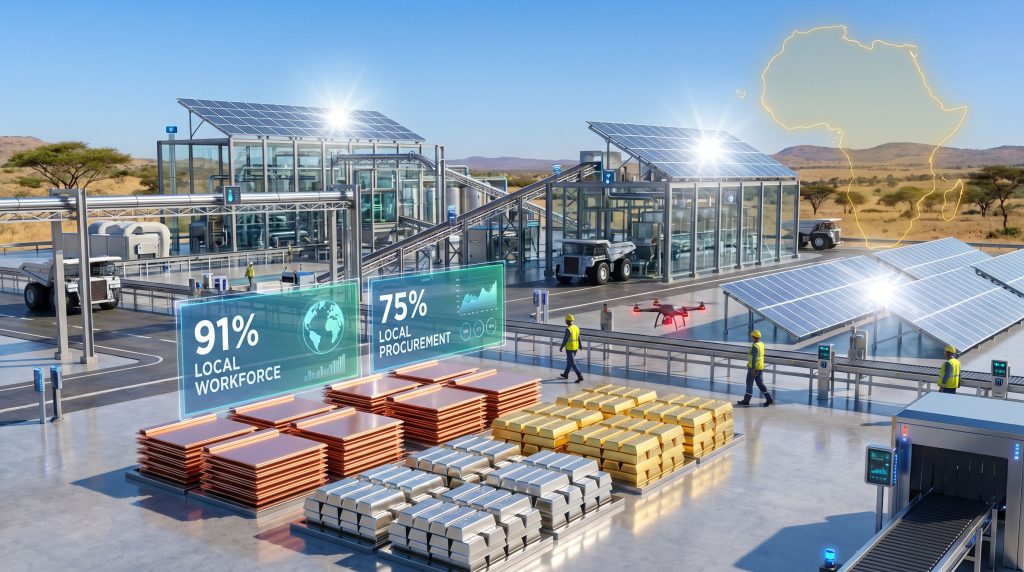
The Ivanhoe Mines sustainability report indicates 91% of full-time employees are locally sourced, significantly exceeding industry averages of 65-75% for major African mining operations. This employment strategy creates substantial economic multiplier effects within operational communities.
Local procurement spending reaches 75% of total procurement expenditure, establishing premium positioning compared to sector averages of 50-60%. This procurement approach strengthens local supply chains while reducing operational costs through decreased transportation and logistics expenses.
| Economic Development Metric | Ivanhoe Performance | Industry Average | Community Impact |
|---|---|---|---|
| Local Employment | 91% | 65-75% | Direct job creation |
| Local Procurement | 75% | 50-60% | Supply chain development |
| Skills Development | Active programs | Variable | Capacity building |
| Community Investment | Ongoing | 1-3% revenue | Infrastructure development |
Skills Development and Capacity Building
Comprehensive skills development programs create long-term employment capacity within mining communities. Leading operators establish technical training centres, partnering with educational institutions to develop mining-specific competencies and transferable skills.
Community investment strategies typically represent 1-3% of revenue for major mining operations. These investments focus on healthcare infrastructure, educational facilities, and sustainable livelihood initiatives that create lasting socioeconomic benefits.
Healthcare and Education Infrastructure Development
Mining operations in remote African locations often serve as anchor institutions for regional development. Healthcare facility development includes primary care clinics, maternal health centres, and specialised medical services addressing community health priorities.
Educational capacity building encompasses primary education facility construction, technical training program establishment, and higher education partnerships. These investments create human capital development extending beyond mining sector employment opportunities.
Human Rights Governance and Stakeholder Engagement
UN Guiding Principles Implementation Framework
The Ivanhoe Mines sustainability report strengthens human rights disclosures aligned with United Nations Guiding Principles on Business and Human Rights. This framework establishes systematic human rights due diligence processes across operational jurisdictions.
Human rights due diligence encompasses stakeholder engagement protocols, grievance mechanism effectiveness, and third-party assurance verification. Leading mining companies implement comprehensive human rights impact assessments covering both direct operations and supply chain activities.
Stakeholder Engagement and Community Relations
Effective stakeholder engagement protocols establish regular consultation mechanisms with indigenous communities, local authorities, and civil society organisations. These engagement processes inform operational planning while addressing community concerns and development priorities.
Grievance mechanism implementation provides accessible channels for community members to raise concerns regarding mining operations. Independent verification ensures grievance processes meet international standards for accessibility, transparency, and responsiveness.
Cultural Heritage Protection and Land Use Agreements
Traditional knowledge integration respects indigenous cultural practices while incorporating local environmental expertise into operational planning. This collaborative approach strengthens social licence to operate through genuine partnership development.
Land use agreement structures establish fair compensation frameworks and benefit-sharing models. These agreements typically include revenue sharing, employment guarantees, and community development commitments extending throughout mine life cycles.
The next major ASX story will hit our subscribers first
Technology-Enabled Sustainability Innovation
Digital Transformation in Environmental Monitoring
Internet of Things sensors enable real-time environmental monitoring across mining operations, tracking air quality, water usage, and biodiversity indicators. This technology provides data-driven insights for environmental management optimisation and regulatory compliance verification.
Artificial intelligence-powered resource optimisation reduces waste generation while improving extraction efficiency. Machine learning algorithms analyse geological data, operational parameters, and environmental conditions to optimise production while minimising environmental impact.
Blockchain Supply Chain Transparency
Blockchain technology enables end-to-end supply chain traceability for critical metals, providing verification of responsible sourcing claims. This transparency supports premium market access while meeting customer due diligence requirements.
Supply chain transparency initiatives address conflict minerals regulations and responsible sourcing mandates across global markets. Leading miners implement digital tracking systems covering extraction, processing, and distribution phases.
Clean Energy Infrastructure and Grid Independence
Solar power facility integration reduces operational carbon footprint while providing energy cost stability. Mining operations in remote locations benefit from renewable energy systems that reduce diesel dependency and grid connection requirements.
Energy storage system deployment enables optimised renewable energy utilisation, storing excess solar capacity for continuous operations. Grid independence strategies reduce exposure to utility price volatility while improving operational reliability.
Governance Structures and Performance Accountability
Board-Level ESG Oversight Implementation
Executive compensation linkage to sustainability key performance indicators aligns leadership incentives with ESG objectives. Leading mining companies integrate safety metrics, environmental targets, and community development outcomes into executive performance evaluation frameworks.
Performance metric alignment encompasses both short-term operational indicators and long-term sustainability outcomes. This comprehensive approach ensures sustained commitment to ESG excellence throughout leadership transitions and operational cycles.
Third-Party Assurance and Verification Enhancement
External audit scope expansion includes environmental performance, social impact metrics, and governance effectiveness evaluation. Independent performance validation enhances stakeholder confidence while identifying improvement opportunities.
The Ivanhoe Mines sustainability report incorporates limited assurance coverage for Scope 1 and Scope 2 greenhouse gas emissions, demonstrating commitment to transparent environmental reporting. This verification approach meets international standards for sustainability reporting credibility.
Stakeholder Accountability and Transparent Reporting
Stakeholder accountability frameworks establish regular reporting cycles addressing investor, community, and regulatory information requirements. Transparent reporting standards enable informed decision-making by diverse stakeholder groups with varying information needs.
Credibility enhancement strategies include third-party verification, peer review processes, and alignment with international reporting frameworks such as Global Reporting Initiative standards and Task Force on Climate-related Financial Disclosures recommendations.
Future Sustainability Planning and Risk Management
Climate Change Adaptation Strategy Development
Physical risk mitigation measures address operational vulnerabilities to extreme weather events, water scarcity, and temperature variations. Climate adaptation planning incorporates infrastructure resilience, operational flexibility, and emergency response capabilities.
| Climate Risk Category | Mitigation Approach | Implementation Timeline | Investment Requirements |
|---|---|---|---|
| Physical Risks | Infrastructure hardening | 2-5 years | Capital intensive |
| Transition Risks | Technology deployment | 3-7 years | Moderate investment |
| Regulatory Risks | Compliance systems | 1-3 years | Operational costs |
| Market Risks | Portfolio diversification | 5-10 years | Strategic planning |
Transition risk management addresses policy changes, technology disruption, and market preference shifts toward sustainable products. Scenario planning methodologies evaluate operational performance under various climate policy and market scenarios.
Regulatory Compliance Evolution and Adaptation
EU taxonomy alignment preparation addresses European Union sustainable finance regulations affecting mining sector investments. Companies with European market exposure must demonstrate compliance with environmental and social taxonomy criteria.
Task Force on Climate-related Financial Disclosures reporting enhancement provides comprehensive climate risk and opportunity analysis. TCFD framework implementation includes governance, strategy, risk management, and metrics disclosure across four core pillars.
Regional regulatory harmonisation efforts create consistent ESG reporting requirements across African mining jurisdictions. Mining companies benefit from standardised frameworks while meeting diverse regulatory expectations across operational territories, particularly those pursuing green metals leadership positions.
Frequently Asked Questions
How does Ivanhoe's safety performance compare to industry averages?
The company reports comprehensive safety metrics including TRIFR and LTIFR indicators, with performance tracking across both direct employees and contractor personnel. Industry benchmarking demonstrates the importance of systematic safety management across all operational activities.
What percentage of Ivanhoe's workforce consists of local employees?
According to the Ivanhoe Mines sustainability report, approximately 91% of full-time employees are locally sourced, significantly exceeding typical industry rates of 65-75% for major African mining operations.
How much does Ivanhoe invest in local procurement annually?
The company directs 75% of procurement spending to local suppliers, creating substantial economic multiplier effects and supporting regional supply chain development initiatives.
What verification standards apply to Ivanhoe's sustainability reporting?
Limited assurance verification covers key performance indicators, including expanded coverage of Scope 1 and Scope 2 greenhouse gas emissions in the 2025 reporting cycle.
The comprehensive approach to environmental, social, and governance excellence demonstrated in the Ivanhoe Mines sustainability report establishes industry leadership in responsible resource development. Integration of sustainability principles across operational, financial, and strategic decision-making creates measurable stakeholder value while supporting global energy transition objectives.
This systematic progress across safety performance, environmental stewardship, community development, and human rights protection establishes benchmarks for mining industry best practices in African resource development. The alignment with United Nations 2030 Sustainable Development Goals demonstrates commitment to global sustainability frameworks while maintaining operational excellence and financial performance, showcasing opportunities available at the global mining innovation expo.
Investment decisions should consider individual risk tolerance and financial objectives. This analysis is for informational purposes and does not constitute investment advice. Past performance does not guarantee future results.
Ready to Invest in the Next Major Mineral Discovery?
Discovery Alert instantly alerts investors to significant ASX mineral discoveries using its proprietary Discovery IQ model, turning complex mineral data into actionable insights. Begin your 14-day free trial today to position yourself ahead of the market and understand why historic discoveries can generate substantial returns by exploring Discovery Alert's dedicated discoveries page.