July 12, 2026
The Hidden Architecture of Commodity Trade Finance Is Being Rebuilt in Real Time
Few structural forces in global finance move as quietly or as consequentially as the slow rehabilitation of previously sanctioned markets. When trade finance institutions begin publicly acknowledging inbound client pressure from commodity trading desks, it rarely signals exploration. It signals that the groundwork has already been laid elsewhere, and that banks are being asked to join a party that started without them.
That dynamic is now playing out in Venezuela. ING Venezuela commodity deals have emerged as a telling indicator of how mainstream finance is repositioning itself around a market that was, until recently, effectively off-limits for regulated European institutions.
Major commodity trading houses have established operational footholds in Venezuelan resource flows, and the financing gap left by years of sanctions caution is becoming commercially untenable for firms managing high-volume cargo logistics on proprietary capital alone.
ING Groep, consistently ranked among the top three commodity trade finance banks in North America, has confirmed it is fielding significant volumes of client requests to support Venezuelan natural resource deals. As of July 2026, the bank has not commenced financing any Venezuelan commodity transactions and has no active plans to do so. Its publicly stated position is that it will evaluate opportunities if and when the legal environment permits, and will explore options at that time.
That carefully worded institutional language tells a specific story about where the market currently sits.
When big ASX news breaks, our subscribers know first
How Commodity Trade Finance Actually Functions
To understand why Venezuela represents such a structurally significant question for banks like ING, it helps to understand the underlying mechanics of commodity trade finance and why legal ambiguity disrupts the entire system.
In a standard commodity trade finance arrangement, the process follows a well-defined sequence:
- A trading house identifies a cargo opportunity, whether crude oil, copper concentrates, aluminum, or bulk agricultural goods.
- The trader approaches a bank to secure a short-term revolving credit facility to fund the purchase leg of the transaction.
- The bank conducts layered compliance reviews covering counterparty identity, jurisdictional risk, sanctions screening, and collateral quality.
- If the facility is approved, the bank finances the trade against the commodity itself as primary collateral, with the physical asset providing security.
- Upon successful sale and cargo settlement, the credit line is repaid with interest, and the facility is available for the next cycle.
This model is elegant in normal operating environments. It allows trading houses to move large volumes of physical commodities without deploying prohibitive amounts of equity capital, and it allows banks to earn structured returns on short-duration exposures backed by tangible assets.
Venezuela disrupts this model at step three. The compliance review process for Venezuelan counterparties and commodity flows requires substantially more legal due diligence, jurisdictional analysis, and reputational risk assessment than standard emerging market transactions. For banks operating under European regulatory frameworks, that compliance cost premium must be priced into the deal structure or absorbed internally. Neither outcome is commercially painless.
Self-Financing vs. Bank-Backed Trade Finance: A Structural Comparison
The table below illustrates why trading houses relying on proprietary balance sheets to move Venezuelan cargoes are under growing pressure to secure institutional financing support.
| Factor | Self-Financed (Balance Sheet) | Bank-Backed Trade Finance |
|---|---|---|
| Capital Requirement | High: trader absorbs full exposure | Low: bank provides credit facility |
| Scalability | Limited by trader's equity base | Scalable with credit line expansion |
| Compliance Burden | Trader-managed entirely | Shared with bank's compliance infrastructure |
| Counterparty Risk | Fully concentrated on trader | Distributed across bank and trader |
| Availability in Venezuela (2026) | Currently the primary method in use | Under active institutional consideration |
| Cost Efficiency | Adequate for small volumes | Superior for large, recurring cargo flows |
As deal volumes grow, the self-financing model becomes increasingly capital-intensive and structurally inefficient. The commercial logic for bringing banks into the picture strengthens with every additional cargo.
Who Is Already Moving Venezuelan Commodities?
The trading house landscape in Venezuelan commodity flows has become considerably more populated in recent years. Commodity trading giants such as Vitol Group and Trafigura Group have been the most prominent participants in moving Venezuelan oil exports, with several smaller trading firms also active in this space.
On the metals and bulk commodities side, Mercuria Energy Group has recently established deals covering Venezuelan resource offtake, a development that represents a meaningful broadening of the export recovery beyond crude oil.
Mercuria and Heeney Capital have reportedly entered Venezuelan offtake arrangements under a White House-backed initiative, which signals that certain private sector deals are occurring within frameworks that have received some form of official engagement at the policy level. It is critical to note, however, that this refers to specific deal structures under a named initiative and does not constitute a blanket endorsement or regulatory clearance for Venezuelan commodity finance broadly.
When the largest and most sophisticated commodity trading houses in the world have already established physical cargo flows and are now approaching top-tier banks for financing support, the question is no longer whether the market will open. The question is which institutions will be positioned when the legal environment resolves.
ING's incoming Americas commodity finance head brings more than fifteen years of metals and mining experience in the region to the role, having previously led ING's metals and mining business for the Americas. That background is relevant: it positions the bank not just as a crude oil financier but as an institution with existing relationships and technical expertise across the metals and bulk commodity segments that are now expanding within Venezuela's export recovery.
Furthermore, Bloomberg's reporting on ING Venezuela commodity deals confirms that the volume of inbound client requests is substantial enough to warrant formal institutional acknowledgement, a threshold that banks rarely cross without meaningful underlying commercial pressure.
The 2026 Commodity Volatility Environment
The macro backdrop amplifying interest in Venezuelan commodity flows is itself extraordinary. Two distinct shocks have defined commodity markets in 2026. Understanding the broader context of commodity market volatility is essential to appreciating why Venezuelan flows have gained such commercial urgency.
The first shock is geopolitical. The outbreak of the U.S.-Iran conflict in February 2026 triggered an immediate surge in demand for short-term credit facilities from commodity trading houses seeking to capture energy price volatility. Trading firms rushed to secure or expand revolving credit lines, increasing the overall volume and intensity of bank-client engagement across the commodity finance sector. Some of those short-term credit facilities are now approaching renewal windows.
The second shock is climatic. El Niño weather pattern disruptions have introduced supply-side uncertainty across soft commodities, natural gas, and hydropower-dependent energy markets, producing the kind of price volatility that benefits well-capitalised trading operations.
Mid-2026 Commodity Price Snapshot
The following prices reflect market levels as of July 2026, illustrating the breadth of commodity price movement across the energy and metals complex.
| Commodity | Price (July 2026) | Movement |
|---|---|---|
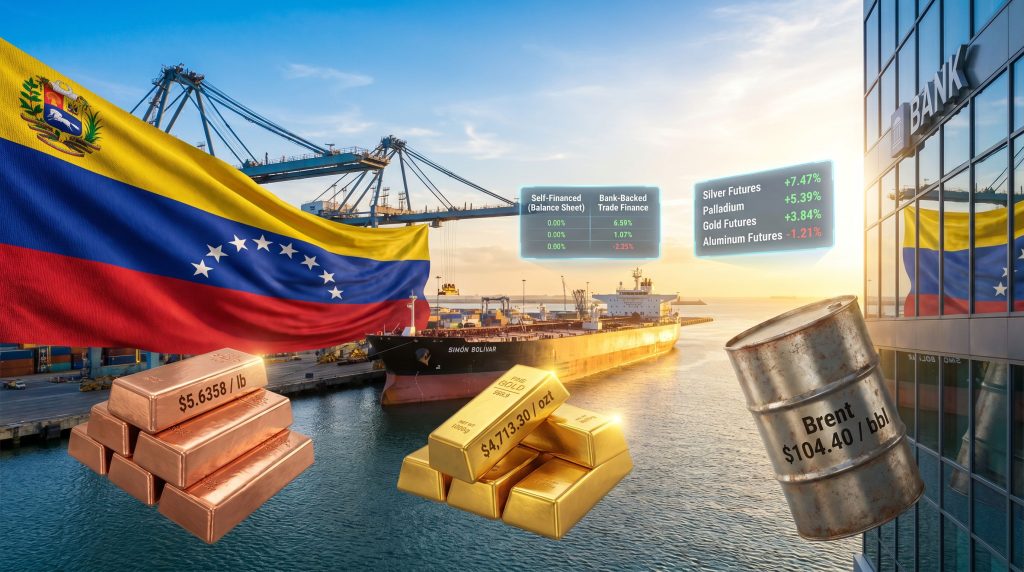
| Copper | $5.6358 / lb | +2.72% |
| Brent Crude Oil | $104.40 / bbl | -4.21% |
| Natural Gas | $2.89 / Btu | +0.10% |
| Gold Futures | $4,713.30 / ozt | +3.84% |
| Silver Futures | $75.495 / ozt | +7.47% |
| Palladium | $1,496.50 / ozt | +5.39% |
| Platinum | $1,973.85 / ozt | +4.22% |
| Aluminum Futures | $3,314.25 / ton | -1.21% |
While commodity price levels in mid-2026 sit broadly below the exceptional peaks of 2022 and 2023, the combination of geopolitical disruption, weather-driven supply shocks, and sanctions-era market reopenings is generating meaningful arbitrage and volatility-capture opportunities for trading houses with the capital and operational infrastructure to act on them. Indications as of July 2026 suggest that profits at some of the largest trading firms are approaching record territory, though it remains premature to confirm whether the sector will formally surpass the 2022-2023 benchmark.
The Credit Line Renewal Dilemma
One underappreciated dynamic in the current commodity finance environment involves the credit facilities secured by trading houses immediately after the Iran war began. Many of those short-term lines were structured for rapid deployment during peak volatility and are now due for renewal at a moment when commodity prices have retreated from their conflict-driven highs.
This creates a genuine commercial tension. Trading houses that secured large credit capacities to capture energy volatility now face the prospect of paying ongoing facility fees for capacity they may not need at current price levels. The counterargument, however, is that geopolitical conflicts rarely resolve on the timelines initially assumed by financial markets.
Extended conflicts tend to generate sustained volatility rather than a single price spike, which means maintaining credit capacity may prove strategically sound even if the immediate utilisation rate is lower.
The Three Conditions That Would Unlock Formal Bank Entry Into Venezuela
ING's current posture of active consideration without active commitment reflects a rational institutional calculus that applies equally to any major European bank evaluating ING Venezuela commodity deals. Three conditions would need to align before formal deal financing could commence.
- Legal environment clarity: Formal and unambiguous regulatory guidance confirming the permissibility of specific transaction types under applicable sanctions frameworks. Without this, no compliance-driven institution can make a lending decision.
- Client mandate alignment: Sustained and sufficient deal flow from creditworthy trading house counterparties to justify the compliance infrastructure investment. A single deal does not justify building out a Venezuela-specific legal and compliance framework.
- Risk-adjusted return threshold: Deal structures that adequately compensate for the layered risk premium of Venezuelan commodity finance, including jurisdictional risk, counterparty concentration risk, and reputational exposure.
In addition, shifts in U.S. policy on Venezuela represent a critical variable that could accelerate or delay each of these conditions materialising simultaneously.
Scenario Analysis: ING's Pathways in Venezuelan Commodity Finance
| Scenario | Trigger Conditions | Estimated Timeline | Probability Context |
|---|---|---|---|
| Full Market Entry | Sanctions fully lifted; unambiguous legal clearance | 12-24 months post-clearance | Moderate: contingent on U.S. policy trajectory |
| Selective Deal Support | Case-by-case approvals for specific commodity types | 6-18 months | Higher: consistent with stated exploratory language |
| Continued Abstention | Sustained legal ambiguity; compliance risk remains prohibitive | Indefinite | Lower given demonstrated client pressure levels |
The most likely near-term pathway is selective engagement on specific, well-structured transactions where legal clarity exists for a particular commodity channel or counterparty type. This approach avoids the reputational and regulatory exposure of a blanket market entry while still serving the client relationships that are driving inbound inquiry volume.
Why European Banks Move Differently Than Trading Houses
A structural asymmetry exists between commodity trading houses and the banks that finance them when it comes to sanctions-era market engagement. Trading firms operate with more operational flexibility and can absorb compliance risk within their own internal frameworks and proprietary capital structures. They also face direct competitive pressure: failing to establish positions in a reopening market means ceding flow to competitors.
Banks, particularly European institutions with large balance sheets, regulated capital ratios, and exposure to multiple regulatory jurisdictions simultaneously, face a fundamentally different risk calculus. A compliance misstep in a legally ambiguous market does not just affect the transaction in question. It creates systemic regulatory exposure across the institution's entire global franchise.
This is precisely why the language banks use when describing their approach to markets like Venezuela is so precise. The distinction between considering options, exploring the legal environment, and actively pursuing deals carries genuine institutional meaning and reflects the compliance gating process that governs bank decision-making in complex jurisdictions.
Consequently, global trade disruption events — whether driven by sanctions regimes, tariff escalations, or geopolitical conflict — tend to affect banks and trading houses on very different timescales, even when both are responding to the same underlying market signal.
The next major ASX story will hit our subscribers first
What Venezuela's Commodity Revival Means for Shipping and Trade Infrastructure
The physical logistics of Venezuelan commodity export recovery present their own structural dimensions. Venezuelan crude exports have historically moved through a combination of VLCC and Suezmax tanker deployments, with the shadow fleet playing an outsized role during peak sanctions periods.
As mainstream trading houses and potentially mainstream banks enter the picture, the routing and vessel selection calculus shifts toward vessels that can access conventional insurance and financing markets. Tanker tracking data corroborates this shift, with vessel routing patterns beginning to reflect the involvement of more commercially mainstream counterparties.
On the metals side, export infrastructure constraints remain a genuine operational consideration. Venezuela's mining and processing infrastructure has experienced significant degradation during the sanctions period, and the ramp-up of metals and bulk commodity exports will depend on both the commercial deal structures being established and the physical capacity to deliver consistent cargo volumes.
This is where Mercuria's recent activity in the metals segment becomes particularly significant as a market signal: it suggests that at least some infrastructure and logistics pathways are operational enough to support commercial offtake agreements. Furthermore, commodity market tariffs affecting Venezuelan exports add another layer of complexity that banks and trading houses must factor into their deal structuring.
Frequently Asked Questions: ING Venezuela Commodity Deals
Is ING currently financing any Venezuelan commodity deals?
As of July 2026, ING has publicly confirmed it is not financing any commodity transactions in Venezuela and does not have active plans to do so. The bank's position is that it will evaluate opportunities if and when the legal environment permits.
Why are trading houses approaching banks now rather than continuing to self-finance?
Trading firms that have established Venezuelan cargo flows using proprietary capital are now seeking bank financing to reduce capital intensity and scale operations. Self-financing is viable for initial market entry but becomes structurally inefficient at high volume, creating a natural inflection point where institutional financing support becomes commercially necessary.
Which commodities are at the centre of Venezuela's export revival?
Crude oil and petroleum products remain the primary export channel, with Vitol and Trafigura among the established participants. Metals and bulk commodities represent an emerging secondary channel, as evidenced by Mercuria's recent deal activity in this segment.
What is the significance of ING's new Americas commodity finance head?
The appointment of a leader with over fifteen years of metals and mining experience in the Americas suggests the bank is positioning its Americas franchise for expanded engagement with resource-intensive Latin American markets. This background is specifically relevant to the metals and bulk commodity segments of Venezuela's export recovery, not only the crude oil channel.
How does the Iran war affect commodity finance demand?
The U.S.-Iran conflict that began in February 2026 triggered a surge in credit facility demand from trading houses seeking to capture energy price volatility. Some of those facilities are now approaching renewal, creating both a reassessment of capacity needs and a strategic question about maintaining optionality in a conflict environment that may extend longer than initially priced by markets.
This article is intended for informational purposes only and does not constitute financial or investment advice. Commodity price data reflects market levels as of July 2026. Statements regarding bank intentions, deal timelines, and market scenarios involve uncertainty and should not be interpreted as definitive forecasts. Readers should conduct independent due diligence before making any financial decisions.
Want to Track the Commodity Discoveries Driving the Next Wave of Market Opportunity?
As global commodity markets shift and new resource flows emerge, Discovery Alert's proprietary Discovery IQ model delivers real-time alerts on significant ASX mineral discoveries — instantly translating complex data into actionable investment opportunities for traders and long-term investors alike. Begin your 14-day free trial at Discovery Alert today and position yourself ahead of the market.