July 23, 2026
Understanding the Structural Logic of Inverse ETFs in the Silver Mining Sector
Most investors approach precious metals through familiar channels: physical bullion, standard ETFs, or direct equity positions in mining companies. Yet within the architecture of modern financial markets, a far narrower and more technically complex product category exists for those with a specific short-term bearish thesis. This inverse silver miners ETF guide examines how these instruments function at the intersection of commodity exposure, equity risk, and derivative mechanics.
The structural logic of inverse ETFs is straightforward in theory but considerably more nuanced in practice. Rather than seeking gains from rising asset prices, these funds are engineered to deliver positive returns when the underlying asset declines. However, when applied to a niche sector like silver mining, the product category becomes far more constrained by demand dynamics, operational costs, and the inherent volatility of a commodity-linked industry.
How Inverse ETFs Work Across Asset Classes
At their core, inverse ETFs construct synthetic short positions using derivative instruments rather than borrowing and selling the underlying securities directly. The primary tools include:
- Total return swaps linked to an underlying index, through which the fund receives payments when the index falls
- Futures contracts that lock in a future selling price, generating gains when market prices decline below that level
- Options strategies that provide defined downside exposure with capped upside participation
These instruments are recalibrated daily. At the close of each trading session, the fund's Net Asset Value (NAV) is recalculated, and positions are rebalanced to maintain the stated inverse exposure ratio for the following session. This daily reset is the defining mechanical feature of inverse ETFs and the source of their most significant structural risk.
Why Silver Mining Creates a Distinct Inverse Product Category
Shorting precious metals through a silver miners ETF is fundamentally different from shorting the silver price itself. Silver mining companies carry a layered risk profile that extends well beyond commodity price movements. Their equity valuations respond to:
- All-in sustaining costs (AISC), which vary significantly between producers and determine how quickly profitability deteriorates during silver price declines
- Currency exposure, as many major silver-producing operations are located in Mexico, Peru, and Bolivia, meaning currency fluctuations between the US dollar and local currencies directly affect reported earnings
- Labor and regulatory risk, including workforce disputes, environmental compliance costs, and changes to mining royalty frameworks in producing jurisdictions
- Broader equity market conditions, which can cause silver mining stocks to sell off even during periods of stable or rising silver prices
Key Distinction: An inverse silver miners ETF targets the equity performance of silver-producing companies, not the commodity price itself. A silver price correction and a silver mining equity selloff are related but not identical events, and this distinction shapes everything from return expectations to risk management approaches.
This layered exposure is precisely what separates an inverse silver miners ETF from its commodity-linked counterpart. Furthermore, during broad equity market downturns, silver mining stocks can fall sharply even if silver prices hold steady, making inverse miner products profitable in scenarios where inverse silver commodity ETFs would generate minimal or negative returns.
When big ASX news breaks, our subscribers know first
How an Inverse Silver Miners ETF Actually Generates Returns
The Mechanics of Daily Reset and Leverage Multipliers
The stated objective of a leveraged inverse ETF applies exclusively to single-day performance. A -2x daily inverse fund is designed to return approximately +2% for every -1% decline in its benchmark index within that same trading session. The following session begins with a fresh reset, and the process repeats.
Understanding leverage multipliers requires clarity on what they do and do not deliver:
| Leverage Type | Daily Index Move | Expected ETF Return | Cumulative Return Assumption |
|---|---|---|---|
| -1x (Single Inverse) | -1% | +1% | Not guaranteed beyond one day |
| -2x (Double Inverse) | -1% | +2% | Not guaranteed beyond one day |
| -2x (Double Inverse) | +1% | -2% | Losses amplified equally |
The leverage multiplier amplifies both gains and losses within a single session. It does not describe performance over any multi-day holding period.
Why Compounding Creates Performance Drift Over Time
The compounding effect embedded in daily rebalancing creates what analysts describe as volatility decay or beta slippage. This is arguably the most structurally significant risk for any investor considering holding these instruments beyond a single trading day.
Consider a simplified example: if an underlying index rises 5% on day one and falls 5% on day two, it returns to approximately 99.75% of its starting value. A -2x inverse ETF, however, would fall 10% on day one and then rise 10% on day two, ending at approximately 99% of its starting NAV. The underlying index recovered almost entirely; the inverse ETF did not.
Risk Warning: In volatile or range-bound markets, daily compounding can cause an inverse ETF's cumulative return to diverge significantly from the expected inverse multiple, even if the underlying index ends the observation period near its starting level. This is not a temporary anomaly but a structural mathematical property of leveraged daily reset instruments.
The practical implication is clear: holding periods extending beyond one to two trading sessions materially increase the probability of performance divergence, and investors should model expected outcomes across multiple volatility scenarios before entering any position.
What Indexes Do Inverse Silver Miners ETFs Track?
The Solactive Global Silver Miners Index
The Solactive Global Silver Miners Index forms the benchmark for certain inverse silver miner products. Its architecture focuses on publicly listed equities involved in silver exploration, production, and processing. Critically, this index does not track the silver commodity spot price. It measures the equity performance of companies engaged in silver-related activities, making it a fundamentally different benchmark from any futures-based silver price index.
Junior vs. Senior Silver Miners: Index-Level Differences
Not all inverse silver miner products target the same universe of companies. The distinction between indexes tracking established producers and those focused on junior explorers carries meaningful implications for risk. For a broader view of available products, resources like ETF Database's silver miners listings offer useful comparative data across the sector.
| Index Type | Company Size Focus | Volatility Profile | Typical Use Case |
|---|---|---|---|
| Global Silver Miners Index | Large and mid-cap producers | Moderate | Broad sector hedging |
| Junior Silver Miners and Explorers Index | Small-cap exploration companies | High | Speculative short exposure |
Junior miner indexes carry considerably higher idiosyncratic risk. Smaller exploration companies often have no producing assets, meaning their valuations are driven almost entirely by project development milestones, cash burn rates, and commodity price sentiment rather than operational earnings. Consequently, inverse products built on junior miner indexes are significantly more volatile than those referencing established producers.
Why Inverse Silver Miners ETFs Are So Rare
The Economics of Niche Inverse Products
Launching and maintaining an inverse ETF targeting silver mining equities requires sufficient assets under management (AUM) to cover the ongoing costs of maintaining derivative positions, including swap fees, rebalancing costs, and administrative expenses. For niche products with a structurally limited investor base, this threshold is exceptionally difficult to sustain.
The economics are further complicated by the cyclical nature of demand. Investors seek inverse silver miner exposure primarily during periods of bearish sentiment toward precious metals equities. When silver prices recover and mining stocks rally, that demand evaporates rapidly, leaving the fund without sufficient trading volume to remain viable.
Historical Lifespan Data: A Pattern of Early Closure
Market Reality: Based on the limited number of inverse silver miner products launched in U.S. markets, the average operational lifespan before closure or liquidation has been approximately 13 to 15 months, well below the industry average for broader equity ETFs.
Both major products in this category followed a broadly similar trajectory: launched during periods of elevated bearish sentiment, they attracted initial trading interest before declining AUM made ongoing operations uneconomical. Their closures proceeded through formal liquidation rather than merger or strategy restructuring, reflecting limited appetite from competing issuers to absorb these strategies.
Historical Case Studies: The Two Major U.S.-Listed Inverse Silver Miners ETFs
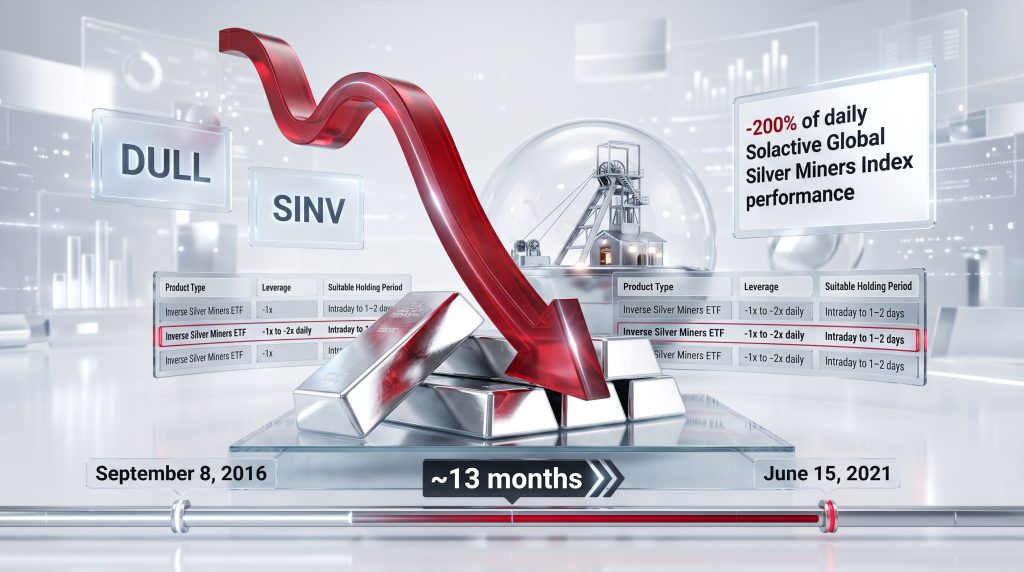
Direxion Daily Silver Miners Index Bear 2X Shares (DULL)
| Attribute | Detail |
|---|---|
| Launch Date | September 8, 2016 |
| Final Trading Date | September 25, 2017 |
| Liquidation Date | October 2, 2017 |
| Stated Objective | -200% of daily Solactive Global Silver Miners Index performance |
| Leverage Type | 2x inverse (Bear Fund) |
| Operational Lifespan | Approximately 13 months |
DULL was launched during a period of significant downward pressure on silver mining equities. It utilised swaps linked to the Solactive Global Silver Miners Index to construct its inverse exposure. The fund's stated objective applied exclusively to single-day performance, and it was explicitly described in its prospectus as "different from and significantly riskier than most exchange-traded funds."
The terminology used across leveraged ETFs is worth clarifying. Funds labelled "Bull" typically seek to deliver daily returns equal to a positive multiple of their benchmark index, while those labelled "Bear" are structured to deliver a negative multiple, benefiting from index declines. This convention applies broadly across leveraged ETF structures in many sectors, not only silver mining.
ETFMG Prime 2X Daily Inverse Junior Silver Miners ETF (SINV)
| Attribute | Detail |
|---|---|
| Launch Date | June 15, 2021 |
| Liquidation Date | July 20, 2022 |
| Stated Objective | -200% of daily Prime Junior Silver Miners and Explorers Index performance |
| Leverage Type | 2x inverse |
| Payment Frequency | Monthly |
| Operational Lifespan | Approximately 13 months |
| Closure Reason | Review of market demand |
SINV was positioned as one of the first thematic products to target junior silver exploration and production companies through a leveraged inverse structure. Its underlying index was specifically designed to capture small-cap silver mining and exploration activity, creating a distinctly higher-volatility benchmark than the broader global miners index used by DULL. The fund was ultimately liquidated following an internal assessment that concluded market demand was insufficient to sustain operations.
What These Closures Reveal About Structural Viability
The parallel trajectories of these two funds point toward a structural ceiling on investor interest in this niche. Several observations stand out:
- Both products achieved roughly identical operational lifespans of approximately 13 months, suggesting this reflects a recurring pattern rather than coincidence
- Neither fund was absorbed into a competing product or restructured, indicating limited institutional appetite for the strategy
- As of 2026, no active U.S.-listed inverse silver miners ETF exists, leaving investors with bearish views on silver mining equities to pursue alternative approaches
Inverse Silver Miners vs. Related Products: A Comparative Framework
Understanding silver's dual nature as both a precious metal and an industrial commodity helps explain why its inverse equity products behave differently from those in other sectors.
| Product Type | What It Tracks | Leverage | Primary Risk Drivers | Suitable Holding Period |
|---|---|---|---|---|
| Inverse Silver Miners ETF | Silver mining company equities | -1x to -2x daily | Equity markets, operating costs, currency, silver price | Intraday to 1-2 days |
| Inverse Silver ETF (e.g., ZSL) | Silver commodity futures | -2x daily | Silver spot price, futures roll costs | Intraday to 1-2 days |
| Physical Silver (Bullion) | Spot silver price (direct) | None | Macroeconomic conditions, USD strength, industrial demand | Long-term |
| Standard Silver Miners ETF | Silver mining company equities | 1x (unleveraged) | Same as inverse miners, but long direction | Medium to long-term |
The divergence between inverse silver miners ETFs and inverse silver commodity ETFs becomes most apparent during periods of broad equity market stress. Silver mining stocks can decline sharply on equity market sentiment alone, while silver prices may remain supported by safe-haven demand. In this environment, an inverse silver miners ETF would generate positive returns while an inverse silver ETF might produce losses.
Conversely, if a silver mining company has locked in forward sales contracts at favourable prices, a sharp commodity price decline may not immediately translate into equivalent equity losses, creating scenarios where inverse silver commodity ETFs outperform inverse mining equity products.
The next major ASX story will hit our subscribers first
Core Risks of Holding an Inverse Silver Miners ETF
Risk 1: Volatility Decay and Daily Compounding
This is the most structurally persistent risk for any leveraged or inverse ETF. The mathematical asymmetry of compounding means that the sequence of returns matters enormously. Alternating daily gains and losses in the underlying index create a systematic drag on the inverse ETF's NAV that compounds over time, regardless of the overall trend direction.
Risk 2: Sector-Specific Operational Exposure
Silver mining companies face a suite of risks entirely unrelated to silver prices:
- Labor strikes and workforce disputes in key mining jurisdictions
- Regulatory shifts affecting royalties, environmental standards, or operating permits
- Currency fluctuations in countries like Mexico, Peru, and Bolivia, which collectively account for a substantial share of global silver production
- Capital cost overruns and exploration disappointments that affect equity valuations independently of commodity price movements
Risk 3: Liquidity and Market Depth
Thinly traded inverse ETFs frequently carry wide bid-ask spreads, which function as a hidden transaction cost that compounds across multiple trades. During periods of elevated market stress, this spread can widen considerably, making it difficult to exit a position at a price close to the fund's stated NAV.
Risk 4: Forced Liquidation
If AUM falls below the issuer's minimum operational threshold, liquidation can be triggered regardless of the investor's intended holding period. This forces realisation of gains or losses at the fund's final NAV, potentially disrupting any existing hedging strategy the investor had constructed around the position.
What Happens When an Inverse Silver Miners ETF Is Liquidated?
The Liquidation Process: Step-by-Step
- Closure Announcement: The fund issuer publicly discloses the decision, typically several weeks before the final trading date, giving investors a window to exit voluntarily
- Final Trading Day: The fund continues to trade on the exchange until the designated last session; investors who do not exit during this window will receive the liquidation distribution
- Asset Liquidation: The fund manager systematically unwinds all derivative positions and converts holdings to cash
- NAV Distribution: Shareholders receive a cash payment equal to the fund's final NAV per share, typically distributed within several business days of the liquidation date
- Tax Implications: Investors may need to recognise realised gains or losses in the tax year in which the liquidation occurs, which may not align with their preferred timing for tax purposes
The forced nature of this process creates a particular challenge when the ETF was being used as a short-term hedge. Its unexpected closure can leave an underlying long position unhedged at precisely the moment when replacement instruments may not be readily available in the same product category.
Alternative Approaches to Hedging Silver Mining Exposure
Given the current absence of any active U.S.-listed inverse silver miners ETF, investors with a bearish thesis on silver mining equities must consider alternative structures. In addition, examining the broader gold-silver ratio can help investors time their entry and exit from bearish silver positions more effectively.
Comparison: Hedging Tools for Silver Mining Exposure
| Strategy | Complexity | Cost | Compounding Risk | Counterparty Risk | Suitable For |
|---|---|---|---|---|---|
| Inverse Silver Miners ETF | Low-Medium | Low (brokerage fees) | High | Moderate | Short-term traders |
| Put Options on Miners ETF | High | Medium (premium) | None | Low | Sophisticated investors |
| Short Selling Miners | High | Medium-High (margin) | None | Low | Active traders |
| Physical Silver | Low | Low-Medium (storage) | None | None | Long-term investors |
Put options on established silver miners ETFs offer directional downside exposure without the compounding decay inherent in inverse products. The maximum loss is defined upfront as the premium paid, while the asymmetric structure preserves potential gains if the thesis proves correct within the options expiration window.
Direct short selling of individual silver mining equities avoids index-level diversification and allows precise targeting of specific operational or financial vulnerabilities. However, it requires a margin account and carries theoretically unlimited loss potential if the position moves against the investor.
Physical silver ownership eliminates counterparty risk, derivative complexity, and the daily reset mechanics that create compounding decay. While it does not generate income and does not function as a short position against silver miners, it provides a structurally simple, long-term real-asset anchor. Furthermore, for investors interested in commodities diversification more broadly, physical silver sits comfortably within a multi-asset real-assets allocation.
Strategic Consideration: Inverse silver miner ETFs are precision instruments designed for deployment around specific near-term market events. Their utility diminishes rapidly as the holding period extends, making them unsuitable as portfolio foundations or long-term inflation hedges.
Frequently Asked Questions: Inverse Silver Miners ETF Guide
What is the difference between an inverse silver ETF and an inverse silver miners ETF?
An inverse silver ETF tracks the commodity price of silver, typically through futures contracts. An inverse silver miners ETF tracks the equity performance of companies that mine silver. The risk drivers are fundamentally different: commodity price ETFs respond primarily to silver spot price movements, while mining equity ETFs are also shaped by corporate earnings, operating costs, currency exposure, and broader equity market conditions. Reviewing historical data on silver versus gold performance can further contextualise where miners fit within the precious metals landscape.
Are there any inverse silver miners ETFs currently available to trade?
As of 2026, no active U.S.-listed inverse silver miners ETF is available for trading. Both major products in this category, DULL and SINV, have been liquidated. Investors seeking short exposure to silver mining equities may need to consider put options, direct short selling, or other derivative strategies. The APMEX inverse silver miners guide provides additional context on the historical landscape of these products.
How long should I hold an inverse silver miners ETF?
These products are designed for short-term use only, ideally within a single trading day. Holding periods beyond one to two sessions introduce meaningful compounding risk, which can cause cumulative returns to diverge materially from the expected inverse multiple.
What causes an inverse silver miners ETF to close?
The most common cause is insufficient assets under management. When fee revenue cannot cover the costs of maintaining derivative positions and fund operations, issuers typically announce liquidation. Declining trading volume, recovering silver mining stock prices, and shifting investor sentiment toward bullish precious metals positioning all accelerate this outcome.
Can I use an inverse silver miners ETF as a long-term hedge?
No. The daily reset mechanism and compounding decay make these instruments structurally unsuitable for sustained hedging. Investors requiring persistent downside protection on silver mining equities should explore put options, structured products, or directly managed short positions with defined risk parameters.
Key Takeaways: Evaluating Inverse Silver Miners ETFs as a Strategic Tool
- Inverse silver miners ETFs are tactical, short-duration instruments, not portfolio foundations or long-term hedging vehicles
- The product category has a historically short lifespan, with both major U.S.-listed examples closing within approximately 13 months of launch
- Compounding decay represents the most structurally persistent risk for investors holding beyond a single trading session
- The risk profile of inverse silver miners ETFs differs materially from inverse silver commodity ETFs because mining equities carry operational, currency, and equity market exposures beyond the commodity price
- As of 2026, no active U.S.-listed inverse silver miners ETF exists, making alternative strategies the practical route for investors with bearish views on silver mining equities
- Physical silver ownership remains the most structurally straightforward method of gaining long-term precious metals exposure without derivative complexity, counterparty risk, or compounding decay
This content is provided for educational and informational purposes only and does not constitute financial advice. Investment decisions should be based on individual research and personal circumstances. Consulting a qualified financial advisor before making any financial commitments is strongly recommended.
Want to Identify Major Silver and Precious Metals Discoveries Before the Broader Market Does?
While inverse silver miners ETFs offer short-term tactical tools, the long-term opportunity in precious metals often lies in identifying significant new discoveries early — Discovery Alert's proprietary Discovery IQ model scans ASX announcements in real time, instantly alerting subscribers to actionable silver and precious metals discoveries, much like the historic finds that generated extraordinary returns showcased on the Discovery Alert discoveries page. Begin your 14-day free trial today and position yourself ahead of the market.