August 22, 2026
Understanding Investment Psychology During Market Uncertainty Cycles
Contemporary energy markets operate within unprecedented complexity, where traditional financial models increasingly fail to capture the full spectrum of risk variables affecting crude oil pricing. Investment behaviour during periods of elevated uncertainty reveals systematic patterns that differ markedly from conventional market wisdom, particularly when geopolitical tensions in oil markets create compound layers of unpredictability.
Professional traders and institutional investors face a unique challenge: historical data becomes less reliable when multiple regional conflicts converge simultaneously. This environment forces market participants to develop new analytical frameworks that integrate political risk assessment with traditional supply-demand fundamentals in ways that previous generations of energy analysts never encountered.
When big ASX news breaks, our subscribers know first
What Fundamental Shifts Are Reshaping Global Energy Risk Assessment?
Advanced Sanctions Architecture and Market Response
Modern economic warfare has evolved far beyond simple trade restrictions. Today's sanctions regimes incorporate sophisticated financial system exclusions, targeted technology transfer limitations, and cascading secondary enforcement mechanisms that create ripple effects throughout global supply networks. Furthermore, the US economy and tariffs landscape demonstrates how trade policies compound energy market uncertainties.
Current Sanctions Impact Metrics:
- Russian crude exports declined 450,000 barrels per day over four weeks ending January 11, 2026
- However, the same period showed exports of 3.42 million barrels daily, exceeding 2025 averages
- Transportation premium increases: 15-20% for sanctioned crude movements
- Secondary sanction compliance costs affecting Indian and Chinese refineries
The distinction between headline impact and operational reality becomes crucial for investment decision-making. While surface-level data suggested significant supply disruptions, granular analysis reveals that adaptation mechanisms functioned more effectively than initial forecasts predicted.
Information Technology Integration in Price Discovery
Electronic trading systems now incorporate geopolitical news into oil pricing within minutes of event occurrence. This technological advancement means that traditional fundamental analysis must compete with algorithmic interpretation of political developments, creating new volatility patterns that require sophisticated hedging strategies.
Real-Time Market Integration:
- Price adjustments occur within 5-10 minutes of major geopolitical announcements
- Automated trading systems process news sentiment before human analysts complete initial assessments
- Options markets reflect elevated volatility premiums 24-48 hours before fundamental supply data confirms disruptions
How Do Multiple Regional Conflicts Create Compound Risk Scenarios?
Venezuela: Production Recovery Amid Political Transition
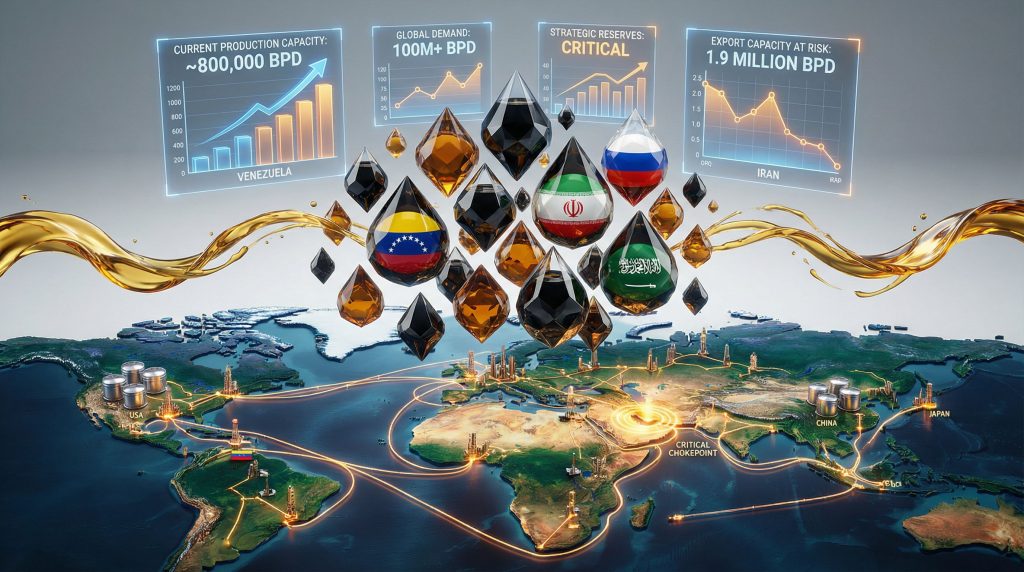
The shift from economic sanctions to direct intervention represents a qualitative change in U.S. energy diplomacy. Current production capacity of approximately 800,000 barrels per day contrasts sharply with pre-crisis peak output of 3.2 million barrels per day, yet recent developments suggest recovery potential exceeds previous estimates.
Recent Market Developments:
- Enverus forecasts 50% production increase by 2035
- Vitol and Trafigura secured U.S. trading licences as of January 14, 2026
- Shipping companies expanding capacity for Venezuelan crude transfers
- China's Venezuelan oil imports facing significant reduction
Industry analysts emphasise that Venezuelan production recovery requires substantial capital investment and technical expertise restoration. The American Petroleum Institute characterises sector revival as a multi-billion dollar, multi-year process requiring systematic infrastructure rehabilitation.
Critical Infrastructure Requirements:
- Refinery equipment replacement and modernisation
- Technical workforce retraining and recruitment
- Pipeline system rehabilitation
- Export terminal capacity restoration
- Estimated recovery timeline: 5-7 years for full capacity restoration
Iran: Civil Unrest and Export Infrastructure Vulnerability
Iranian oil export capacity of 1.9 million barrels per day faces disruption risks from escalating civil protests, though current unrest has not spread to primary oil-producing regions. ANZ analysts note that protesters actively encourage oil industry worker participation, creating potential for coordinated labour disruptions beyond isolated civil demonstrations.
Strategic Chokepoint Analysis:
- Strait of Hormuz handles 20% of global oil transit
- Khuzestan Province contains majority of Iranian refining capacity
- Multiple export routes create redundancy but remain politically vulnerable
- Regional military tensions affect tanker insurance and routing decisions
Citi analysts emphasise that Iranian protest risks create skewed probabilities toward political and logistical friction rather than immediate supply outages. This assessment suggests manageable near-term impacts with escalating longer-term uncertainties.
Russia-Ukraine: Infrastructure Targeting and Supply Chain Adaptation
Ongoing conflict has evolved into systematic energy infrastructure targeting, creating persistent transportation disruptions and elevated compliance costs for Russian crude exports. Despite sanctions pressure, Russian export flows demonstrate remarkable resilience through alternative routing and buyer diversification. Moreover, the US‑China trade strategies significantly influence how Asian buyers approach Russian energy purchases.
Market Adaptation Indicators:
- 12+ tankers carrying Urals crude in floating storage
- Transportation premiums: 15-20% above standard rates
- Asian buyer concentration increasing as European demand declines
- Infrastructure repair cycles: 3-6 months for critical facilities
Recent drone attacks on Black Sea terminals highlight ongoing operational risks. Two tankers en route to Caspian Pipeline Consortium loading facilities were struck, demonstrating how regional conflicts extend beyond national borders to affect international energy infrastructure.
Which Market Mechanisms Amplify Geopolitical Price Volatility?
Floating Storage Dynamics and Supply Assessment
Traditional inventory metrics fail to capture current market complexity. Vortexa data reveals that crude oil stored on stationary tankers (seven days or longer) declined to 120.9 million barrels as of January 9, 2026, contrasting sharply with total tanker crude volumes exceeding 1.3 billion barrels.
Storage Classification Framework:
- Operational storage: Crude held deliberately for market timing
- Transit inventory: Oil moving between seller and buyer locations
- Distressed storage: Crude awaiting buyers due to sanctions complications
- Strategic positioning: Volumes held for geopolitical contingency planning
This distinction proves critical for accurate supply assessment. Total tanker inventories include operational logistics, while meaningful storage indicators reflect deliberate market positioning decisions.
Risk Premium Calculation Models
Professional trading operations now employ probability-weighted scenario models that incorporate multiple simultaneous geopolitical events. These frameworks differ fundamentally from historical approaches that assumed single-theatre conflict patterns. Consequently, understanding tariff impact on investments becomes essential for comprehensive risk assessment.
| Disruption Scenario | Probability Assessment | Price Impact Range |
|---|---|---|
| Iran regime instability | 40% (institutional consensus) | +$15-25 per barrel |
| Venezuela complete halt | 25% | +$5-10 per barrel |
| Russian export disruption | 60% | +$8-15 per barrel |
| OPEC+ coordination breakdown | 30% | +$10-20 per barrel |
Options Market Sentiment Indicators
Saxo Bank's commodity strategy analysis reveals that institutional investor sentiment toward oil reached extreme bearish levels despite mounting geopolitical risks. This positioning creates vulnerability to rapid price reversals should technical or fundamental outlooks improve.
Sentiment Measurement Tools:
- Goldman Sachs institutional investor surveys showing declining oil allocation preferences
- Options market skew indicating upside protection demand
- Commodity futures positioning data revealing concentrated short positions
- Volatility surface analysis suggesting event risk premiums
How Do OPEC+ Dynamics Respond to External Political Pressure?
Strategic Reserve Policy Evolution
OPEC+ spare capacity management has deliberately created market structures where geopolitical tensions in oil markets generate amplified price effects. Member nations maintain lower buffer capacity, reducing ability to compensate for supply losses during crisis periods.
Spare Capacity Distribution:
- Saudi Arabia: 1.5-2.0 million barrels per day available capacity
- UAE: 0.8-1.0 million barrels per day potential increase
- Kuwait: 0.3-0.5 million barrels per day emergency reserves
- Combined OPEC+ buffer: 3.0-4.0 million barrels per day maximum surge capacity
Alliance Cohesion Under Stress
External geopolitical events test OPEC+ internal coordination, particularly when member states face differential pressure levels or opportunity structures. Recent developments reveal strains within traditional alliance frameworks.
Coordination Challenge Areas:
- Saudi-UAE strategic alignment on regional conflict positions
- Iraq balancing between U.S. and Iranian influence spheres
- Venezuela's potential organisational exit due to political transitions
- Nigeria and Angola production compliance under economic pressure
What Investment Strategies Address Compound Geopolitical Risk?
Portfolio Diversification Frameworks
Modern energy investment portfolios require multi-dimensional risk distribution that extends beyond traditional geographic and sector allocation models. Successful strategies integrate political stability metrics, infrastructure security assessments, and regulatory continuity evaluations. For instance, implementing volatility hedging strategies becomes crucial during uncertain periods.
Advanced Diversification Components:
- Geographic stability weighting: Democratic governance indicators, rule of law metrics
- Infrastructure resilience: Pipeline diversity, port access redundancy, strategic reserve availability
- Technology hedging: Conventional versus unconventional production method balance
- Political risk insurance: Coverage for expropriation, currency inconvertibility, political violence
Alternative Risk Management Instruments
Financial markets have developed sophisticated instruments for hedging geopolitical energy risks that extend beyond traditional commodity futures. These tools allow investors to isolate specific conflict scenarios while maintaining broader market exposure.
Specialised Hedging Options:
- Geopolitical volatility derivatives linked to specific regional conflicts
- Political risk credit default swaps for energy-exporting nations
- Infrastructure disruption insurance for critical transportation routes
- Supply chain continuity guarantees through multiple sourcing arrangements
The next major ASX story will hit our subscribers first
Which Long-Term Structural Changes Are Emerging?
Energy Security Policy Adaptation
National strategic petroleum reserves are being reconceptualised as geopolitical volatility management tools rather than emergency supply buffers. This shift requires coordination mechanisms that can respond rapidly to multiple simultaneous disruptions.
Strategic Reserve Innovation:
- Coordinated release protocols among allied nations during crisis periods
- Quality-specific reserves matching domestic refinery requirements
- Geographic distribution reducing single-point-of-failure vulnerabilities
- Private sector integration through mandatory commercial inventory requirements
Supply Chain Resilience Investment
Energy companies increasingly prioritise supply chain redundancy over cost optimisation, recognising that geopolitical disruptions can eliminate efficiency gains within hours. This strategic shift affects capital allocation patterns across the industry.
Resilience Investment Priorities:
- Supplier diversification across multiple stable political jurisdictions
- Transportation route redundancy reducing dependence on single chokepoints
- Regional storage capacity providing operational flexibility during disruptions
- Technology transfer partnerships maintaining technical capabilities across regions
What Economic Scenarios Could Emerge From Current Tensions?
Scenario 1: Managed Volatility With Contained Disruptions
Regional conflicts remain localised without cascading effects on global supply chains. Market fundamentals reassert dominance over pricing while geopolitical risk premiums gradually normalise to historical ranges.
Scenario Characteristics:
- Oil prices stabilise within $55-65 per barrel trading range
- Investment flows return to efficiency-focused project development
- Strategic reserve releases become unnecessary
- OPEC+ coordination mechanisms function effectively
Scenario 2: Escalating Multi-Theatre Conflicts
Multiple simultaneous disruptions create compound supply shocks that overwhelm market adaptation mechanisms. Traditional hedging strategies prove inadequate as correlation patterns break down during extreme stress periods. In such scenarios, oil price rally analysis becomes essential for understanding market dynamics.
High-Impact Scenario Indicators:
- Oil prices exceed $80 per barrel sustained levels
- Strategic petroleum reserve releases coordinated internationally
- Alternative energy investment acceleration due to security concerns
- Long-term supply agreements replace spot market transactions
Scenario 3: New Geopolitical Equilibrium Formation
Current conflicts resolve into stable arrangements that permanently reshape global energy trade patterns. Bilateral partnerships replace multilateral frameworks as primary coordination mechanisms.
Structural Transformation Elements:
- Permanent supply chain geography changes reducing traditional chokepoint dependence
- New bilateral energy partnerships between politically aligned nations
- Technology transfer restrictions creating separate development pathways
- Regional energy security blocs replacing global integration models
Advanced Technical Analysis and Market Psychology
Electronic Trading System Impact on Volatility Patterns
Algorithmic trading systems now process geopolitical news sentiment faster than traditional fundamental analysis can incorporate supply disruption probabilities. This technological shift creates new volatility patterns that require sophisticated risk management approaches.
Electronic Market Dynamics:
- Initial price movement: Occurs within 5-10 minutes of news events
- Algorithmic interpretation: News sentiment processing before human analyst assessment
- Correlation breakdown: Traditional relationships fail during extreme stress periods
- Liquidity evaporation: Market depth declines during uncertainty spikes
Institutional Investor Behaviour During Crisis Periods
Professional investment managers face unique challenges when traditional diversification strategies fail simultaneously across multiple asset classes. Energy markets become both risk assets and safe havens depending on specific geopolitical scenarios.
Investment Behaviour Patterns:
- Flight to quality: Preference for energy assets in politically stable jurisdictions
- Concentration risk: Avoiding regions with elevated political uncertainty
- Liquidity prioritisation: Maintaining position flexibility over yield optimisation
- Time horizon compression: Short-term positioning until clarity emerges
Infrastructure Vulnerability Assessment and Mitigation
Critical Chokepoint Analysis
Global energy transportation depends on a limited number of geographic bottlenecks that become strategic targets during conflict periods. Understanding vulnerability patterns helps investors anticipate disruption impacts and position portfolios accordingly.
Primary Vulnerability Points:
- Strait of Hormuz: 20% of global oil transit, Iranian military control
- Suez Canal: 12% of global trade, political stability dependent
- Turkish Straits: Russian and Central Asian export route
- Panama Canal: Pacific-Atlantic crude movements
Technology Solutions for Infrastructure Resilience
Energy companies invest increasingly in technological solutions that reduce dependence on vulnerable infrastructure whilst maintaining operational efficiency. These investments create competitive advantages during disruption periods.
Technology Investment Areas:
- Satellite monitoring systems for real-time infrastructure threat assessment
- Alternative transportation methods including rail and truck capacity expansion
- Distributed storage networks reducing single-point vulnerabilities
- Digital twin modelling for rapid disruption impact assessment
Market Data Interpretation and Analysis Frameworks
Floating Storage Classification Systems
Accurate market analysis requires sophisticated understanding of inventory classification systems. Traditional metrics fail to capture current complexity where sanctions, logistics constraints, and strategic positioning create multiple storage categories with different market implications.
Storage Category Definitions:
- Voluntary commercial storage: Market timing and arbitrage positioning
- Involuntary sanctions storage: Crude awaiting compliant buyers
- Transit delays: Logistical bottlenecks creating temporary accumulation
- Strategic positioning: Government or corporate contingency reserves
Price Discovery Mechanism Evolution
Physical oil markets increasingly disconnect from financial futures pricing during extreme geopolitical stress. This divergence creates arbitrage opportunities but requires sophisticated analysis to identify sustainable trades versus temporary dislocations. Research from oil market analysis confirms these evolving patterns.
Price Relationship Analysis:
- Futures versus physical premiums: Immediate delivery value during uncertainty
- Regional price differentials: Political risk reflecting in geographic spreads
- Quality premiums: Light, sweet crude commanding higher security premiums
- Term structure implications: Long-term contracts versus spot market pricing
Understanding these evolving market dynamics becomes essential for energy investors, policy makers, and industry participants as geopolitical factors increasingly dominate traditional supply-demand analysis. The integration of political risk assessment with fundamental energy market analysis represents a new paradigm requiring continuous adaptation to changing global circumstances.
Professional success in contemporary energy markets demands sophisticated analytical frameworks that can process multiple simultaneous variables whilst maintaining operational flexibility during periods of extreme uncertainty. The convergence of technological advancement, geopolitical complexity, and market evolution creates both unprecedented challenges and unique opportunities for participants who develop appropriate analytical capabilities.
Want to Navigate Market Volatility with Advanced Discovery Intelligence?
Discovery Alert's proprietary Discovery IQ model delivers real-time alerts on significant mineral discoveries while market uncertainty creates opportunities across commodity sectors. Stay ahead of complex market dynamics by accessing actionable insights that help identify emerging opportunities when traditional analysis fails to capture the full spectrum of market variables. Start your 30-day free trial today and secure your market-leading advantage during volatile periods.