August 8, 2026
What Drives Investor Preference Between Oil and Gold Assets?
Market psychology reveals fascinating patterns when investors evaluate commodity allocations between energy assets and precious metals. The decision-making process extends far beyond simple price movements, incorporating deep-seated behavioral patterns that influence portfolio construction and risk assessment frameworks.
The risk-reward profile of oil over gold attracts investors seeking active income generation alongside capital appreciation potential. This preference stems from fundamental psychological differences in how market participants view volatile versus stable asset characteristics. Energy investments appeal to those comfortable with operational complexity and cyclical income streams, while precious metals draw preservation-focused investors prioritising stability over yield generation.
Furthermore, this commodities investment guide demonstrates how understanding various investment vehicles can enhance decision-making processes.
When big ASX news breaks, our subscribers know first
Psychological Anchoring in Commodity Selection
Behavioral finance research demonstrates that investors anchor their commodity preferences to distinct risk tolerance frameworks. Oil and gas investments require acceptance of operational variables including production schedules, geological uncertainty, and regulatory compliance costs. This complexity attracts investors who view active management as value-enhancing rather than burdensome.
Gold investors typically anchor to different psychological triggers, including currency debasement fears and portfolio insurance concepts. The precious metals mindset prioritises wealth preservation through periods of monetary system stress, accepting lower expected returns in exchange for reduced volatility and correlation benefits.
Income-seeking versus preservation psychology creates distinct investor segments within commodity markets. Energy asset holders often demonstrate higher tolerance for quarterly income fluctuations when offset by substantial tax benefits and depletion allowances. Gold holders typically prefer consistent purchasing power protection over time, viewing periodic price volatility as acceptable within longer investment horizons.
Market Timing Psychology and Commodity Cycles
Fear and greed cycles manifest differently across energy and precious metals markets. Oil price movements trigger immediate supply-demand calculations among investors, with geopolitical events creating rapid sentiment shifts. The January 2026 precious metals volatility, likely triggered by Federal Reserve leadership speculation, demonstrates how monetary policy expectations drive gold market psychology distinctly from energy sector dynamics.
Consequently, the recent gold market surge illustrates these distinct market psychology patterns affecting precious metals investors. Inflation hedge expectations create temporal preference differences between the commodities. Oil provides immediate inflation protection through both price appreciation and ongoing income distributions, satisfying investors seeking current purchasing power maintenance. Gold offers pure price-based hedging with historical effectiveness during extended inflationary periods, appealing to investors with longer time horizons and patience for compound appreciation.
Volatility tolerance thresholds vary significantly across investor demographics when comparing energy and precious metals exposure. Institutional investors often demonstrate greater comfort with oil price swings given diversified operational exposure, while individual investors may prefer gold's perceived stability despite similar underlying volatility measures during certain market periods.
How Do Tax Incentives Shape Oil Investment Appeal?
Tax policy creates substantial differentiation in the risk-reward profile of oil over gold through direct investment structures. Understanding these mechanisms requires careful analysis of current tax law provisions and their practical application across different investor circumstances.
Direct Investment Tax Advantage Analysis
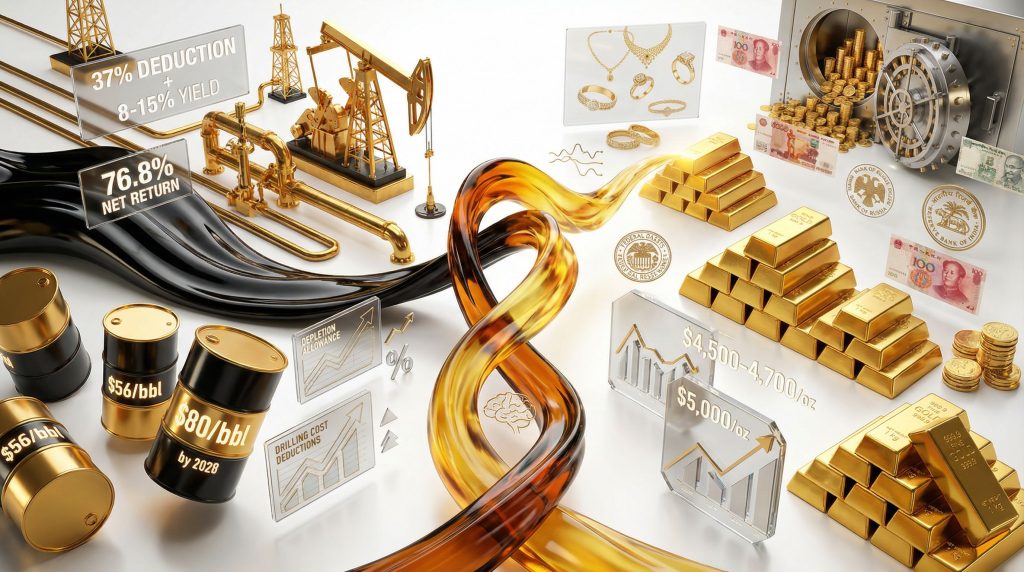
Intangible drilling cost deductions provide immediate tax benefits for qualified oil and gas investments, potentially allowing deductions up to the highest marginal tax brackets. For 2026, investors in top tax brackets may realise significant first-year tax benefits when combined with percentage depletion allowances on ongoing production.
The tax-equivalent yield calculation reveals compelling advantages for direct energy investments compared to traditional asset classes. When production income receives favourable tax treatment through depletion allowances, the effective after-tax return can substantially exceed stated yields on comparable risk investments.
| Investment Approach | Tax Treatment | Typical Yield Range | After-Tax Benefit |
|---|---|---|---|
| Direct Working Interest | Depletion + IDC deductions | 8-15% + tax savings | Enhanced first-year returns |
| Oil/Gas ETFs | Standard capital gains | Market movement only | No direct tax benefits |
| Physical Gold | Capital gains treatment | Price appreciation | No income component |
| Gold Mining Stocks | Dividend + capital gains | 2-4% dividend yield | Standard corporate tax treatment |
Income Generation vs Capital Appreciation Psychology
Cash flow certainty appeals to investors seeking predictable income streams from commodity exposure. Direct oil and gas investments can provide monthly or quarterly distributions tied to production levels and commodity prices, creating dividend-like income characteristics that gold ownership cannot match.
The compound growth psychology differs between energy income recipients and precious metals holders. Oil investment returns combine current income with potential price appreciation, satisfying investors who prefer receiving regular cash flows rather than depending solely on future price appreciation for investment returns.
Production-based income from energy investments provides inflation protection through both current distributions and future price appreciation potential. This dual protection mechanism attracts investors concerned about maintaining purchasing power during inflationary periods while generating current income for living expenses or reinvestment opportunities.
Why Do Geopolitical Risk Perceptions Differ Between Assets?
Geopolitical analysis reveals distinct risk perception frameworks between energy security concerns and monetary system stability fears. These differences fundamentally shape investor preference patterns and allocation decisions across commodity sectors.
Energy Security vs Monetary System Stability
Supply disruption scenarios create immediate price impact potential for oil markets, particularly regarding Iran sanctions enforcement and OPEC+ production coordination. Regime change possibilities in major oil-producing regions generate both risk and opportunity perceptions among energy investors, with potential supply disruptions creating upside price scenarios.
Additionally, the current oil price rally analysis suggests these geopolitical factors continue to influence market dynamics. Currency debasement concerns drive gold accumulation among investors focused on monetary system stability. Central bank reserve diversification trends, particularly among emerging market economies, provide structural demand support for gold prices that differs fundamentally from oil market dynamics driven by immediate supply-demand balances.
The Trump administration's focus on energy security and potential Iran policy changes creates specific geopolitical scenarios that could benefit oil investments through reduced global supply availability. These policy-driven supply constraints differ from the monetary policy concerns that typically drive precious metals demand during periods of currency uncertainty.
Volatility Tolerance and Risk Premium Expectations
Oil price scenario planning requires acceptance of significant price ranges, with Brent crude potentially trading between $30-80 per barrel depending on geopolitical developments and global economic conditions. Investors comfortable with this volatility range often view price swings as opportunities rather than risks when combined with ongoing production income.
Gold stability preferences cluster around different psychological anchor points, with many analysts targeting $4,500-5,000 per ounce ranges for 2026-2027. This price clustering reflects investor comfort with precious metals as portfolio insurance rather than speculative appreciation vehicles.
Tail risk assessment creates different expectations between commodities. Oil investors often focus on upside tail risk scenarios including supply disruptions or geopolitical premium expansion, while gold investors typically emphasise downside protection during financial system stress or currency devaluation scenarios.
What Market Structure Factors Influence Risk-Reward Calculations?
Market structure analysis reveals important differences in supply elasticity, demand patterns, and inventory dynamics that influence investor risk-reward assessments between oil and gold markets.
Supply-Demand Imbalance Psychology
Non-OPEC production growth impacts investor sentiment through expectations of increased supply availability and price pressure. However, the complexity of oil production economics creates opportunities for investors who understand operational leverage benefits during price recovery periods.
Structural gold demand from central banks provides price floor psychology that differs from oil market dynamics. Jewellery demand stability and industrial applications create baseline consumption patterns that support gold prices independent of investment demand fluctuations.
Inventory level interpretation requires different analytical frameworks between commodities. Oil inventory buildups signal potential oversupply and price pressure, while gold accumulation by central banks and institutional investors typically signals strength and continued demand support.
Inflation Hedge Effectiveness Comparison
Oil provides dual inflation protection through both price appreciation and income generation, while gold offers pure price-based hedging with lower volatility but no yield component.
Historical performance during inflationary periods shows both commodities providing positive real returns, but through different mechanisms. Oil prices typically respond quickly to inflation expectations through input cost increases and demand patterns, while gold appreciation may lag but provide more consistent protection over extended periods.
Moreover, understanding gold as inflation hedge helps investors appreciate these protection mechanisms. Real yield sensitivity creates different response patterns between the commodities. Oil investments may benefit from negative real yields through increased economic activity and energy demand, while gold traditionally performs well when real yields remain negative due to monetary policy accommodation.
Portfolio correlation benefits vary across market regimes, with oil showing higher correlation to equity markets during economic expansion periods while gold maintains lower correlation during financial stress periods. Understanding these correlation patterns helps investors optimise allocation timing and sizing decisions.
The next major ASX story will hit our subscribers first
How Do Investment Vehicle Options Affect Risk-Reward Profiles?
Investment structure choices significantly impact the risk-reward profile of oil over gold through different exposure mechanisms, operational requirements, and liquidity characteristics.
Direct Ownership vs Financial Instruments
Working interest investments provide direct operational exposure to oil and gas production, including both upside potential and operational risk acceptance. This direct involvement appeals to investors seeking active participation in commodity production rather than passive price exposure.
Commodity ETFs offer liquid exposure to price movements without operational complexity, but sacrifice the tax benefits and income generation characteristics available through direct investment structures. This trade-off between simplicity and optimisation creates distinct investor segments within each commodity sector.
Physical gold ownership requires storage and custody considerations that oil investments avoid through direct production participation. Insurance costs, storage fees, and liquidity access during market stress periods create ongoing expenses that reduce net returns for physical precious metals holders.
Liquidity Premium and Exit Strategy Psychology
Market depth differences affect investor comfort levels with position sizing and exit strategy planning. Oil futures markets provide substantial daily trading volume across multiple contract months, while gold markets offer similar liquidity through established futures and options markets.
Investment horizon matching influences vehicle selection preferences. Short-term traders often prefer ETF structures for ease of entry and exit, while long-term investors may accept direct investment complexity in exchange for enhanced tax benefits and income generation characteristics.
Redemption mechanism preferences create different investor psychology patterns. Oil investments typically provide ongoing income that can facilitate partial position monetisation without asset sales, while gold investments require price appreciation or partial sales for liquidity access.
What Are the Key Risk Factors Investors Must Evaluate?
Comprehensive risk assessment requires understanding both commodity-specific risks and portfolio-level implications of oil versus gold allocation decisions.
Downside Protection Mechanisms
Oil investments offer several downside protection approaches including production hedging strategies, geographic diversification across multiple projects, and operational cost management during low-price periods. These active management opportunities appeal to investors comfortable with involvement in risk mitigation strategies.
Gold provides different protection mechanisms through central bank support dynamics, jewellery demand stability during economic downturns, and negative correlation benefits during equity market stress periods. These passive protection characteristics suit investors preferring portfolio insurance approaches.
Correlation breakdown scenarios during market stress require careful analysis. Oil prices may decline with equity markets during economic contractions despite potential supply disruption benefits, while gold may experience initial selling pressure during liquidity crises before benefiting from safe-haven demand.
Upside Capture Potential Analysis
| Market Scenario | Oil Investment Potential | Gold Investment Potential |
|---|---|---|
| Base Case 2026 | Production income + moderate price appreciation | Steady appreciation toward $4,500-4,700 range |
| Economic Expansion | Strong demand growth + continued income | Moderate gains, potential yield competition |
| Geopolitical Stress | Supply disruption premium + ongoing income | Safe-haven premium + central bank demand |
| Inflationary Environment | Immediate price response + income protection | Long-term purchasing power preservation |
Supply disruption scenarios could drive oil prices substantially higher while maintaining income generation, providing both capital appreciation and cash flow benefits. Gold upside scenarios typically focus on monetary system stress or currency devaluation concerns that drive investment demand beyond industrial and jewellery consumption.
Production leverage in oil investments creates amplified returns during price recovery periods, as fixed operational costs spread across higher revenue per unit. Gold investments lack this operational leverage but provide more predictable appreciation patterns during favourable market conditions.
How Should Investors Structure Their Commodity Allocation Strategy?
Portfolio construction psychology plays a crucial role in optimising the risk-reward profile of oil over gold through strategic allocation and risk management approaches.
Portfolio Construction Psychology
Risk budget allocation requires careful consideration of volatility tolerance and correlation patterns across different market environments. Oil investments typically require larger risk budget allocation due to operational complexity and price volatility, while gold positions may serve risk reduction functions within broader portfolio contexts.
Rebalancing triggers and behavioural discipline requirements differ between commodities. Oil investments may require more frequent monitoring due to production variables and tax optimisation opportunities, while gold positions typically benefit from longer-term holding periods and less frequent adjustment.
Correlation management during different market regimes requires understanding how each commodity responds to various economic scenarios. Oil correlations with equity markets may increase during economic stress periods, while gold correlations typically decrease, providing diversification benefits during portfolio stress periods.
Investment Thesis Validation Framework
Performance measurement criteria should align with each commodity's primary return drivers. Oil investments require evaluation of both income generation and price appreciation components, while gold performance focuses primarily on price appreciation and portfolio protection effectiveness.
Exit strategy planning differs based on fundamental versus technical factors. Oil investments may require operational considerations including production decline curves and tax optimisation timing, while gold positions typically involve simpler market timing and portfolio rebalancing decisions.
Regular thesis review protocols should address changing market conditions and policy environments. Energy investments require monitoring of regulatory changes, tax policy modifications, and geopolitical developments, while gold positions benefit from tracking monetary policy, currency trends, and central bank reserve patterns.
What Does the 2026 Outlook Suggest for Risk-Reward Optimisation?
Market outlook analysis provides important context for evaluating the risk-reward profile of oil over gold through current economic and policy environment considerations.
Consensus Forecast Analysis and Contrarian Opportunities
Goldman Sachs base case scenarios around $56 Brent pricing provide conservative foundation assumptions for oil investment planning, though upside scenarios could emerge from geopolitical developments or supply constraint realisation. These base case assumptions may underestimate potential returns from direct investment structures with tax optimisation benefits.
In addition, this comprehensive analysis demonstrates the current ratio extremes between these commodities. Furthermore, examining the long-term trends provides valuable historical context for current market positioning.
The current gold price forecast suggests target convergence in the $4,500-5,000 range reflecting analyst consensus around continued central bank demand and monetary accommodation effects. This clustering suggests limited downside risk but also indicates potentially modest upside surprise potential compared to energy sector opportunities.
Market positioning indicators suggest potential opportunities in both sectors, though energy investments may offer more asymmetric risk-reward profiles given tax advantages and income generation characteristics not reflected in simple price appreciation expectations.
Strategic Timing Considerations
Federal Reserve policy impact timing affects both commodities differently. Interest rate normalisation could pressure gold prices through opportunity cost considerations, while oil investments may benefit from economic growth associated with policy normalisation combined with ongoing income generation.
Seasonal patterns provide tactical timing opportunities, with January precious metals volatility patterns potentially creating entry opportunities for patient investors. Energy investments may benefit from different seasonal dynamics related to production cycles and heating demand patterns.
Geopolitical event probability assessment suggests potential catalysts favouring energy investments through supply disruption scenarios. Iran policy developments and OPEC+ coordination challenges could create favourable supply-demand dynamics for oil investors while having neutral to negative effects on gold demand.
Implementation Recommendations by Investor Profile
Risk-Tolerant Income Seekers: Direct oil and gas investments with tax optimisation may provide superior risk-adjusted returns through combination of current income and appreciation potential.
Preservation-Focused Investors: Gold allocation provides portfolio insurance benefits and central bank demand support, though without income generation characteristics.
Balanced Approach: Complementary exposure recognising different risk-reward drivers can optimise portfolio outcomes across various economic scenarios.
Tax-advantaged investors should carefully evaluate direct energy investment opportunities given substantial first-year deduction potential and ongoing depletion benefits. These structures may provide after-tax returns substantially exceeding traditional investment alternatives.
Income-focused investors may find energy investments particularly attractive given monthly or quarterly distribution potential combined with favourable tax treatment. Gold investments cannot provide comparable current income characteristics despite portfolio diversification benefits.
Disclaimer: This analysis contains forward-looking statements and market projections that involve substantial risk and uncertainty. Commodity investments carry significant risks including price volatility, operational risks in direct investments, and potential for substantial losses. Tax benefits depend on individual circumstances and current tax law provisions that may change. Investors should consult qualified tax and financial advisors before making investment decisions. Past performance does not guarantee future results.
Ready to Capitalise on the Next Major Commodity Discovery?
Discovery Alert's proprietary Discovery IQ model delivers real-time alerts on significant ASX mineral discoveries, instantly empowering subscribers to identify actionable opportunities ahead of the broader market. Understand why historic discoveries can generate substantial returns by exploring Discovery Alert's dedicated discoveries page, and begin your 14-day free trial today to position yourself ahead of the market.