
June 16, 2026
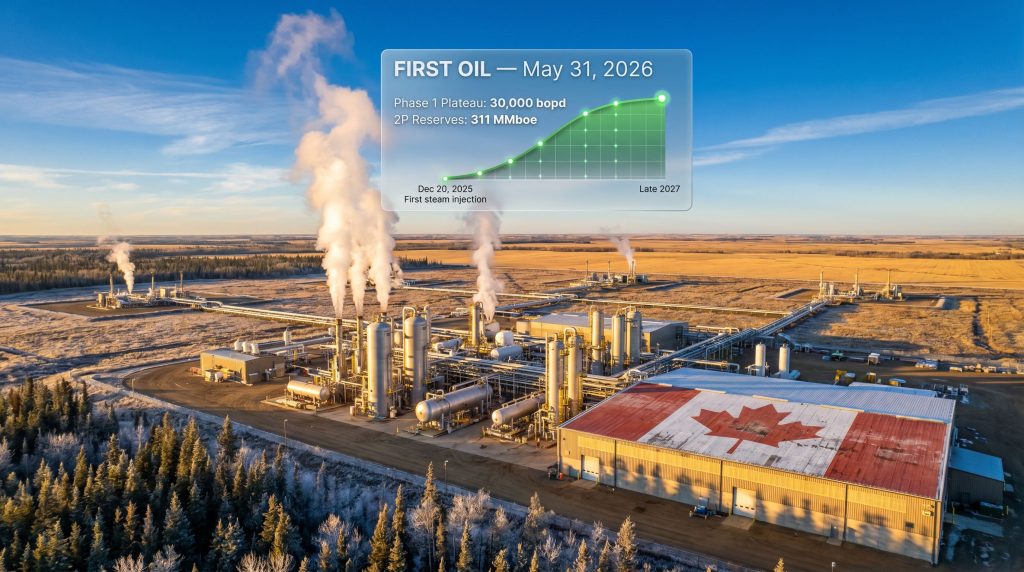
Why Greenfield Thermal Oil Sands Development Is Rarer Than Most Investors Realise
Building a thermal oil sands project from a blank canvas is one of the most capital-intensive and operationally complex undertakings in the global upstream energy sector. Unlike brownfield expansions, which benefit from existing infrastructure, established reservoir data, and proven surface facilities, greenfield thermal developments require operators to simultaneously engineer subsurface extraction strategies, construct processing facilities, and integrate regional pipeline connectivity, all before a single barrel reaches market.
This is precisely why Alberta's oil sands sector has been dominated by incremental capacity additions and debottlenecking programs for the better part of a decade. Against that backdrop, the IPC Blackrod Phase 1 first oil milestone, achieved in late May 2026, carries significance well beyond a single production announcement.
When big ASX news breaks, our subscribers know first
What the Blackrod Asset Actually Represents Within Alberta's Oil Sands
The Geological and Structural Foundation of Blackrod
The Blackrod thermal oil sands project sits within the broader Athabasca oil sands region of northern Alberta, where bitumen-saturated sands are recovered using steam-assisted gravity drainage, more commonly referred to as SAGD. This technique involves injecting high-pressure steam through horizontal well pairs drilled in parallel formations, one above the other. The steam heats the surrounding bitumen, dramatically reducing its viscosity and allowing it to drain under gravity to the lower production well, where it is pumped to surface.
What makes Blackrod geologically compelling is not just the quality of its reservoir but the scale of recoverable resource it contains. The Phase 1 development is underpinned by 311 million barrels of oil equivalent (MMboe) in 2P reserves, while the broader Blackrod asset holds an estimated 1.1 billion barrels of oil equivalent (Bboe) in contingent resources across its full footprint. These are not exploration estimates; they reflect a mature, appraised resource base that International Petroleum Corp. (IPC) has systematically de-risked since acquiring the asset in 2018.
Eight Years From Acquisition to Commercial Production
The timeline from IPC's initial acquisition of Blackrod to commercial first oil spans roughly eight years. That duration reflects the multi-stage nature of thermal oil sands development rather than any execution delay. The sequence typically involves:
- Appraisal drilling to characterise reservoir thickness, bitumen saturation, and cap rock integrity
- Front-end engineering and design (FEED) to establish facility specifications and cost estimates
- Regulatory approval including environmental assessment and project licence applications
- Final investment decision (FID) and project sanction, which occurred for Blackrod Phase 1 in 2023
- Construction and commissioning of the central processing facility and well pad infrastructure
- Steam injection and reservoir warm-up, initiated on December 20, 2025
- Transition from steam circulation to active production, achieved on May 31, 2026
Understanding this sequencing is important for investors evaluating the credibility of future phase timelines, because each stage has well-established engineering precedents within the Alberta SAGD industry.
Blackrod Phase 1 Infrastructure: How the System Is Engineered to Scale
Central Processing Facility and Well Pad Architecture
The Phase 1 configuration centres on a central processing facility (CPF) connected to three dedicated well pad facilities, each of which manages a discrete set of SAGD well pairs and associated drainage patterns. The CPF handles fluid separation, water treatment, steam generation, and bitumen handling, while the well pads serve as the interface between subsurface reservoir drainage and surface processing.
This hub-and-spoke architecture is a deliberate design choice. By centralising steam generation and fluid processing at the CPF, IPC reduces the capital and operational complexity that would arise from distributed processing infrastructure. It also creates a scalable foundation, as additional well pads can be tied back to the same CPF in future phases without duplicating the most capital-intensive surface equipment.
Pipeline connectivity to the Grand Rapids Pipeline system, which serves the Edmonton market, provides Blackrod with direct access to one of Alberta's primary bitumen and blended crude transport corridors. Condensate supply and natural gas infrastructure integration are also in place, both of which are operationally critical for SAGD projects. Natural gas fuels the steam generators, while condensate serves as a diluent to reduce bitumen viscosity sufficiently for pipeline transport.
Project Scale Summary
| Metric | Detail |
|---|---|
| Phase 1 Plateau Production Target | 30,000 bopd |
| Revised Plateau Timeline | Late 2027 (approx. one quarter earlier than original guidance) |
| 2P Reserves (Phase 1) | 311 MMboe |
| Contingent Resources (Broader Asset) | 1.1 Bboe |
| Regulatory Approval for Expansion | Up to 80,000 bopd |
| Forecast Plateau Production Lifespan | 25+ years |
| Growth Capex to First Oil | ~USD 850 million |
| IPC Working Interest | 100% |
What Ahead-of-Schedule Delivery Signals About Project Governance
Original Timelines Versus Actual Performance
When IPC formally sanctioned Blackrod Phase 1 in 2023, the project's plateau production rate was projected to be achieved approximately one quarter later than the current revised forecast of late 2027. First oil was originally guided for late 2026, yet the initial well pairs entered production in May 2026, representing a meaningful outperformance relative to that original schedule.
This distinction matters because thermal oil sands projects are notoriously susceptible to schedule slippage. Large-scale greenfield construction in northern Alberta involves extreme weather constraints, complex modular fabrication logistics, and a deep supply chain of specialised contractors. Delivering on budget at approximately USD 850 million in a cost environment that has challenged oil sands construction programs across the province is a noteworthy outcome.
Why Budget Discipline Matters for Subsequent Phases
Key Insight: In the oil sands sector, a project's execution track record on Phase 1 is often the single most important input into an operator's ability to attract financing, negotiate contractor terms, and secure board approval for Phase 2. Investors and lenders assign material risk premiums to operators with poor first-project delivery records, regardless of the underlying resource quality.
IPC's demonstrated execution discipline on Blackrod Phase 1 therefore does more than validate the current project. It materially strengthens the investment case for future phases by establishing a credible cost and schedule baseline.
Blackrod in Context: Alberta's Greenfield Thermal Development Landscape
The Shift Away from New-Build Projects
For most of the past decade, capital allocation within Alberta's oil sands sector has overwhelmingly favoured brownfield expansions and debottlenecking programs over greenfield development. The reasons are straightforward. Brownfield projects offer lower capital intensity, faster time-to-production, and reduced permitting complexity because they leverage existing infrastructure and established regulatory footprints.
Furthermore, commodity prices impact on decision-making has been significant, with operators preferring lower-risk capital deployment. The contrast between development types is instructive:
| Development Type | Capital Intensity | Risk Profile | Time to First Oil | Blackrod Classification |
|---|---|---|---|---|
| Greenfield Thermal SAGD | High | Higher | Longer | Yes |
| Brownfield Expansion | Moderate | Lower | Shorter | No |
| Debottlenecking / Optimisation | Low | Minimal | Near-immediate | No |
Blackrod Phase 1 is widely regarded as the largest greenfield thermal oil sands development brought online in Alberta in approximately ten years. That designation reflects a genuine structural gap in new-build activity across the sector, rather than simply a marketing claim.
What Low-Decline Plateau Production Means for Reserve Replacement
One of the least appreciated characteristics of mature SAGD operations is their production stability. Unlike conventional oil wells or tight oil plays, which exhibit steep hyperbolic decline curves requiring continuous infill drilling to sustain production, a well-designed SAGD operation at plateau can maintain relatively flat production rates for extended periods.
Blackrod Phase 1 is forecast to sustain approximately 30,000 bopd for more than 25 years, providing IPC with a structurally different cash flow profile than most mid-cap independents operating in light oil or shale plays. This characteristic also has implications for Alberta's aggregate production outlook at a time when several legacy thermal projects are approaching the end of their productive plateau phases and no comparable greenfield replacements have been announced at scale.
The Expansion Roadmap: From 30,000 bopd to 80,000 bopd
Pre-Approved Capacity and What It De-Risks
IPC holds existing regulatory approval to expand total Blackrod production to 80,000 bopd, representing more than 2.6 times the Phase 1 plateau rate. The significance of pre-approved expansion capacity is often underappreciated by investors outside the oil sands sector. Obtaining new regulatory approvals for thermal oil sands expansions in Alberta involves environmental impact assessments, indigenous consultation processes, and detailed engineering submissions that can collectively span several years. Having that approval framework already in place removes one of the most unpredictable variables from the Phase 2 capital planning process.
Unlocking 1.1 Billion Barrels of Contingent Resources
The 1.1 Bboe of contingent resources across the broader Blackrod asset represents the long-duration value optionality that distinguishes this project from conventional upstream developments. Contingent resources are classified as potentially recoverable but not yet associated with an approved development plan. Converting a portion of those resources into developed reserves through future phases is the primary long-term value creation pathway available to IPC beyond Phase 1.
However, it is worth noting that the broader oil price rally environment will also influence the pace at which IPC elects to advance future phases.
Scenario Perspective: If future development phases were structured to add approximately 25,000 bopd each, two additional phases beyond Phase 1 could bring total Blackrod production close to the 80,000 bopd regulatory ceiling. At that output level, Blackrod would rank among the most significant single-operator thermal oil sands complexes in Alberta. These are illustrative projections only and are subject to future investment decisions, capital availability, and regulatory conditions.
Phase 2 Timing and Cash Flow Sequencing
Conventional project development logic suggests that a formal Phase 2 final investment decision would follow Blackrod Phase 1 reaching plateau production, currently targeted for late 2027. This sequencing allows Phase 1 cash flows to contribute to funding subsequent development capital, reducing IPC's reliance on external financing and providing the board with empirical production data against which to calibrate Phase 2 cost estimates.
The next major ASX story will hit our subscribers first
Ramp-Up Milestones to Monitor Through 2027
Staged Commissioning of Well Pairs
The initial well pairs that entered production on May 31, 2026 represent the first tranche of a staged ramp-up sequence. SAGD ramp-up is not instantaneous. Each well pair must complete its individual steam circulation phase, during which steam is injected to heat the reservoir and establish thermal connectivity between the injector and producer wells before transitioning to active fluid production. This process typically takes several months per well pair.
| Phase | Expected Timing | Key Milestone |
|---|---|---|
| First Steam Injection | December 20, 2025 | Reservoir warm-up initiated |
| First Oil (Initial Well Pairs) | May 31, 2026 | Steam-to-production transition |
| Additional Well Pairs Online | Mid-to-Late 2026 | Progressive commissioning |
| Plateau Production (30,000 bopd) | Late 2027 | Full Phase 1 capacity reached |
Steam-to-Oil Ratio as a Key Operational Metric
One technical metric that investors in SAGD projects should understand is the steam-to-oil ratio (SOR), which measures how many barrels of cold water equivalent steam are required to produce one barrel of bitumen. During the ramp-up phase, SOR values are typically elevated because the reservoir is still being heated.
As the thermal chamber matures and expands, SOR typically declines toward a steady-state operating value. Lower SOR is desirable because it reduces natural gas consumption, water treatment requirements, and therefore operating costs per barrel. Monitoring Blackrod's SOR trajectory as Phase 1 ramps toward plateau will be an important indicator of long-term operating cost competitiveness. In addition, crude oil price trends through 2025 and 2026 will directly influence the netback economics of each barrel produced.
Frequently Asked Questions: IPC Blackrod Phase 1 First Oil
When did IPC Blackrod Phase 1 achieve first oil?
The initial well pairs at Blackrod Phase 1 transitioned from steam circulation to active production on May 31, 2026, representing the formal IPC Blackrod Phase 1 first oil milestone for the project.
What is the plateau production target for Phase 1?
Phase 1 is designed to reach a sustained plateau rate of 30,000 barrels of oil per day, with that production level forecast to be maintained for more than 25 years.
How much did Phase 1 cost to develop?
IPC's total growth capital expenditure to first oil was approximately USD 850 million, and the project was delivered on budget relative to that forecast.
What is the full resource potential of the Blackrod asset?
Phase 1 is underpinned by 311 MMboe of 2P reserves. The broader asset holds a further 1.1 Bboe of contingent resources available for development through future phases.
Can Blackrod be expanded beyond 30,000 bopd?
IPC holds existing regulatory approval to expand total Blackrod production capacity to 80,000 bopd through future development phases, more than 2.6 times the Phase 1 plateau rate.
Why is Blackrod considered significant within the Alberta oil sands sector?
Blackrod Phase 1 is the largest greenfield thermal oil sands development brought online in Alberta in approximately a decade, distinguishing it from the brownfield expansions and optimisation projects that have dominated recent industry capital allocation.
What the Blackrod Milestone Means for IPC's Long-Term Capital Strategy
100% Working Interest as an Earnings Amplifier
IPC retained a 100% working interest in Blackrod throughout the development process, forgoing the risk dilution that a joint venture structure would have provided in exchange for capturing the full economic upside of plateau production. At 30,000 bopd, even modest netback improvements translate directly into material cash flow increments without the dilution that partial interest structures impose.
This decision reflects a high-conviction view on the asset's long-term economics and IPC's confidence in its own execution capability. Consequently, Australia's resource and energy export landscape offers a useful contrast, illustrating how different ownership structures and commodity mixes shape long-term revenue resilience for mid-cap operators globally.
Long-Duration Assets and Capital Allocation Discipline
The thermal oil sands asset class, when operated efficiently, provides something that is genuinely scarce in the upstream energy sector: predictable, long-duration, low-decline production. This profile supports a capital allocation model that blends sustained operational cash flows with staged reinvestment into future phases, rather than the constant capital recycling required to maintain production in high-decline resource plays.
For a mid-cap independent operator like IPC, Blackrod's plateau production profile provides a financial foundation that larger integrated operators have historically used to fund both shareholder returns and growth capital simultaneously. Furthermore, trade war impacts on global energy markets remain a key variable that could influence the timing and economics of future Blackrod phases.
Disclaimer: This article contains forward-looking projections, scenario analyses, and timeline estimates that are inherently subject to uncertainty. Production targets, plateau timelines, expansion scenarios, and resource conversion pathways are based on publicly available company guidance and independent analysis. They should not be construed as investment advice. Readers should conduct their own due diligence and consult a licensed financial adviser before making investment decisions.
Want to Identify the Next Major Resource Discovery Before the Market Moves?
Discovery Alert's proprietary Discovery IQ model scans ASX announcements in real time, instantly alerting subscribers to significant mineral discoveries and actionable investment opportunities across more than 30 commodities — the same class of early-stage insight that has historically preceded extraordinary returns. Explore Discovery Alert's dedicated discoveries page to understand how major resource discoveries have generated substantial market returns, and begin your 14-day free trial to position yourself ahead of the broader market.