
June 9, 2026
Gold's Hidden Price Mechanics: What the Iran Conflict Is Actually Revealing
Most investors approach precious metals through a relatively simple mental model: global instability rises, gold prices follow. It is an intuitive framework, but one that consistently leads to poor timing decisions and misread market signals. The reality of how geopolitical events interact with gold pricing is far more layered, involving competing forces that can cancel each other out, amplify one another, or produce outcomes that appear paradoxical on the surface.
The iran conflict impact on gold prices offers one of the most instructive case studies in recent years for understanding these mechanics. Rather than producing a clean, sustained gold rally, the situation has generated choppy price action, unexpected short-term declines, and a divergence in behaviour between different categories of investors. Understanding why this has happened requires moving well beyond the headline narrative.
When big ASX news breaks, our subscribers know first
The Variable That Matters More Than the Headlines
At the centre of gold's pricing mechanism sits a single variable that receives far less media attention than geopolitical developments: real interest rates. The real rate, calculated by subtracting long-term inflation expectations from nominal bond yields, represents the actual return investors receive after accounting for purchasing power erosion. When this figure rises, the cost of holding a non-yielding asset like gold increases. When it falls, gold becomes relatively more attractive.
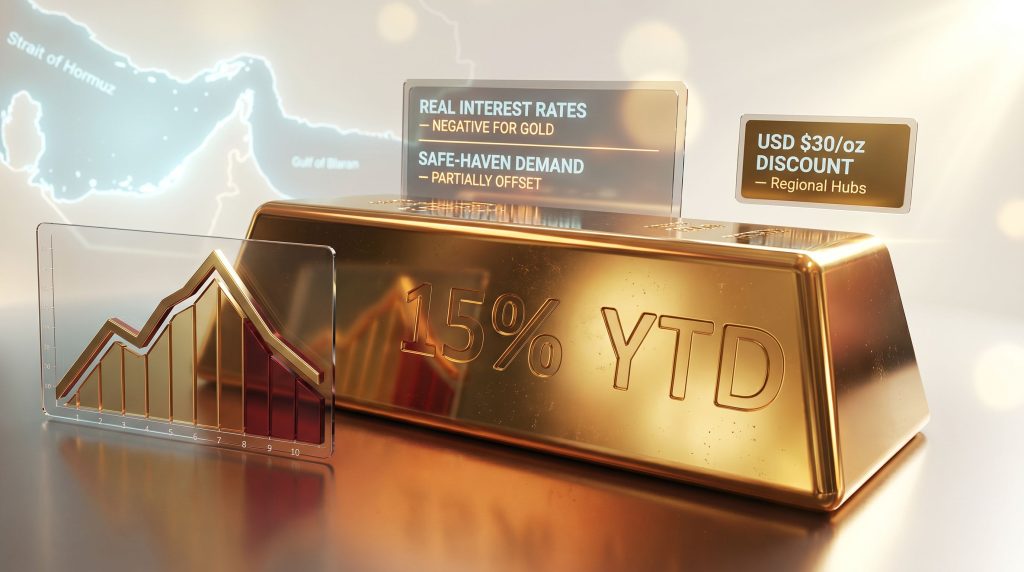
Following the escalation of the conflict, bond markets sold off as investors anticipated fiscal pressures and uncertainty. Nominal yields moved higher. Critically, however, long-term inflation expectations remained comparatively anchored, reflecting continued market confidence in the Federal Reserve's capacity to manage price stability over time. The arithmetic result was higher real interest rates, creating a structural headwind for gold at precisely the moment many investors expected a surge.
This dynamic explains a pattern that repeatedly confuses retail investors: gold can fall during active geopolitical crises not because it has lost its safe-haven properties, but because other market forces are simultaneously moving against it.
This is not a new phenomenon. Gold's sensitivity to real rates is one of the most historically durable relationships in financial markets. The metal's apparent decoupling from this relationship during 2024, when it rallied strongly despite elevated real yields, led some commentators to argue that gold had been permanently re-rated. More recent price action suggests that interpretation was premature, with gold reasserting its conventional relationship with real rate dynamics. Furthermore, understanding the broader geopolitical gold drivers at play helps contextualise why these mechanics behave differently across conflict cycles.
Three Forces Competing for Control of the Gold Price
Safe-Haven Demand: Real but Conditional
The safe-haven premium attached to gold during periods of conflict is genuine, but it is not automatic. It activates most powerfully when geopolitical tension threatens to produce lasting consequences for currency purchasing power, inflation regimes, or systemic financial stability. When markets assess a conflict as likely to be contained, the safe-haven premium remains modest.
The Iran conflict has, so far, been categorised by institutional participants as a temporary shock rather than a transformational event. That single classification has done more to shape gold's near-term trajectory than the conflict itself. Institutional investors with long time horizons and sophisticated analytical frameworks are not ignoring the situation; they are simply not assigning it the kind of structural significance that would justify a sustained gold re-rating. Gold safe-haven demand is consequently more conditional than many retail participants assume.
Energy Markets and the Strait of Hormuz Calculus
Iran's strategic position adjacent to the Strait of Hormuz introduces an energy dimension to the conflict's market impact. Approximately 20% of global oil supply transits this waterway, making any escalation involving Iranian control over shipping a potential energy market shock. Rising oil prices feed into inflation expectations, which in turn affect real bond yields and gold's relative attractiveness as an inflation hedge.
The complexity, however, is that markets immediately begin pricing in adaptation. Even in scenarios where Iran imposed fees or restrictions on Strait of Hormuz traffic, historical precedent suggests producers, consumers, and governments would pursue alternative routes, infrastructure investments, and energy substitution strategies. The market tends to price in some degree of normalisation, which limits the inflationary impulse even from significant supply disruptions. According to Reuters analysis of the conflict's market effects, risk-off sentiment has kept gold particularly volatile throughout this period.
Historical context matters here. The 1970s oil embargo did not cause a decade of stagflation on its own. It was the combination of price controls, monetary policy errors, and fiscal expansion layered on top of the supply shock that created lasting economic damage and, ultimately, a historic bull market for gold.
Leveraged Selling: The Counterintuitive Suppressor
Perhaps the least discussed force operating on gold during the conflict period is the mechanical selling pressure generated by leveraged investors reducing risk exposure. When volatility spikes unexpectedly, participants who entered markets during extended periods of optimism often find themselves needing to liquidate positions rapidly to meet margin requirements or manage drawdown limits.
This dynamic creates selling across asset classes simultaneously, including gold. Combined with typical USD strength during risk-off episodes, which increases the opportunity cost of holding dollar-denominated gold, leveraged selling can temporarily push gold prices below pre-conflict levels. Available data from this period suggests gold declined approximately 10% over a ten-week window at certain points, while physical gold in transit hubs such as Dubai traded at discounts of roughly USD $30 per ounce due to elevated transport and insurance costs reducing buyer appetite.
Importantly, this occurred despite gold having gained more than 15% on a year-to-date basis prior to conflict-related volatility, illustrating that underlying structural demand remained intact even as short-term mechanics created pressure. Forbes has also noted how gold and silver prices faced sharp pressure as the conflict sparked inflation concerns and strengthened the dollar simultaneously.
| Market Force | Direction of Impact on Gold | Observed During Iran Conflict |
|---|---|---|
| Safe-haven demand | Positive | Moderate; offset by other factors |
| Rising nominal bond yields | Negative | Confirmed |
| Anchored inflation expectations | Negative (limits re-rating) | Confirmed |
| Higher real interest rates | Negative | Confirmed |
| USD strength during risk-off | Negative | Partially confirmed |
| Leveraged investor selling | Negative | Confirmed; amplified short-term decline |
| Long-term institutional buying | Positive | Confirmed; net buying bias maintained |
When a Shock Becomes a Structural Market Event
The more analytically important question is not what gold has done during the conflict, but what conditions would need to change for the situation to transition from a temporary disruption into a lasting structural shift for markets. Three scenarios represent the most credible pathways.
Pathway 1: Sustained energy supply disruption
A prolonged interruption to global oil flows through the Strait of Hormuz lasting long enough to permanently re-anchor inflation expectations at a higher level would meaningfully alter the gold pricing calculus. Short-term disruptions are absorbed; sustained ones force structural adjustments in how markets price long-term purchasing power.
Pathway 2: Policy amplification of the shock
Historical analysis consistently identifies government policy responses, rather than supply shocks themselves, as the primary source of lasting economic damage. Price controls, emergency fiscal programmes, and trade interventions can transform a manageable disruption into a structural distortion. The economist Friedrich Hayek's work on the relationship between debt, monetary policy independence, and governance structures remains particularly relevant here.
Hayek argued that excessive government debt progressively undermines the ability of central banks to act independently, a dynamic that investors monitoring gold through a long-term fiscal lens consider a slow-moving but powerful catalyst. In addition, the gold and bond dynamics at play across economic cycles reinforce why policy amplification matters so significantly to precious metals pricing.
Pathway 3: Central bank credibility deterioration
The Federal Reserve's perceived ability to contain inflation over the long term is currently providing a ceiling on gold's safe-haven premium. If that credibility erodes, whether through a policy error, a loss of fiscal discipline, or a forced subordination of monetary policy to debt sustainability concerns, long-term inflation expectations would shift materially. That scenario, sometimes described through the framework of fiscal dominance, would represent the most powerful structural catalyst for gold.
The Behavioral Split: Two Kinds of Gold Investors
One of the most revealing aspects of the current market environment is the divergence in behaviour between different categories of gold investors. This split contains important information about market structure and forward expectations.
Long-term strategic holders are maintaining a net buying bias throughout the conflict period. Precious metals managers overseeing more than $4 billion in assets have observed this pattern among long-horizon investors, who view current price weakness as an accumulation opportunity consistent with their multi-year thesis on currency purchasing power erosion and fiscal dynamics. These participants are not reacting to the conflict as a specific event; they are using price softness to build positions they intend to hold through multiple market cycles.
Leveraged short-term participants are behaving in the opposite manner, reducing risk exposure when volatility arrives. Both groups may describe their actions using the language of risk management, but the underlying logic is fundamentally different. One group is executing a pre-established systematic process; the other is responding reactively to conditions that exceeded their original risk tolerance.
The distinction between professional risk management and reactive panic can look nearly identical from the outside. Both involve reducing exposure during volatile periods. The difference lies entirely in whether the decision was pre-planned or emotionally triggered.
Central banks and sovereign wealth funds represent a third category operating on an entirely different time horizon. The broader central bank influence on gold markets has been a consistent structural force that preceded the Iran conflict and is unlikely to be materially altered by it in either direction. Non-Western central banks have consequently maintained their reserve diversification strategies throughout.
The Passive Investing Effect: Why Precious Metals May Be Mispriced
A structural shift in how capital is allocated has created an underappreciated dynamic in the precious metals sector. The decade-long dominance of passive, index-tracking investment strategies reduced the depth of active analytical coverage across specialised market segments. As capital flowed into broad market indices, niche sectors including mining and precious metals received proportionally less dedicated research attention from professional analysts.
This reduction in analytical coverage creates conditions where pricing inefficiencies can persist longer than they might in more heavily scrutinised markets. Investors willing to conduct detailed, ground-level research into individual mining companies, specific deposit characteristics, or regional physical gold market dynamics may encounter pricing gaps that passive strategies structurally cannot capture.
One commonly overlooked example: the gold price most widely quoted in financial media represents the London Bullion Market Association (LBMA) benchmark, specifically the price for a standardised gold bar of defined purity held in London. Understanding the distinction between LBMA versus COMEX settlement structures is essential, as during periods of market stress or supply chain disruption, physical gold prices in other locations can diverge materially from this benchmark. Investors monitoring only the LBMA headline figure receive an incomplete picture of real-world precious metals market conditions.
The next major ASX story will hit our subscribers first
Debt, Fiscal Dominance, and Gold's Long Horizon
While geopolitical events drive near-term volatility, the structural case for gold over a multi-year horizon rests primarily on fiscal and monetary dynamics that receive comparatively little attention in conflict-focused market commentary.
Elevated government debt levels do not generate clean, tradeable signals. Unlike interest rate changes or earnings revisions, debt dynamics unfold over years and decades. However, their influence on gold's long-term trajectory is arguably more significant than any single geopolitical event. The mechanism operates through several interconnected channels:
- Debt levels constrain central bank independence, reducing the capacity to raise rates sufficiently to contain inflation without triggering sovereign debt instability
- Inflation gradually erodes the real value of government obligations, transferring purchasing power loss to holders of currency-denominated assets
- Political pressure consistently favours fiscal expansion over meaningful deleveraging, suggesting the trajectory is more likely to worsen than improve
- Gold, as a non-sovereign store of value with no counterparty liability, captures the cumulative effect of purchasing power erosion over time
Rather than anticipating a single dramatic financial reset, a more rigorous framework envisions a prolonged period of gradual instability. Households adapt incrementally, labour markets adjust, consumption patterns shift, and political dynamics evolve. The resulting environment is characterised by slowly rising instability rather than a sudden reckoning, and gold functions as a long-duration insurance policy against that process.
A Practical Framework for Geopolitical Gold Events
The most common investment mistake during periods of geopolitical tension is conflating headline severity with market impact. Media coverage intensity has no consistent relationship with the magnitude or direction of gold's price response. A structured evaluation framework produces better decisions than reactive positioning.
Before adjusting precious metals exposure in response to geopolitical events, investors should work through the following assessment:
- Have long-term inflation expectations in bond markets moved materially, or remained anchored?
- Are central banks signalling any change in their inflation-management posture?
- Is there evidence of sustained, rather than temporary, disruption to global energy supply chains?
- Are governments implementing policy responses likely to amplify the economic shock?
- Has the USD weakened materially, reducing the opportunity cost of holding gold?
- Are long-term institutional gold holders increasing or reducing exposure?
If the honest answers to these questions are predominantly negative, the conflict is likely being correctly assessed by markets as a temporary shock rather than a structural event. That assessment does not mean gold is a poor investment; it means the specific conflict does not represent a near-term catalyst sufficient to override the real rate headwinds currently in place.
Three portfolio discipline principles that apply regardless of geopolitical conditions:
- Rebalance during periods of market strength, not in response to volatility. Investors who fail to reduce risk asset exposure during bull markets frequently discover they are dangerously overexposed when conditions deteriorate.
- Maintain personal financial flexibility. Investors whose expenditure is well below their income can tolerate far greater portfolio volatility without being forced into ill-timed liquidations.
- If market positions are generating compulsive price-monitoring behaviour or disrupting sleep, the portfolio is likely carrying more risk than is personally appropriate, regardless of whether the underlying investment thesis is correct.
FAQ: Iran Conflict Impact on Gold Prices
Does Middle East conflict reliably push gold higher?
Not automatically. Whilst the iran conflict impact on gold prices has been a consistent topic of investor discussion, short-term price action can be neutral or negative when conflict simultaneously triggers USD strength, higher real interest rates, or forced liquidation by leveraged investors. The net direction depends on which forces dominate in the immediate aftermath of escalation.
Why did gold decline during active conflict phases?
Rising nominal bond yields without a corresponding increase in long-term inflation expectations produced higher real interest rates. Higher real rates increase the opportunity cost of holding non-yielding gold, creating downward pressure that can temporarily outweigh safe-haven demand flows.
What would transform the Iran conflict into a lasting gold catalyst?
A sustained disruption to Strait of Hormuz oil flows, a loss of Federal Reserve credibility on inflation management, or a government policy response that amplifies the economic shock through fiscal expansion or price controls would each represent potential pathways for a structural re-rating of gold.
Why do physical gold prices sometimes differ from the LBMA benchmark?
The widely quoted spot price reflects a standardised bar in London. Physical gold in other locations, transit hubs, or alternative product forms carries additional logistics, insurance, and settlement costs. During periods of market stress, these factors can produce meaningful price divergences that the headline LBMA figure does not capture.
Is gold losing its safe-haven properties?
The iran conflict impact on gold prices has led some to question gold's fundamental character. However, current underperformance during certain conflict phases is more accurately explained by standard real interest rate mechanics than by any permanent structural shift. The metal's behaviour reflects the dominance of rising real rates over safe-haven demand, a historically normal dynamic.
Key Takeaways
| Insight | Investor Implication |
|---|---|
| Markets classify Iran conflict as temporary shock | Limited structural gold re-rating in near term |
| Real rates rose despite conflict escalation | Headwind offsetting safe-haven demand |
| Long-term investors maintained net buying bias | Strategic investment case remains intact |
| Leveraged selling amplified short-term price weakness | Decline does not equal fundamental deterioration |
| Policy responses pose greater risk than conflict itself | Monitor fiscal and monetary reactions, not just headlines |
| Passive investing reduced precious metals research coverage | Potential mispricing opportunities for research-intensive investors |
| LBMA benchmark diverges from physical market during stress | Headline gold price may misrepresent real-world conditions |
| Fiscal dominance risk grows with government debt levels | Long-term gold thesis strengthens regardless of near-term volatility |
This article is intended for informational purposes only and does not constitute financial advice. All investment decisions involve risk, including the potential loss of capital. Past performance of any asset class, including gold, is not indicative of future results. Readers should conduct their own research or consult a licensed financial adviser before making investment decisions.
Want to Stay Ahead of the Next Major Mineral Discovery on the ASX?
Whilst gold's price mechanics are shaped by real interest rates, geopolitical shocks, and institutional behaviour, the biggest returns in the resources sector have historically come from identifying significant mineral discoveries at the earliest possible moment — precisely what Discovery Alert's proprietary Discovery IQ model is built to do, delivering real-time ASX discovery alerts that cut through market noise and turn complex data into actionable investment insights. Explore how historic discoveries have generated extraordinary returns on Discovery Alert's dedicated discoveries page and begin your 14-day free trial today to position yourself ahead of the broader market.