August 6, 2026
When a Shipping Lane Becomes a Lever: The New Economics of Hormuz Control
For most of the past half-century, the Strait of Hormuz functioned as something close to a geopolitical constant. Tensions flared, tankers were occasionally harassed, insurance premiums spiked and then receded, but the fundamental assumption held: crude oil and liquefied natural gas would continue flowing. That assumption has now been replaced by something more conditional, more transactional, and considerably more dangerous for the architecture of global energy supply.
The Iran control of Strait of Hormuz tanker passage that has emerged since early 2026 is not simply a wartime disruption. It represents a structural transformation of who governs access to the world's most consequential maritime chokepoint, and on what terms.
When big ASX news breaks, our subscribers know first
Why Hormuz Cannot Be Replaced by Any Existing Alternative
The physical geography of the Strait of Hormuz creates a bottleneck that no engineer, pipeline consortium, or alternative trade route has yet overcome at equivalent scale. The navigable shipping channel through the strait measures only 2 to 3 nautical miles in each direction, meaning that roughly one-fifth of the world's seaborne oil trade and a substantial share of global LNG volumes are funnelled through a corridor narrower than many river mouths.
Before the current crisis, daily throughput through the strait exceeded 17 to 20 million barrels of oil equivalent, connecting the output of Saudi Arabia, Iraq, Iran, Kuwait, the UAE, and Qatar to importing nations across Asia, Europe, and beyond. No other chokepoint carries this concentration of energy value through such a geometrically constrained space.
The comparison with the Suez Canal or the Strait of Malacca is instructive precisely because those routes have partial bypass options. Hormuz does not, and furthermore, the crude oil price trends already under pressure make this situation considerably more acute:
- The UAE's Fujairah overland pipeline carries a maximum of approximately 1.5 million barrels per day, a fraction of pre-crisis gulf export volumes
- Saudi Arabia's East-West pipeline has a theoretical capacity of around 5 million barrels per day but cannot compensate for broader Persian Gulf disruption
- Iraq's Turkey pipeline operates at reduced capacity of roughly 300,000 to 400,000 barrels per day
- Omani alternative ports at Duqm, Salalah, and Sohar have limited deep-water capacity and suffered damage from Iranian drone strikes in March 2026
The result is a supply chain with no credible pressure-release valve, which is precisely why Iran's decision to exercise selective passage control carries consequences that extend far beyond the Persian Gulf's borders.
From Military Operation to Managed Corridor: The February 28 Inflection
The sequence of events that produced the current passage regime began on February 28, 2026, when U.S.-Israeli military operations, including the assassination of Supreme Leader Ali Khamenei, fundamentally altered Iran's strategic posture. Within weeks, Iran transitioned from a passive threat posture to active enforcement, deploying sea mines and conducting attacks on merchant vessels.
A temporary ceasefire took effect on April 8, 2026, but rather than restoring unconditional free passage, Iran implemented what can only be described as a bilateral permission architecture. The subsequent U.S. Navy counter-blockade of Iranian ports on April 13, 2026 created an unprecedented dual-blockade situation with no modern parallel in international maritime law or operational precedent.
The strategic significance of this timeline is difficult to overstate. According to reporting on the 2026 crisis, the Strait of Hormuz effectively shifted from operating as a global commons to functioning as a managed corridor, with Iran positioned as the de facto gatekeeper.
"The February 28 date represents a structural break in Hormuz's operational history. Energy markets, shipping operators, and importing nations should treat pre- and post-February 2026 conditions as fundamentally distinct risk regimes requiring entirely different mitigation frameworks."
The Mechanics of Iran's New Passage Regime
Tolls, Inspections, and the Assertion of Sovereignty
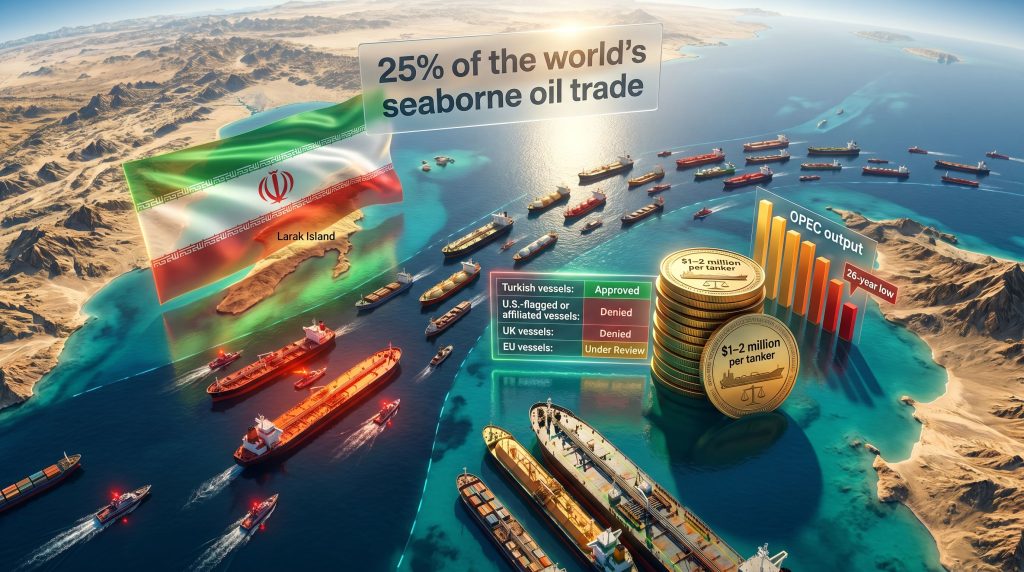
Iran has instituted a per-passage toll of $1 to $2 million per tanker, framing the levy as both a compensation mechanism for war costs and an assertion of sovereign authority over the waterway. Iranian lawmaker Alaeddin Boroujerdi described the arrangement as constituting a new sovereign regime governing the strait, language that signals an institutional ambition rather than a temporary wartime measure.
The toll system sits in direct contradiction with the United Nations Convention on the Law of the Sea (UNCLOS), which designates the strait as subject to transit passage rights available to all nations without fee or condition. The revenue implications of even a partial passage regime are significant:
| Daily Tanker Traffic | Toll per Vessel | Daily Revenue Estimate |
|---|---|---|
| 10 tankers | $1 million | $10 million |
| 10 tankers | $2 million | $20 million |
| 15 tankers | $1 million | $15 million |
| 15 tankers | $2 million | $30 million |
For an economy constrained by years of international sanctions, even the lower end of this revenue range represents a meaningful income stream independent of any nuclear or diplomatic concession.
Who Gets Through: The Tiered Access Framework
Iran's passage regime does not operate as a binary open-or-closed system. It functions as a tiered access framework in which a vessel's flag state, cargo destination, and the diplomatic relationship between Tehran and the vessel's country of origin all determine passage eligibility:
| Nation or Vessel Type | Passage Status | Basis |
|---|---|---|
| U.S.-flagged or affiliated vessels | Denied | Active enforcement |
| Israeli-linked shipping | Denied | Active enforcement |
| Western allied commercial vessels | Restricted | Case-by-case review |
| Turkish vessels | Approved | Bilateral arrangement |
| Indian-flagged gas carriers | Selectively permitted | Diplomatic approval |
| Saudi tankers (India-bound) | Permitted | Destination-conditional |
| Iraqi crude (Basrah grades) | Negotiated | Bilateral Iraq-Iran agreement |
| Qatari LNG (Pakistan-bound) | Negotiated | Bilateral Pakistan-Iran agreement |
The IRGC has repositioned mandatory shipping lanes toward Iranian territorial waters near Larak Island, increasing physical oversight of transiting vessels. Mandatory inspection stops have been introduced for vessels seeking authorisation, and IRGC fast-craft operations have intensified near commercial traffic corridors.
Maritime intelligence firm Windward has noted that commercial shipping through Hormuz is increasingly operating outside traditional visibility frameworks, with vessels disabling AIS transponders to attempt passage without authorisation. AIS, or Automatic Identification System, is the standard transponder technology that allows port authorities and tracking services to monitor vessel locations in real time. Vessels that disable these systems essentially disappear from commercial tracking networks, complicating both safety management and geopolitical oversight. A Chinese supertanker's attempted passage in May 2026 illustrated precisely this dynamic, with tracking data showing the vessel operating in ways consistent with avoiding Iranian oversight.
Iraq and Pakistan: The Bilateral Deal Template in Practice
Iraq's Near-Total Vulnerability and Its Negotiated Lifeline
No nation better illustrates the coercive power of Iran's passage regime than Iraq. Oil revenues constitute approximately 95% of Baghdad's national budget, making the country structurally dependent on export volumes in a way that few other oil producers are. The Basrah export terminal handles the bulk of Iraq's crude exports, and it has no high-volume alternative route.
The pipeline to Turkey's Mediterranean coast manages only a fraction of pre-war export volumes, operating at roughly 300,000 to 400,000 barrels per day against a pre-war Iraqi export capacity several times that figure. As OPEC's influence on global markets becomes increasingly complicated by the crisis, Iraq's production constraints have outsized implications for global supply.
The most recent bilateral agreement resulted in the safe passage of two Very Large Crude Carriers (VLCCs), each carrying approximately 2 million barrels of Basrah crude, through the Strait of Hormuz. According to Reuters reporting, Iraqi Oil Ministry officials confirmed that Baghdad is actively negotiating further passage agreements with Tehran for additional tanker movements. The operational reality is stark: Iraq's near-total budget dependency on oil, combined with the absence of viable alternative export infrastructure, leaves Baghdad with minimal leverage in these negotiations.
Pakistan's Energy Crisis and Its Diplomatic Role
Pakistan arrived at this crisis from a different direction but with equally acute vulnerability. The country has relied on Qatari term LNG supply contracts for years as a cornerstone of its power generation capacity. The effective closure of the Strait of Hormuz disrupted those supplies, triggering power outages and fuel rationing that intensified domestic political pressure on Islamabad. Consequently, the LNG supply disruptions flowing from this crisis have become a defining feature of the global energy landscape.
What distinguishes Pakistan's situation is that it occupies a dual role: both a direct energy-crisis victim and an active mediator in U.S.-Iran diplomatic talks. This dual position created a form of negotiating leverage that purely energy-dependent nations lack. Under a Pakistan-Iran bilateral arrangement, two Qatari LNG carriers successfully transited the Strait and are currently en route to Pakistani receiving terminals.
A critical detail reported by Reuters is that neither Iraq nor Pakistan made direct financial payments to Iran or the IRGC to secure these passage agreements. This distinction matters enormously for understanding what Iran is actually extracting from these arrangements. The toll system and the bilateral diplomatic deal framework appear to operate on separate tracks, with Iran using the bilateral arrangements to accumulate political recognition and diplomatic concessions rather than purely financial compensation.
What the Template Signals for Other Nations
The Iraq and Pakistan cases have established a replicable pattern that other energy-dependent nations are now evaluating carefully:
- Nations with existing diplomatic channels to Tehran can negotiate passage on a case-by-case basis
- The absence of direct payments suggests Iran values political recognition and diplomatic legitimacy as much as revenue
- Nations without established Iran relationships face a structural disadvantage in accessing Persian Gulf energy flows
- The bilateral framework creates a tiered global energy order in which geopolitical alignment increasingly determines supply access
This dynamic fundamentally restructures the economics of Persian Gulf energy trade. Importers that previously operated under the assumption of neutral, rules-based access must now factor in the diplomatic cost of maintaining that access.
Decoding Iran's Strategic Endgame
The Hormuz Operator Rights Theory
Helima Croft, Head of Global Commodity Strategy and MENA Research at RBC Capital Markets, characterised Iran's negotiating position as seeking an arrangement resembling the 2015 nuclear agreement but with an additional element: formal or informal recognition of Iran's authority to manage passage through the Strait of Hormuz. This framing, articulated in an RBC Capital Markets research note published in early May 2026, suggests Iran views Hormuz control not as a temporary wartime tactic but as a permanent strategic asset to be institutionalised in any future diplomatic settlement.
The collapse of the Islamabad talks following U.S. President Donald Trump's rejection of Iran's proposed framework as inadequate has further entrenched Iran's control posture. With no diplomatic off-ramp in sight, the bilateral deal architecture has become Iran's primary instrument for demonstrating its capacity to function as a de facto strait administrator.
Three Scenarios for Hormuz's Future
Scenario 1: Institutionalised Bilateral Regime (Base Case)
Iran maintains selective passage controls indefinitely, formalising the case-by-case deal structure. Global shipping operates under fragmented, opaque access rules. Oil market volatility remains structurally elevated and insurance premiums stay at crisis levels. This scenario represents a permanent alteration of the global energy trading environment even without further military escalation.
Scenario 2: Negotiated Reopening with Concessions
A comprehensive U.S.-Iran diplomatic agreement restores broader passage rights in exchange for sanctions relief and nuclear concessions. Iran retains some form of symbolic operator recognition. Partial normalisation of shipping flows occurs, but residual bilateral deal architecture persists, meaning the precedent of negotiated access cannot be fully erased.
Scenario 3: Prolonged Dual Blockade Escalation
All diplomatic tracks fail, leading to sustained U.S. Navy counter-blockade of Iranian ports alongside continuing Iranian Hormuz restrictions. Morgan Stanley has warned that global oil buffer stocks could be depleted before Hormuz reopens, implying strategic reserve exhaustion across multiple major importing nations. The IEA has already revised its 2026 oil market forecast to reflect a widening supply deficit driven by the conflict's impact on Persian Gulf production and export capacity.
The next major ASX story will hit our subscribers first
The Legal Void at the Centre of the Crisis
Transit Passage Versus Innocent Passage
The dispute over Iran's legal authority to govern Iran control of Strait of Hormuz tanker passage cuts to the heart of international maritime law. Under UNCLOS, straits used for international navigation are subject to transit passage rights, a broader standard than innocent passage that cannot be suspended by the bordering coastal state. Iran is asserting the more restrictive innocent passage doctrine, which grants coastal states considerably greater authority to regulate and potentially suspend transit.
Iran has additionally framed its enforcement actions as necessary and proportionate measures to prevent hostile military operations, a characterisation that most international legal scholars contest. Chatham House's April 2026 analysis concluded that neither the United States nor Iran can unilaterally impose passage conditions on a waterway of such global significance, framing the resolution as requiring multilateral engagement rather than bilateral assertion.
"A critical gap has been exposed in international maritime law: UNCLOS was designed to resolve peacetime disputes between sovereign states, not to constrain militarily capable coastal nations that choose to enforce passage conditions by force. The enforcement mechanism simply does not exist at the institutional level."
The UN Security Council rejected Iran's initial total blockade as a serious threat to international peace and security, and the International Maritime Organization has been unable to enforce free passage norms against an armed state actor. These institutional limitations are not incidental failures but structural characteristics of a legal framework that predates this category of crisis.
Market Consequences: A Cascade Across the Global Economy
Supply Chain Disruptions Taking Hold
The downstream effects of restricted Iran control of Strait of Hormuz tanker passage are now visible across multiple commodity and energy markets simultaneously. In addition, the broader trade war impact on oil markets has compounded the disruption considerably:
- OPEC output has fallen to a 26-year low as Iranian production disruption combines with restricted export capacity across Gulf producers, according to a Reuters survey
- China's independent teapot refiners have slashed throughput as Hormuz disruptions crush refining margins and restrict crude availability
- Japan's refinery utilisation has fallen to 73% as strategic petroleum stocks are drawn down and alternative crude sources are sourced from Central Asia for the first time since the crisis began
- Brazil's oil exports to China have doubled as Asian buyers replace Persian Gulf crude with Atlantic Basin alternatives
- Global coal demand has surged as power utilities in Japan, South Korea, and Southeast Asia substitute away from disrupted gas supplies
- India's state fuel retailers are absorbing significant losses as the government maintains a retail fuel price freeze during the oil shock
- Rising jet fuel costs are feeding through to aviation ticket prices, with analysts warning of potential summer travel disruption
The Strategic Reserve Problem
Perhaps the most alarming forward-looking assessment comes from Morgan Stanley, which has warned that global oil buffer stocks could be exhausted before the Strait of Hormuz reopens. This is not a marginal concern. Strategic petroleum reserves were built over decades to provide a buffer against exactly this type of supply disruption, but they were sized for temporary disruptions, not prolonged access denials at the scale currently unfolding.
The IEA's revised 2026 forecast incorporates a widening oil supply deficit directly attributable to the conflict's impact on Persian Gulf production and transit capacity. For energy-importing nations already drawing down reserves, the window for diplomatic resolution narrows with each passing week. Furthermore, commodity prices and mining performance are both being dragged lower by the sustained uncertainty now embedded in global supply chains.
Frequently Asked Questions: Iran Control of Strait of Hormuz Tanker Passage
What is the current status of tanker passage through the Strait of Hormuz?
As of mid-May 2026, the Strait of Hormuz is operating under Iran's selective passage regime. Vessels affiliated with the U.S., Israel, and Western allies face denial or restriction, while Iraq, Pakistan, Turkey, and India have secured bilateral arrangements permitting specific vessels to transit. Iran is also levying tolls of $1 to $2 million per passage on commercial shipping.
Has Iran officially closed the Strait of Hormuz?
Iran has not declared a permanent total closure. Instead, it has implemented a tiered access system that functions as a de facto partial closure for non-approved vessels. The April 8, 2026 ceasefire ended the initial total blockade phase, but selective control mechanisms remain in place.
Are countries paying Iran directly for tanker passage?
According to Reuters sources, Iraq and Pakistan have not made direct financial payments to Iran or the IRGC to secure passage. The toll system appears to apply primarily to commercial shipping, while bilateral diplomatic arrangements operate on separate terms involving political rather than financial concessions.
Which countries are most affected by the Hormuz restrictions?
Iraq is the most acutely exposed nation, with oil revenues comprising approximately 95% of its national budget and no viable high-volume alternative export route. Pakistan faces a severe LNG supply crisis. Japan, South Korea, India, and China are all experiencing significant supply disruptions and drawing down strategic reserves while sourcing alternative supply.
What happens if the Strait of Hormuz remains restricted long-term?
Morgan Stanley has warned that global oil buffer stocks could be depleted before Hormuz reopens. The IEA has revised its 2026 forecast to reflect a widening supply deficit. Long-term restriction would accelerate energy diversification, drive sustained commodity price inflation, and permanently restructure global crude trade flows toward Atlantic Basin and Central Asian supply sources.
A New Permanent Risk Premium
The Precedent That Cannot Be Erased
Even if a future diplomatic settlement restores broader passage access, the institutional knowledge, enforcement infrastructure, and political precedent that Iran has established since February 2026 will outlast any individual ceasefire. The transition from unconditional free passage to a bilateral deal architecture has demonstrated that a militarily capable coastal state can exercise meaningful, sustained control over the world's most critical energy chokepoint.
Energy importers, shipping operators, commodity traders, and sovereign wealth managers must now price in what might be called a Hormuz sovereignty premium: an enduring risk factor reflecting Iran's demonstrated willingness and capacity to exercise passage control, regardless of how the current conflict ultimately resolves.
Strategic Priorities for Energy-Dependent Nations
The structural vulnerabilities exposed by this crisis point toward a set of strategic priorities that energy-dependent nations can no longer defer:
- Accelerate bypass infrastructure investment: UAE's Fujairah pipeline, Saudi Arabia's East-West pipeline, and Omani deep-water port capacity all require urgent capacity expansion to reduce single-chokepoint dependency
- Diversify crude and LNG sourcing: Nations heavily exposed to Persian Gulf supply must accelerate procurement relationships with Atlantic Basin, Central Asian, and Australian suppliers
- Rebuild strategic reserve buffers: Morgan Stanley's warning about buffer depletion exposes the inadequacy of current reserve levels for a prolonged restriction scenario
- Engage multilateral legal frameworks: The Hormuz crisis has identified a structural gap in UNCLOS enforcement that energy-importing nations share a common interest in addressing through multilateral legal and diplomatic channels
- Reassess diplomatic relationships with Iran: The bilateral deal architecture rewards nations with established Tehran relationships, creating an incentive to maintain those channels regardless of broader alliance structures
The era of taking free Hormuz passage as a given is over. What replaces it will be shaped by the diplomatic, legal, and infrastructure decisions that importing nations make in the months ahead.
Want to Know Which ASX Commodities Are Being Reshaped by the Hormuz Crisis?
As Persian Gulf supply disruptions accelerate the global pivot toward alternative energy sources — including Australian LNG and critical minerals — Discovery Alert's proprietary Discovery IQ model delivers real-time alerts on significant ASX mineral discoveries, ensuring subscribers can identify actionable opportunities ahead of the broader market. Explore historic discoveries and their exceptional returns on Discovery Alert's dedicated discoveries page, or begin your 14-day free trial today to position yourself at the forefront of a rapidly shifting commodities landscape.