July 25, 2026
Economic pressures across oil-producing nations have accelerated energy subsidy reforms as governments grapple with fiscal sustainability challenges and inflation management imperatives. Traditional subsidy models that once provided political stability now create unsustainable budgetary burdens, forcing policymakers to reconsider fundamental approaches to domestic energy pricing. These reforms reflect broader macroeconomic shifts as resource-rich economies navigate complex transitions between maintaining social stability and achieving long-term fiscal health. Furthermore, the Iran gasoline price hike represents a significant milestone in regional energy policy, demonstrating how even heavily subsidised markets must eventually confront economic realities.
Understanding Iran's Revolutionary Pricing Architecture
Iran's graduated fuel pricing system represents a sophisticated policy framework designed to balance competing economic objectives through targeted consumption management. This three-tier structure establishes consumption-based pricing that protects essential household needs whilst creating escalating costs for discretionary usage. Consequently, this tariff impact analysis becomes increasingly relevant as global trade dynamics shift.
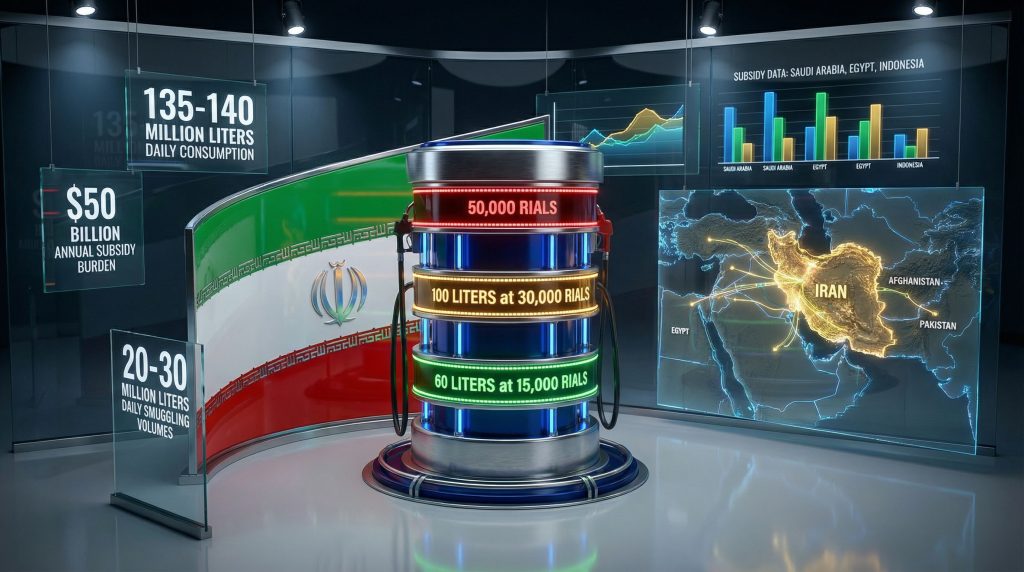
The implementation on December 13, 2025, introduced distinct pricing categories that fundamentally alter the country's approach to fuel subsidisation. The basic tier provides 60 litres monthly at 15,000 rials per litre, approximately $0.047 USD, establishing a protected allocation for essential transportation needs. Secondary consumption receives additional 100 litres at 30,000 rials per litre, roughly $0.094 USD, accommodating moderate commercial and business usage patterns.
Market-rate pricing applies to excess consumption at 50,000 rials per litre, approximately $0.157 USD, though this rate remains substantially below actual import costs. This tiered approach operationalises progressive taxation principles applied to energy consumption, creating marginal cost escalation that discourages overconsumption whilst maintaining targeted protection for vulnerable populations.
Technical Implementation Mechanisms
The consumption thresholds reflect detailed analysis of Iranian household fuel usage patterns, with the 60-litre basic allocation corresponding to average monthly consumption for urban families. The 100-litre secondary tier accommodates moderate commercial activities, particularly important given Iran's extensive taxi-driver population exceeding 8 million individuals.
Production costs versus pricing reveals the continued subsidy burden even under the new framework. Domestic production costs exceed state-set prices by approximately 20 times, whilst import costs reach 700,000 rials per litre (roughly $2.34 per gallon). Even the highest market-rate tier represents merely 7% of actual import costs, indicating substantial implicit subsidisation remains embedded within the system.
When big ASX news breaks, our subscribers know first
Historical Context and Regional Significance
This pricing reform marks the first adjustment since 2019, when fuel price increases of up to 200% triggered massive nationwide unrest. The previous experience demonstrated the significant political risks associated with energy subsidy reforms in authoritarian contexts, establishing institutional memory that shaped the current gradualist approach. However, according to Reuters, the current implementation appears more carefully calibrated than previous attempts.
The six-year gap between price adjustments reflects the government's cautious approach to subsidy reform following the traumatic 2019 protests. International estimates suggest over 1,500 casualties resulted from the previous price increase, with approximately 700 banks and gas stations attacked or burned during what became known as Bloody November.
Regional comparative analysis reveals Iran's subsidy burden as exceptionally high by Middle Eastern standards:
| Country | Annual Subsidies | GDP Percentage | Reform Status |
|---|---|---|---|
| Iran | $50 billion | 12% | December 2025 implementation |
| Saudi Arabia | $20 billion | 3.2% | Vision 2030 ongoing |
| Egypt | $15 billion | 4.1% | Gradual since 2014 |
| Indonesia | $12 billion | 2.8% | Completed 2014-2015 |
Fiscal Sustainability and Economic Distortions
Iran's $50 billion annual subsidy burden creates severe fiscal pressures equivalent to approximately 12% of GDP, representing one of the world's most fiscally unsustainable subsidy programs. This expenditure occurs through dual channels: direct budgetary appropriations and forgone revenue from selling production domestically below international opportunity costs. In addition, this Iran gasoline price hike demonstrates the broader challenges facing oil-dependent economies globally.
Consumption patterns reveal classic subsidy-induced market distortions. Daily domestic consumption reaches 135-140 million litres whilst production capacity maxes at 110 million litres, creating a structural deficit of 25-30 million litres daily (approximately 18-21% of total consumption). This shortfall requires $6 billion annually in imports procured through complex sanctions-avoiding arrangements.
Inflation and Monetary Policy Implications
The relationship between subsidy spending and Iran's 40% inflation rate demonstrates monetary expansion pressures created by maintaining substantial fiscal expenditures without corresponding revenue generation. Standard macroeconomic analysis suggests each percentage point of GDP devoted to unfunded subsidies represents potential inflationary money creation, particularly in constrained foreign exchange environments. Furthermore, this connects to broader oil price stagnation review patterns observed globally.
Economic theory indicates gasoline demand responds to price changes through substitution effects (modal choice, vehicle selection) and income effects (demand intensity). International research suggests fuel demand elasticity ranges from -0.2 to -0.5 short-run and -0.6 to -1.2 long-run across developing economies, implying the current price increase could reduce consumption by 15-25% over 12-18 months.
Cross-Border Arbitrage and Smuggling Economics
Subsidised domestic pricing creates substantial arbitrage opportunities that manifest through illicit cross-border trade. Daily smuggling volumes of 20-30 million litres to Afghanistan and Pakistan represent approximately 20% of total domestic consumption, driven by price differentials approaching 20 times Iranian domestic rates.
The economic scale of this arbitrage activity approximates $8.4-12.8 billion annually in lost government revenue. These volumes effectively represent Iran subsidising neighbouring countries' fuel consumption whilst depleting domestic fiscal resources and exacerbating import dependency.
Regional price differentials create systematic incentives for smuggling networks that operate across porous borders. The 35,000 rial average price differential between domestic rates and Afghan-Pakistani markets generates substantial rent-capture opportunities for illicit traders, undermining both fiscal sustainability and regional energy market stability.
Sanctions Impact on Energy Trade Dynamics
International sanctions have fundamentally transformed Iran from a potential gasoline exporter into a significant importer, altering the basic economic calculus of domestic pricing policies. Complex import arrangements through intermediary nations create substantial procurement markups above typical international market rates. For instance, Iran International reports that these complications significantly increase operational costs.
Import costs at 700,000 rials per litre reflect multiple sanctions-related premiums:
- Intermediary trading margins: 10-20% above standard rates
- Sanctions-avoidance risk premium: 15-30% additional costs
- Complex transshipment logistics: 20-35% operational markups
- Currency settlement friction: 15-25% exchange rate penalties
These combined factors result in import premiums approximately 95-145% above typical international refining margins, demonstrating how geopolitical constraints compound domestic subsidy burdens through elevated procurement costs.
International Models and Reform Precedents
Successful subsidy reform programmes typically incorporate gradual implementation phases, targeted protection mechanisms, and revenue recycling toward productive investments. Indonesia's 2014-2015 transition from universal fuel subsidies eliminated approximately $15 billion annually in expenditures whilst maintaining targeted support for agricultural and transportation sectors.
Egypt's ongoing energy price liberalisation since 2014 demonstrates sustained reform implementation through quarterly adjustments aligned with international benchmark reviews. Initial price increases of 40-78% created short-term inflationary pressures exceeding 8% but achieved substantial fiscal savings over multi-year periods.
Saudi Arabia's Vision 2030 incorporates energy subsidy rationalisation as a component of broader economic diversification objectives, though implementation timelines extend through the mid-2020s with gradual phase-in mechanisms designed to minimise economic disruption. However, these efforts increasingly connect to renewable energy trends that reshape global energy markets.
Progressive Taxation Theory Application
Iran's tiered pricing structure reflects economic principles of progressive consumption taxation applied to energy markets. This framework aims to protect low-income households through subsidised basic allocations whilst discouraging overconsumption via escalating marginal costs, generating fiscal savings whilst maintaining social stability.
The consumption threshold design incorporates Ramsey pricing principles, setting prices inversely proportional to price elasticity of demand. Essential consumption receives protection whilst discretionary usage faces market-rate signals, optimising welfare outcomes within fiscal constraints.
The next major ASX story will hit our subscribers first
Regional Response Dynamics and Market Implications
Iran's pricing reform may accelerate similar policy discussions across Gulf Cooperation Council nations as fiscal pressures from energy transition investments intensify. Saudi Arabia's economic transformation initiatives already incorporate energy subsidy components, whilst UAE diversification programmes include domestic energy pricing considerations.
The success or failure of Iran's graduated approach will influence policy decisions across the broader Middle East, particularly in countries maintaining substantial fuel subsidy programmes. Iraq, Algeria, and Libya all face comparable economic distortions from heavy subsidisation, making Iran's experience relevant for regional policy development. Moreover, this Iran gasoline price hike could signal broader shifts in regional energy policy approaches.
Export Potential and Strategic Implications
Successful consumption reduction could theoretically free additional volumes for export, though sanctions constraints limit Iran's ability to capitalise on this potential. The policy represents strategic shift toward domestic demand management as a component of broader energy security planning. Furthermore, analysis of oil price crash insights suggests similar dynamics across global markets.
Higher transportation costs may accelerate Iran's transition toward less energy-intensive economic activities, potentially supporting longer-term economic diversification objectives despite short-term adjustment challenges for transportation-dependent sectors.
Social Stability and Labour Market Considerations
The concentration of 8 million Iranians employed as taxi drivers (nearly 10% of the population) demonstrates fuel price sensitivity within Iran's labour market structure. This employment concentration in transportation services reflects broader structural economic challenges and creates disproportionate impacts from fuel price adjustments.
For comparative context, Uber employs 8.8 million drivers and couriers globally, indicating Iran's taxi driver population represents extraordinary concentration within a single country. This employment pattern creates unique political economy considerations for fuel pricing policy implementation.
The government's gradual approach reflects lessons learned from 2019's violent suppression of protests, when security forces killed over 1,500 demonstrators according to international estimates. Current implementation seeks to avoid triggering similar social unrest whilst achieving necessary fiscal adjustments.
Performance Monitoring and Assessment Frameworks
Effective monitoring of subsidy reform effectiveness requires tracking consumption reduction rates across income quintiles, smuggling volume changes, inflation impacts on essential goods, and social stability indicators. Key performance metrics include:
- Consumption elasticity responses by tier and demographic
- Border enforcement effectiveness against smuggling networks
- Inflationary transmission mechanisms through transportation costs
- Social acceptance levels and public opinion tracking
International benchmarking against Indonesia's fuel subsidy elimination and Egypt's energy price liberalisation provides comparative assessment frameworks for measuring reform outcomes. These precedents offer empirical baselines for evaluating Iran's graduated approach effectiveness. In addition, oil price rally analysis provides broader market context for understanding these policy changes.
Regional Energy Market Integration
Iran's domestic pricing reform intersects with broader regional energy market dynamics, particularly as neighbouring countries reassess their own subsidy frameworks. Cross-border price harmonisation pressures may accelerate as arbitrage opportunities diminish through Iran's price increases.
The reform's impact on regional energy security depends partly on Iran's ability to redirect consumption toward export markets, though geopolitical constraints limit immediate market access opportunities. Long-term strategic implications include potential shifts in regional energy trade flows as domestic consumption patterns adjust to new pricing realities. Consequently, this Iran gasoline price hike represents a significant milestone in regional energy policy evolution.
This analysis is based on publicly available information and should not be considered investment advice. Energy policy reforms involve complex political and economic factors that may affect outcomes. Readers should consult additional sources and professional advisers when making investment or policy decisions.
Ready to capitalise on energy market transformations?
Discovery Alert's proprietary Discovery IQ model delivers real-time alerts on significant ASX mineral discoveries, including energy and commodities sectors, instantly empowering subscribers to identify actionable opportunities ahead of the broader market. Begin your 30-day free trial today to secure your market-leading advantage in navigating global energy transitions and resource investment opportunities.