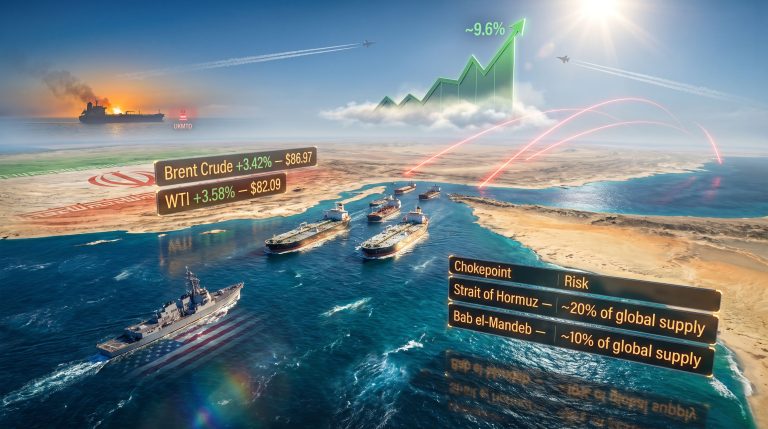
July 29, 2026
When Diplomacy Fails: Understanding What Iran's Latest Missile Strike Means for Markets and Global Stability
The history of geopolitical risk pricing in commodity markets follows a consistent pattern: markets underreact to slow-burning tensions and overreact to sudden kinetic events. The Iran missile attack on U.S. forces in the Middle East, confirmed by U.S. Central Command in late July 2026, is a textbook example of the latter forcing a rapid repricing cycle. But the deeper story is not simply about missiles and interceptions. It is about what happens when a two-day diplomatic pause collapses under military pressure, how that collapse reshapes energy market psychology, and why the convergence of two simultaneous war theaters is creating a compounding risk environment unlike anything seen in recent geopolitical history.
When big ASX news breaks, our subscribers know first
The Collapse of the Ceasefire Window and What It Signals
Diplomatic pauses in active conflict zones are rarely neutral events. They create expectations, shift market pricing, and generate political capital. When they collapse, the damage is often worse than if no pause had occurred at all, because the failure is interpreted as a signal about intent.
The Islamic Revolutionary Guard Corps launched multiple ballistic missiles in an attempted surprise strike targeting U.S. military personnel in the region. U.S. Central Command confirmed via official channels that all incoming projectiles were successfully intercepted, with no confirmed American casualties from this specific incident. Reporting from Axios, citing U.S. officials, indicated the intended target was a military installation in Jordan, representing a geographic expansion of Iranian targeting beyond the Iraq-centric operations seen in prior years.
What makes this attack strategically significant is not only its execution but its timing. It occurred immediately after a two-day cessation of hostilities between Washington and Tehran, a window that had temporarily suppressed oil prices and generated cautious optimism in diplomatic circles. The resumption of missile fire after that window is best understood through the lens of coercive diplomacy: Tehran appears to be using ballistic missile launches as leverage instruments within a broader negotiating framework rather than as terminal acts of war.
Furthermore, the geopolitical risk in mining and wider commodity sectors is directly amplified by this pattern of short-cycle escalation followed by brief pauses. This mirrors the pressure-relief valve dynamic that has characterised Iranian foreign policy since at least 2019, where military actions serve to reset diplomatic leverage rather than signal an intent to pursue full-scale warfare.
Iran's Ballistic Missile Doctrine: A Pattern Six Years in the Making
How Has Iran's Targeting Strategy Evolved?
To fully assess the current escalation, it is necessary to trace the doctrinal lineage of Iran's missile programme as a coercive instrument. The most significant precedent was established in January 2020, when Iranian forces launched a ballistic missile barrage against U.S.-utilised airbases in Iraq following the killing of IRGC General Qasem Soleimani. That strike resulted in no immediate fatalities but caused documented traumatic brain injuries among U.S. personnel, illustrating an important distinction: successful interceptions and zero casualties are not always equivalent outcomes.
The following table maps the escalation arc from 2020 through the July 2026 incident:
| Year | Incident | Reported Target | Outcome |
|---|---|---|---|
| 2020 | Ballistic missile barrage post-Soleimani killing | U.S. airbases, Iraq | Intercepted; TBI injuries reported |
| 2026 (Early) | Multiple strikes amid U.S.-Israel operations | Qatar, Bahrain, Kuwait, UAE | Mixed results; some casualties |
| 2026 (July) | Attempted surprise ballistic missile attack | U.S. base, Jordan | All missiles intercepted; no confirmed U.S. casualties |
The geographic expansion evident in this timeline deserves attention. Moving from Iraq-based targets to installations in Jordan, Qatar, Bahrain, Kuwait, and the UAE reflects a deliberate broadening of Iran's operational targeting envelope. Jordan in particular represents a strategically sensitive choice, as it is a key U.S. partner state hosting significant American military infrastructure and has historically maintained relatively stable relations with both Washington and regional Arab governments.
In addition, understanding Operation Martyr Soleimani provides essential historical context for how Iran has consistently used missile capabilities as a tool of strategic signalling rather than outright warfare.
Oil Market Mechanics: How Geopolitical Risk Gets Priced
What Drives the Immediate Commodity Response?
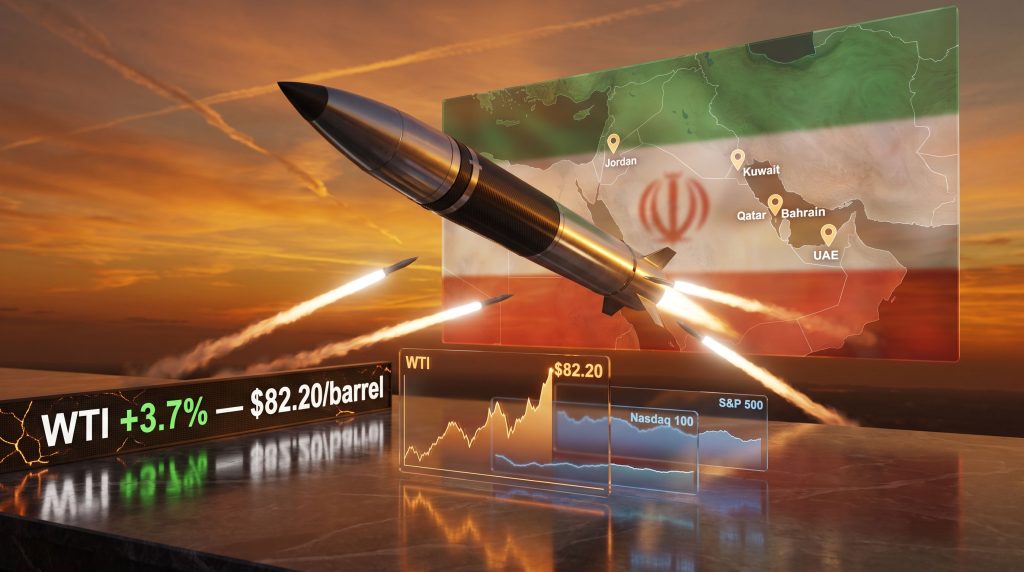
The immediate commodity market response to the confirmed Iran missile attack on U.S. forces in the Middle East was sharp and directionally consistent with historical precedents. WTI crude futures surged 3.7%, reaching approximately $82.20 per barrel, partially reversing losses that had accumulated during the diplomatic pause. Brent crude had previously dropped 4.8% to close at $84.09 per barrel, with the renewed hostilities clawing back a portion of that decline.
Moreover, the trade war impact on oil prices has already conditioned traders to expect volatility, making the repricing cycle even more pronounced when kinetic events occur. Understanding why oil markets respond with such immediacy to Iran-U.S. hostilities requires a structural perspective on global energy supply routing:
- The Strait of Hormuz handles approximately 20% of global daily oil supply in transit volume
- Any credible threat to Hormuz shipping security immediately triggers a risk premium embedded in futures pricing
- Iran's geographic position gives it the theoretical capability to contest Hormuz access using a combination of naval assets, coastal missile batteries, and mine-laying operations
- Even a partial disruption to Hormuz transit would create supply shocks affecting Asian economies most acutely, given that the majority of Hormuz-transiting crude flows east rather than west
The risk premium embedded in crude pricing during periods of Iran-U.S. hostility is therefore not simply speculative. It reflects a genuine supply vulnerability that energy traders have priced repeatedly across multiple escalation cycles since 2019.
Consequently, commodity market volatility of this nature creates structural challenges for portfolio managers seeking to hedge exposure across both energy and broader asset classes simultaneously.
A critical but often overlooked dynamic is the cost-exchange asymmetry in this conflict. Iran's ballistic missiles are relatively inexpensive to produce at scale. U.S. interceptor systems, by contrast, carry a significantly higher per-unit cost. Over an extended conflict timeline, this asymmetry structurally favours the attacker, creating a slow-burning cost attrition pressure on defensive military posture that does not immediately appear in market pricing.
Equity Market Psychology: Why Stocks Shrugged
The divergence between oil's sharp upward repricing and equity markets' measured response reveals something important about institutional investor psychology in mid-2026. S&P 500 futures traded marginally higher following the attack. Nasdaq 100 futures held near the flat line. Dow Jones Industrial Average futures declined by approximately 38 points, representing a decline of roughly 0.1%, a reaction so small as to be categorised as noise within normal daily volatility ranges.
Several factors explain this divergence:
- Interception credibility: CENTCOM's confirmed interception of all missiles signalled that U.S. force protection systems are functioning as designed, limiting the perceived probability of a catastrophic near-term escalation
- Repetition desensitisation: Institutional investors have now cycled through multiple Iran escalation events in 2026 without a breakthrough attack. Repeated non-catastrophic outcomes gradually reduce the fear premium embedded in equity pricing
- AI narrative dominance: The extraordinary growth expectations driving technology sector valuations create a gravity-defying effect in equity indices, where geopolitical noise struggles to compete with the structural bull narrative
- Sector insulation: Large-cap technology companies have minimal direct exposure to Middle East energy supply disruptions in the short term, creating a genuine fundamental basis for the tech sector's relative calm
However, this apparent insulation contains a hidden vulnerability. A sustained energy price shock, particularly one threatening Hormuz transit security, would materially increase data centre operating costs through higher electricity prices. AI infrastructure investment is power-intensive at a scale that makes energy cost a genuinely significant variable in long-term profitability modelling. The tech sector's immunity to geopolitical risk is conditional rather than structural.
The Two-War Problem: Iran, Ukraine, and Strategic Convergence
Perhaps the most consequential and underappreciated dimension of the current geopolitical environment is the visible convergence between the U.S.-Iran conflict and Russia's ongoing military campaign in Ukraine. These are no longer simply parallel conflicts managed through independent diplomatic channels.
Ukraine conducted strikes on Iranian naval vessels, prompting Tehran to formally accuse Kyiv of a hostile act, directly linking the operational theatres. Iranian military equipment has been documented in use by Russian forces in Ukraine, creating a supply chain dimension to the convergence. The Ukraine minerals deal between Washington and Kyiv adds yet another layer of strategic complexity, as resource security becomes inseparable from military alliance management.
The Trump administration simultaneously managed a diplomatic pause with Tehran whilst Ukrainian President Volodymyr Zelenskyy visited the White House seeking reinforcement of U.S. support for Kyiv, approximately 17 months after a previous meeting that deteriorated into a public confrontation. A congressional push to tighten sanctions on Moscow gained momentum in parallel, with the Senate scheduling a procedural vote on legislation targeting Russia and nations continuing to purchase its energy exports.
What Are the Three Strategic Scenarios?
The three strategic scenarios analysts are modelling for this dual-theatre environment are meaningfully different in their market implications:
Scenario A: Contained Parallel Wars
- Iran and Russia operate as parallel adversaries without formal coordination
- U.S. manages both theatres independently
- Oil maintains a structural risk premium of $5 to $10 per barrel but does not spike to crisis levels
Scenario B: Axis Coordination Emerges
- Evidence of formal military or intelligence coordination between Tehran and Moscow triggers a fundamental Western strategic reassessment
- Energy markets price in a sustained structural premium
- NATO allies face pressure to expand defence commitments, increasing fiscal pressure across European economies
Scenario C: Diplomatic Resolution on One Front
- A durable U.S.-Iran ceasefire allows Washington to redirect diplomatic bandwidth toward Ukraine
- Oil prices normalise as Hormuz risk premium deflates
- Equity markets re-rate geopolitical risk lower, providing a tailwind for broader indices
The next major ASX story will hit our subscribers first
Defence Economics and Safe-Haven Asset Flows
Sustained Middle East instability historically generates identifiable patterns in asset class behaviour beyond the commodity markets. Furthermore, gold safe-haven demand consistently reasserts itself during periods of prolonged regional conflict, as institutional investors seek to hedge against broader financial market dislocation.
| Asset Class | Historical Pattern During ME Escalation | Current Signal |
|---|---|---|
| Crude oil futures | Immediate spike; sustained premium | +3.7% WTI confirmed |
| Gold | Safe-haven demand increases | Risk premium reassertion likely |
| U.S. Treasuries | Flight-to-quality bid strengthens | Conditional on further escalation |
| Defence equities | Increased procurement expectations priced in | Structural tailwind |
| EM currencies (oil importers) | Pressure from higher import costs | Secondary risk building |
| U.S. dollar | Safe-haven strengthening | Likely to persist |
Defence sector equities typically benefit from sustained Middle East hostility cycles through increased procurement spending expectations. Aerospace and defence contractors with exposure to missile defence systems, precision munitions, and force protection technologies tend to outperform broader indices during extended escalation periods.
The U.S. dollar's safe-haven characteristics during geopolitical stress events create secondary economic pressures for oil-importing developing economies, which face a compounding burden of higher commodity costs denominated in a strengthening currency.
What a Successful Strike Would Mean for Markets
The current market equilibrium rests heavily on a single assumption: that U.S. air defence systems will continue intercepting Iranian ballistic missiles before they reach their targets. This assumption has held through multiple incidents in 2026. However, military planners and sophisticated market participants are modelling the tail risk scenario in which it does not.
A successful strike causing significant U.S. casualties would represent a qualitative shift in the conflict's character. The likely consequences would include:
- A substantial and immediate U.S. military response, dramatically escalating the conflict beyond its current parameters
- An oil price surge potentially moving WTI toward the $100 to $110 per barrel range as Hormuz threat risk becomes acute
- Broad financial market volatility with equity indices experiencing a meaningful sell-off as the geopolitical risk premium is urgently repriced
- Potential activation of strategic petroleum reserve releases by the U.S. and allied nations to offset supply shock concerns
It is important to note that this remains a tail risk scenario rather than a base case. All available evidence from CENTCOM indicates that layered U.S. air defence architectures deployed across the region are performing effectively. However, saturation attack strategies, hypersonic delivery systems, or simultaneous multi-vector strikes represent theoretical capabilities that could challenge even advanced interception architectures over time.
Frequently Asked Questions
Were Any U.S. Military Personnel Killed or Injured in the Latest Iran Missile Attack?
No confirmed U.S. casualties were reported. U.S. Central Command confirmed all ballistic missiles were successfully intercepted before reaching their intended target.
Where Was the Targeted U.S. Base Located?
Reporting from Axios, citing U.S. officials, indicated the target was a U.S. military installation in Jordan. CENTCOM did not officially specify the target location in its initial public statement.
Why Did Oil Prices Spike So Sharply After the Attack?
WTI crude futures rose approximately 3.7% to around $82.20 per barrel following confirmation of the attack. The movement reflects traders reassigning a higher geopolitical risk premium to Middle East crude supply routes, particularly given Iran's proximity to the Strait of Hormuz, through which roughly 20% of global daily oil supply transits.
What Is the IRGC and Why Does Its Involvement Matter?
The Islamic Revolutionary Guard Corps is an elite branch of Iran's armed forces responsible for protecting the Islamic Republic's political system and controlling its ballistic missile programme. The IRGC has been designated a foreign terrorist organisation by the United States. Direct IRGC involvement in missile strikes against U.S. forces constitutes state-level military engagement rather than proxy warfare, which carries different escalation implications. For a broader overview of attacks on U.S. bases during the ongoing Middle Eastern crisis, the historical record illustrates just how frequently this pattern has repeated since 2023.
How Does the Iran Conflict Connect to the Ukraine-Russia War?
The two conflicts have demonstrated signs of strategic convergence. Ukraine conducted strikes on Iranian naval vessels, and Iran has been associated with supplying military equipment used by Russian forces. This dual-theatre dynamic complicates U.S. diplomatic and military resource allocation simultaneously.
Disclaimer: This article contains forward-looking analysis, scenario projections, and market commentary based on publicly available information. It does not constitute financial or investment advice. Past geopolitical patterns are not reliable indicators of future market outcomes. Readers should conduct independent research and consult qualified financial professionals before making investment decisions.
Want to Stay Ahead of the Market Movements Driven by Geopolitical Discoveries?
When escalating tensions reshape commodity pricing in real time — from oil surges to safe-haven flows into gold and critical minerals — Discovery Alert's proprietary Discovery IQ model instantly identifies significant ASX mineral discoveries before the broader market reacts, turning complex data across 30+ commodities into clear, actionable intelligence. Explore historic discovery returns on Discovery Alert's dedicated discoveries page and begin your 14-day free trial today to ensure you're positioned ahead of the next major market-moving opportunity.