July 29, 2026
The Anatomy of an Oil Price Shock: When Geopolitics Overrides Fundamentals
There is a particular type of market event that strips away all the usual noise of supply-demand modelling, inventory data, and production quotas. It happens when two nuclear-capable adversaries exchange direct military fire near the world's most consequential energy corridor. In those moments, oil jumps as U.S.-Iran resume strikes and futures markets do not wait for confirmation of physical damage. They price in the possibility of catastrophic disruption within hours, sometimes minutes.
Understanding why this mechanism works the way it does, and what it means for investors navigating the current environment, requires looking well beyond the headline price move. The geopolitical oil price drivers at play here are layered, interconnected, and historically significant.
When big ASX news breaks, our subscribers know first
Why the U.S.-Iran Escalation Sent Oil Jumping Across Asian Markets
The Ballistic Missile Threshold and Why It Matters
Not all military provocations in the Middle East move oil markets equally. Drone harassment campaigns, proxy skirmishes, and vessel seizures generate noise, but seasoned commodity traders have learned to distinguish between theatre and genuine structural threat. The deployment of ballistic missiles by the Islamic Revolutionary Guard Corps against U.S. military positions in the region represents a categorically different signal.
Ballistic missiles carry greater destructive payload, are harder to intercept reliably, and communicate a willingness to escalate beyond the ambiguous cover that drone operations provide. This distinction is not semantic. When the U.S. Central Command confirmed that IRGC forces launched multiple ballistic missiles from Iranian territory in what was described as an attempted surprise attack on U.S. forces stationed in the Middle East, commodity markets treated it immediately as a structural supply risk event.
The retaliatory response, involving U.S. and Saudi forces striking multiple logistics and weapons sites across eastern Iraq in response to more than 30 drone attacks conducted over the preceding three days by Iran-aligned forces, further confirmed that the conflict had moved into a sustained exchange cycle rather than an isolated incident.
The Immediate Price Reaction
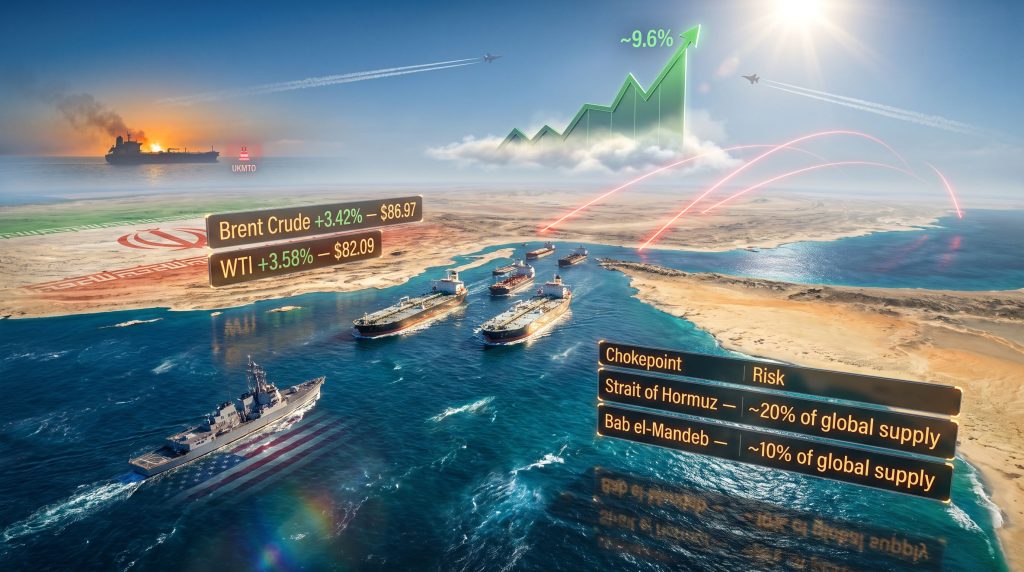
The market's verdict arrived swiftly during Asian trading sessions. Brent crude futures for September delivery climbed 3.42%, reaching $86.97 per barrel, while U.S. West Texas Intermediate futures advanced 3.58% to $82.09 per barrel. Broader data from escalation-linked sessions shows Brent has registered spikes ranging from 5% to as high as 9.6% depending on the severity and proximity of the triggering event, with prices touching $83.30 for Brent and $78.14 for WTI in sessions tied to renewed U.S. naval pressure on Iranian oil exports.
Oil futures markets reprice geopolitical risk faster than equity markets because the commodity itself is the asset being threatened. There is no earnings revision required, no analyst downgrade cycle to wait for. The threat is direct and the market responds accordingly.
The speed of price discovery in crude oil futures during geopolitical crises reflects a structural feature of the market: physical supply disruptions, even anticipated ones, cannot be offset through financial instruments in the short term. A barrel that cannot transit the Strait of Hormuz is simply unavailable, regardless of what the futures curve says.
What Makes the Strait of Hormuz the World's Most Sensitive Energy Chokepoint
Volume, Geography, and Strategic Leverage
Roughly 20% of the world's daily oil supply passes through the Strait of Hormuz, the narrow passage separating Iran from the Omani coast. At its narrowest navigable point, the strait is approximately 33 kilometres wide, with shipping lanes spanning only a fraction of that distance. Iran's geographic position along the northern coastline of this passage gives it an asymmetric capability to threaten tanker traffic without necessarily deploying conventional military force at scale.
What makes this geography particularly consequential is the concentration of producing nations behind the chokepoint. Saudi Arabia, Iraq, Kuwait, the UAE, and Qatar all rely on Hormuz for the majority of their crude exports. A closure, even a partial or temporary one, would not merely inconvenience global supply chains. It would eliminate a significant portion of available export capacity from the world's most oil-dense region with no immediately viable alternative routing.
Historical precedent underscores the severity of this risk. The 2019 attack on Saudi Aramco's Abqaiq and Khurais processing facilities, which temporarily knocked out roughly 5% of global daily oil supply, caused Brent crude to spike more than 14% in a single trading session — the largest single-day percentage move in decades. That event involved no Hormuz disruption at all. A credible threat to the strait itself carries proportionally greater implications.
Red Sea Disruption: The Second Front
The current escalation cycle is unusual in that it activates two major maritime risk corridors simultaneously. While Persian Gulf tensions drive Hormuz risk premium, the Red Sea presents its own compounding threat. The U.K. Maritime Trade Operations Centre reported suspicious activity in the southern Red Sea, including an account from a tanker master who reported hearing an explosion during transit of the area.
The advisory, issued by UKMTO, reflects a pattern of Houthi-linked activity that has made the Red Sea corridor increasingly hazardous for commercial shipping. Bjorn Vang Jensen, Executive Industry Advisor at Xeneta, has noted that Houthi strikes targeting Saudi oil production sites, storage facilities, and port infrastructure carry the potential to meaningfully disrupt regional energy flows.
The strategic significance of this extends beyond Saudi Arabia's own exports. The Bab el-Mandeb strait, located at the southern entrance to the Red Sea, represents a secondary chokepoint through which approximately 10% of global oil supply transits. Saudi Arabia cannot sustain prolonged disruption at this gateway without material impact on its export economics.
Dual Chokepoint Risk: A Structural Comparison
| Chokepoint | Daily Oil Flow at Risk | Primary Threat Actor | Market Sensitivity |
|---|---|---|---|
| Strait of Hormuz | ~20% of global supply | Iran / IRGC | Extremely High |
| Bab el-Mandeb (Red Sea) | ~10% of global supply | Houthi Forces | High |
| Combined Disruption Scenario | Compounding supply shock | Multi-actor escalation | Severe |
The simultaneous activation of both corridors is not a scenario analysts had modelled as a base case before the current cycle. It introduces a compounding dynamic where alternative routing options, already strained by the Red Sea campaign, become even less available as Hormuz risk elevates.
How U.S. Policy Choices Are Amplifying the Supply Shock
Sanctions as a Parallel Pressure Mechanism
Military escalation is only one of the two supply-constraining forces operating simultaneously. Reports indicate the U.S. revoked existing Iranian oil export waivers as part of its broader escalation response. These waivers had permitted certain volumes of Iranian crude to reach international buyers under diplomatic carve-outs. Their removal creates a supply contraction pathway that operates independently of any physical infrastructure damage.
Iranian crude exports, operating under varying degrees of sanction pressure over the past several years, have nonetheless found their way to international markets through intermediary channels, particularly routed through Asian buyers. When waiver arrangements are revoked and enforcement posture tightens, those volumes face increased friction and, in some cases, complete displacement from accessible markets.
The combined effect of military risk premium and sanctions-driven supply reduction creates what analysts describe as a dual-pathway contraction scenario, where prices face upward pressure from two structurally distinct mechanisms at once. Furthermore, the broader picture of oil prices and geopolitics suggests this dynamic is unlikely to resolve quickly.
The Federal Reserve Complication
Adding a third layer of complexity to the current environment is the monetary policy backdrop. Federal Reserve Chair Kevin Warsh's tone at his first FOMC meeting leaned toward the hawkish end of market expectations, introducing uncertainty about the near-term rate trajectory at precisely the moment when energy-driven inflation risk is re-emerging.
As noted in analysis from Kitco, the oil price surge was compounded by this hawkish signalling, creating a dual-pressure environment that complicates positioning across multiple asset classes. The interaction between oil price spikes and central bank policy is historically fraught. Rising energy costs feed directly into headline CPI components, increasing inflationary pressure at the same moment that a hawkish central bank is attempting to justify rate restraint.
The result is a stagflationary risk signal that markets price negatively across equities, bonds, and growth-sensitive commodities simultaneously.
The Three Structural Forces Driving the Current Oil Rally
Understanding the mechanics behind the current price movement requires disaggregating the rally into its component parts:
1. Escalation Risk Premium
The shift from proxy drone warfare to direct ballistic missile exchanges signals a qualitative escalation threshold. Traders apply a higher risk premium to state-level direct conflict than to proxy engagements because the escalation pathway is less predictable and the potential for infrastructure damage is meaningfully greater. The pattern of more than 30 drone attacks in three days preceding the missile launches established an accelerating escalation curve that markets had begun pricing before the ballistic strike itself.
2. Supply Shock Expectations
Physical damage is not a prerequisite for a supply shock in oil markets. The expectation of disruption moves prices because tanker operators, insurers, and logistics providers respond to threat signals by repricing risk, rerouting vessels, or suspending transits. War risk insurance premiums for tankers operating in conflict-adjacent zones can rise by multiples in a single session, effectively increasing the delivered cost of crude regardless of whether a barrel has been physically destroyed.
3. Sanctions-Driven Supply Contraction
The revocation of Iranian export waivers removes available supply from global markets through a non-military mechanism. This creates a scenario where even a de-escalation in military activity would not fully reverse the supply-side pressure, because the sanctions layer remains independent of battlefield outcomes. In addition, oil market disruption risks stemming from broader trade tensions further compound the supply picture.
Historical Context: How Comparable Events Moved Markets
| Event | Year | Brent Crude Spike | Duration of Elevated Prices |
|---|---|---|---|
| Abqaiq-Khurais Attack (Saudi Arabia) | 2019 | ~14% single-day spike | 2 to 3 weeks |
| U.S. Strike on Qasem Soleimani | 2020 | ~4 to 5% spike | 1 to 2 weeks |
| Russia-Ukraine War Onset | 2022 | ~30%+ over weeks | Several months |
| Houthi Red Sea Campaign | 2024 | ~3 to 5% episodic spikes | Ongoing volatility |
| U.S.-Iran Resumed Strikes | 2026 | ~3.4 to 9.6% session-dependent | Developing |
The magnitude of oil price responses to geopolitical events is determined not merely by the event itself, but by pre-existing supply buffers, OPEC+ spare capacity, and whether the event threatens physical infrastructure or transit routes. A threat to a transit route affecting 20% of global supply is structurally more severe than an attack on a single facility, even a very large one.
The next major ASX story will hit our subscribers first
What This Means for Investors Across Asset Classes
Short-Term vs. Medium-Term Market Dynamics
| Timeframe | Market Behaviour | Key Variables |
|---|---|---|
| Immediate (0 to 72 hours) | Sharp futures spike, elevated volatility | Escalation severity, chokepoint proximity |
| Short-Term (1 to 4 weeks) | Price stabilisation or continued rally | Ceasefire signals, OPEC+ response |
| Medium-Term (1 to 3 months) | Supply re-routing, demand adjustment | Alternative supply activation, tanker re-routing |
| Long-Term (3 to 12 months) | Structural repricing or normalisation | Diplomatic resolution, U.S. shale response |
Sector-Level Implications
The ripple effects of sustained oil price elevation extend well beyond crude benchmarks:
- Energy equities: Upstream producers and integrated oil majors typically benefit from sustained price elevation as their revenue realisation improves against relatively fixed production costs
- Tanker and shipping operators: Vessel operators transiting the Red Sea and Persian Gulf see freight rate surges during disruption events, sometimes dramatically, as route premiums compress available capacity
- Inflation-sensitive assets: Sustained crude price increases feed into transportation, manufacturing, and consumer goods costs, putting upward pressure on CPI and complicating bond market pricing
- Defensive positioning: Historical data shows investor rotation into energy equities and commodity-linked instruments during Middle East escalation cycles, while growth-sensitive sectors face headwinds
- Strategic Petroleum Reserve considerations: Governments may draw on SPR resources to signal supply confidence, though reserve levels and political appetite for intervention vary considerably
OPEC+ Response and the Swing Supply Question
How Saudi Arabia and Gulf producers respond to sustained price elevation involves a calculation that balances revenue optimisation against alliance obligations and longer-term market share considerations. OPEC's market influence remains a critical variable here, particularly as elevated prices create incentive to increase output while OPEC+ cohesion and production target agreements constrain unilateral action.
The U.S. shale response to sustained price elevation represents a potential swing supply buffer in extended conflict scenarios. However, their capacity to respond meaningfully within weeks rather than months remains limited, given the drilling-to-production timelines involved. Consequently, near-term supply tightness is unlikely to be offset by non-OPEC producers in any rapid fashion.
Frequently Asked Questions: Oil Prices and U.S.-Iran Tensions
Why do oil prices rise sharply when U.S.-Iran military exchanges resume?
Iran's geographic position adjacent to the Strait of Hormuz gives it direct leverage over the transit of approximately one-fifth of global daily oil supply. When military exchanges create credible risk to tanker navigation through this corridor, futures markets price the potential supply disruption immediately, often before any physical damage has occurred. The situation of oil jumps as U.S.-Iran resume strikes is therefore a well-established market reflex with deep structural logic.
Could oil prices breach $100 per barrel if the conflict intensifies?
While precise forecasting carries inherent uncertainty, analysts widely acknowledge that a sustained or partial closure of the Strait of Hormuz would place significant upward pressure on Brent crude. The $100 per barrel threshold represents a plausible outcome in severe escalation scenarios, as reported by CNBC. Furthermore, the current rally reflects risk pricing rather than confirmed disruption, meaning prices remain sensitive to diplomatic signals in either direction.
How does Federal Reserve policy interact with an oil-driven inflation spike?
Rising energy costs increase headline inflation at the same time a hawkish central bank is attempting to manage rate expectations. This creates a stagflationary risk dynamic where monetary tightening cannot address supply-side inflation, growth expectations face headwinds, and policymakers are caught between conflicting objectives. Markets historically respond to this configuration with elevated volatility across equities, fixed income, and commodities simultaneously.
Disclaimer: This article is for informational purposes only and does not constitute financial or investment advice. Oil price movements and geopolitical developments involve significant uncertainty, and past price behaviour during conflict events is not a reliable indicator of future outcomes. Readers should consult qualified financial advisors before making investment decisions.
Want to Stay Ahead of the Next Major Commodity Discovery Before the Market Moves?
While geopolitical shocks like U.S.-Iran escalations send oil prices surging within hours, the same principle of acting before the broader market applies to mineral discoveries on the ASX — and Discovery Alert's proprietary Discovery IQ model delivers real-time alerts the moment significant discoveries are announced, turning complex data across 30-plus commodities into clear, actionable insights. Explore historic examples of major discovery returns and begin your 14-day free trial today to ensure you are never the last to know.