July 29, 2026
The Quiet Transformation Happening Inside Indonesia's Nickel Laterite Sector
Nickel laterite deposits have long been misunderstood by investors conditioned to think of nickel through the lens of sulphide ores and traditional smelting economics. For decades, laterite deposits were considered lower-quality, technically challenging resources — abundant but difficult to monetise without the right processing infrastructure. That perception is now shifting dramatically, and the Nickel Industries Sampala nickel resource boost announced in the June 2026 quarter illustrates precisely why the laterite narrative is being rewritten at scale.
The convergence of battery-grade nickel demand, Indonesian processing mandates, and maturing High-Pressure Acid Leach (HPAL) technology has fundamentally altered the economics of laterite development. Operators who have built integrated platforms connecting large-scale ore resources to downstream HPAL capacity are no longer simply mining companies — they are positioning themselves as vertically integrated components of the global EV battery supply chain. Furthermore, understanding nickel's battery importance is essential context for appreciating why this shift carries such long-term strategic weight.
When big ASX news breaks, our subscribers know first
Why the Sampala JORC Upgrade Is More Than a Geological Milestone
Understanding What a JORC Resource Revision Actually Signals
In the mining industry, a JORC-compliant resource estimate is not a guess or a projection. It represents a methodically validated body of geological knowledge, constrained by drilling data, analytical results, and independently reviewed modelling. When a resource estimate is revised upward at the scale seen at Sampala, it signals that a systematic delineation campaign has substantially confirmed the deposit's lateral and vertical extent beyond what earlier, sparser drilling could support.
The distinction matters because resource upgrades built on dense drilling campaigns carry materially lower geological uncertainty than those supported by wide-spaced reconnaissance programs. With 4,308 drill holes across 112,588 metres of drilling underpinning the revised estimate, the Sampala resource is now one of the most thoroughly drilled nickel laterite deposits in Southeast Asia. That density of data reduces the risk premium investors and offtake counterparties would otherwise apply.
The Revised Numbers: What Sampala Now Represents
The upgraded JORC resource places Sampala in a tier occupied by only a handful of deposits globally:
| Metric | Sampala Resource (Post-Upgrade) |
|---|---|
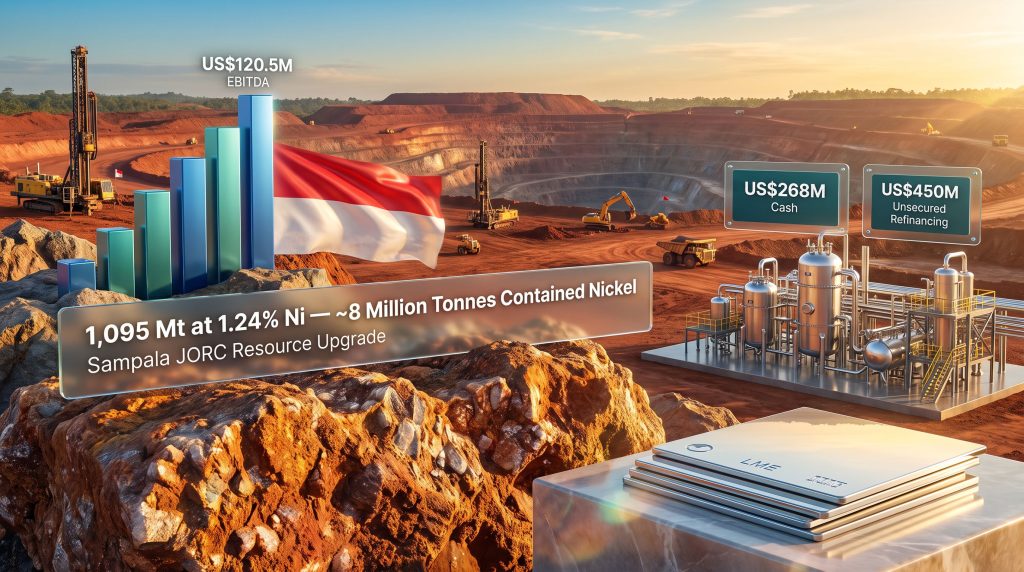
| Total Resource Tonnage | 1,095 million wet metric tonnes (wmt) |
| Nickel Grade | 1.24% Ni |
| Cobalt Grade | 0.09% Co |
| Contained Nickel Metal | ~8 million tonnes |
| Contained Cobalt Metal | ~583,000 tonnes |
| Drilling Campaign Scale | 4,308 holes / 112,588 metres |
A grade of 1.24% nickel sits comfortably within the competitive range for laterite deposits, which typically span 0.9% to 1.5% depending on ore type and depth profile. What is particularly notable here is the cobalt co-product content. At 0.09% cobalt and approximately 583,000 tonnes of contained cobalt metal, Sampala carries meaningful battery-critical mineral optionality beyond nickel alone. This feature becomes increasingly material as global cobalt supply chains face independent pressure from the energy transition.
Critically, the GF area of the deposit has been drilled but those results have not yet been incorporated into the current resource statement. This represents a quantified but not yet formalised upside position — a structural feature that may support further resource revisions in subsequent quarters.
The Strategic Logic of Connecting Ore to HPAL Processing
How Laterite Ore Becomes Battery-Grade Nickel: The HPAL Process Explained
High-Pressure Acid Leach is a hydrometallurgical processing technology that uses sulphuric acid under elevated temperature and pressure to selectively dissolve nickel and cobalt from laterite ore. Unlike pyrometallurgical methods such as Rotary Kiln Electric Furnace (RKEF) smelting, HPAL can process limonite-rich laterite ores that contain insufficient iron and silica profiles for efficient smelting, while simultaneously producing a battery-compatible nickel intermediate.
The output pathway from HPAL typically follows this sequence:
- Laterite ore is fed into high-pressure autoclave vessels with sulphuric acid solution
- Nickel and cobalt are selectively leached into solution under controlled temperature and pressure
- The pregnant leach solution is purified through a series of solvent extraction and precipitation stages
- Mixed Hydroxide Precipitate (MHP) is produced as the first marketable intermediate
- MHP is refined further to produce nickel sulphate or nickel cathode for battery precursor manufacturing
This processing pathway is fundamentally distinct from RKEF, which produces Nickel Pig Iron (NPI) — a lower-purity, higher-carbon product suited to stainless steel manufacturing rather than battery chemistry:
| Technology | Primary Output | Battery Supply Chain Fit | Nickel Grade |
|---|---|---|---|
| RKEF (Rotary Kiln Electric Furnace) | Nickel Pig Iron (NPI) | Limited (stainless steel focus) | Lower purity |
| HPAL (High-Pressure Acid Leach) | MHP / Nickel Sulphate / Cathode | High (EV battery precursor) | Battery-grade |
Why Feedstock Security Is the Critical Vulnerability in Standalone HPAL Projects
One of the least discussed risks in HPAL project development is feedstock risk. HPAL facilities are capital-intensive to construct and require sustained ore supply at consistent grade and moisture content to maintain economic throughput. Standalone HPAL operations without secured ore supply face significant exposure to spot market pricing and third-party supply disruptions.
This is precisely why the integration of the Sampala deposit as a long-term ore supply source for both the PT Chengsheng New Energy (CNE) and PT Teluk Metal Industry (TMI) HPAL operations is strategically significant. The deposit does not merely represent contained nickel value in isolation — it serves as a feedstock anchor for multiple downstream processing investments, dramatically reducing the inter-segment supply risk that has undermined standalone HPAL economics globally. For further detail on the Sampala project update, publicly filed disclosures provide additional technical context.
The share swap transaction that valued Sampala in excess of US$1.3 billion reflects precisely this calculus. The market is pricing the ore asset's strategic utility to the downstream processing pipeline, not simply its in-situ resource value at prevailing nickel prices.
June Quarter Operational Performance: What the Numbers Reveal
Segment-Level Results for Q2 2026
| Segment | Q2 2026 Result | Quarter-on-Quarter Change |
|---|---|---|
| Group Adjusted EBITDA | US$120.5 million | Down 11% |
| Hengjaya Mine Adjusted EBITDA | US$45.7 million (record) | Up 58% |
| RKEF Nickel Production | 27,864 tonnes | Down 8% |
| RKEF Adjusted EBITDA | US$60.3 million | Down 30% |
| HPAL Attributable Adjusted EBITDA | US$14.4 million | Down 30% |
| Quarter-End Cash Position | US$268 million | — |
| Refinancing Completed | US$450 million unsecured facilities | — |
The Hengjaya Mine Record: Understanding the Price and Volume Dynamic
The Hengjaya Mine delivered a record adjusted EBITDA of US$45.7 million, representing a 58% increase on the prior quarter. Two factors combined to produce this outcome:
- Ore production increased 4% despite a temporary operational suspension during the quarter, demonstrating operational resilience in the upstream mining business
- Indonesian government policy adjustments enabled a 50% uplift in ore sale prices, a regulatory development that materially amplified margin outcomes without requiring additional capital expenditure
This result illustrates a dynamic that is frequently underappreciated in how investors model upstream mining segments within integrated portfolios. When ore pricing shifts upward due to policy-driven mechanisms, the earnings leverage at the mine level can be substantial because operational costs do not move proportionally with the revenue line.
Contextualising RKEF Softness Within the Portfolio Transition Narrative
The RKEF segment produced 27,864 tonnes of nickel in Q2 2026, down 8% from the prior period, with adjusted EBITDA contracting 30% to US$60.3 million. For investors focused exclusively on quarter-to-quarter RKEF metrics, this may read as operational deterioration. A more instructive framing recognises that RKEF operations are transitioning from being the primary earnings driver to serving as the cash flow engine that funds HPAL commissioning expenditure.
RKEF facilities produce NPI primarily consumed by stainless steel manufacturers, a market with structurally different demand characteristics than battery supply chains. The deliberate portfolio shift toward HPAL capacity is a conscious strategic repositioning — one that accepts near-term RKEF earnings variation in exchange for longer-term exposure to the higher-value battery materials market. Consequently, the broader battery metals investment landscape provides useful context for understanding why this transition is occurring across the sector.
HPAL Commissioning: The Milestone That Changes Everything
From Construction Asset to Revenue-Generating Operation
The ENC HPAL project reached advanced commissioning status during the June quarter, with first Mixed Hydroxide Precipitate produced in July 2026. This transition from construction-phase asset to first production represents a qualitative inflection point — the project moves from absorbing capital to generating cash returns.
First nickel cathode production was anticipated by mid-August 2026. The significance of this milestone extends beyond the quantity of cathode initially produced. Nickel cathode delivered against London Metal Exchange (LME) specifications is exchange-grade metal — a product with transparent pricing, significant market liquidity, and direct access to battery supply chain offtake agreements that intermediate products such as NPI or MHP do not command in the same way.
Producing LME-deliverable cathode from company-owned ore completes a vertically integrated value chain that very few nickel operators globally have achieved:
- Stage 1: Laterite ore mined at Hengjaya and Sampala (upstream mining)
- Stage 2: Ore processed through HPAL autoclave circuit (hydrometallurgical refining)
- Stage 3: MHP refined to battery-grade cathode (downstream finishing)
- Stage 4: Cathode delivered to market at LME-referenced pricing (commercial offtake)
Why Exchange-Grade Cathode Matters for Long-Term Portfolio Positioning
An aspect of this development that warrants deeper consideration is how cathode production reshapes the pricing risk profile of the portfolio. Producers of intermediate nickel products — NPI and MHP — sell into markets where pricing is negotiated bilaterally or benchmarked to indices that can diverge from LME nickel prices depending on supply-demand dynamics within each product segment. Exchange-grade cathode, by contrast, is directly tied to LME pricing, which is the global reference benchmark for nickel.
This pricing transparency matters for institutional offtake counterparties, particularly battery manufacturers and precursor chemical producers who are building long-term supply agreements. The ability to offer LME-priced cathode with known provenance from a vertically integrated supply chain is becoming a meaningful competitive differentiator.
Balance Sheet Architecture Supporting the Development Pipeline
What the US$450 Million Unsecured Refinancing Signals
Completing an unsecured debt facility of this scale is a more significant indicator of financial health than the headline number alone might suggest. Unsecured debt does not require the pledging of specific assets as collateral, which preserves maximum flexibility to deploy assets — including Sampala equity stakes — in future strategic transactions without lender consent requirements that would otherwise apply to secured structures.
The refinancing, completed in April 2026, extended the financial runway to support concurrent commissioning at ENC HPAL while advancing feasibility work at Sampala and progressing the Siduarsi project through regulatory approval processes. Managing multiple development-stage assets simultaneously requires balance sheet depth that this refinancing has meaningfully extended.
The quarter closed with US$268 million in cash, supported by continued operating cash flow generation across the RKEF and Hengjaya Mine segments. A maiden distribution from the HNC joint venture during the period is also notable as an early signal that the HPAL portfolio is beginning to generate distributable cash returns rather than purely absorbing development expenditure.
The next major ASX story will hit our subscribers first
Placing Sampala in the Global Nickel Laterite Context
How Sampala Compares at the World Scale
With approximately 8 million tonnes of contained nickel metal, Sampala's upgraded resource places it in direct comparison with some of the largest undeveloped nickel laterite deposits globally — including major projects across the Philippines, Papua New Guinea, and New Caledonia. The characteristics that define a world-class nickel laterite deposit are worth examining explicitly:
- Scale: Total resource tonnage exceeding 500 million wet metric tonnes is generally considered large-scale in the laterite category; Sampala at 1,095 million tonnes sits well above this threshold
- Grade: A 1.24% nickel grade is competitive for laterite resources, which typically range from 0.9% to 1.5% depending on ore type
- Cobalt co-product: At 0.09% cobalt and approximately 583,000 tonnes of contained cobalt metal, the deposit carries meaningful battery-critical mineral optionality
- Proximity to processing infrastructure: Indonesian location with HPAL processing capacity under active development nearby provides infrastructure adjacency that remote deposits lack
- Remaining upside: GF area drilling completed but not yet incorporated into the current JORC estimate represents unquantified additional resource potential
Indonesia's Structural Role in Reshaping Global Nickel Supply
Indonesia's nickel role in the global energy transition has become increasingly pivotal, and the country's domestic processing mandates have fundamentally shifted value capture from ore export to in-country refining. According to the United States Geological Survey, Indonesia produced approximately 1.8 million tonnes of nickel in 2023, representing more than half of global mine supply. The rapid build-out of HPAL capacity within Indonesia positions operators with established in-country platforms at the geographic centre of the EV battery materials supply chain.
Furthermore, the Indonesian nickel industry growth trajectory continues to attract significant capital as downstream processing capacity expands beyond what was considered achievable only a decade ago. In addition, the scale of resource upgrades such as the Nickel Industries Sampala nickel resource boost reinforces why Indonesia's laterite sector is commanding renewed international attention.
ESG Obligations and the Licensing-to-Operate Reality
Environmental Management in Large-Scale Laterite and HPAL Operations
Large-scale laterite mining and HPAL processing carry environmental management obligations that are substantively different from conventional hard-rock mining. Key areas requiring rigorous management include:
- Tailings storage: HPAL generates significant volumes of neutralised tailings requiring engineered containment systems designed to prevent acid drainage and heavy metal leaching
- Water management: HPAL operations consume large volumes of water in the leaching and washing circuits, requiring careful hydrological planning particularly in regions with seasonal rainfall variation
- Acid management: Sulphuric acid is consumed in large quantities during the HPAL process, with residual acid requiring careful neutralisation before tailings discharge
- Community engagement: Large-scale mining operations in Indonesia require ongoing social licence maintenance through community programs, land access negotiations, and local employment commitments
ESG performance is increasingly a commercial requirement rather than a reporting exercise for projects targeting battery supply chain integration. Major automotive manufacturers and battery cell producers are building provenance and sustainability requirements into their procurement frameworks, making operational ESG credentials a potential differentiator in offtake negotiations.
Key Metrics and Catalysts to Monitor in Coming Quarters
What Investors and Industry Observers Should Track
The following developments represent the most material near-term catalysts for understanding how the Nickel Industries Sampala nickel resource boost translates into operational and financial outcomes:
- GF area drilling results and any subsequent revision to the Sampala JORC resource statement
- ENC HPAL commercial production declaration and the ramp-up trajectory from first cathode production
- CNE and TMI HPAL commissioning progress and any updates to project timelines
- Siduarsi project regulatory approval outcomes, which will determine the timeline for developing the next asset in the ore supply pipeline
- Indonesian nickel policy developments, particularly any changes to ore pricing frameworks, export levies, or domestic processing requirements that could affect Hengjaya Mine margins
- Global nickel price movements and their differential impact on RKEF NPI economics versus HPAL cathode economics
The divergence between these two pricing environments will become an increasingly important analytical lens as the portfolio continues its deliberate migration from pyrometallurgical to hydrometallurgical processing. For additional disclosure context, the ASX quarterly activity report filed by Nickel Industries provides further granular operational data for those conducting detailed analysis.
This article contains general information only and does not constitute financial advice. Past performance is not indicative of future results. Investing in mining and resources companies involves material risks, including commodity price volatility, operational execution risk, regulatory uncertainty, and geological variability. Readers should conduct their own due diligence and consult a licensed financial adviser before making any investment decisions. All financial figures referenced are drawn from publicly available ASX quarterly activity reports filed by Nickel Industries Ltd (ASX: NIC). Further industry context is available through the International Nickel Study Group (INSG) and publicly available USGS Mineral Commodity Summaries.
Want to Catch the Next Major Mineral Discovery Before the Market Does?
Discovery Alert's proprietary Discovery IQ model scans ASX announcements in real time, instantly identifying significant mineral discoveries across nickel, cobalt, and more than 30 other commodities — turning complex geological data into actionable investment insights for both short-term traders and long-term investors. Explore Discovery Alert's discoveries page to see how historic ASX mineral discoveries have generated substantial returns, and begin your 14-day free trial today to position yourself ahead of the broader market.