
July 29, 2026
When Margins Tell the Real Story: Understanding Operational Leverage in Large-Cap Mining
There is a moment in every commodity supercycle when the most revealing number is not the revenue line, but the gap between revenue growth and earnings growth. For investors who understand how mining economics actually work, that gap is where the real story lives. When a company generates 43 times more earnings growth than revenue growth in a single reporting period, it is signalling something fundamental about cost structure, commodity mix, and the compounding power of operational efficiency at scale.
That is precisely the analytical lens through which Rio Tinto's first-half 2026 financial result deserves to be examined. The Rio Tinto interim profit rise is not simply a headline number. It is a case study in how the world's largest iron ore producer converts marginal improvements across multiple variables into outsized earnings outcomes.
When big ASX news breaks, our subscribers know first
The Numbers Behind the 43% Surge
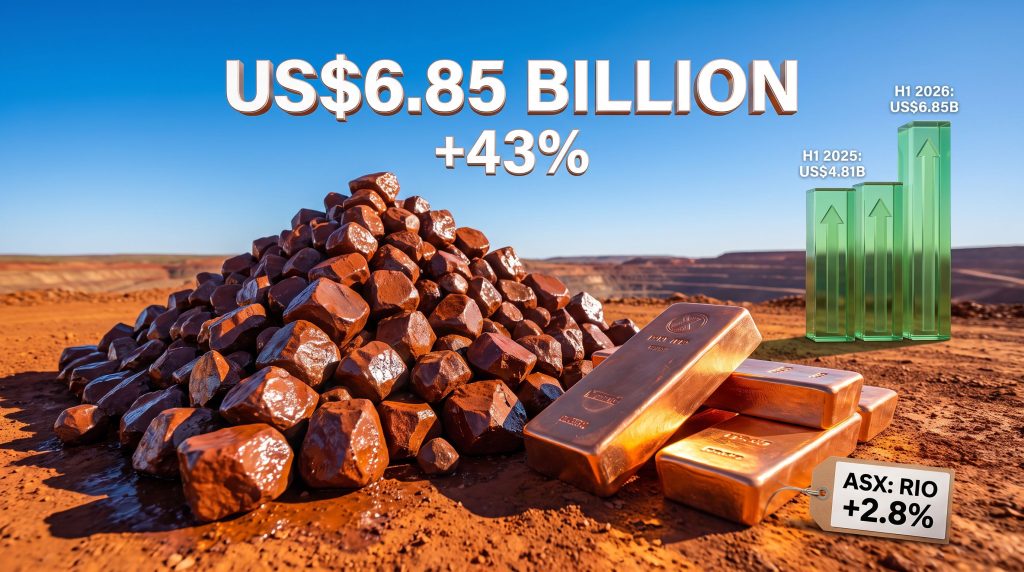
Rio Tinto reported underlying earnings of US$6.85 billion for the six months ended June 30, 2026, a 43% increase compared to US$4.81 billion in the prior corresponding period. Profit after tax rose a more modest 14% to US$5.81 billion, while total revenue grew just 1% to US$26.8 billion.
| Financial Metric | H1 2025 | H1 2026 | Change |
|---|---|---|---|
| Underlying Earnings | US$4.81 billion | US$6.85 billion | +43% |
| Profit After Tax | ~US$5.10 billion (est.) | US$5.81 billion | +14% |
| Revenue | ~US$26.5 billion (est.) | US$26.8 billion | +~1% |
| Interim Dividend | US$1.77/share | US$1.77/share | Unchanged |
| ASX Share Price Reaction | N/A | +2.8% (day of release) | Positive |
The divergence between revenue growth of roughly 1% and underlying earnings growth of 43% is the defining feature of this result. In mining, this phenomenon is known as operational leverage: the mechanism by which fixed costs are spread across growing volumes, and where even marginal improvements in commodity pricing relative to production costs generate disproportionate earnings outcomes.
Key Analytical Point: The gap between Rio Tinto's underlying earnings metric and its statutory profit after tax reflects adjustments for non-cash items, impairments, and currency effects. Underlying earnings strip these out to reveal the operational core of the business. A 43% jump in the underlying measure against a 14% rise in statutory profit tells analysts that the operational engine is firing strongly, but that accounting-level factors are moderating the headline statutory result.
According to Rio Tinto's official results release, the result was underpinned by 8% copper-equivalent production growth and sharper cost discipline across the portfolio — a combination that directly explains the earnings leverage dynamic described above.
Iron Ore: The Pilbara Remains the Profit Engine
Rio Tinto's position as the world's largest iron ore producer anchors its financial performance in ways that are easy to underestimate. The Pilbara region of Western Australia is not just a large operation. It is one of the most capital-efficient iron ore production systems on earth, characterised by massive scale, low strip ratios in many areas, world-class port and rail infrastructure, and decades of operational refinement.
What makes the Pilbara particularly powerful as a profit engine is its unit cost structure. At high production volumes, the fixed cost per tonne of ore shipped is extraordinarily low, meaning that even modest increases in iron ore pricing or shipment volumes translate directly into substantial additional earnings. This is the arithmetic of operational leverage made concrete.
Furthermore, the iron ore demand outlook for the coming years remains constructive, shaped by several intersecting forces. Iron ore pricing in H1 2026 reflected a complicated but broadly constructive demand picture, shaped by:
- Chinese infrastructure spending cycles, which continue to drive significant steel demand despite headwinds from the property sector
- Seaborne supply dynamics, where Rio Tinto's Pilbara competes primarily against Brazilian producers, particularly Vale
- Steel decarbonisation pressures, which are beginning to influence the types of iron ore feedstock steelmakers prefer, with higher-grade ore commanding pricing premiums
That last point is worth examining more carefully. The global steel industry's gradual shift toward electric arc furnace technology and direct reduced iron processes is quietly reshaping demand for different iron ore qualities. Higher-grade iron ore products, which reduce the energy and carbon intensity of steelmaking, are attracting a growing premium over standard fines.
Rio Tinto has been investing in ore beneficiation and product development to capture this quality premium, a strategic positioning that carries implications for long-term pricing power that go beyond simple volume metrics. In addition, the evolving China steel and iron ore landscape continues to present both challenges and opportunities for major producers navigating policy-driven demand shifts.
Copper's Growing Contribution to the Earnings Mix
Copper traded at approximately US$5.64 per pound in mid-2026, reflecting sustained structural demand from electrification infrastructure, data centre construction, and the accelerating rollout of renewable energy systems globally. At these price levels, copper is generating returns that are materially higher than the marginal cost of production at most operating mines worldwide.
Rio Tinto's copper portfolio is anchored by two significant assets:
- Kennecott in Utah, USA, one of North America's largest copper operations, which has been undergoing significant underground development to extend mine life
- Oyu Tolgoi in Mongolia, where the underground block cave expansion represents one of the largest new copper mines brought into production in the current decade
Is the Oyu Tolgoi Expansion a Multi-Year Catalyst?
The Oyu Tolgoi expansion underground ramp-up is particularly significant from a forward-looking perspective. Block cave mining is a technically complex method that involves inducing a controlled collapse of a large ore body, allowing ore to fragment and flow to extraction points below. When executed successfully at scale, it produces copper at low unit costs over very long mine lives.
The Oyu Tolgoi underground operation is expected to reach its full production rate over the coming years, making it a multi-year production growth catalyst within Rio Tinto's portfolio. Consequently, Rio Tinto copper growth prospects are increasingly central to how analysts are valuing the company's long-term earnings trajectory.
The ongoing supply disruptions affecting Chilean copper producers, including extreme winter weather events damaging infrastructure and Codelco's acknowledged difficulties in meeting production targets, are tightening the global copper supply picture precisely when demand from the energy transition is accelerating. This creates a structural tailwind for copper pricing that could persist for several years.
However, it is worth noting that the broader copper supply crunch dynamic extends well beyond any single producer, with structural deficits forecast across the industry as new project development lags behind demand growth.
Aluminium, Gold, and the Secondary Earnings Contributors
Aluminium futures traded near US$3,314 per tonne in H1 2026, providing a moderate pricing environment for Rio Tinto's integrated aluminium business, which spans bauxite mining, alumina refining, and primary aluminium smelting. The vertical integration of this business provides some margin stability across the value chain, but aluminium smelting remains heavily exposed to energy costs, particularly electricity prices, which vary significantly by geography.
Gold, while a minor component of Rio Tinto's portfolio, was a notable tailwind in H1 2026, with prices near US$4,713 per troy ounce reflecting sustained safe-haven demand and investor positioning ahead of Federal Reserve rate decisions. Gold testing the US$4,000 floor in late H1 2026 illustrated the degree to which macroeconomic uncertainty was supporting precious metal valuations.
The Dividend Decision: Reading Capital Allocation Signals
Rio Tinto maintained its interim dividend at US$1.77 per share, unchanged from the prior period. Against a backdrop of 43% earnings growth, this decision is analytically interesting. The company's historical payout framework has typically targeted a 40-60% payout ratio on underlying earnings. A flat dividend against dramatically higher earnings implies the payout ratio has compressed toward the lower end of, or potentially below, that historical range.
Capital that is not returned as dividends must go somewhere. The most likely destinations include:
- Accelerated capital expenditure in copper, lithium, and other energy transition materials
- Balance sheet strengthening to maintain financial flexibility through commodity price cycles
- Potential acquisition activity in critical minerals where organic growth alone cannot meet strategic targets
- Share buyback programs as a tax-efficient mechanism for returning capital to shareholders
Investor Framework: A flat dividend against surging earnings is not automatically a negative signal. In capital-intensive industries with long project development cycles, retaining earnings during high-profitability periods to fund the next generation of growth assets can generate significantly more long-term shareholder value than maximising near-term distributions. The relevant question is whether management's identified reinvestment opportunities offer returns above the cost of capital.
The next major ASX story will hit our subscribers first
Market Reaction and What It Reveals About Positioning
Rio Tinto's ASX-listed shares rose 2.8% in early trading on July 28, 2026, following the earnings release. The relatively contained share price move in response to a substantial earnings beat reveals important information about market positioning. When consensus analyst estimates were already reflecting optimism about the result, the incremental surprise is smaller, and price reactions are accordingly muted.
Notably, Reuters reported that in the prior year's comparable period, Rio Tinto had recorded its smallest first-half profit in five years due to lower iron ore prices — making the scale of the Rio Tinto interim profit rise in H1 2026 all the more striking by comparison.
The broader mining equity market context adds further nuance:
- BHP's ongoing wage negotiations at Port Hedland, Western Australia, were unresolved at the time of Rio Tinto's result, introducing sector-wide labour cost uncertainty
- Codelco's production guidance downgrades were tightening the copper supply outlook, a positive read-across for Rio Tinto's copper assets
- Gold's testing of the US$4,000 support level was creating volatility in precious metals equities, with broader implications for investor risk appetite toward commodities
- Rare earth supply chain realignment was accelerating as Western nations invested in alternatives to Chinese processing dominance, a long-term theme with growing relevance to critical minerals producers
Strategic Outlook: Where Rio Tinto is Positioning for the Next Decade
The Simandou iron ore project in Guinea deserves mention as a long-term variable in Rio Tinto's production growth story. Simandou contains some of the world's highest-grade undeveloped iron ore deposits, with grades significantly above the Pilbara average, which makes it attractive from a steelmaking efficiency perspective. However, the project involves substantial infrastructure requirements in a geopolitically complex environment, and its timeline to meaningful production remains subject to considerable uncertainty.
What Are the Key Risks to Monitor?
The risks facing Rio Tinto in H2 2026 and beyond are real and warrant careful monitoring:
- Sustained weakness in China's property sector could weigh on steel demand and iron ore pricing
- Australian dollar appreciation against the US dollar reduces the local currency value of commodity revenues
- Operational disruptions from weather events, particularly as climate patterns affect the Pilbara wet season
- Regulatory and community relations challenges across new project developments in multiple jurisdictions
For investors seeking to understand the full picture, the Rio Tinto interim profit rise of 43% represents more than a single strong reporting period. It reflects the compounding effect of deliberate portfolio diversification, disciplined cost management, and strategic positioning across commodities that sit at the intersection of industrial demand and the global energy transition.
Disclaimer: This article is intended for informational purposes only and does not constitute financial advice. All financial figures, commodity prices, and market data referenced are based on information available at the time of writing. Past performance of any commodity, company, or financial instrument is not indicative of future results. Readers should conduct their own independent research and consult qualified financial advisers before making investment decisions.
Want to Catch the Next Major Mineral Discovery Before the Market Does?
While large-cap miners like Rio Tinto demonstrate the powerful returns that operational leverage and strategic commodity positioning can generate, the most transformative gains in mining investment history have often originated at the discovery stage — and Discovery Alert's proprietary Discovery IQ model delivers real-time ASX mineral discovery alerts straight to subscribers, turning complex exploration data into actionable insights for both short-term traders and long-term investors. Explore historic discoveries and the exceptional returns they generated to understand why positioning early matters, then begin your 14-day free trial to secure your market-leading advantage.