July 29, 2026
The Quiet Transformation Reshaping North Africa's Energy Map
Across petroleum-producing economies, the gap between resource endowment and operational delivery has historically been the decisive variable separating energy wealth from energy dependence. Nations sitting atop vast hydrocarbon reserves have frequently underperformed not because their geology was deficient, but because the financial, operational, and institutional scaffolding required to extract and refine those resources at scale had not yet been fully assembled. Egypt's petroleum sector trajectory in 2026 illustrates precisely what happens when that scaffolding finally comes together simultaneously across multiple layers of the value chain.
What is unfolding in Egypt is not a routine production uptick. It represents the convergence of upstream recovery, downstream capacity expansion, and the restoration of foreign investor confidence into a single, reinforcing cycle. Understanding each layer of this transformation, and how they interact, reveals why the Egypt refining output surge of 2026 carries significance well beyond a single calendar year's production statistics.
When big ASX news breaks, our subscribers know first
Three Forces Converging at Once
Most commodity production recoveries are driven by a single catalyst: a price increase, a new field coming online, or a policy change. What distinguishes Egypt's current position is that three structurally distinct forces are advancing simultaneously.
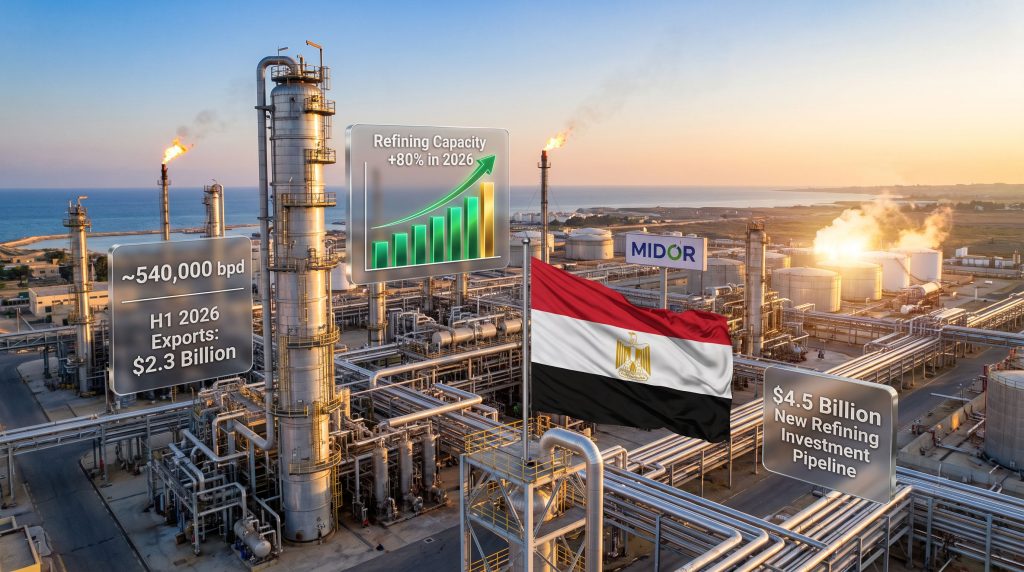
First, upstream crude production has rebounded to approximately 540,000 barrels per day, a level characterised as the highest in roughly two years, following the completion of targeted oilfield development programs by international oil company partners. Second, refining infrastructure across multiple facilities has expanded in aggregate capacity by approximately 80% in 2026 relative to prior-year baselines, combining physical additions with operational performance improvements. Third, the resolution of outstanding financial obligations owed to foreign operators has unlocked a renewed cycle of upstream capital commitment that is expected to drive further production gains.
Each of these forces would be meaningful in isolation. Together, they create a momentum dynamic that is qualitatively different from any one of them operating independently.
The Arrears Settlement: Why Financial Credibility Matters More Than Reserves
Egypt's proven crude oil reserves, estimated by the Kuwait-based Arab Energy Organisation at 3.3 billion barrels, and natural gas deposits quantified at approximately 2.1 trillion cubic metres, have long established the country's resource credentials. These figures are not new. What was missing for an extended period was not geology but the investment climate required to monetise those reserves at higher throughput rates.
International oil companies operating in Egypt had accumulated significant unpaid dues from the state, a situation that predictably dampened their appetite for incremental drilling, development, and enhanced recovery investment. The strategic decision to settle these outstanding obligations functioned as a credibility restoration signal. Once cleared, the mechanism was direct: foreign operators reinvested into oilfield development, which fed additional crude volumes into a refining system that was simultaneously being upgraded to absorb them.
Egypt's resource endowment has been established for decades. The decisive shift in 2026 was the operational and financial environment that allowed those reserves to be monetised at meaningfully higher rates.
Egypt's Petroleum and Mineral Resources Minister Karim Badawi has indicated that crude output is projected to climb further as foreign oil companies accelerate investment across development, exploration, and production activities. This forward guidance reflects a recognition that the arrears settlement was not a one-time intervention but the beginning of a sustained reinvestment cycle.
Facility-Level Performance: Where the Refining Gains Are Being Generated
The Egypt refining output surge is not a headline abstraction. It is grounded in measurable, facility-specific performance improvements across several installations. The table below captures the scale of gains at individual refineries.
| Refinery | Output Category | Scale of Improvement |
|---|---|---|
| Mostorod | Gasoline production | ~45,000 tonnes/month additional |
| Mostorod | Jet fuel production | ~40,000 tonnes/month additional |
| Alexandria National Refining & Petrochemicals | Operating rate | Exceeding 110% of design capacity |
| Amreya | 92-octane gasoline output | +10,000 to 15,000 tonnes/month |
| MIDOR | Annual throughput (2025 baseline) | Over 49 million barrels refined |
| MIDOR | Annual product output (post-overhaul) | Approximately 6.6 million tonnes |
Several dynamics within this data deserve closer examination.
The Alexandria National Refining and Petrochemicals facility operating at above 110% of nameplate design capacity is particularly noteworthy. This outcome reflects operational efficiency gains and process optimisation rather than physical expansion alone, suggesting that Egyptian refinery operators have extracted meaningful throughput improvements without necessarily committing additional capital to infrastructure. This is a technically sophisticated outcome, as running a refinery above design capacity over a sustained period requires careful management of equipment integrity and process unit load balancing.
MIDOR's overhaul trajectory illustrates a different mechanism. The facility's major maintenance program, often perceived as a short-term output headwind when scheduled, translated into sustained performance uplift in its aftermath. Processing over 49 million barrels in 2025 and delivering approximately 6.6 million tonnes of refined product output post-overhaul positions MIDOR as one of Egypt's highest-throughput downstream assets.
Amreya's product-mix shift toward higher-octane gasoline grades carries an additional commercial dimension. 92-octane gasoline commands a quality premium in regional product markets, meaning Amreya's output optimisation serves both volume and value objectives simultaneously. For a broader picture of how Egypt's refining sector has evolved structurally, independent analysis confirms the scale of capacity transformation now underway.
Export Performance: A Six-Month Result That Exceeded a Full Prior Year
The most commercially striking data point emerging from Egypt's 2026 petroleum sector performance is its export trajectory. Petroleum product exports reached approximately 2.3 million tonnes valued at $2.3 billion in the first half of 2026 alone. To contextualise that figure: it surpassed the entire volume of petroleum product exports recorded across the full calendar year of 2025.
This is not a marginal outperformance. Achieving in six months what previously required twelve is a structural step-change in export capacity rather than a favourable pricing coincidence.
The drivers behind this acceleration follow a logical supply chain sequence:
- Higher crude production provides greater feedstock availability to refineries.
- Expanded and upgraded refinery capacity converts that feedstock into refined products at elevated throughput rates.
- Domestic consumption absorbs a portion of refined output, with surplus volumes directed toward export markets.
- Egypt's Mediterranean geographic positioning facilitates cost-competitive delivery to European, East African, and Levantine product importers.
Ministry guidance projects petroleum product exports reaching approximately 2.5 million tonnes in the second half of 2026, implying a full-year export volume trajectory of roughly 4.8 million tonnes if H2 targets are achieved. That figure would represent a multi-year high for Egyptian refined product exports and would signal a meaningful repositioning of the country within regional product trade flows.
The $4.5 Billion Downstream Investment Pipeline
Current performance metrics, while strong, represent only the first phase of Egypt's downstream ambition. Plans for new refining projects carrying total investment commitments of approximately $4.5 billion have been confirmed at the ministerial level. Earlier reporting from February 2026 indicated a programme encompassing six oil refineries with combined investments exceeding $4 billion, providing a facility-level framework for how this capital deployment is structured.
The strategic objectives of this investment pipeline operate across two dimensions simultaneously:
- Import substitution: Higher domestic refining capacity reduces Egypt's foreign currency expenditure on petroleum product imports, delivering fiscal savings that compound over time as global product prices fluctuate.
- Export revenue generation: Surplus production above domestic absorption creates exportable volumes that generate hard currency inflows, functioning as a partial offset to Egypt's broader current account pressures.
The dual-benefit model embedded in this investment logic is particularly relevant given Egypt's macroeconomic context. As the country continues to navigate IMF programme commitments and manage foreign exchange dynamics, a petroleum sector that simultaneously reduces import bills and grows export revenues provides a structurally supportive contribution to balance of payments stabilisation. Furthermore, understanding crude oil price geopolitics helps contextualise why Egypt's downstream positioning matters at a regional strategic level, not merely a domestic one.
The next major ASX story will hit our subscribers first
Strategic Petroleum Reserve Expansion: Reading the Geopolitical Signal
Prime Minister Mostafa Madbouly's announcement of plans to expand Egypt's strategic petroleum reserves adds a geopolitical risk management dimension to what might otherwise appear to be a purely commercial story. The stated trigger for this expansion is renewed concern over supply disruption risk associated with shipping through the Strait of Hormuz.
The Hormuz dimension creates an interesting two-sided dynamic for Egypt's energy positioning:
- Risk exposure: Egypt imports crude and petroleum product feedstocks from Gulf producers, meaning Hormuz disruption creates supply-side vulnerability that strategic reserves are designed to buffer.
- Opportunity vector: Disruption to Hormuz shipping elevates demand for alternative refined product suppliers in regional markets. Egypt's Mediterranean export infrastructure positions it to serve this demand, particularly for European and East Mediterranean importers seeking to reduce Gulf dependency.
This dynamic is not hypothetical. Egypt's Suez Canal infrastructure, operating as a strategic energy transit corridor, creates a complementary strategic asset base that amplifies the commercial value of domestic production and refining growth during periods of regional supply disruption. A country that simultaneously expands its strategic reserves, grows its domestic refining capacity, and controls a major transit route occupies a uniquely resilient position in the regional energy security architecture. This mirrors broader discussions around regional energy security in other parts of the world, where transit infrastructure and refining capability increasingly define strategic advantage.
Egypt's Refining Competitiveness in a North African Context
Examining Egypt's refining expansion alongside the broader North African producer landscape adds important comparative context. Libya's downstream sector remains constrained by ongoing political fragmentation and infrastructure underinvestment. Algeria, while a substantial upstream producer, has historically directed refining capacity primarily toward domestic consumption and LNG export infrastructure rather than refined product export growth at scale.
Egypt's combination of geographic positioning, refinery fleet diversity, and improving investment climate creates a differentiated competitive profile within the region. The country's transition from a net importer of certain petroleum product categories toward a net exporter position is a structural shift with lasting implications for regional trade flows. In addition, the global crude steel outlook and other commodity sectors similarly reflect how emerging economy infrastructure cycles can reshape international supply chains when conditions converge effectively.
A large-population economy achieving petroleum product self-sufficiency represents a qualitatively different energy security outcome than a small producer running export surpluses. Egypt's scale makes its downstream transformation regionally significant rather than simply nationally relevant.
However, this transition does not occur in isolation from broader market forces. OPEC market influence continues to shape the pricing environment within which Egyptian export economics are evaluated, meaning Egypt's refining competitiveness is partly a function of how cartel production decisions interact with Mediterranean product market dynamics. Consequently, trade war oil markets represent an additional variable that could either accelerate or complicate Egypt's export trajectory depending on how global demand patterns evolve.
Key Metrics at a Glance
| Metric | Data Point |
|---|---|
| Crude oil production (reported) | ~540,000 barrels per day |
| Production status | Highest level in approximately 2 years |
| Refining capacity expansion | ~80% increase in 2026 |
| H1 2026 petroleum product exports | ~2.3 million tonnes |
| H1 2026 export value | ~$2.3 billion |
| H2 2026 export projection | ~2.5 million tonnes |
| Implied full-year 2026 export volume | ~4.8 million tonnes |
| Proven crude oil reserves | 3.3 billion barrels |
| Proven natural gas reserves | 2.1 trillion cubic metres |
| New refining investment pipeline | ~$4.5 billion |
| Refinery development programme | 6 refineries planned |
| MIDOR 2025 throughput | Over 49 million barrels |
| MIDOR product output (post-overhaul) | ~6.6 million tonnes |
| Alexandria refinery operating rate | Over 110% of design capacity |
| Mostorod gasoline gain | ~45,000 tonnes/month |
| Mostorod jet fuel gain | ~40,000 tonnes/month |
| Amreya 92-octane gasoline gain | +10,000 to 15,000 tonnes/month |
Frequently Asked Questions
What caused Egypt's refining output to surge in 2026?
The Egypt refining output surge reflects three converging factors: increased crude feedstock availability resulting from upstream production recovery, major overhauls and operational upgrades at key refinery facilities including MIDOR and Alexandria National Refining and Petrochemicals, and aggregate capacity additions across multiple installations. The combined effect elevated both throughput volumes and product output to levels not previously recorded.
How does crude production growth connect to the refining expansion?
The relationship is one of feedstock supply meeting processing capacity. Higher crude output at approximately 540,000 bpd provides refineries with the raw material base required to operate at elevated rates. Without the upstream recovery, downstream capacity additions would have been partially constrained by feedstock availability. The two trends are mutually reinforcing rather than independent.
Which facilities have delivered the largest output improvements?
MIDOR's post-overhaul performance and the Alexandria National Refining and Petrochemicals facility's above-capacity operation represent the headline examples. Mostorod's combined gasoline and jet fuel additions of approximately 85,000 tonnes per month in aggregate also represent substantial incremental output. Amreya's product-mix optimisation toward higher-octane grades reflects a commercially targeted upgrade.
What is Egypt's full-year petroleum product export target for 2026?
Based on confirmed first-half actuals of approximately 2.3 million tonnes and ministerial guidance projecting roughly 2.5 million tonnes in the second half, the implied full-year trajectory is approximately 4.8 million tonnes. This would represent a multi-year high and would confirm the structural nature of the export capacity expansion.
How does Strait of Hormuz disruption affect Egypt's energy strategy?
Hormuz disruption creates both supply risk, through potential feedstock import constraints, and commercial opportunity, through elevated regional demand for alternative refined product suppliers. Strategic petroleum reserve expansion addresses the risk dimension. Egypt's Mediterranean refining and export infrastructure positions it to capitalise on the opportunity dimension if sustained Hormuz constraints redirect European and East Mediterranean importers toward alternative sources.
What does the $4.5 billion refining investment programme target?
The programme encompasses new refinery construction and existing facility upgrades structured across a pipeline of six refineries. Primary objectives include reducing the petroleum product import bill through import substitution, growing exportable surplus volumes, and reinforcing long-term domestic energy security against supply disruption scenarios.
From Deficit Management to Surplus Ambition
The analytical thread connecting Egypt's upstream recovery, downstream capacity surge, and export performance acceleration leads to a single conclusion: Egypt's petroleum sector is in the process of redefining its structural role, both domestically and within the regional energy trade architecture.
The conditions required to sustain this momentum are identifiable. Continued international oil company investment is contingent on the maintenance of financial credibility established through the arrears settlement. Refinery investment programme execution carries inherent timeline and capital deployment risks that must be managed carefully across a $4.5 billion commitment horizon. Macroeconomic stability functions as a prerequisite for sustained energy sector capital formation, connecting petroleum sector performance to the broader trajectory of Egypt's economic management.
What the 2026 data makes difficult to dispute is that the inflection point has already arrived. Whether the trajectory from here reaches its full potential depends on the institutional and financial discipline applied to sustaining the conditions that made the initial surge possible. The resource base is established, the infrastructure is being built, and the investment cycle has restarted. The question for the years ahead is not whether Egypt can produce and refine more, but whether the ecosystem supporting that growth can be maintained with sufficient consistency to convert a 2026 surge into a durable, decade-long repositioning.
This article is intended for informational purposes only and does not constitute financial, investment, or trading advice. Forward-looking projections referenced herein are based on ministerial guidance and publicly available data and are subject to material revision based on operational, geopolitical, and macroeconomic developments.
Want to Stay Ahead of the Next Major Resource Discovery?
While Egypt's petroleum transformation illustrates how converging upstream and downstream forces can reshape entire energy economies, similar inflection points occur across ASX-listed mineral explorers — often with little warning. Discovery Alert's proprietary Discovery IQ model delivers real-time alerts the moment significant ASX mineral discoveries are announced, turning complex resource data into actionable investment insights; explore the historic returns major discoveries have generated and begin your 14-day free trial to position yourself ahead of the broader market.