July 29, 2026
When Geopolitical Risk Becomes Balance Sheet Risk: The LNG Market's New Reality
For decades, long-term LNG supply contracts were considered among the most reliable instruments in global energy procurement. Their multi-decade horizons, oil-indexed pricing, and rigid volume commitments gave both buyers and sellers a framework of predictability that underpinned billions of dollars in infrastructure investment. That assumption is now being stress-tested in real time, as the QatarEnergy force majeure on LNG cargoes demonstrates how quickly geopolitical events can transform contractual certainty into operational crisis.
The situation unfolding across global LNG markets in 2026 is not merely a supply disruption. It is a repricing event for geopolitical risk that will reshape how energy buyers structure contracts, diversify suppliers, and model earnings exposure for years to come. Furthermore, understanding the broader LNG supply outlook is essential context for evaluating just how significant this disruption truly is.
When big ASX news breaks, our subscribers know first
The Anatomy of a Major Supply Shock
Qatar occupies a singular position in the global LNG hierarchy. The country is consistently ranked among the world's two or three largest LNG exporters, underpinning energy security frameworks across Europe and Asia simultaneously. When infrastructure attacks in March 2026 damaged key LNG processing and liquefaction facilities, the consequences extended far beyond Qatar's borders.
Estimates place the resulting capacity reduction at approximately 17% of Qatar's total LNG export throughput. That figure alone understates the severity of the situation. What makes this disruption structurally different from a routine supply interruption is the repair timeline: engineering assessments project a three-to-five year horizon before affected facilities return to full operational capacity.
A disruption measured in years, not weeks, does not belong in the same category as a weather event or a maintenance outage. It belongs in the category of structural supply constraint. Consequently, the geopolitical risk landscape across global energy markets has shifted considerably as a result.
A 17% reduction in export capacity from one of the world's top-tier LNG producers does not simply tighten spot markets. It forces a fundamental reassessment of long-term contract reliability as a concept across the entire global LNG supply chain.
This distinction matters enormously for how buyers, traders, and policymakers respond. Emergency procurement strategies designed for short-term gaps are categorically different from the supply portfolio restructuring required to manage a multi-year deficit.
How Force Majeure Functions Inside LNG Contracts
The Legal Mechanism and Its Commercial Consequences
Force majeure clauses are standard instruments in long-term commodity supply agreements. Their purpose is to protect a supplier from financial liability when fulfilment becomes impossible due to circumstances genuinely outside their control, such as natural disasters, armed conflict, or critical infrastructure destruction. When invoked legitimately, the supplier is relieved of delivery obligations for the affected period without penalty.
The commercial burden, however, does not disappear. It transfers entirely to the buyer, who must source replacement volumes at their own cost and risk. In a tight market, this means competing for spot cargoes at elevated premiums, often against other buyers facing identical circumstances. Al Jazeera's initial reporting confirmed the scale of QatarEnergy's original declaration, which set the stage for subsequent extensions.
The following table illustrates the typical structural features of long-term LNG agreements and how force majeure alters the contractual dynamic:
| Contract Element | Standard LNG Agreement | Under Force Majeure |
|---|---|---|
| Contract Duration | 15 to 25 years | Unchanged, but deliveries suspended |
| Annual Volume Commitment | Fixed BCM targets | Supplier obligation suspended |
| Price Mechanism | Oil-indexed or hybrid formula | Buyer pays spot premium for replacements |
| Buyer Obligation | Receive contracted volumes | Source alternative supply independently |
| Financial Penalty | Applies to buyer for rejection | Waived for supplier under qualifying events |
Edison's Exposure: A Case Study in Concentrated Supplier Risk
Edison, the Italian utility and a subsidiary of French energy group EDF, holds one of the most significant long-term LNG supply agreements with QatarEnergy in Europe. The contract, operational since 2009, commits QatarEnergy to supply 6.4 billion cubic meters (BCM) of natural gas annually to Italy over a 25-year duration. That scale of contracted volume makes Edison one of QatarEnergy's largest European customers and simultaneously one of the most exposed buyers to the current disruption.
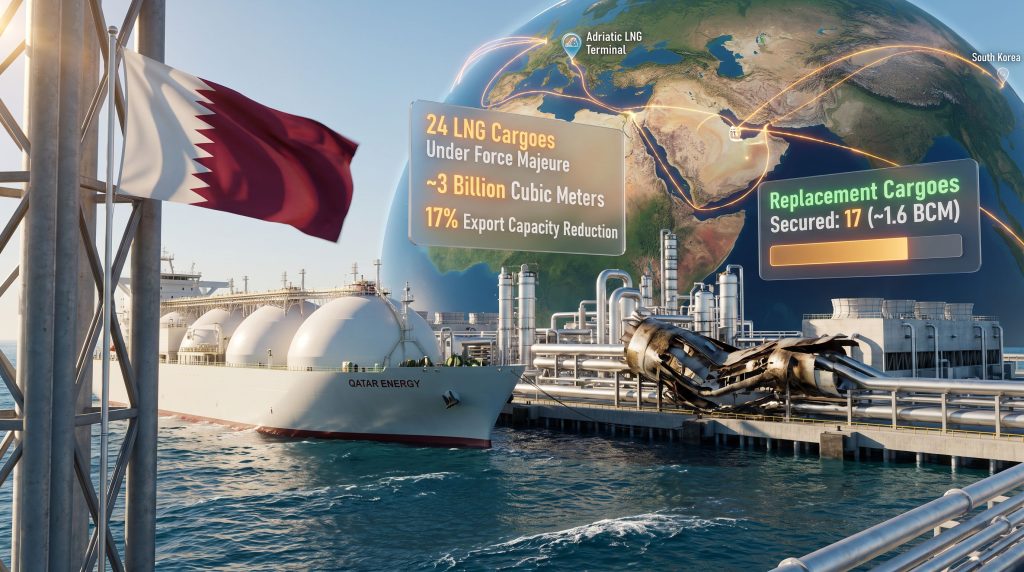
As of 28 July 2026, QatarEnergy had extended force majeure to cover a total of 24 LNG cargoes, representing approximately 3 billion cubic meters of natural gas. This followed an initial wave of declarations after the March 2026 infrastructure damage, with the cargo count escalating from 21 to 24 as the disruption persisted and expanded. Reuters reported that QatarEnergy was preparing to extend force majeure further into mid-October 2026, underscoring the prolonged nature of the crisis.
The financial consequences became visible early. Edison reported that its first-quarter operating profit was roughly halved, with the force majeure identified as the primary driver of the deterioration. The company subsequently revised its full-year earnings guidance downward, citing ongoing uncertainty linked to the broader regional conflict.
Supply Gap Snapshot as of Late July 2026:
- Total cargoes under force majeure: 24
- Equivalent gas volume: ~3 billion cubic meters
- Replacement cargoes secured: 17 (~1.6 BCM)
- Remaining unmet volume: ~7 cargoes / ~1.4 BCM
Edison confirmed it had replaced 17 of the 24 affected cargoes through the Adriatic LNG terminal, Italy's primary regasification facility on the Adriatic coast. This terminal has served as a critical logistical bridge, enabling Edison to receive spot and alternative-source cargoes and redistribute them into the Italian gas network. However, the remaining gap of approximately seven cargoes represents a sustained supply shortfall that carries both operational and financial implications into the second half of 2026.
Which Regions Face the Greatest Exposure
European Markets: Italy at the Centre
Italy's structural dependency on Qatari LNG, concentrated through Edison's long-term contract, places it at the epicentre of the European exposure. With 6.4 BCM per year committed through the QatarEnergy agreement, any prolonged curtailment represents a material share of Italy's overall gas import portfolio. The country has some flexibility through pipeline connections and spot market access, but the scale of the contracted volume makes full substitution operationally challenging and commercially expensive.
The Q1 profit impact at Edison functions as an early indicator of what full-year financial deterioration could look like if the force majeure persists. Utility earnings models built around contracted LNG at known price formulas are ill-equipped to absorb sudden exposure to volatile spot markets.
Asian Buyers: South Korea and India
The disruption is not confined to Europe. Force majeure extensions have also been communicated to buyers in South Korea and India, two of Asia's most significant LNG importers. Both countries operate in an energy environment where LNG plays a structurally dominant role, particularly South Korea, where LNG accounts for a substantial share of electricity generation capacity.
Asian buyers face a distinct version of the substitution problem. While European utilities can draw on pipeline gas alternatives and a relatively well-developed spot LNG market infrastructure, Asian buyers are more dependent on seaborne LNG supply with fewer alternative pipeline routes available at short notice.
| Buyer Region | Contract Dependency | Alternative Supply Pathways | Short-Term Flexibility |
|---|---|---|---|
| Italy (Europe) | High, 25-year contract at 6.4 BCM/year | Adriatic LNG terminal, pipeline gas | Moderate |
| South Korea (Asia) | High, LNG-dominant energy system | Spot market, US LNG imports | Limited |
| India (Asia) | Moderate, diversified supplier base | Spot market, some pipeline alternatives | Moderate |
Price Dynamics and the Spot Market Premium Problem
How LNG Benchmarks Respond to Structural Supply Withdrawal
Removing approximately 17% of Qatari export capacity from the market is not a shock that can be absorbed quietly. LNG pricing in Europe references the TTF (Title Transfer Facility) benchmark in the Netherlands, while Asian buyers trade against the JKM (Japan Korea Marker). Both benchmarks are sensitive to supply-demand imbalances, and a sustained reduction of this magnitude from a top-tier producer creates upward pressure across both.
The mechanism is straightforward: buyers scrambling to replace contracted volumes compete for the same pool of spot cargoes, driving up clearing prices. The cost differential between a contracted cargo delivered at an oil-indexed formula price and an emergency spot cargo purchased at peak market rates can be substantial, often running to tens of millions of dollars per cargo depending on prevailing market conditions. This dynamic closely mirrors the oil price volatility patterns seen in other geopolitically disrupted commodity markets.
Downstream Earnings Compression
This cost premium flows directly into utility income statements. Edison's Q1 experience is illustrative. A company that budgets for contracted supply at a known cost formula and then absorbs spot premiums on top of that faces a margin compression that is both immediate and difficult to hedge retrospectively. As force majeure declarations extend and the cargo count grows, the cumulative financial drag compounds.
For investors, this creates a new lens through which to evaluate utility sector earnings: the degree of single-supplier LNG concentration embedded in a company's supply portfolio is now a measurable risk factor that deserves explicit disclosure and pricing. Indeed, the broader commodity price impacts across energy markets reinforce just how rapidly concentrated exposure can translate into earnings deterioration.
Medium-Term Supply Rebalancing: The Three-to-Five Year Problem
The global LNG supply landscape is expected to expand materially between 2026 and 2030, with significant new capacity coming from US export terminals, Australian projects, and East African developments including Mozambique LNG. However, new supply additions require years of construction and commissioning before they reach the market, and none of these projects were designed or timed to compensate for a sudden 17% reduction in Qatari output.
The three-to-five year repair timeline for the damaged Qatari facilities creates a sustained deficit window that coincides precisely with a period of elevated European demand. Europe is actively reducing dependence on Russian pipeline gas, increasing LNG import reliance as a bridging strategy toward renewable energy targets. The intersection of rising European LNG demand and constrained Qatari supply represents a structurally tighter market than pre-2026 projections had modelled.
In addition, the trade war impacts on global energy flows add another layer of complexity, as shifting trade alliances and tariff structures further complicate the already strained LNG procurement environment.
Strategic Consideration: If Qatari export capacity remains significantly below pre-incident levels through 2028 or beyond, the global LNG market will likely face a structural supply deficit during a period of peak transitional demand from European buyers, with limited short-term relief available from alternative producers.
The next major ASX story will hit our subscribers first
Force Majeure Defensibility and Buyer Recourse
The Legal Standard Under International Commercial Law
For a force majeure declaration to withstand commercial and legal scrutiny, the triggering event must typically satisfy several criteria: it must be genuinely unforeseeable, outside the supplier's reasonable control, and must directly prevent contractual performance. Infrastructure damage resulting from military or geopolitical attacks generally meets these thresholds under most governing law frameworks, though the specific language of each contract determines the precise scope of protection.
Buyers have limited direct financial recourse when force majeure is legitimately invoked. Most LNG supply agreements do not require the supplier to compensate the buyer for the cost of replacement supply. The buyer's primary protections are:
- The right to be released from their own take-or-pay obligations for the affected volumes
- The right to challenge the force majeure declaration through arbitration if they believe the event does not meet contractual thresholds
- The ability to invoke termination clauses if force majeure persists beyond defined maximum periods, typically 12 to 24 months in standard agreements
Historical LNG arbitration precedents suggest that buyers rarely succeed in challenging force majeure declarations arising from physical infrastructure destruction. The more productive avenue is typically negotiation around make-up volume schedules once normal operations resume.
Rethinking LNG Supply Chain Architecture
The Systemic Lesson for Energy Procurement
The QatarEnergy force majeure on LNG cargoes has exposed a fundamental tension in long-term energy contracting strategy. The pursuit of price stability through decade-long volume agreements with dominant producers creates concentration risk that standard risk management frameworks have historically underweighted. When a single counterparty controls a disproportionate share of contracted volumes, any operational or geopolitical disruption at that counterparty propagates directly into the buyer's earnings and operational reliability.
The likely industry response includes several structural shifts:
- Mandatory supply diversification thresholds built into new long-term LNG contracts, limiting single-supplier exposure to a defined percentage of total contracted volumes
- Force majeure cost-sharing mechanisms that distribute replacement procurement costs between buyer and seller during extended disruption periods
- Enhanced emergency supply reserve obligations for LNG import-dependent nations, similar to oil strategic reserve frameworks
- Accelerated contracting with alternative suppliers including US LNG, Australian producers, and emerging East African exporters to build structural redundancy
Key Takeaways for Market Participants
-
Energy buyers: Concentration of contracted LNG volumes with any single major supplier, regardless of that supplier's historical reliability, embeds geopolitical risk that must be explicitly quantified and managed
-
LNG traders: Extended force majeure from a top-tier producer creates sustained spot market opportunity, but also introduces price volatility that can erode trading margins if positions are not carefully structured
-
Policymakers: National energy security frameworks must treat LNG import infrastructure diversification and emergency storage capacity as strategic imperatives, not optional enhancements
-
Investors: Utility sector earnings are directly exposed to force majeure risk embedded in long-term supply contracts, and the Edison Q1 experience demonstrates how rapidly that exposure can manifest in reported financial results
FAQ: QatarEnergy Force Majeure on LNG Cargoes
What is force majeure in the context of LNG supply contracts?
Force majeure is a contractual provision allowing a supplier to suspend delivery obligations without financial penalty when an extraordinary event, such as infrastructure destruction, armed conflict, or natural disaster, makes fulfilment genuinely impossible.
How many LNG cargoes are currently under force majeure?
As of 28 July 2026, a total of 24 LNG cargoes have been placed under force majeure, representing approximately 3 billion cubic meters of natural gas.
What caused the force majeure declaration?
Infrastructure attacks in March 2026 damaged LNG processing and liquefaction facilities in Qatar, reducing the country's export capacity by an estimated 17%. Repair timelines are projected at three to five years.
Which countries are directly affected?
Italy is the most significantly exposed European market, through Edison's 25-year, 6.4 BCM per year contract with QatarEnergy. Buyers in South Korea and India have also received force majeure notifications.
How are affected buyers replacing missing supply?
Through spot market procurement and alternative supply agreements. As of late July 2026, Edison had successfully replaced 17 of the 24 affected cargoes, primarily through the Adriatic LNG terminal in Italy.
What is the financial impact on energy companies?
Edison reported that its first-quarter operating profit was approximately halved due to the QatarEnergy force majeure on LNG cargoes. The company has also revised its full-year earnings guidance downward. Similar financial pressures are expected to affect other exposed buyers.
How long will the disruption last?
Repair of the damaged Qatari facilities is estimated to require three to five years, suggesting the supply constraint could persist into the late 2020s.
Disclaimer: This article contains forward-looking statements, market projections, and analytical commentary based on publicly available information as of the date of publication. These should not be construed as financial advice. Energy market conditions are subject to rapid change, and readers should conduct independent research before making investment or procurement decisions.
Want To Capitalise on the Next Major Mineral Discovery Before the Broader Market Reacts?
While geopolitical shocks continue to reprice risk across global energy and commodity markets, Discovery Alert's proprietary Discovery IQ model scans ASX announcements in real time, instantly identifying significant mineral discoveries and turning complex data into actionable investment insights — explore historic discovery returns to understand the opportunity, then begin your 14-day free trial at Discovery Alert to position yourself ahead of the market.