June 24, 2026
When a 60-Day Clock Governs Billions of Barrels: The Real Stakes of Iran's Sanctions Window
Global oil markets have always been shaped as much by political architecture as by geology or demand fundamentals. The history of Iranian crude is perhaps the clearest illustration of this principle: a nation sitting atop some of the world's most prolific hydrocarbon reserves, yet perpetually constrained by the geopolitical scaffolding erected around it. Understanding Iran oil exports after US waiver authorization requires stepping back from the headlines and examining what a temporary sanctions window can and cannot actually achieve, and why the gap between those two outcomes matters enormously for Asian energy markets.
When big ASX news breaks, our subscribers know first
What General License X Actually Authorizes
Issued on 22 June 2026, General License X represents a structurally distinct departure from previous US attempts to calibrate pressure on Iran's oil economy. Rather than a blanket diplomatic concession, this authorization is explicitly performance-based, meaning Iranian access to international financial flows remains conditional on Tehran fulfilling two concrete obligations: maintaining free and open transit through the Strait of Hormuz, and allowing IAEA inspectors back into Iranian nuclear facilities.
The license covers a broad range of energy-related activities, including:
- Crude oil and condensate production, delivery, and sale
- Petrochemical and petroleum-derived products
- Liquefied petroleum gas (LPG)
- Maritime services, including shipping, insurance, and crew operations
- US dollar-denominated payment for all authorised transactions
That last point carries particular weight. Prior sanctions frameworks explicitly prohibited USD settlement for Iranian crude, forcing transactions through currency swap arrangements, barter mechanisms, and opaque intermediary structures. The authorisation of direct dollar payments is a meaningful structural change, one that in theory lowers the friction cost for international buyers and narrows the discount Iran must offer to attract commercial interest.
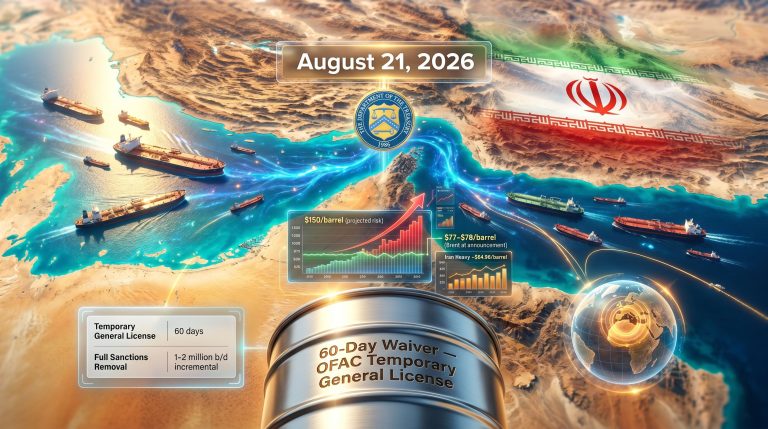
However, the window is fixed at 60 days, expiring 21 August 2026, and it explicitly excludes transactions involving North Korea, Cuba, and Russian-occupied Ukraine.
How Does This Compare to Previous Iran Sanctions Relief?
| Feature | Pre-2026 Waivers | General License X (2026) |
|---|---|---|
| USD Payment Authorisation | Not permitted | Fully authorised |
| Maritime Services Coverage | Partial | Includes shipping, insurance, crewing |
| Conditionality | Largely diplomatic | Performance-based (IAEA + Hormuz) |
| Duration | Varied | Fixed 60-day window |
| Dark fleet status | Tolerated | Port access complications persist |
The Trump administration's stated rationale centres on redirecting Iranian barrels from discounted, opaque channels into transparent, price-discoverable markets. This goal aligns with its broader objective of suppressing global energy prices through increased supply, though the US sanctions relief precedent established with Venezuela offers a useful comparison for how such frameworks can evolve.
Iran's Floating Inventory: 68 Million Barrels Looking for a Home
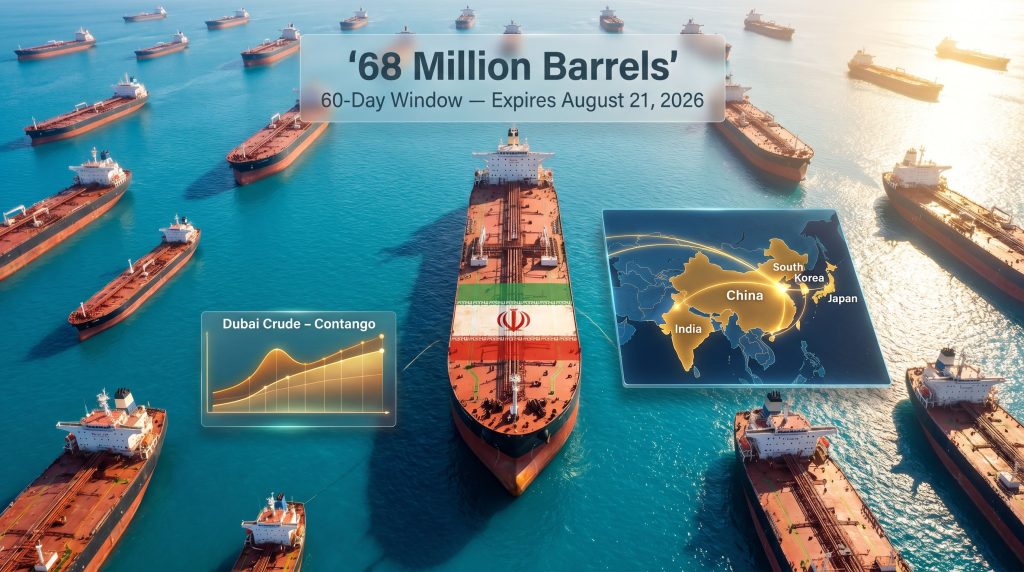
The commercial urgency driving Iranian outreach becomes immediately clear when the scale of its floating inventory is quantified. According to data from Vortexa analytics and Bloomberg calculations, approximately 68 million barrels of crude and condensate were held on tankers at sea as of 22 June 2026. Critically, more than 80% of this volume lacked a confirmed buyer destination at that point.
To contextualise that figure: 68 million barrels is roughly equivalent to two-thirds of a single day's worth of global oil consumption. The sheer concentration of unsold inventory creates both pricing pressure and logistical urgency. Iran needs to clear these cargoes before 21 August, or risk them reverting to their prior status as sanctioned supply accessible only to buyers willing to operate outside conventional financial and insurance frameworks.
Since 15 June 2026, approximately 36 million barrels had already been exported, with a further 6 million barrels reported in active transit via supertanker. That still leaves a substantial overhang requiring placement within the authorised window.
The compressed timeline creates an inherently asymmetric negotiation dynamic: Iranian sellers and their intermediaries are operating under deadline pressure, while Asian buyers face no comparable urgency given their well-stocked inventory positions.
Why Asian Refiners Are Staying Cautious Despite Iran's Outreach
Iran oil exports after US waiver authorisation have not triggered the purchasing wave that Tehran had hoped for. The reasons are layered and structural rather than simply political.
The Oversupply Problem Is Already Baked In
Middle East benchmark grades, specifically Dubai crude and Abu Dhabi's Murban, are currently trading in contango, a market structure where near-term delivery contracts are priced below later-dated forward contracts. Contango is the market's way of signalling that prompt supply exceeds immediate demand, and it removes one of the key incentives for buyers to scramble for additional barrels. Furthermore, these oil market dynamics are compounding the commercial hesitancy already present among Asian refiners.
Asian refiners spent months securing alternative crude supplies during the Strait of Hormuz disruptions that preceded the waiver. Indian refiners, for instance, had already locked in crude arrival schedules through August 2026, overlapping almost entirely with the authorised window. Kpler's lead refining analyst noted that refiners across Asia excluding China had largely secured the volumes needed to meet near-term requirements, making additional Iranian barrels a logistical redundancy rather than a necessity.
The Structural Barriers Constraining Commercial Engagement
Beyond the oversupply dynamic, a distinct set of operational and policy barriers is complicating buyer engagement:
- Policy consistency risk: The Trump administration's track record of abrupt shifts on sanctions enforcement makes long-term supply commitments commercially hazardous for regulated buyers.
- Parallel sanctions architecture: EU and UK sanctions frameworks remain fully active, creating complications around trade finance, letters of credit, and hull/cargo insurance underwriting for non-US counterparties.
- Dark fleet port restrictions: Not all regional ports accept vessels associated with Iran's shadow shipping network, creating bottlenecks that cannot be resolved within a 60-day commercial window.
- China waiver uncertainty: Beijing, historically the dominant buyer of Iranian crude under sanctions, was still negotiating its specific waiver terms as of the licence issuance date, leaving the largest potential buyer on the sidelines at the critical early stage.
In addition, broader US-China trade tensions are adding another layer of complexity, as Beijing weighs the geopolitical implications of increasing its engagement with Iranian energy supply under a US-authorised framework.
Country-by-Country Buyer Readiness
| Country | Key Advantage | Key Barrier | Most Likely Engagement |
|---|---|---|---|
| India | 2–3 day sailing proximity to Iranian ports | Crude needs covered through August | LPG, petrochemicals, fertilisers |
| Japan | Included in waiver framework | Taiyo Oil confirmed non-participation; government coordination required | Minimal near-term |
| South Korea | Waiver coverage confirmed | EU/UK insurance constraints; policy caution | Selective, limited volume |
| China (Shandong teapots) | Established buyer relationships | Waiver terms still being negotiated | Primary near-term crude buyer |
India's geographic position is genuinely significant: certain Iranian export terminals sit within two to three days' sailing time of Indian refinery ports, a logistical advantage that carries real weight when operating inside a fixed 60-day authorisation. However, Indian refiners have historically been conservative about engaging with sanctioned crude, and their forward coverage through August reduces the commercial imperative. The more realistic near-term pathway involves LPG, petrochemical feedstocks, and fertiliser inputs rather than crude oil contracts.
Japan's position is instructive in a different way. Taiyo Oil, a named Japanese refiner, publicly confirmed it was not considering Iranian crude purchases, with procurement decisions subject to ongoing government coordination. This bureaucratic dimension adds a layer of institutional inertia that a 60-day commercial window cannot easily overcome.
China's Shandong-based independent teapot refineries remain the most commercially viable near-term destination for Iranian barrels. These facilities have historically absorbed discounted Iranian crude outside the mainstream financial system, and their operational flexibility makes them less constrained by the EU/UK sanctions complications that affect other buyers. ING Groep's head of commodities strategy in Singapore observed that the waiver creates a broader opportunity for Iran to diversify its customer base beyond near-total China dependency, with the potential side effect of narrowing the discount Iran has historically needed to offer to secure Chinese purchases.
Pricing Dynamics: What the Waiver Does and Does Not Change
The discount structure surrounding Iranian crude is one of the most consequential, and least discussed, dimensions of the current situation.
Under the sanctions-era model, Iran routed crude through opaque intermediary networks at steep discounts, primarily to Chinese independent refiners willing to accept the counterparty risk. USD payment prohibition meant additional friction costs were embedded in every transaction. General License X, by authorising dollar settlement and expanding the theoretically accessible buyer pool, creates conditions under which those discounts could narrow. Consequently, the resulting oil price volatility is being watched closely by traders and analysts across the region.
ING Groep's Singapore-based commodities strategy head has noted that the waiver broadens Iran's sales options beyond its near-exclusive China reliance, which could reduce the depth of price concessions Iran must offer to attract buyers. The same analyst emphasised, however, that a more substantive increase in Iranian supply would require a durable sanctions framework rather than a short-term authorisation.
The pricing scenarios break down as follows:
| Scenario | Iranian Discount Trajectory | Likely Market Response |
|---|---|---|
| Waiver extended or made permanent | Narrows significantly | Broader Asian uptake, volume ramp-up |
| Waiver expires without renewal | Widens sharply | Return to China-only dependency |
| Partial renewal with conditions | Moderate narrowing | Selective Indian and Korean engagement |
| Full sanctions removal | Approaches market parity | Complete Asian market reintegration |
The 60-day duration fundamentally limits how aggressively buyers will commit. Refineries operate on procurement cycles measured in months, not weeks, and locking into Iranian supply chains requires infrastructure adjustments, compliance reviews, and insurance arrangements that cannot be completed and justified within a two-month window without a credible expectation of continuity.
The Longer Game: Iran's Path Beyond China Dependency
Perhaps the most strategically significant dimension of the current situation is what it reveals about Iran's longer-term commercial ambitions. The outreach to Indian, Japanese, and South Korean refiners began before General License X was formally issued, indicating that Tehran and its intermediaries had been preparing for this window and viewed diversification as a priority, not an afterthought.
Iran's reliance on Chinese buyers was never a preference; it was the product of sanctions constraints eliminating every other viable option. The consequence has been structural: China has been able to extract progressively deeper discounts from Iran, knowing it had no competitive alternatives. A broader buyer base would restore negotiating balance.
The more realistic near-term diversification pathway, as Kpler's refining analysts have noted, runs through LPG, petrochemicals, fertiliser inputs, and broader energy cooperation frameworks rather than crude oil contracts. These product categories carry lower political visibility, involve smaller transaction sizes, and are less likely to trigger secondary sanctions scrutiny from US regulators focused primarily on crude oil flows.
Longer-term deal discussions are reportedly underway alongside the immediate clearing of floating inventory, suggesting Iran is attempting to use the 60-day window as a platform for relationships that could survive or influence a future, more permanent sanctions framework. However, the wider context of global trade disruption means that any such framework will need to be robust enough to withstand considerable external pressure.
What Would Permanent Relief Actually Require?
The current waiver is explicitly not a nuclear deal. It is tied to two operational conditions — IAEA access and Hormuz transit — rather than to full resolution of Iran's nuclear programme. Structural barriers to complete market reintegration remain substantial:
- Active EU and UK sanctions architecture independent of US policy
- Reputational exposure for major international shipping and insurance firms
- Dark fleet vessel constraints and port access restrictions that cannot be quickly dismantled
- Ongoing uncertainty around the trajectory of US-Iran nuclear negotiations
Disclaimer: This article contains forward-looking analysis based on publicly available market data and analyst commentary as of late June 2026. Oil market conditions, sanctions policy, and geopolitical developments can change rapidly. Nothing in this article constitutes financial or investment advice.
The next major ASX story will hit our subscribers first
Frequently Asked Questions: Iran Oil Exports After US Waiver
What Is General License X and What Does It Permit?
General License X is a 60-day US sanctions authorisation issued 22 June 2026, permitting the production, sale, and delivery of Iranian crude oil and related energy products, including USD-denominated payment. It expires 21 August 2026, and is conditioned on Iran maintaining Strait of Hormuz access and allowing IAEA inspector entry.
Which Asian Countries Are Covered Under the Waiver?
India, Japan, and South Korea are among the covered markets. China's specific waiver terms were still under negotiation at the time of issuance, though independent teapot refineries in Shandong province are considered the most commercially prepared near-term buyers.
How Much Iranian Crude Is Currently Available for Purchase?
Approximately 68 million barrels of crude and condensate were held on tankers at sea as of 22 June 2026, with over 80% lacking a confirmed buyer. Around 36 million barrels had already been exported since 15 June, with a further 6 million barrels in active transit.
Why Are Asian Refiners Not Rushing to Purchase Iranian Crude?
Asian refiners are broadly well-supplied following months of alternative procurement during Strait of Hormuz disruptions. Concerns about US policy consistency, active EU and UK sanctions on financing and insurance, and dark fleet port access restrictions are all contributing to buyer caution.
Will the Waiver Meaningfully Lower Global Oil Prices?
The near-term price impact is expected to be limited. Benchmark Middle East grades are already in contango, indicating short-term oversupply. A material price impact would require a permanent sanctions framework rather than a 60-day authorisation. Iran oil exports after US waiver conditions are resolved more durably would represent a far more significant supply event.
What Happens If the Waiver Expires Without Renewal?
Iranian crude would revert to its prior status, sold primarily at steep discounts through opaque channels to Chinese buyers, with the broader buyer pool inaccessible under existing US, EU, and UK sanctions frameworks.
Want To Stay Ahead of the Next Major Resource Discovery Reshaping Global Markets?
While geopolitical events like Iran's sanctions window dominate energy headlines, Discovery Alert's proprietary Discovery IQ model delivers real-time alerts the moment significant ASX mineral discoveries are announced — converting complex data across 30+ commodities into clear, actionable insights for both short-term traders and long-term investors. Explore how historic discoveries have generated extraordinary returns and begin your 14-day free trial today to ensure you never miss the market's next defining opportunity.