June 12, 2026
The Geopolitical Architecture of Oil Pricing: When Diplomacy Becomes a Market Event
Energy markets have always priced two things simultaneously: the physical reality of supply and demand, and the political probability of disruption. Most of the time, these two forces exist in uneasy equilibrium. However, when a major geopolitical conflict involving the world's most consequential energy chokepoint moves toward resolution, the second force collapses rapidly, and prices follow. The Iran peace deal and oil prices are now inseparable topics for anyone tracking current crude oil prices and their underlying drivers.
The question of what an Iran peace deal would do to oil prices is not purely academic. With Washington and Tehran reportedly inching toward a framework that could end more than three months of active conflict, crude markets are beginning to price a probability, however uncertain, that the Strait of Hormuz could reopen to normal commercial traffic. What happens next depends on whether that deal is real, durable, and enforceable, and history gives traders plenty of reasons to remain sceptical on all three counts.
When big ASX news breaks, our subscribers know first
Why the Strait of Hormuz Is the Single Most Important Variable in Global Energy Pricing
No maritime passage on Earth carries a heavier burden for global energy security than the Strait of Hormuz. Approximately 20% of the world's traded oil moves through this narrow waterway, which separates Iran from the Arabian Peninsula at its narrowest point of roughly 33 kilometres. Gulf producers including Saudi Arabia, the UAE, Kuwait, Iraq, and Qatar all depend on Hormuz access to reach Asian, European, and global markets.
When Iran exercises even partial control over passage through the strait, whether through military presence, threat of mine deployment, or outright closure declarations, the geopolitical risk premium embedded in crude benchmarks rises sharply. Conversely, any credible signal that Hormuz will reopen to unrestricted commercial traffic carries an equally powerful deflationary impulse for oil prices.
This is why the Iran peace deal and oil prices cannot be analysed in isolation. The strait is not merely a transit route. It is the physical mechanism through which geopolitical tension converts into barrel pricing. Every dollar of risk premium currently sitting in WTI and Brent is a market estimate of how long the disruption lasts, how severe it is, and how likely a resolution becomes. Furthermore, the trade and geopolitics analysis surrounding this region underscores just how deeply intertwined diplomatic signals are with crude benchmarks.
Measuring the War's Achievements Against Its Original Objectives
To understand what a peace deal would actually mean, it is necessary to assess what the conflict has and has not accomplished. The original U.S. objectives, as stated at the outset of hostilities in early 2026, encompassed four distinct goals.
Nuclear Programme Neutralisation: Significant but Incomplete
Strikes on Iran's primary enrichment infrastructure produced measurable results. The Fordow fuel enrichment plant was rendered inoperable, the above-ground facilities at Natanz were completely destroyed, and the underground laboratories at the same site sustained very significant damage. The Isfahan Nuclear Technology Centre, which plays a critical role in converting uranium into the gas required for enrichment, was also severely disrupted.
However, a critical unresolved problem undermines any claim of complete success. The International Atomic Energy Agency (IAEA) had already lost track of up to 440 kilograms of 60%-enriched uranium before the conflict began, and that material remains unaccounted for. Broader Iran uranium concerns have, in fact, been building for some time, with the IAEA acknowledging it cannot independently verify the full scope of Iran's nuclear activities, particularly at undisclosed facilities. This gap in verification creates persistent uncertainty that will complicate any peace framework's credibility with markets.
Ballistic Missile Capabilities: A Partial and Asymmetric Outcome
The military balance on missiles tells an unusual story. U.S. intelligence assessments indicate that approximately 70% of Iran's pre-war ballistic missile stockpile remains intact, even as roughly the same proportion of its launch infrastructure was destroyed. Fifteen key weapons production sites tied to advanced ballistic missile development were eliminated, and three major steel factories linked to defence manufacturing in Mobarakeh, Khuzestan, and Sefid Dasht were severely damaged.
The distinction between stockpile survival and launcher destruction matters enormously for strategic assessment. Missiles without functional launchers represent a degraded but recoverable capability, not a neutralised one. More critically, U.S. intelligence officials have warned that Iran's defence industrial base is recovering faster than expected, aided by components flowing through covert supply networks linked to China. The speed of that recovery fundamentally changes the calculus of any peace agreement's enforceability.
Regime Change and the IRGC's Survival
The removal of Supreme Leader Ali Khamenei and numerous senior religious, political, and military figures through coordinated strikes represents a structural leadership change. Yet the institutional architecture of the hardline Islamic Revolutionary Guards Corps (IRGC) remains operational. The IRGC is not merely a military organisation. It is an ideological custodian of the 1979 Revolution with deep economic, political, and paramilitary reach throughout Iranian society. Its survival as a functional institution constrains what any new Iranian leadership can actually commit to in a peace framework.
Proxy Network Dismantlement: The Most Measurable Gain
Operation Epic Fury produced the clearest military outcome of the conflict. The command-and-control architecture linking Tehran to its network of regional proxy groups was comprehensively fractured. The deaths of key operational leaders have left previously coordinated proxy organisations functioning as isolated regional actors rather than a unified strategic front. According to CENTCOM assessments, Iran's capacity to project heavy proxy force has been fundamentally degraded, at least in the near term.
| Military Objective | Estimated Outcome |
|---|---|
| Nuclear enrichment infrastructure | Major sites severely damaged; underground facilities partially intact |
| Ballistic missile stockpiles | ~70% estimated to remain intact |
| Missile launch infrastructure | ~70% of launchers reportedly destroyed |
| Weapons production facilities | 15 key sites destroyed; recovery underway via external supply chains |
| Proxy command structure | Severely fractured; groups operating as isolated regional actors |
| Regime change | Senior leadership removed; IRGC institutional structure remains operational |
What Iran Actually Wants From a Peace Agreement
Tehran's negotiating position is not built on weakness. Despite the material damage sustained, Iran retains its most powerful single piece of leverage: continued control over Strait of Hormuz access. This asymmetry fundamentally distinguishes the current negotiating environment from the 2015 Joint Comprehensive Plan of Action (JCPOA) process.
The original 2015 nuclear deal, negotiated between Iran and the P5+1 group (the five permanent UN Security Council members plus Germany), was itself a softened version of an earlier, more stringent framework. That dilution was driven primarily by French and German pressure during negotiations. The agreement that emerged was already viewed by hawkish analysts as insufficient in its verification mechanisms and enforcement architecture. It was this version from which the U.S. unilaterally withdrew in May 2018.
Any new framework Iran agrees to will need to deliver substantially more than the 2015 deal provided. Sources close to Iran's energy sector indicate that Tehran's demands include many tens of billions of dollars in war damage compensation, though this figure is expected to be repackaged in U.S. domestic political framing as something closer to an investment or reconstruction fund rather than outright reparations.
The IRGC's institutional scepticism toward any peace agreement negotiated under the current U.S. administration is a factor that markets may be underweighting. Iran's military establishment views the timing of diplomatic overtures through the lens of the approaching U.S. mid-term election cycle, interpreting any deal as potentially a temporary ceasefire rather than a durable strategic settlement.
This internal Iranian tension is not academic. Oil price drops amid hopes of a resolution have already been recorded in recent sessions, yet if the IRGC delays or undermines compliance on key commitments, the physical reopening of Hormuz shipping lanes may lag significantly behind any signed framework. This would compress the downward price response that markets are currently anticipating.
How a Peace Deal Would Move Oil Prices: A Three-Phase Model
Vikas Dwivedi, global energy strategist at Macquarie Group and a Houston-based specialist in energy market dynamics, has outlined a structured model for how crude prices would likely respond to a credible peace agreement. The sequence is not a single event but a phased process driven by logistics, market psychology, and physical supply dynamics.
Phase 1: The Immediate Sell-Off
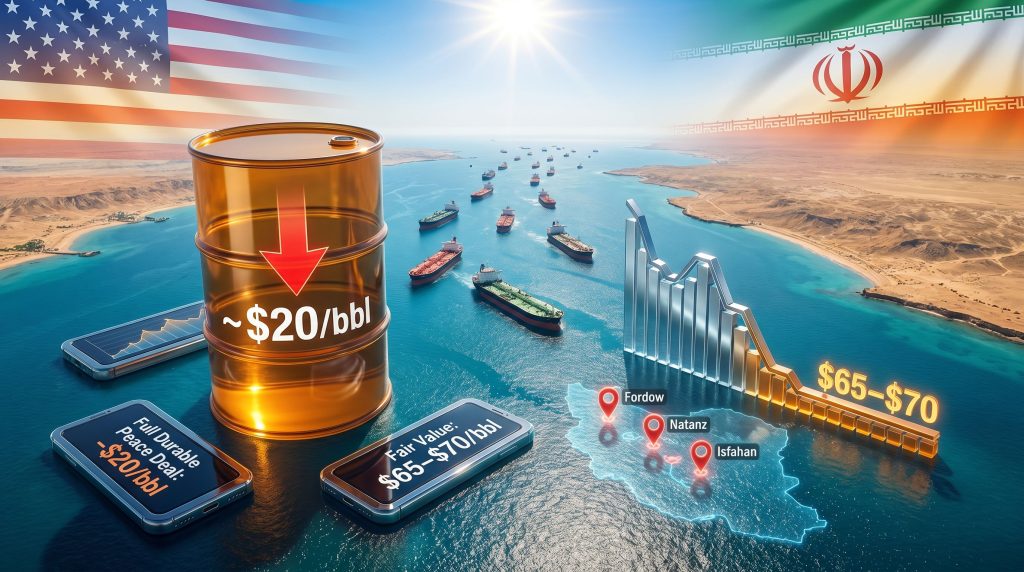
In a base-case scenario where markets genuinely believe the agreement is real and durable, the initial price response would be swift and substantial. Dwivedi's analysis projects an approximate $20 per barrel sell-off within the first week of a credible deal announcement. This reaction would occur before a single additional barrel of Iranian crude actually reached a tanker. Futures markets price geopolitical risk premiums forward, meaning the unwinding of that premium begins at the moment credibility is established, not when physical flows resume.
This is a critically underappreciated dynamic. The $20 sell-off is not a response to increased supply. It is a repricing of risk. The barrels do not move for weeks. The market moves immediately.
Phase 2: Logistical Repricing Over Two to Four Weeks
Restoring normal commercial shipping through Hormuz is not instantaneous. Gulf shipping backlogs, insurance premium recalibration, tanker repositioning, and the reactivation of cargo financing facilities all introduce meaningful friction. The realistic clearing timeline for the Gulf backlog is estimated at two to four weeks for initial recovery, with flows potentially ramping toward full pre-conflict levels over a further two to four weeks after that.
During this consolidation window, prices stabilise as the market processes logistical realities alongside geopolitical signals. Volatility remains elevated because enforcement uncertainty does not disappear on the day a deal is signed.
Phase 3: Supply Overshoot and Return to Fair Value
The final phase involves a structural problem that many investors overlook. As Hormuz flows ramp back toward full capacity, the mitigation supply sources that came online during the disruption do not disappear overnight. OPEC spare capacity deployed as an emergency response, alternative routing arrangements, and strategic reserve drawdowns all represent incremental supply that continues flowing even as Iranian volumes return. In addition, OPEC's market influence during the disruption period has added considerable complexity to the supply picture.
This creates the conditions for a physically driven overshoot to the downside, where the market temporarily has far more crude than underlying demand requires. From that overshooting point, prices trend toward what Macquarie Group describes as the fair value range of $65 to $70 per barrel, representing normalised crude supply and demand fundamentals.
| Price Phase | Estimated WTI Impact | Timeframe |
|---|---|---|
| Deal announcement sell-off | ~$20/bbl immediate decline | Week 1 |
| Logistical repricing and consolidation | Stabilisation with elevated volatility | Weeks 2 to 4 |
| Supply overshoot | Downward pressure below fair value | 4 to 8 weeks post-deal |
| Fair value normalisation | $65 to $70 per barrel | Medium term |
What $65 to $70 Oil Means for Consumers and Politics
The economic transmission from crude pricing to consumer behaviour operates through a well-documented mechanism. Every $10 per barrel change in crude oil prices produces approximately a 25 to 30 cent change in the retail price of a gallon of gasoline. With U.S. gasoline currently priced above $4 per gallon under elevated oil prices, a move toward the $65 to $70 WTI range would reduce pump prices by roughly 50 to 60 cents per gallon.
The consumer spending implications of that shift are substantial. For every single cent that the average gasoline price falls, consumers recover more than $1 billion annually in discretionary spending capacity. Consequently, a 50-cent reduction in the pump price translates to more than $50 billion per year flowing back into household consumption rather than fuel costs.
| WTI Price Range | Estimated Gasoline Price | Consumer Impact |
|---|---|---|
| $85 to $90/bbl | ~$4.00+ per gallon | Significant consumer spending drag |
| $70 to $75/bbl | ~$3.50 to $3.70 per gallon | Moderate relief; economy stabilising |
| $65 to $70/bbl | ~$3.30 to $3.50 per gallon | Meaningful spending recovery |
| Below $65/bbl (overshoot) | ~$3.00 to $3.20 per gallon | Maximum near-term relief; supply concerns emerging |
The political dimension of these price levels is well established by historical data. Since 1896, incumbent U.S. presidents seeking re-election have won in 11 out of 11 instances when the economy was not in recession within two years of an election. Sitting presidents running in recessionary conditions have prevailed in only one out of seven historical cases. With gasoline above $4 per gallon and mid-term elections approaching in November, the pressure on the current administration to secure a credible deal is not merely diplomatic. It is arithmetically political.
The next major ASX story will hit our subscribers first
The Durability Problem: Why Markets Will Not Simply Celebrate a Signed Agreement
The history of U.S.-Iran diplomatic frameworks offers a sobering lesson about the gap between agreement and enforcement. The 2015 JCPOA ultimately collapsed not because its initial provisions were immediately violated in an obvious way, but because its enforcement architecture was structurally insufficient to survive changes in U.S. political leadership. A new framework faces the same fundamental vulnerability. Furthermore, the oil market trade war impact has already demonstrated how quickly external political pressures can destabilise even well-constructed energy agreements.
Three specific durability risks warrant close monitoring:
-
IAEA verification access: Any agreement's credibility depends on independent inspectors being able to confirm compliance at declared and undeclared facilities. Given the persistent gaps in current IAEA visibility into Iran's nuclear activities, this condition may be harder to satisfy than publicly acknowledged.
-
IRGC compliance timeline: Iran's hardline military establishment has strong institutional incentives to delay, obstruct, or partially fulfil commitments, particularly those tied to missile stockpile reductions and nuclear access. Their stated scepticism about the deal's durability through the U.S. mid-term cycle creates asymmetric incentives.
-
Chinese supply network continuity: If Iran's defence industrial base continues recovering through covert external supply chains, the military threat environment that motivated the conflict does not actually diminish, regardless of what any signed framework states.
Even a formally signed agreement may produce only a partial or temporary downward price response if crude futures traders price in a meaningful probability of breakdown. Markets do not simply price what is announced. They price what they believe will actually be enforced.
Comparing This Scenario to Previous Middle East Diplomatic Oil Shocks
The 2015 JCPOA provides the most directly relevant historical comparison. When Iranian crude re-entered global markets after sanctions relief under that agreement, the global supply environment was already oversupplied, and the additional Iranian barrels accelerated a price collapse that had begun earlier in 2014. Brent crude fell from above $60 per barrel in mid-2015 to below $30 per barrel by early 2016.
The current situation differs in several important structural ways. First, the supply disruption from Hormuz closure is more acute and physically severe than anything that preceded the 2015 deal. Second, the mitigation supply that came online during the conflict represents a more significant volume of incremental crude than the spare capacity situation in 2015. Third, the geopolitical risk premium that would unwind is larger in absolute dollar terms, creating a more dramatic initial sell-off potential. Analysts tracking the Iran peace deal and oil prices have noted that mixed signals on a US-Iran deal continue to add uncertainty to near-term price forecasts.
| Scenario | Estimated WTI Impact | Key Variable |
|---|---|---|
| Full durable peace deal | -$20/bbl immediate; trend toward $65 to $70 | Market confidence in enforcement |
| Partial or fragile agreement | -$8 to -$12/bbl with elevated volatility | Compliance uncertainty |
| Deal collapse or ceasefire failure | +$30 to +$65/bbl spike risk | Hormuz closure duration |
| Status quo with no deal | Elevated risk premium maintained | Ongoing supply disruption |
FAQ: Iran Peace Deal and Oil Prices
What happens to oil prices if the U.S. and Iran sign a peace deal?
A credible agreement would trigger an immediate and substantial sell-off in crude benchmarks, driven by the unwinding of the geopolitical risk premium currently embedded in prices. The magnitude depends on how convincingly markets assess the deal's durability.
How quickly would oil prices fall after a deal is announced?
Macquarie Group's analysis projects approximately a $20 per barrel decline within the first week of a credible announcement, before physical Hormuz flows have resumed. Logistical normalisation would follow over two to four weeks, with full supply repricing taking longer.
Why does the Strait of Hormuz matter so much to global oil markets?
Approximately 20% of globally traded oil transits Hormuz. Any disruption to that flow, or credible resolution of one, carries an immediate and measurable impact on global crude benchmarks.
What is the fair value range for crude oil once Iranian supply normalises?
Macquarie Group's energy strategy team places the fair value range at $65 to $70 per barrel once crude supply and demand fundamentals rebalance following Hormuz reopening.
Could oil prices fall below $65 per barrel after a peace deal?
Yes. The supply overshoot dynamic, in which mitigation sources continue flowing as Iranian volumes return, creates conditions for a temporary downside overshoot below fair value before prices stabilise.
What would happen to oil prices if the Iran deal collapses?
A ceasefire breakdown or deal failure would likely trigger a sharp spike, with some analysts placing the upper risk range at $30 to $65 per barrel above current levels depending on the severity and duration of renewed Hormuz disruption.
How does a peace deal affect gasoline prices for consumers?
Every $10 per barrel decline in crude translates to approximately 25 to 30 cents per gallon of gasoline. A move from current levels to the $65 to $70 fair value range would represent meaningful relief at the pump, with significant downstream effects on consumer spending capacity.
Three Market Signals That Would Confirm a Durable Re-Pricing
For energy investors and market participants, the question is not simply whether a deal gets signed. It is whether the conditions for a sustained downward re-pricing of crude are actually met. Three observable signals would confirm that the market's risk premium is genuinely dissolving rather than merely pausing:
-
Verified Hormuz shipping resumption at scale, confirmed by AIS transponder data showing consistent commercial tanker traffic through the strait without military interference or dark-mode concealment.
-
IAEA confirmation of restored nuclear site access, providing independent verification that Iran's declared facilities are being monitored and that the outstanding 440-kilogram enriched uranium gap is being addressed.
-
A sustained crude inventory build in OECD nations over four to six weeks, demonstrating that physical supply is genuinely normalising and that the structural overshoot phase has begun.
Without all three signals, a deal announcement alone may produce the initial sell-off without the sustained price normalisation that the $65 to $70 fair value target implies. In that scenario, the market faces its most uncomfortable outcome: geopolitical noise that temporarily moves prices without resolving the underlying structural uncertainty.
This article contains forward-looking analysis and price projections drawn from third-party energy market research. All projections are inherently uncertain and should not be construed as investment advice. Readers should conduct their own due diligence before making any investment or trading decisions based on geopolitical or energy market forecasts.
Want to Stay Ahead of Market-Moving Discoveries While Geopolitical Events Reshape Commodity Prices?
While oil markets grapple with geopolitical uncertainty, significant mineral discoveries on the ASX can deliver transformative returns independent of crude benchmarks — and Discovery Alert's proprietary Discovery IQ model ensures subscribers receive real-time alerts the moment those discoveries are announced. Explore historic examples of exceptional discovery-driven returns and begin a 14-day free trial to position yourself ahead of the broader market.