August 25, 2026
Financial Warfare as the New Frontier of Geopolitical Strategy
When governments seek to exert pressure on rival states, the instinct has historically leaned toward military posturing. Yet the evolution of global finance has quietly produced a more precise instrument: the weaponisation of dollar-system access. Cutting an economy off from the US dollar-denominated financial architecture is, in practice, as disabling as a blockade, and far more deniable. This is the logic now driving Washington's approach to Iran, and its implications for global oil markets are both immediate and structurally complex.
Understanding how expanded US sanctions against Iran affect oil prices requires more than tracking daily futures movements. It demands a framework that accounts for enforcement probability, reserve buffer capacity, chokepoint geography, and the compliance calculus of major crude-importing economies. Furthermore, oil price movements during periods of sanctions escalation rarely follow a single, predictable trajectory.
When big ASX news breaks, our subscribers know first
The Mechanics of Secondary Sanctions: Financial Exclusion as Leverage
Primary sanctions restrict what American individuals, companies, and institutions can do. Secondary sanctions, however, operate on an entirely different scale, reaching into foreign sovereign economies and compelling third-country actors to choose between continued dealings with Iran and continued access to the US financial system.
The threat is structural. Since the vast majority of global oil trade is invoiced in US dollars, any entity locked out of dollar-denominated correspondent banking effectively loses the ability to operate in international commodity markets. This creates a compliance incentive far more powerful than any direct legal penalty, because the cost of non-compliance is potential exclusion from the global financial system altogether.
The US sanctions against Iran framework was significantly expanded in August 2026. Treasury Secretary Scott Bessent announced a significant escalation designed to sever Iran's remaining economic lifelines. Critically, the announcement deliberately withheld specifics: no countries were named, and no penalty start dates were confirmed. That ambiguity was not an oversight. It was a strategic design choice intended to maximise compliance through uncertainty.
This kind of deliberate vagueness is a well-documented tool in sanctions enforcement strategy. By keeping the threat broad and the timeline undefined, the sanctioning authority forces self-policing among buyers who cannot afford to test the boundaries.
Oil Price Dynamics: Why Sanctions Announcements Do Not Always Spike Crude Markets
The conventional expectation is that any development threatening Iranian oil supply should push crude prices higher. The August 25, 2026 session, however, told a different story.
Benchmark Movements Around the Sanctions Announcement
| Benchmark | Price Level (Aug 25, 2026) | Session Change |
|---|---|---|
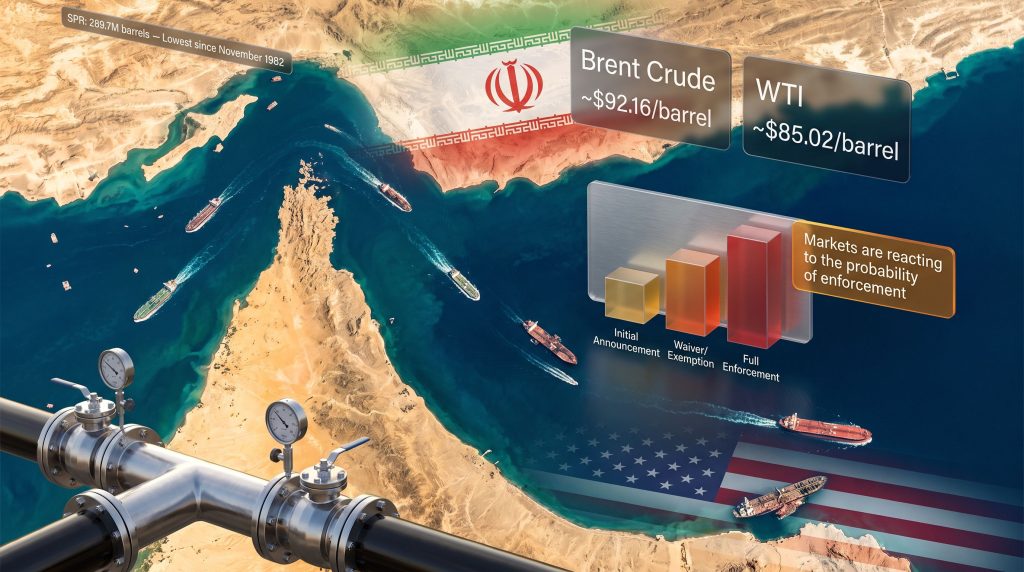
| Brent Crude Futures | ~$92.16 per barrel | -0.1% (-$0.09) |
| WTI Crude | ~$85.02 per barrel | +$0.01 |
| Prior Session (Monday) | Both contracts | -2%+ decline |
Both contracts had rallied substantially over the preceding two weeks, setting up conditions for profit-taking regardless of the geopolitical headline. The specific direction of the selloff, consequently, reflected something more deliberate than routine position unwinding.
How Do Markets Interpret Economic Coercion Versus Military Action?
Markets interpreted the shift toward economic coercion as a signal that the immediate risk of physical supply disruption through military action had diminished. Tim Waterer, chief market analyst at KCM Trade, noted that markets appeared to be pricing economic pressure as a lower-risk pathway for physical supply compared to kinetic military action. The logic is counterintuitive but internally consistent: economic sanctions take time to bite, allow compliance windows, and do not destroy infrastructure.
The Enforcement Probability Framework
Energy traders do not respond to sanctions text. They respond to the probability-weighted impact of those sanctions on actual barrel flows. Three variables dominate this calculation:
- Which countries are named and when — Until specific targets are designated, importers can continue operating under the assumption they will either be excluded or given extended grace periods.
- Whether waivers are issued — Historical precedent from the 2018 sanctions reimposition shows that waiver issuance can neutralise much of the immediate supply impact.
- How China responds — Given that China has absorbed the dominant share of sanctioned Iranian crude in recent years, Beijing's compliance posture is the single most consequential variable in determining actual volume displacement.
The Strait of Hormuz: Where Economic and Military Risk Converge
Even as financial coercion displaces military action as the primary policy tool, the physical chokepoint risk has not been neutralised. The Strait of Hormuz remains the world's most consequential oil transit corridor, with cargo volumes historically representing approximately 20% of total global oil consumption passing through this narrow maritime corridor before the conflict began in February 2026.
Iran has repeatedly asserted jurisdictional authority over the strait and has demonstrated both the intent and capability to act on those claims. In a development that underscored the persistence of physical risk, an oil tanker was struck by an unidentified projectile and disabled approximately 9 nautical miles northeast of Oman's Ash Shishah on August 25, 2026, according to confirmation from UK Maritime Trade Operations.
Furthermore, Iran identified 45 tankers it claimed had violated its rules governing passage through the strait, threatening enforcement action including cargo confiscation. This represents an escalation in Iran's willingness to use the strait as a pressure release valve against both sanctions and the broader military campaign.
Waterer further noted that Iran retains significant capacity to respond to economic pressure by disrupting shipping activity, and that this ongoing threat continues to embed a structural risk premium into crude prices that does not simply disappear when the primary policy framework shifts from military to economic tools.
Strategic Petroleum Reserve Depletion: A Structural Vulnerability Amplifying Market Risk
The sanctions story cannot be evaluated in isolation from the state of global emergency buffer capacity, and the picture here is historically concerning.
US Strategic Petroleum Reserve: Key Metrics
| SPR Metric | Data Point |
|---|---|
| Current SPR Level | 289.7 million barrels |
| Weekly Drawdown | -3.7 million barrels |
| Historical Comparison | Lowest level since November 1982 |
| Drawdown Driver | Supply disruptions from US-Israeli military campaign beginning February 28 |
The US Strategic Petroleum Reserve exists precisely to buffer markets during periods of acute supply disruption. At 289.7 million barrels following a 3.7 million barrel drawdown in a single week, the reserve has been significantly eroded by the supply dislocations created since the US-Israeli military campaign against Iran began on February 28, 2026.
A depleted SPR creates a compounding vulnerability. If enforcement of the expanded US sanctions against Iran causes a genuine reduction in export volumes, Washington's capacity to release emergency crude to offset the price impact is materially diminished compared to historical precedents. The compounding risk scenario involves three simultaneous pressures:
- Sanctions enforcement reducing Iranian barrel availability
- Strait of Hormuz disruption potential restricting transit of non-Iranian crude
- SPR capacity insufficient to provide the volume buffer markets would expect from Washington during a supply crisis
Historical Sanctions Cycles: What Price Patterns Reveal About This Moment
Iran has been subject to multiple rounds of sanctions over several decades, and the historical pattern of market responses offers a useful framework for assessing the current cycle.
Three-Phase Price Response Pattern
| Sanctions Phase | Typical Market Reaction | Duration of Price Impact |
|---|---|---|
| Initial announcement | Moderate-to-sharp price spike | Days to weeks |
| Waiver or exemption issuance | Price correction or decline | Weeks to months |
| Full enforcement or escalation | Sustained premium embedded in benchmarks | Months to years |
What makes the 2026 cycle structurally distinct from previous rounds is the simultaneous presence of active military conflict. In 2012 and again in 2018, sanctions were imposed against a backdrop of diplomatic tension but without ongoing kinetic engagement. Today, however, sanctions and active military operations are running concurrently, and the SPR drawdown data reflects the physical supply disruption that has already materialised since February.
This simultaneity creates conditions where the historical mean-reversion pattern — where prices spike on announcement and then correct as waivers emerge — may not hold. With buffers depleted and the conflict generating real-time supply pressure, the announcement-to-enforcement gap carries higher structural risk than in previous cycles. In addition, geopolitical trade tensions of this magnitude tend to produce ripple effects well beyond the immediate commodity markets.
The next major ASX story will hit our subscribers first
Which Economies Face Maximum Exposure to Secondary Sanctions?
The deliberate non-disclosure of target countries in the August announcement has created a compliance dilemma for several major economies:
- China has been the dominant absorber of Iranian crude under sanctions, often through shadow fleet arrangements and alternative payment systems. The US-China trade war context makes Washington's zero-exemption signal place Beijing in a fundamentally different compliance posture than in prior rounds.
- India has historically navigated sanctions periods through diplomatic engagement and payment system workarounds, but the scale of Washington's stated zero-exemption position creates new legal exposure for Indian refiners.
- Turkey has similarly maintained Iranian crude import relationships through periods of elevated sanctions pressure, and faces comparable secondary exposure.
The financial mechanism is worth understanding at a granular level. When the US Treasury designates a foreign bank for sanctions violations, that institution loses access to US correspondent banking. Since correspondent banking is the infrastructure through which most international financial transactions clear, designation is effectively an exclusion from global commerce. Consequently, the trade war supply chains disruption from secondary sanctions can extend far beyond the energy sector alone.
Macro-Economic Transmission: Beyond the Crude Benchmark
Energy price volatility does not remain contained within commodity markets. When crude benchmarks sustain elevated levels under sanction-driven supply pressure, the transmission mechanism runs through transportation costs, manufacturing input prices, and ultimately consumer inflation. This creates a compounding policy challenge for central banks already managing inflation expectations in a period of geopolitical uncertainty.
The demand-side counterweight is, however, worth noting. Slowing global economic growth, particularly in major crude-importing economies, creates a natural ceiling on price upside even under genuine supply constraints. If sanctions enforcement compresses Iranian supply while simultaneously the global growth outlook deteriorates, the net price effect may be more modest than a pure supply analysis would suggest.
OPEC's market influence also enters the equation as a critical secondary variable. Whether member nations choose to increase output to compensate for Iranian volume displacement will be decisive. Saudi Arabia has demonstrated willingness in previous cycles to calibrate production decisions based on the severity and duration of Iranian supply loss, but the calculus becomes more complex when the sanctioning power is simultaneously drawing down strategic reserves and running a military operation in the same geography.
Key Variables for Energy Market Participants to Monitor
- Enforcement timeline disclosure: When the US Treasury moves from deliberate ambiguity to specific country designations and penalty start dates, markets will reprice Iranian supply risk rapidly and potentially sharply.
- Strait of Hormuz incident frequency: Any sustained escalation in tanker strikes or Iranian interdiction activity will override the current market consensus that economic coercion represents the lower-risk path for physical supply.
- SPR policy decisions: Further drawdowns from an already four-decade-low reserve level will progressively reduce Washington's capacity to manage price volatility during acute supply events.
- OPEC+ production signals: Emergency meetings or voluntary output adjustments in response to Iranian supply uncertainty would signal that member states view the volume gap as real and durable.
- China's compliance posture: Beijing's decision on whether to continue Iranian crude purchases under the threat of secondary sanctions will be the single most influential variable in determining how many Iranian barrels actually leave the market.
Frequently Asked Questions: Expanded US Sanctions Against Iran and Oil Prices
What are US secondary sanctions on Iran and how do they differ from primary sanctions?
Primary sanctions apply directly to US persons, companies, and institutions, prohibiting them from transacting with Iran. Secondary sanctions extend that prohibition to foreign entities, threatening to cut non-US companies, banks, and governments off from the US dollar financial system if they continue conducting business with Iran. The coercive power of secondary sanctions derives from the centrality of the dollar in global trade finance.
Why did oil prices fall after the expanded Iran sanctions announcement?
Markets interpreted the pivot toward economic coercion as reducing the immediate probability of physical supply disruption through military action. Additionally, the deliberate non-disclosure of target countries and penalty timelines allowed traders to discount near-term supply impact, triggering profit-taking after a two-week price rally in both Brent and WTI. Oil prices remained steady as investors weighed the full implications of the expanded framework.
How much Iranian oil is at risk under the expanded sanctions regime?
The Strait of Hormuz, through which approximately 20% of global oil consumption transited before the current conflict, represents the geographic concentration point for Iranian export exposure. The actual volume at risk depends heavily on enforcement intensity and the compliance decisions of major importers, particularly China. Furthermore, Iran's discovery of over 75 trillion cubic feet of gas underscores the broader strategic energy stakes involved in this confrontation.
What is the current level of the US Strategic Petroleum Reserve?
As of the week ending August 25, 2026, the US SPR stood at approximately 289.7 million barrels, the lowest level recorded since November 1982. The reserve declined by 3.7 million barrels in a single week as countries drew on commercial and strategic stockpiles to offset supply disruptions stemming from the US-Israeli military campaign against Iran that began on February 28, 2026.
Could Iran disrupt the Strait of Hormuz in response to expanded sanctions?
Iran has repeatedly demonstrated both the stated intent and physical capability to disrupt tanker traffic through the Strait of Hormuz. The August 25 tanker strike near Oman's Ash Shishah and Iran's warning against 45 tankers underscore that maritime interdiction capacity remains an active variable in the risk calculus, independent of whether Washington's primary policy instrument is military or economic.
This article contains forward-looking analysis and references to geopolitical and market scenarios. Energy price forecasts and enforcement outcome projections involve significant uncertainty. Readers should not interpret this analysis as financial or investment advice. Market conditions can change rapidly based on enforcement decisions, diplomatic developments, and supply-demand dynamics outside the scope of any single analytical framework.
Want to Stay Ahead of the Market Moves Driven by Geopolitical Disruption?
When sanctions escalations, supply shocks, and commodity volatility reshape investment landscapes overnight, Discovery Alert's proprietary Discovery IQ model ensures subscribers receive real-time alerts on significant ASX mineral discoveries — turning complex market signals into actionable opportunities the moment they emerge. Explore historic discoveries and their extraordinary returns, then begin your 14-day free trial at Discovery Alert to position yourself ahead of the market.