August 25, 2026
The Hidden Architecture of Energy Dependency: Why Supply Guarantees Between Major Nations Are Never Simple
When large economies negotiate energy and food security arrangements, the public-facing announcements rarely capture the full strategic weight of what is being agreed upon. Putin assures India of uninterrupted energy and fertiliser supply in a statement that, on the surface, reads as routine diplomatic reassurance. However, behind every such communique lies a layered architecture of dependency, leverage, and long-term positioning that shapes national policy well beyond commodity pricing or shipping logistics.
The relationship between Russia and India in the energy and agricultural inputs space is one of the most consequential bilateral supply arrangements operating in the global economy today. Understanding its depth requires looking past the headlines and into the structural realities that make this partnership simultaneously indispensable and complicated for both parties.
When big ASX news breaks, our subscribers know first
From Marginal Buyer to Anchor Customer: India's Energy Transformation
Before 2022, Russia occupied a peripheral position in India's crude oil import mix. Within roughly three years, that position inverted entirely. By 2025–26, Russia had become India's single largest crude oil supplier, a transformation with few modern parallels in the speed at which one nation's energy procurement strategy can reorient.
This shift was not purely opportunistic. India's import-dependent energy economy had long sought diversification, and discounted Russian crude offered an alignment of strategic and economic incentives that New Delhi proved willing to act on despite considerable Western diplomatic pressure. Furthermore, crude oil price volatility in global markets gave India additional motivation to lock in stable, discounted supply.
India's Russian energy import basket now spans multiple commodity categories:
- Crude oil (the dominant volume driver)
- Coal and associated petroleum products
- Natural gas and liquefied natural gas volumes
- Nuclear fuel and associated technology inputs
Each category carries its own supply chain complexity, pricing dynamics, and geopolitical sensitivity. Together, they represent a procurement architecture that has fundamentally reshaped India's energy import strategy in a remarkably compressed timeframe.
The Fertiliser Dependency: Food Security as a Geopolitical Variable
Energy often dominates the conversation in India-Russia trade discussions, but the fertiliser dimension may carry equally significant strategic weight when measured against downstream economic and social consequences.
Russia is among the world's top three producers across all three primary fertiliser categories: nitrogen-based, phosphate-based, and potash-based compounds. These are not interchangeable inputs. Each plays a specific role in crop nutrition, and India's agricultural sector, which supports the livelihoods of hundreds of millions of people, requires access to all three in substantial volumes. This situation closely mirrors broader fertiliser import dependency challenges faced by other major economies.
Russia's dual role as both an energy supplier and an agricultural input provider creates an unusually broad leverage point within India's import dependency structure, one that New Delhi is actively managing with considerable sophistication.
Putin assured India of uninterrupted supplies during the August 2026 meeting, confirming that Russia is not merely maintaining fertiliser shipments but actively increasing them, with a stated readiness to fully meet the requirements of Indian farmers and the broader agricultural sector. This commitment, reported by the state-run TASS news agency, carries operational significance given the tightness of global fertiliser supply chains following years of geopolitical disruption.
Why Timing Makes Fertiliser Supply So Critical
A critical but underappreciated dynamic here is the timing sensitivity of fertiliser supply. Unlike crude oil, which can be stored and strategic reserves can buffer disruptions, fertiliser requirements are tied to agricultural planting calendars. A supply disruption during a critical pre-planting window cannot be retrospectively remedied. This time-sensitivity elevates the strategic value of Putin's supply assurance beyond its nominal face value.
Trade Trajectory and the $50 Billion Imbalance Problem
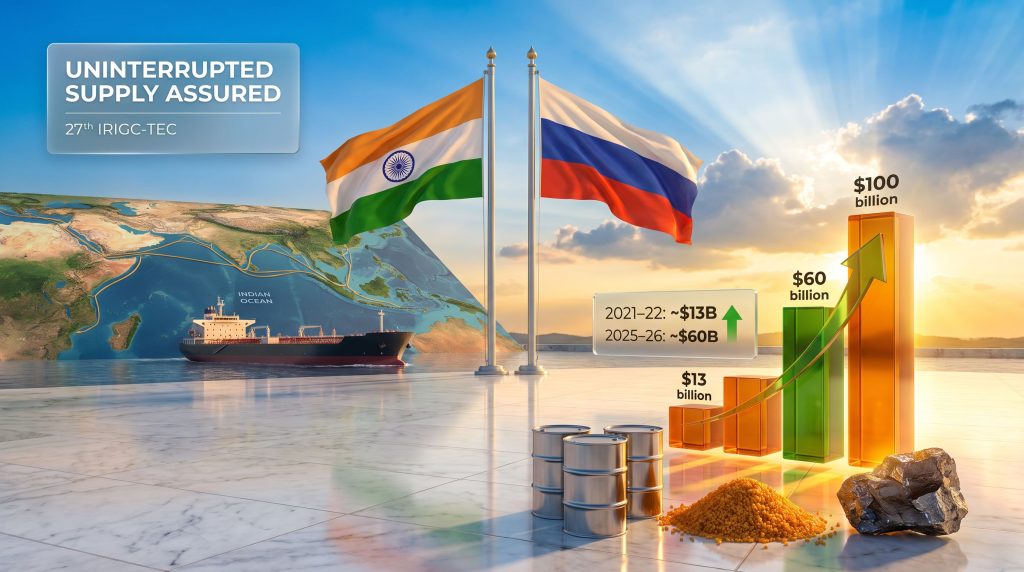
The headline trade growth figures between India and Russia are remarkable by any bilateral standard. As reported by External Affairs Minister S. Jaishankar at the 27th IRIGC-TEC session, bilateral trade expanded approximately four-fold in five years, moving from roughly $13 billion in 2021–22 to nearly $60 billion in 2025–26.
| Metric | 2021–22 | 2025–26 | 2030 Target |
|---|---|---|---|
| Bilateral Trade Volume | ~$13 billion | ~$60 billion | $100 billion |
| India's Trade Deficit | ~$6.6 billion | $50+ billion | Target: significant reduction |
| Year-on-Year Momentum | Baseline | 4x growth | Requires export expansion |
However, this growth conceals a structural problem that Jaishankar explicitly identified as one of New Delhi's foremost priorities: the trade imbalance has widened from approximately $6.6 billion to over $50 billion over the same period. This asymmetry is almost entirely attributable to India's massive energy import bill, which has no equivalent counterflow of Indian goods and services into Russia.
What Is Causing the Trade Imbalance?
Putin acknowledged at the meeting that bilateral trade had experienced a slight contraction in the preceding year before recovering upward momentum in 2025–26. This dip reflects a combination of factors that are less commonly discussed in mainstream coverage:
- Payment mechanism friction resulting from Western sanctions on Russian financial institutions, which complicated settlement processes for Indian importers and Russian exporters alike
- Shipping route adjustments as traditional maritime pathways faced insurance complications and flag-state restrictions
- Currency accumulation imbalances, with Russia reportedly building substantial rupee balances from Indian energy payments that proved difficult to deploy effectively in Russian markets
This last point is particularly significant and underappreciated. When bilateral trade is settled in non-convertible or restricted currencies, the receiving party can accumulate balances that become a structural liability rather than an asset. Russia's accumulated rupee holdings represent an implicit pressure on India to expand Russian market access for Indian goods, simply to provide Russia with a meaningful outlet for currency it has already earned.
Rebalancing the Equation: Jaishankar's Three-Pillar Framework
Addressing a $50 billion trade imbalance requires more than political will. Jaishankar's approach at the IRIGC-TEC meeting outlined a three-pillar framework for structural rebalancing:
- Market Access Expansion – Pushing for meaningful opening of Russian markets to Indian manufactured goods, pharmaceuticals, engineering products, and agricultural exports
- Tariff and Non-Tariff Barrier Removal – Systematically reducing friction on the Indian export side to create commercially viable entry points for Indian businesses in Russia
- Payment Mechanism Strengthening – Developing rupee-rouble or alternative multilateral settlement frameworks that bypass Western-controlled financial infrastructure and reduce the currency friction that has hampered trade flows
Jaishankar also made a point that reflects a sophisticated understanding of how trade actually works: governments can establish enabling frameworks, but the actual expansion of commerce depends on businesses making investment decisions, forming partnerships, and identifying opportunities that state-to-state negotiations alone cannot manufacture.
If India successfully closes even 30–40% of the trade gap through expanded exports by 2030, the bilateral relationship transforms from a dependency arrangement into a genuine economic partnership, significantly altering New Delhi's negotiating leverage within the relationship.
West Asia Disruption and the Insurance Logic of Russian Supply
The timing of Putin's supply assurance is directly connected to the ongoing West Asia crisis, which has introduced material uncertainty into global energy shipping lanes. Russia's assurance of steady energy and fertiliser supplies has consequently taken on even greater strategic significance for New Delhi. For India, which sources a significant portion of its crude from Gulf producers, the disruption risks associated with Middle Eastern instability are not abstract.
Russia's geographic positioning offers India a supply corridor that is structurally differentiated from Gulf-dependent shipping routes. Overland pipeline connectivity, Arctic maritime alternatives, and eastern-facing Russian port infrastructure all provide routing options that are insulated from the Strait of Hormuz and Red Sea disruption vectors that currently threaten Gulf supply chains. In addition, global supply chain disruption across other sectors has reinforced New Delhi's appetite for supply security wherever it can be secured.
| Scenario | Impact on India's Gulf Imports | Russia's Strategic Role |
|---|---|---|
| Moderate escalation (current) | Shipping cost increases, routing delays | Supplementary and growing supplier |
| Severe escalation (Hormuz disruption) | Critical supply shortfall risk | Emergency primary supplier |
| Full de-escalation | Gulf supply normalises | Competitive pricing relationship |
India's rational strategic calculus favours maintaining robust Russian supply relationships regardless of how the West Asia situation evolves. In the de-escalation scenario, Russian crude pricing simply becomes more competitive against Gulf alternatives. In escalation scenarios, it becomes irreplaceable. This asymmetric optionality is precisely why New Delhi has resisted Western pressure to curtail Russian energy imports.
The next major ASX story will hit our subscribers first
The Multilateral Scaffolding: BRICS, SCO, and Personal Diplomacy
The August 2026 Jaishankar-Putin meeting did not occur in isolation. It sits within a dense calendar of multilateral engagement between the two nations, each forum serving a distinct diplomatic function.
Putin's anticipated visit to New Delhi for the BRICS Leaders' Summit on September 12–13 positions India as the host nation for a forum where Russia-India bilateral priorities can be advanced within a multilateral framing that reduces the visibility of direct engagement. The SCO Summit provides an additional touchpoint for Modi-Putin interaction.
Jaishankar hand-delivered a personal communication from Prime Minister Narendra Modi to President Putin during the meeting, a gesture that signals the relationship operates at a depth of personal political trust that extends beyond institutional frameworks. Modi's anticipated engagement with Putin across three separate multilateral or bilateral summit formats reflects a deliberate strategy of high-frequency personal contact.
How Does Strategic Autonomy Shape India's Approach?
This approach reflects India's long-standing strategic autonomy doctrine — the principle that New Delhi's foreign policy is guided by national interest rather than bloc alignment. India has maintained this posture throughout the post-2022 geopolitical reconfiguration despite sustained Western diplomatic pressure to reduce Russian engagement. Furthermore, the broader trade war impacts reshaping global commerce have only strengthened India's resolve to maintain independent supply relationships wherever strategically viable.
Can the $100 Billion Trade Target Be Achieved by 2030?
The declared target of $100 billion in bilateral trade by 2030 requires approximately $40 billion in additional trade from the current $60 billion base, representing roughly a 67% increase over four to five years. The conditions for and against achieving this target are worth examining honestly.
Conditions Favouring the Target:
- Strong and demonstrated political will on both sides
- An existing commodity trade base that provides structural momentum
- Complementary economic structures: Russia's resource abundance aligns with India's manufacturing and consumption growth profile
- Shared interest in developing non-dollar payment infrastructure
- Russia's accumulated rupee balances create an incentive to expand Indian imports
Structural Obstacles:
- The $50 billion imbalance must be substantially narrowed for the $100 billion figure to represent genuine partnership rather than amplified dependency
- Western sanctions continue to complicate banking, insurance, and shipping logistics across the bilateral relationship
- Russian market access for Indian goods remains significantly underdeveloped relative to the theoretical potential
- Rupee-rouble settlement mechanisms have faced practical deployment challenges that have not yet been fully resolved
The $100 billion target is achievable, but the pathway that matters most for India's strategic interests is not simply expanding the overall trade volume. It is ensuring that the composition of that expanded trade is more balanced, so that New Delhi's position in the relationship evolves from a dependent buyer to an equal economic partner.
Complementarity as an Underexplored Strategic Asset
One of the most analytically significant observations from the IRIGC-TEC session was Jaishankar's characterisation of the fundamental complementarity between the Russian and Indian economies as still largely underexplored. This framing implies that the current $60 billion trade relationship, impressive as its growth rate has been, represents only a fraction of the structural potential that exists between a resource-abundant, technology-capable economy and a large, rapidly industrialising one with deep manufacturing ambitions.
Russia's vast endowments in energy, fertiliser inputs, rare minerals, and nuclear technology align structurally with India's resource-import requirements as it pursues industrial expansion. The growing critical minerals demand driven by energy transition priorities globally adds yet another dimension to the potential depth of this bilateral relationship. As India's manufacturing sector grows, the volume and variety of Russian inputs that serve that growth could expand significantly beyond the current crude oil-dominated profile.
The broader global trend that Jaishankar referenced — of nations across the international system focusing intensely on de-risking and diversifying their critical supply chains — means that Putin assures India of uninterrupted energy and fertiliser supply in a context where such assurances carry far more than symbolic weight.
The relationship is no longer simply a product of post-2022 sanction arbitrage. It has developed institutional depth, political backing at the highest levels, and a structural logic grounded in genuine economic complementarity. Whether it evolves into a truly balanced partnership or remains an asymmetric dependency arrangement will depend on how effectively both sides execute on the rebalancing frameworks now under active discussion.
This article is intended for informational and analytical purposes only. All trade figures, diplomatic timelines, and geopolitical assessments referenced reflect publicly available reporting. Readers should not construe this content as financial or investment advice. Forward-looking scenarios involve inherent uncertainty and should be interpreted accordingly.
Want to Stay Ahead of the Next Major Resource Discovery?
As geopolitical shifts reshape global supply chains for critical minerals, energy, and fertilisers, Discovery Alert's proprietary Discovery IQ model delivers real-time ASX alerts on significant mineral discoveries, transforming complex data into actionable investment insights — explore how historic discoveries have generated substantial returns and begin your 14-day free trial today to position yourself ahead of the market.