August 25, 2026
When the Weapon Is the Dollar: Understanding America's Financial War on Iran
Secondary sanctions are one of the most misunderstood instruments in modern geopolitical strategy. Unlike primary sanctions, which restrict the behaviour of a designated country's own citizens and institutions, secondary sanctions extend U.S. legal authority outward, threatening to penalise any foreign company, bank, or government that continues doing business with the targeted nation. The implications are profound: Washington effectively converts access to the U.S. dollar clearing system into a global compliance mechanism, one that no major economy can afford to ignore entirely.
The Trump administration's "economic D-Day" on Iran represents the most aggressive deployment of this architecture in recent history. Framed not simply as a sanctions package but as a phased coercive campaign, it targets the full ecosystem sustaining Iranian commerce, from tankers and trading companies to financial intermediaries and digital asset networks. The first enforcement round, covering nearly 60 entities across shipping, aviation, technology, gold, and digital assets, has already been deployed. What comes next could reshape global energy trade, diplomatic alignments, and the financial exposure of five of the world's most strategically significant economies.
When big ASX news breaks, our subscribers know first
The Architecture of Escalation: How Secondary Sanctions Actually Work
The structural logic of Trump economic D-Day on Iran follows a tiered escalation design. Washington begins by targeting entities operating at the periphery of Iranian trade, those with limited or no U.S. financial system exposure, where enforcement costs are low and collateral disruption to allies is manageable. As compliance from Iran's trading partners remains insufficient, enforcement pressure moves up the chain toward institutions with genuine stakes in dollar access and U.S. market relationships.
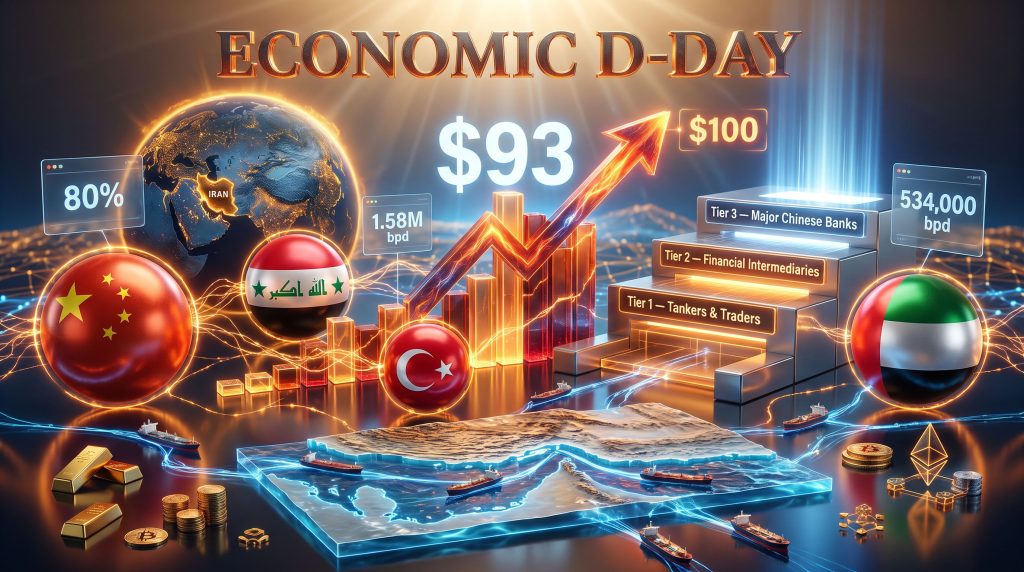
The three-tier structure currently in play looks as follows:
| Sanctions Tier | Primary Targets | Collateral Risk to Third Countries |
|---|---|---|
| Tier 1 (Deployed) | Tankers, shell companies, small refiners, traders | Low — largely contained to Iran-linked networks |
| Tier 2 (Threatened) | Mid-size financial intermediaries, exchange houses | Moderate — regional banking and trade finance exposure |
| Tier 3 (Reserved) | Major Chinese banks, sovereign-linked institutions | Severe — potential for global financial system disruption |
Treasury Secretary Scott Bessent's initial deployment was deliberately restrained. By sparing China's major banks in round one, Washington sent a calibrated signal: this is a sequenced campaign, not a one-time action. The deliberate pause also buys negotiating space ahead of a scheduled Trump-Xi summit in late September, where the November 2025 bilateral trade agreement covering U.S. tariffs and Chinese rare-earth supply commitments remains a central pillar of the relationship.
Furthermore, the U.S. tariff landscape adds another layer of complexity, as Washington must balance enforcement ambitions against the risk of destabilising trade frameworks that serve its own strategic interests.
The most consequential insight here is that Washington's most powerful enforcement lever — sanctioning major Chinese financial institutions — has been withheld precisely because deploying it would impose significant costs on U.S. interests as well. The threat is credible only so long as it remains unused.
Iran has constructed a sophisticated evasion infrastructure over years of living under sanctions pressure. This includes:
- Yuan-denominated settlement systems that route transactions outside SWIFT and the dollar clearing network
- Ship-to-ship transfer operations conducted in international waters to obscure crude origins
- Flag-of-convenience vessel registrations across multiple jurisdictions
- Layered trading company structures that introduce multiple intermediate counterparties between Iranian crude and its final buyer
Previous U.S. rounds have successfully disrupted individual nodes in this network without terminating the broader trade flow. The question now is whether the escalating enforcement intent behind Trump economic D-Day on Iran is sufficient to overcome evasion infrastructure that has been iteratively refined over nearly a decade.
The Hormuz Variable: How a Closed Strait Transformed a Sanctions Dispute
The U.S.-Iran military conflict and the resulting closure of the Strait of Hormuz fundamentally altered the strategic context for the sanctions campaign. What might otherwise have been a slow-building diplomatic and economic dispute became an acute global energy crisis, with supply disruption and financial isolation pressures arriving simultaneously. These broader geopolitical trade tensions have reverberated well beyond the Middle East, affecting supply chains and trade flows across multiple continents.
The energy price transmission has been swift and severe:
- Brent crude surpassed $93 per barrel amid the U.S.-Iran impasse, with market participants pricing in both the Hormuz disruption and the potential removal of Iranian barrels from global markets
- WTI settled at approximately $85, reflecting domestic U.S. supply buffers but tracking the broader upward trajectory
- Supertanker freight rates reached record highs as Middle East maritime routing fractured, forcing vessels onto longer, more expensive alternative paths
- Saudi Arabia pivoted crude export routes through Mediterranean corridors, with export volumes from that direction surging significantly
- Japan's energy import bill reached all-time highs, with power prices jumping to their highest levels since 2023
- Goldman Sachs assessed that European gas prices needed to rise substantially further to secure adequate winter stockpile levels
- TotalEnergies formally backed two major pipeline bypass projects designed to reduce dependency on Hormuz transit
An estimated 4 million barrels per day of crude continues to move through the strait despite the conflict, routed through informal and evasion-based channels, according to reporting from OilPrice.com. This shadow oil highway has partially cushioned the supply shock, but its reliability is inherently fragile and subject to further military escalation. Understanding the full range of crude oil price drivers is essential context for interpreting how these disruptions translate into broader market consequences.
China: Washington's Most Complex and Consequential Target
No single variable carries more weight in the outcome of Trump economic D-Day on Iran than China. Beijing purchases more than 80% of Iran's total seaborne crude exports, making it simultaneously the largest source of hard-currency revenue for Tehran and the most powerful third-party lever available to Washington.
The Scale and Speed of the Supply Disruption
Chinese imports of Iranian crude reached a peak of approximately 1.58 million barrels per day earlier in 2026 before the war and U.S. naval blockade began compressing those flows. By August, shipments had fallen to roughly 534,000 bpd, down sharply from 823,000 bpd recorded in July, according to Reuters. That represents a month-on-month decline of more than 35%, driven by a combination of physical routing disruption and anticipatory compliance behaviour from buyers nervous about escalating enforcement.
The buyers absorbing most of this crude are China's independent teapot refineries, smaller operations concentrated in Shandong province that operate outside the financing channels of major state-owned banks. Their structural distance from the U.S. financial system makes them less directly vulnerable to dollar-based secondary sanctions, which is precisely why Washington's evasion-targeting measures have repeatedly disrupted individual companies without stopping the overall trade flow.
Why Chinese Banks Are Washington's Nuclear Option
Major Chinese financial institutions present a fundamentally different sanctions calculus. Unlike teapot refiners, these banks retain meaningful exposure to the U.S. dollar clearing system and international financial markets. Treasury has reportedly issued private warnings to at least two larger Chinese banks that Iranian fund flows through their systems could trigger formal enforcement action.
Bessent's explicit promise of a significant announcement involving a financial institution within days of the initial sanctions wave suggests the escalation timeline is compressed. Yet the diplomatic constraints are equally real:
- A Trump-Xi summit is scheduled for late September 2026
- Both governments are working to preserve the November 2025 bilateral trade framework covering U.S. tariffs and Chinese rare-earth export commitments
- Sanctioning a major Chinese bank would risk triggering Beijing's formal diplomatic retaliation and potentially destabilising the trade relationship that underpins U.S. access to critical mineral supply chains
However, the ongoing U.S.-China trade war means both sides are already navigating elevated tensions, making any additional flashpoint around bank sanctions particularly volatile. Chinese refiners have already begun pivoting toward Iraqi crude as Iranian supply tightens, according to OilPrice.com reporting on refinery procurement patterns. This market adaptation illustrates both the resilience of Chinese energy procurement systems and the unintended consequences of the sanctions campaign: redirecting Chinese demand toward Iraqi barrels may temporarily benefit Baghdad's export pricing power even as the Hormuz closure devastates its overall export volumes.
Iraq: Fiscal Collapse Meets Energy Dependency
Iraq represents arguably the most acute near-term casualty of the sanctions campaign, facing simultaneous destruction of export revenue and existential pressure on energy supply.
Iraq's state budget is almost entirely built around oil export earnings. Following the Hormuz closure, southern export volumes collapsed by approximately 75%, compressing monthly oil revenues to roughly $1.2 billion, according to Reuters. At that level, Baghdad cannot sustain public sector wages, infrastructure commitments, or debt service obligations without drawing down reserves or accessing external financing.
The gas dependency problem compounds this fiscal crisis:
- Iranian natural gas accounts for 30% to 40% of Iraq's total electricity generation capacity
- Iraq imports approximately $4 billion to $5 billion worth of Iranian gas annually
- Full enforcement of secondary sanctions, specifically the removal of the sanctions waivers that have allowed Baghdad to continue these purchases, would trigger severe power grid stress across the country
- Rolling blackouts affecting millions of citizens during peak summer demand periods represent a realistic near-term scenario under full enforcement
Iraq has proposed a pipeline bypass corridor through Syria as a medium-term alternative to Hormuz routing, but this project is estimated to cost $15 billion and require approximately four years to construct, offering zero near-term relief. Washington retains significant coercive leverage over Baghdad through the threat of waiver withdrawal, making Iraq's political alignment a live variable in the broader sanctions calculus.
Turkey: Expiring Contracts and Compounding Costs
Turkey entered the current crisis period in a structurally weakened position. Its 25-year natural gas supply agreement with Iran, which provided for purchases of up to 9.6 billion cubic metres annually via the Tabriz-Ankara pipeline, expired at the end of July 2026. Active conflict between the U.S. and Iran made renegotiation impossible, removing a contractual framework that had structured Turkish-Iranian energy commerce for a generation.
| Factor | Resilience Indicator | Vulnerability Indicator |
|---|---|---|
| Gas supply diversification | Azerbaijan pipeline capacity, expanded LNG terminals | Eastern Turkey relies on Tabriz routing with limited substitution options |
| Manufacturing inputs | Some domestic industrial production | Roughly 50% of fertilizer inputs sourced from Iran and Gulf region |
| Financial exposure | Limited direct dollar-clearing dependency | Broader trade finance exposure to sanctioned networks |
| Diplomatic position | NATO membership provides partial insulation | No formal U.S. sanctions waiver arrangement currently in place |
Iranian gas imports spiked 34% year-on-year to 4.5 billion cubic metres in the first half of 2026, briefly exceeding Russian pipeline volumes and second only to Azerbaijani supply. Turkey also sources roughly half its fertilizer inputs and critical petrochemical feedstocks from Iran and the broader Gulf region, meaning the sanctions wave intersects with its industrial supply chain as well as its energy balance.
Fuel price inflation has reached approximately 50%, and energy import costs are projected to exceed total export revenues by up to $40 billion in 2026. Ankara is not without alternatives: it has expanded LNG import infrastructure and floating storage capacity. However, replacing Iranian pipeline volumes forces a shift to structurally more expensive LNG precisely when import costs are already at multi-year highs, with the eastern distribution challenge adding further cost to any substitution strategy.
The next major ASX story will hit our subscribers first
India and the UAE: Contrasting Postures Under Pressure
India's 90% Import Dependency and Residual Iran Exposure
India's direct trade relationship with Iran has already been largely dismantled by previous U.S. sanctions rounds. Bilateral trade fell from approximately $17 billion in the 2018/19 fiscal year to just $1.63 billion in 2025/26, a contraction exceeding 90%, according to Reuters. Indian oil imports from Iran during the first half of 2026 totalled roughly $707 million, conducted under U.S. exemption arrangements.
The far larger problem for India is the macro transmission effect:
- India imports close to 90% of its crude oil requirements, creating acute sensitivity to sustained price elevation
- The rupee has come under additional depreciation pressure as the energy import bill expands
- Inflationary pass-through from elevated fuel costs is compressing household purchasing power and complicating monetary policy settings
- The UAE's suspension of dealings with Iran has disrupted the Dubai re-export corridor traditionally used by Indian agricultural and pharmaceutical exporters
The UAE's Proactive Compliance Strategy
Before the conflict, the UAE exported approximately $21 billion worth of goods to Iran annually, equivalent to roughly 30% of Iranian total imports. Dubai functioned as Iran's primary international logistics, financial, and re-export hub, connecting Iranian businesses to the global economy through correspondent banking and trade finance networks.
On 19 August 2026, the UAE suspended all financial and economic dealings with Iran after detecting ballistic missile launches from Iranian territory toward maritime traffic near Emirati waters. By moving ahead of Washington's formal secondary sanctions enforcement timeline, Abu Dhabi effectively reduced its exposure to being caught in the enforcement net while absorbing the commercial cost of severing decades of trading relationships.
The strategic logic is clear: ADNOC's issuance of its ninth spot crude tender since June 2026 signals that UAE production is being actively mobilised to partially offset Iranian supply disruption, positioning Abu Dhabi as a beneficiary of the supply gap rather than a target of the enforcement campaign.
Three Scenarios: How the Enforcement Timeline Plays Out
The next 60 to 90 days will define whether Trump economic D-Day on Iran delivers genuine enforcement transformation or functions primarily as a coercive threat designed to extract diplomatic concessions. In addition, the U.S. policy on Venezuela provides a useful comparative lens, given how Washington has previously navigated the tension between maximum pressure and strategic flexibility in oil-producing nations. Three trajectories are plausible:
Scenario A: Calibrated Pressure
Washington enforces Tier 1 and Tier 2 measures while restraining action against major Chinese banks. Iranian exports stabilise in the 400,000 to 600,000 bpd range. Brent holds in the $90 to $95 band. Iraq retains limited waivers. Turkey accelerates LNG procurement under financial stress.
Scenario B: Escalated Enforcement
Treasury sanctions a major Chinese financial institution. Beijing issues formal diplomatic protest while calibrating its response to protect the bilateral trade framework. Iranian exports fall below 300,000 bpd. Brent tests the $100 to $110 range. Rare-earth supply commitments become an active negotiating lever.
Scenario C: Full Economic Isolation
Comprehensive secondary sanctions enforcement across all exposed nations. Iranian oil is effectively removed from global markets, creating a supply deficit exceeding 1.5 million bpd. Global recession risk rises materially as energy cost cascades through manufacturing, logistics, and consumer prices.
Trump's Iran sanctions campaign has drawn significant international commentary, with analysts debating whether the coercive architecture is sustainable at full enforcement intensity. The structural paradox at the centre of Trump economic D-Day on Iran is this: the more comprehensively Washington enforces secondary sanctions, the greater the economic disruption imposed on nations that are either U.S. allies or critical trade partners. The collateral architecture of maximum pressure may ultimately constrain the campaign's own escalation.
Disclaimer: This article is for informational and educational purposes only and does not constitute financial, investment, or legal advice. Forecasts, scenario projections, and market assessments referenced herein are subject to significant uncertainty and should not be relied upon as predictions of future outcomes. Readers should conduct their own independent research before making any financial or investment decisions.
Want to Track the Commodity Opportunities Emerging From Global Energy Disruptions?
As geopolitical tensions reshape oil markets and mineral supply chains, Discovery Alert's proprietary Discovery IQ model delivers real-time alerts on significant ASX mineral discoveries — turning complex market shifts into actionable investment insights for both short-term traders and long-term investors. Explore how historic mineral discoveries have generated substantial returns and begin your 14-day free trial today to position yourself ahead of the market.