August 25, 2026
The Timeline Problem No One Wants to Talk About
When a mining project breaks ground today, it will not deliver its first commercial output until the mid-2030s at the earliest. That is not a pessimistic forecast — it is the geological and regulatory reality of the modern extraction industry. From initial discovery through feasibility studies, environmental assessment, permitting, construction, and commissioning, the average new mine requires between seven and ten years before a single tonne of ore reaches a processing facility. For rare earth elements and specialty metals, that timeline often extends further.
This is the inconvenient arithmetic sitting at the heart of the global critical minerals competition. Whoever locked in supply agreements, broke ground on processing facilities, and secured bilateral resource partnerships earliest holds a structural advantage that no policy announcement can quickly overcome. And by that measure, the question of whether the U.S. leaves Europe behind in the critical minerals race is no longer speculative — the gap is already embedded in the timeline itself.
When big ASX news breaks, our subscribers know first
Critical Minerals: The Resource Architecture of Modern Power
What Makes a Mineral Critical?
The term critical mineral carries a precise technical meaning that is often lost in political discourse. A mineral is classified as critical when two conditions converge: it is economically essential to modern industrial and defence applications, and its supply chain is exposed to significant disruption risk. The combination of indispensability and vulnerability is what elevates a commodity from a market asset to a national security concern.
The minerals most frequently appearing on critical lists across the U.S., EU, and allied nations include:
- Lithium — the foundational element of battery storage for electric vehicles and grid-scale energy systems
- Cobalt — essential for battery cathodes and high-temperature aerospace alloys
- Rare earth elements (REEs) — a group of 17 elements underpinning permanent magnets in EV motors, wind turbines, and precision-guided munitions
- Tungsten — the densest commercially available metal, used in armour-piercing ammunition, cutting tools, and radiation shielding
- Antimony — a flame retardant and semiconductor dopant with critical applications in military electronics
- Graphite — the dominant anode material in lithium-ion batteries, with natural and synthetic variants serving distinct performance profiles
What makes this list strategically alarming is not merely the end-use diversity — it is the geographic concentration of processing capacity. China controls an estimated 60% of global rare earth processing, over 70% of cobalt refining, and nearly 80% of graphite anode production, according to data from the International Energy Agency. Furthermore, rare earth supply chains are particularly exposed given that mining the ore is only the first step; without refining infrastructure, raw extraction is commercially worthless. Western nations spent decades outsourcing that processing capability, and rebuilding it from scratch is a multi-decade undertaking.
The Refining Bottleneck: A Structural Vulnerability Often Overlooked
One of the least understood dynamics in critical minerals supply chain security is the distinction between mine production and processed output. A nation can possess vast in-ground reserves yet remain entirely dependent on foreign refining. Australia, for instance, is one of the world's largest producers of lithium spodumene concentrate, yet for years the majority of that material was shipped to China for refining before re-entering global supply chains as battery-grade lithium hydroxide.
This processing gap is where China's strategic incumbency is most deeply entrenched and most difficult to dislodge. Building a hydrometallurgical refinery capable of producing battery-grade materials requires not just capital — it requires specialised technical knowledge, environmental permitting for chemical processing, and years of operational refinement to achieve consistent output quality. Grade consistency and chemical purity at the parts-per-million level are what battery manufacturers require, and achieving that specification reliably is a genuinely difficult industrial challenge.
The real competition is not over who digs the most holes in the ground — it is over who controls the transformation of raw ore into specification-grade material ready for advanced manufacturing.
How the U.S. Built a Commanding Early Lead
Capital Deployment at Scale
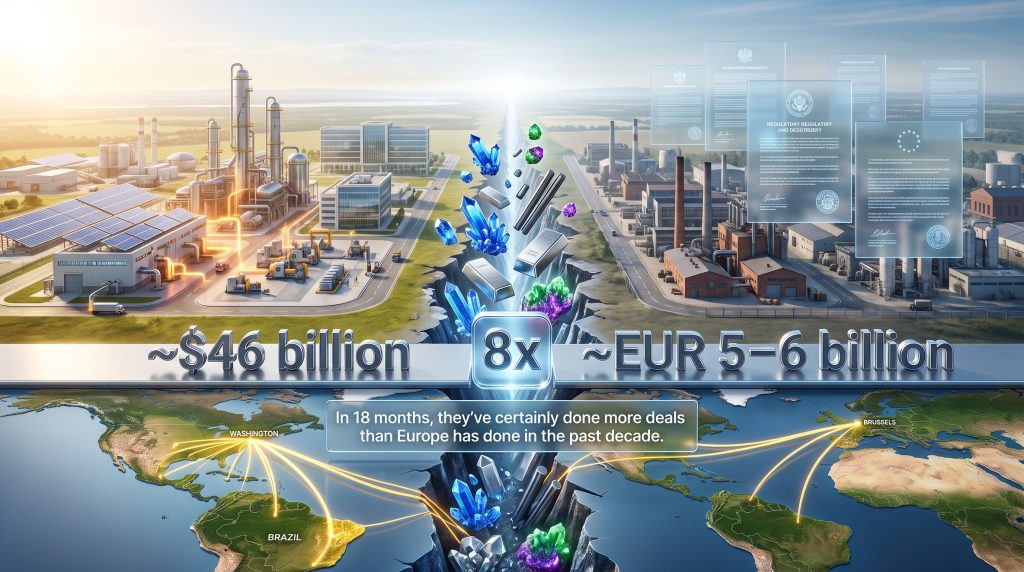
The United States has committed approximately $46 billion across five years to critical minerals supply chain development, deployed through a combination of direct grants, loan guarantees, production tax incentives, and bilateral offtake agreements. This is not a single programme — it is a layered architecture of funding mechanisms designed to de-risk private investment at multiple stages of the supply chain, from exploration through refining. The US critical minerals strategy reflects a deliberate decision to treat supply chain exposure as a national security liability rather than a purely commercial exercise.
By framing the issue through a defence procurement lens, the U.S. has been able to mobilise capital instruments — including Defence Production Act authorities — that bypass the typical constraints of commercial investment thresholds and payback periods. The contrast in approach between Washington and Brussels is stark when mapped against comparable metrics:
| Metric | United States | European Union |
|---|---|---|
| Total critical minerals funding (5-year estimate) | ~$46 billion | ~EUR 5-6 billion |
| Funding ratio advantage | ~8x greater | Baseline |
| Policy philosophy | Security-driven, deal-first | Regulatory, framework-first |
| Overseas deal activity (Latin America, Africa) | Extensive | Limited and fragmented |
| Speed to final investment decision | Faster | Frequently stalled |
| Domestic permitting culture | Security-framed | Compliance-layered |
The Latin America Strategy: Locking In Supply Before Production
Resource-rich Latin American nations have become the primary battleground for early-stage supply agreements. The U.S. moved with committed capital into countries including Brazil, positioning itself as a financial partner before projects reached commercial production — the point at which competition becomes most intense and leverage is lowest.
The Brazil episode is particularly instructive. When the U.S. arrived at negotiations with concrete financial commitments, the EU found itself removed from the shortlist for partnership consideration. This is the operational consequence of the funding gap: not merely that Europe has less money, but that the absence of deployable capital in real time translates directly into lost deal flow. A policy framework, regardless of how strategically sophisticated, cannot substitute for money on the table during an active negotiation.
According to reporting by Bloomberg, the pattern of the U.S. displacing European competitors in resource partnership negotiations has become a recurring dynamic across multiple jurisdictions.
Where the U.S. Strategy Still Struggles
Even the most aggressively funded national strategy encounters friction at the operational level. Domestic U.S. critical minerals development faces meaningful headwinds:
- Environmental litigation — Mining projects in sensitive ecosystems face multi-year legal challenges that permitting reform alone cannot eliminate
- Infrastructure deficits — Remote mineral deposits often lack road, power, and water access, creating capital requirements that exceed mineral asset values at current prices
- The NASA-tungsten conflict — One of the more unusual obstacles in recent memory involves a domestic tungsten project whose geographic footprint interferes with satellite-tracking operations managed by NASA, illustrating how national security priorities can collide with one another in unexpected ways
- Processing technology gaps — The U.S. retains limited domestic refining capacity for many critical minerals, meaning secured ore supply still depends on allied-nation processing
Moreover, mine permitting timelines remain a persistent bottleneck, and these friction points reveal that political will and capital availability, while necessary conditions for supply chain independence, are not sufficient ones.
Europe's Structural Disadvantages in the Critical Minerals Race
The Regulatory Paradox
The EU's response to regulatory criticism has frequently been to introduce new regulatory frameworks designed to reduce regulatory burden — an approach that, in practice, adds compliance layers rather than removing them. Recent examples include methane emission reduction regulations and packaging compliance frameworks, both of which generated significant industry opposition due to near-impossible implementation timelines.
For critical minerals specifically, this regulatory culture creates a compounding problem. The time between a project receiving strategic designation and that project producing commercial output can exceed a decade. Fast-track permitting accelerates only one segment of a much longer development pipeline.
Bernd Schaefer, leading a pan-European organisation representing critical minerals companies, made his frustration with Brussels' pace publicly clear in comments to the Financial Times, characterising the American approach as one of decisive execution versus European institutional hesitation and delay.
The NIMBY Dynamic: Community Opposition as a Structural Barrier
The most underappreciated obstacle to European domestic mineral development is not regulatory — it is social. Local communities across European nations have demonstrated consistent and organised opposition to new mining projects regardless of their strategic classification or economic benefit arguments.
The Jadar lithium project in Serbia serves as the defining case study. Despite receiving EU strategic project designation — intended as the highest level of institutional endorsement for a critical minerals development — the project faces sustained and politically visible community opposition. The fact that Jadar is located outside EU borders did not insulate it from this dynamic; it arguably intensified local resistance by framing the project as resource extraction for foreign industrial benefit.
Even if every permitting barrier were removed overnight, the social licence to operate — the consent of local communities — cannot be legislated into existence. It must be earned through benefit-sharing, transparency, and time.
The structural irony of EU climate politics compounds this further. The same political constituencies that have driven the push for renewable energy and EV adoption are frequently the most organised opponents of the mining necessary to supply those technologies. Green political movements within EU institutional structures face an internal contradiction that has not yet produced a coherent resolution.
The Dependency Substitution Risk
Europe's supply chain challenge extends beyond simply closing the funding gap. Senior industry advisors have begun flagging with increasing urgency the risk of substituting one dependency for another — specifically, that if the EU's critical mineral supply increasingly flows through U.S.-secured and U.S.-controlled channels, Brussels will have traded Chinese leverage for American leverage.
The historical parallel is direct. Post-2022, Europe executed a rapid and painful transition away from Russian pipeline gas — demonstrating that dependency substitution is possible, but at enormous economic and industrial cost. A comparable scenario in critical minerals, triggered by a deterioration in transatlantic relations or a shift in U.S. trade policy, would hit European defence manufacturing, EV production, and semiconductor supply chains simultaneously.
A European critical minerals industry advisor, speaking to the Financial Times, noted that the volume of U.S. supply deals secured within roughly 18 months exceeded what the EU achieved across the preceding decade — a comparison that frames the scale of the divergence more clearly than any funding figure.
Three Scenarios for How This Divergence Resolves
Scenario 1: The Catch-Up Sprint (Low Probability, High Effort)
For the EU to meaningfully close the gap, it would need to deploy capital at a fundamentally different scale and speed than anything its current institutional architecture supports. This would require a dedicated EU-level sovereign minerals fund, expanded European Investment Bank mandates targeting extraction and processing, and harmonised environmental review timelines across all member states.
Even under the most optimistic assumptions, the production timeline constraint means that meaningful supply chain independence is a post-2035 outcome at the earliest.
Scenario 2: Managed Dependency (Most Likely Base Case)
The EU secures partial supply through strategic project designations, selective bilateral agreements, and participation in U.S.-led supply partnerships. European industry gains partial insulation from Chinese supply disruption but sacrifices strategic autonomy to allied-nation supply chain architectures. This is the path of least institutional resistance and the most likely near-term outcome.
Scenario 3: Structural Marginalisation (Credible Downside)
Regulatory paralysis, community opposition, and inadequate capital deployment combine to leave European domestic production at negligible levels through the 2030s. EU manufacturers in automotive, defence, and energy storage sectors face persistent supply risk and cost disadvantage relative to U.S. and Asian competitors. The downstream industrial consequences of this scenario would be severe and potentially irreversible within a policy cycle.
The next major ASX story will hit our subscribers first
What Genuine Catch-Up Would Actually Require
Closing an eightfold funding gap is not achievable through incremental budget adjustments. It requires structural changes to EU fiscal architecture — specifically, the creation of capital instruments that can move at commercial speed rather than bureaucratic speed. Consequently, the connection between critical minerals and energy security has never been more direct, as the downstream consequences of supply chain failure now extend into power generation, transport, and defence simultaneously.
Beyond capital, three additional shifts would be necessary:
- Regulatory harmonisation: A single environmental review standard across member states, replacing the current patchwork of national assessment regimes that can add years to project timelines
- National security framing: Integrating mineral supply chain security into defence planning frameworks, which would unlock procurement-style capital instruments not available under standard industrial policy
- Community co-investment models: Establishing royalty-sharing, equity participation, and direct community benefit frameworks that create genuine local economic interest in project success, rather than treating social opposition as a communications problem to be managed
The competitive landscape for critical minerals will only intensify as battery technology scales, defence budgets expand, and semiconductor supply chain reshoring accelerates. The window in which Europe can exercise meaningful strategic agency over its own mineral supply is narrowing, and the timeline mathematics are unforgiving. Policy frameworks without capital are aspirations. Capital without community consent is litigation risk. And both without a decade of operational time are simply insufficient.
This article is intended for informational purposes only and does not constitute investment advice. Forecasts, scenario projections, and timeline estimates involve inherent uncertainty and should not be relied upon as predictions of future outcomes.
Want to Track the ASX Discoveries Shaping the Critical Minerals Race?
Discovery Alert's proprietary Discovery IQ model delivers real-time alerts the moment significant mineral discoveries are announced on the ASX, instantly translating complex geological data into actionable investment insights for both short-term traders and long-term investors — begin your 14-day free trial today and see why historic discoveries have generated extraordinary returns.