August 25, 2026
The Hidden Infrastructure Fault Line Running Through Global Aluminium Supply
Every commodity market has a point of maximum vulnerability. For aluminium, that point is not a mine, a smelter, or a trading desk. It is a single railway line cutting through the West African interior, connecting an isolated refinery to the coast. When that line fails, the consequences ripple outward across one of the most structurally concentrated supply chains in global metals markets.
The Rusal derailment in Guinea halts alumina exports has brought this vulnerability into sharp focus. However, to understand why a weekend rail incident in Dubreka Prefecture carries genuine market weight, it is necessary to examine the industrial architecture that makes Guinea's alumina logistics so uniquely fragile.
When big ASX news breaks, our subscribers know first
Guinea's Rail-Dependent Refining Model: Why Is There No Backup Plan?
How the Friguia Supply Chain Actually Functions
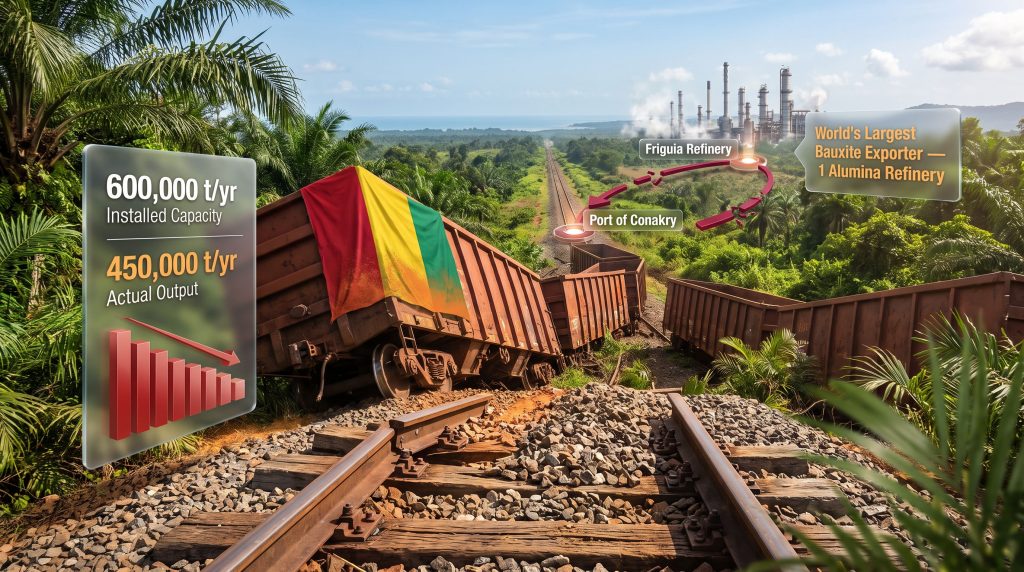
Most alumina refineries in peer jurisdictions operate within reach of road networks, coastal loading facilities, or diversified transport corridors. Guinea's Friguia refinery does not. Situated inland, it is entirely dependent on a privately operated rail corridor linking it to the Port of Conakry. This is not a redundant link in a broader logistics network. It is the only link.
What makes this dependency particularly acute is the bidirectional nature of the rail flow. The line does not simply carry alumina outward to market. It simultaneously carries inbound chemical inputs and fuel that the refinery requires to operate. Remove the rail connection and the refinery is cut off from both its output markets and its production inputs at the same time.
The step-by-step logistics chain at Friguia operates as follows:
- Inbound fuel deliveries are transported by rail from the Port of Conakry to the refinery site, powering the energy-intensive Bayer refining process.
- Caustic soda shipments follow the same inbound rail corridor, supplying the primary chemical reagent used to dissolve aluminium oxide from bauxite ore.
- Bauxite is processed on-site into refined alumina using heat, pressure, and the caustic soda inputs delivered by rail.
- Finished alumina is loaded onto outbound trains and transported back to Conakry for export vessel loading.
A single derailment event severs all four of these stages simultaneously. Inbound chemical supply stops. Fuel delivery halts. Processing slows. Export loading ceases. It is a full-chain failure triggered by one point of mechanical failure.
Friguia's Capacity Position Before the Incident
The Friguia refinery was originally commissioned with an installed capacity of 600,000 metric tons of alumina per year. After being shuttered in 2012 during a period of operational restructuring, the facility was brought back online in 2018 following a six-year closure. Since resuming operations, actual output has averaged approximately 450,000 metric tons per year, reflecting a persistent utilisation gap of around 25% relative to nameplate capacity.
This pre-existing underperformance matters for supply analysts. The refinery was already running below its design ceiling before the derailment introduced further constraints. A reduction applied to an already-reduced baseline amplifies the effective market impact beyond what installed capacity figures alone would suggest.
What Happened Near Kagbelen: Dissecting the Operational Incident
Incident Overview and Immediate Consequences
On a Saturday evening, a freight train crashed near Kagbelen in Guinea's Dubreka Prefecture. The incident resulted in four people sustaining injuries and triggered an immediate suspension of all rail traffic along the affected corridor. An assessment and repair team was dispatched to the site to evaluate the extent of track damage and begin remediation work.
As of the initial reporting period, the operational picture at Friguia was as follows:
- Alumina production was continuing, but at a materially reduced pace compared to pre-incident output levels.
- No quantified throughput figure was provided by company officials, leaving the precise production reduction unconfirmed.
- Alumina exports were completely halted, with no shipments leaving the facility pending rail restoration.
- The cause of the derailment had not been officially confirmed by Guinean authorities at the time of reporting.
The Caustic Soda Problem: An Underappreciated Vulnerability
While the export halt draws immediate attention, the more technically consequential consequence of the derailment may be the interruption to inbound caustic soda supply. In the Bayer process, which is the universal method for refining bauxite into alumina, caustic soda (sodium hydroxide) is used to dissolve the aluminium-bearing minerals from the ore under high-temperature, high-pressure conditions. The resulting sodium aluminate solution is then precipitated and calcined to produce finished alumina.
Caustic soda is not simply a processing aid. It is consumed during the refining process and must be continuously replenished. A refinery cannot maintain output without it. Because Friguia relies on rail delivery for its caustic soda supply, the derailment effectively introduced a countdown clock on production continuity, independent of any repair work underway on the track itself.
Fuel supply was already identified as a constraint before the derailment occurred. Furthermore, industry sources confirmed that Rusal had already reduced alumina output at Friguia due to fuel delivery challenges prior to the rail incident. The derailment compounded an existing stress, rather than initiating a fresh one.
Guinea's Systemic Rail Maintenance Problem
Chronic Underinvestment in a Critical Corridor
Guinea's mining rail network operates through several privately maintained corridors, each designed to serve specific commodity export streams. This model places maintenance responsibility with the operating companies rather than a centralised national rail authority, creating uneven investment incentives and variable maintenance standards across the network.
A senior official within Guinea's transport ministry publicly characterised the Kagbelen derailment as symptomatic of long-standing and systemic maintenance deficiencies across the country's rail infrastructure. This framing positions the incident not as an isolated mechanical failure but as a structural risk that has accumulated over time without adequate remediation.
The infrastructure risk profile across key global bauxite producers illustrates how significantly Guinea's position diverges from peer jurisdictions:
| Country | Rail Governance Model | Maintenance Oversight | Redundancy Options |
|---|---|---|---|
| Guinea | Privately operated corridors | Limited state oversight | Minimal, single-line dependency |
| Australia | Mixed public/private | Regulated maintenance schedules | Multiple route alternatives available |
| Brazil | Concession-based | ANTT regulatory framework | Partial redundancy available |
| Jamaica | State-linked | Government-managed | Limited but road alternatives exist |
Guinea's combination of single-line dependency and limited state oversight creates a risk profile without meaningful parallel among major aluminium-chain exporters.
Rusal's Compounding Stress Profile: Three Problems Converging
A Timeline of Overlapping Disruptions
The Kagbelen derailment did not arrive in isolation. It is the third significant operational stress event affecting Rusal's Friguia operations within a compressed timeframe:
- Shipping route disruptions linked to the Iran war had already created export headwinds for Rusal's broader logistics network prior to the rail incident.
- Fuel supply constraints had forced internal production cutbacks at Friguia before the derailment, reducing output from its already below-nameplate baseline.
- The derailment itself then simultaneously halted exports and severed inbound delivery of the fuel and caustic soda that production depends upon.
Friguia is not simply an export asset. It is a captive alumina supply source feeding directly into Rusal's downstream aluminium smelting operations. Disruption here does not stay contained at the refinery. It propagates forward into the company's smelter feed availability and, ultimately, its finished aluminium output capacity.
Why Rusal's Guinea Position Carries Outsized Market Significance
Despite Guinea holding the status of the world's largest bauxite exporter, the country has historically maintained a narrow downstream processing base. Rusal's Friguia facility is the only alumina refinery currently operating in Guinea, meaning there is no domestic alternative processing route for Guinean bauxite when Friguia's output contracts. The entire refining capacity of the country, for the purposes of alumina production, sits within one facility on one rail line.
This concentration creates what supply chain analysts describe as a single-point failure architecture. Consequently, when the single point fails, there is no fallback position within the same geography. This echoes broader concerns around commodity market concentration that analysts have increasingly flagged across global metals supply chains.
Understanding the Aluminium Production Chain and Why Refinery Disruptions Hit Hardest
Breaking Down Bauxite, Alumina, and Aluminium
These three commodities are frequently conflated in general reporting, but they represent distinct materials at separate stages of production, with different pricing dynamics, logistics requirements, and substitutability profiles:
- Bauxite is the raw ore extracted through open-cut or underground mining. It is relatively low in value per tonne and can be transported in bulk via rail, barge, or conveyor systems. Multiple countries produce significant bauxite volumes, offering moderate supply substitutability.
- Alumina is the refined intermediate product, produced from bauxite through the Bayer process using caustic soda, heat, and pressure. It has a significantly higher value per tonne and requires substantial refinery infrastructure. Geographic refining concentration limits rapid substitution.
- Aluminium is the final smelted metal, produced from alumina through the Hall-Heroult electrolysis process. It is an energy-intensive manufacturing step that requires a stable alumina feed to maintain continuous production.
The refinery stage, where Friguia operates, is the most logistically constrained node in this chain. Bauxite supply disruptions can often be absorbed through alternative sourcing over weeks to months. However, alumina refinery outages are more difficult to replace quickly because spare refining capacity is limited globally and because captive supply arrangements, like Rusal's model at Friguia, create specification dependencies that complicate third-party sourcing.
The next major ASX story will hit our subscribers first
Market and Price Implications: Short-Term Shock vs. Medium-Term Structural Risk
Scenario-Based Impact Assessment
The duration of the rail disruption is the primary variable determining how far the supply impact propagates through the market:
| Timeframe | Expected Impact | Key Variable |
|---|---|---|
| Immediate (0 to 2 weeks) | Export halt; refinery at reduced output | Speed of rail repair and traffic resumption |
| Short-term (2 to 6 weeks) | Potential alumina spot price pressure | Duration of caustic soda and fuel supply interruption |
| Medium-term (1 to 3 months) | Smelter feed disruption risk for Rusal downstream | Whether alternative alumina sourcing is secured |
| Long-term (3-plus months) | Infrastructure investment pressure; potential output restructuring | Capital response from Rusal and Guinean stakeholders |
Historical Context: How Do Markets Respond to Alumina Supply Shocks?
Historical precedent suggests aluminium markets tend to respond to alumina disruptions with price sensitivity that exceeds the proportional volume impact. Sentiment amplification, particularly in markets where one major producer holds a large share of a constrained supply node, can drive spot price movements that outpace the physical shortfall in tonnage.
The aluminum and alumina markets have shown this pattern repeatedly, with previous Guinea-linked disruptions generating alumina price spikes toward record highs as buyers scramble to secure alternative supply. Rusal's position as one of the top aluminium producers globally, combined with the geopolitical complexity that surrounds its operations, means that any operational setback at a captive supply facility tends to attract elevated market attention.
Disclaimer: The price impact analysis presented here is based on historical patterns and structural assessment. It does not constitute financial advice. Actual market outcomes will depend on the duration of the disruption, Rusal's sourcing response, and broader commodity market conditions at the time of resolution.
Frequently Asked Questions
What Caused the Train Derailment Near Kagbelen in Guinea?
The precise mechanical cause of the derailment had not been officially confirmed by either Guinean authorities or Rusal at the time of reporting. An assessment and repair team was dispatched to the site following the incident to evaluate track conditions and initiate remediation.
How Much Alumina Does the Friguia Refinery Produce Annually?
Friguia has an installed nameplate capacity of 600,000 metric tons per year. In practice, the refinery has produced approximately 450,000 metric tons per year since resuming operations in 2018. Output had already been reduced below this level before the Rusal derailment in Guinea halts alumina exports situation further constrained throughput.
Why Does Guinea Only Have One Alumina Refinery Despite Being the World's Largest Bauxite Exporter?
Guinea's downstream processing infrastructure has historically remained underdeveloped relative to its raw ore export volumes. The country's wealth is concentrated at the mining stage, with limited investment in value-added refining capacity. These resource export challenges are not unique to Guinea, though the country's single-refinery position is particularly acute. Friguia is the sole alumina refinery in operation, representing a significant structural gap in the country's mineral processing ecosystem.
Could This Derailment Affect Global Aluminium Prices?
A sustained outage at Friguia, particularly one that restricts caustic soda and fuel delivery alongside the export halt, could create upward pressure on alumina spot markets. The downstream impact on aluminium prices would depend on the duration of the disruption and Rusal's ability to secure alternative alumina supply for its smelter operations. Historical alumina supply shocks have generated price responses disproportionate to their volume impact.
What the Friguia Incident Reveals About Critical Minerals Supply Chain Design
The Rusal derailment in Guinea halts alumina exports event is, at one level, an operational incident with a finite repair timeline. At another level, it is a diagnostic signal about how global critical minerals supply chains are structured and where they are most exposed to sudden disruption.
Several structural observations emerge from examining this incident in full context:
- Single-point infrastructure dependencies in rail-reliant mining jurisdictions represent a category of systemic risk that commodity markets frequently undervalue until a disruption event crystallises the exposure.
- Guinea's refining infrastructure deficit is disproportionate to its raw ore export dominance. The world's largest bauxite exporter hosts exactly one alumina refinery, creating a concentration of processing risk with no domestic fallback.
- Compounding stress factors are more dangerous than individual disruptions. The convergence of fuel supply constraints, shipping route disruptions, and rail infrastructure failure across a single operational asset reflects a deeper fragility in Rusal's Guinea supply chain.
- The bidirectional nature of rail dependency in refinery logistics means that disruptions are never simply export events. They are simultaneously input supply events, and the input supply dimension can determine whether production can resume even after physical rail damage is repaired.
- Aluminium's energy transition demand trajectory makes reliable alumina supply more strategically important over time. The metal is a critical input for electric vehicle components, power transmission infrastructure, and renewable energy systems, adding long-term consequence to what might otherwise be assessed as a short-term operational setback.
In addition, for market participants tracking base metals exposure, the Friguia situation is a reminder that commodity supply risk often lives not in the geology of a deposit or the economics of a project, but in the physical infrastructure connecting resource to market. That infrastructure, when it fails, reveals how thin the margin between operational continuity and supply disruption actually is. Understanding the resource export challenges faced across different jurisdictions underscores just how critical robust logistics infrastructure remains for any commodity-dependent economy.
Want to Stay Ahead of the Next Major Mineral Discovery?
Discovery Alert's proprietary Discovery IQ model delivers real-time alerts the moment significant ASX mineral discoveries are announced, transforming complex commodity data into clear, actionable insights for both short-term traders and long-term investors. Explore Discovery Alert's dedicated discoveries page to understand how major mineral discoveries have historically generated substantial returns, and begin your 14-day free trial today to position yourself ahead of the broader market.