August 25, 2026
The Geopolitics of Chokepoints: Why Hormuz Has Always Been the World's Most Dangerous Energy Bottleneck
Throughout modern energy history, no single stretch of water has carried more strategic weight than the narrow passage separating the Persian Gulf from the Arabian Sea. At its tightest point, the Strait of Hormuz measures just 33 kilometres wide, yet it functions as the circulatory system of global oil trade. For decades, policymakers, military strategists, and commodity traders have modelled worst-case scenarios around this bottleneck, understanding that whoever controls or threatens the strait holds enormous leverage over the world economy. That leverage is now at the centre of one of the most consequential diplomatic developments in recent memory: a reported Iran U.S. deal to reopen Strait of Hormuz and lift oil sanctions, a framework that, if confirmed, would reshape energy markets, reorder OPEC+ dynamics, and recalibrate the entire architecture of Middle Eastern geopolitics.
When big ASX news breaks, our subscribers know first
What the Reported Framework Actually Involves
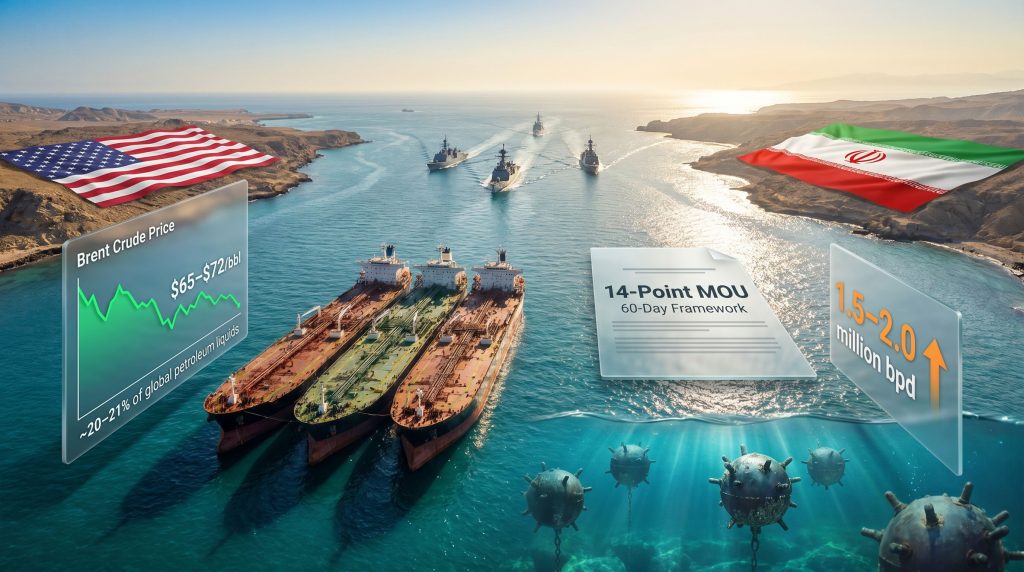
The foundational document reportedly at the centre of these negotiations is a 14-point memorandum of understanding, details of which were published by Iran's Mehr News Agency on June 12, 2026. It is important to distinguish this from a treaty or a finalised agreement. A memorandum of understanding is a non-binding instrument that outlines mutual intentions, serving as a precursor to formal negotiations rather than a conclusion of them.
According to Iranian state media reporting, the draft MOU contains two headline commitments operating in parallel:
- The United States would commit to lifting oil sanctions currently imposed on Iranian crude exports
- Iran would commit to reopening the Strait of Hormuz, including clearing any naval mines from the waterway
Furthermore, the document is reported to be structured around a 60-day timeframe, positioning it explicitly as a temporary arrangement rather than a permanent diplomatic resolution. Nuclear-related obligations are said to be deliberately excluded from this phase, deferred to a separate and later round of talks.
President Donald Trump stated on June 11, 2026 that the United States had reached a settlement with Iran, contingent on the finalisation of supporting documentation. This represents the most senior political acknowledgment of the negotiations from the American side, though the use of conditional language is notable and should not be interpreted as confirmation of a binding agreement.
Editorial Note: As of the time of writing, no final, publicly verified agreement has been confirmed by both governments simultaneously. The information currently in circulation originates from Iranian state media and a presidential statement using conditional framing. Market participants and analysts should treat any interpretation of this framework as provisional until formal confirmation is provided.
What Are the Three Preconditions Iran Has Reportedly Demanded?
One of the more structurally significant aspects of the reported MOU is its sequencing logic. According to Mehr News Agency's account of the draft document, Iran has insisted that final negotiations cannot commence until three specific conditions are satisfied in advance. This represents a fundamental inversion of how Western diplomatic frameworks typically operate, where concessions are generally the outcome of successful talks rather than preconditions for beginning them.
| Precondition | Description |
|---|---|
| Release of frozen funds | Half of Iran's frozen financial assets must be released before final talks begin |
| Suspension of oil sanctions | Active oil sanctions must be suspended as a precondition, not as a reward for compliance |
| Lifting of naval blockade | The U.S. naval blockade on Iranian ports must be removed before negotiations commence |
This sequencing reveals the depth of Tehran's institutional scepticism toward incremental diplomacy. Iran's negotiating posture reflects lessons drawn from previous engagement cycles, particularly the 2015 Joint Comprehensive Plan of Action (JCPOA), where Iran ultimately received sanctions relief only after years of compliance verification. By front-loading demands, Tehran is effectively seeking to lock in economic gains before entering a negotiating environment where domestic political pressures in Washington could again unravel the process.
The OFAC Waiver: Washington's First Move
Separate from the MOU discussions, the U.S. Office of Foreign Assets Control issued a 30-day limited waiver on March 20, 2026, authorising specific transactions involving Iranian crude oil and petroleum products already loaded aboard vessels at the time of issuance. This measure represents targeted, time-limited sanctions relief rather than a comprehensive suspension of the sanctions regime.
The OFAC waiver is significant for two reasons. First, it demonstrates that Washington has already tested partial easing mechanisms, providing a procedural template for broader relief measures if the diplomatic framework advances. Second, it illustrates the contradictory dual-track approach currently characterising U.S. policy: the same period also saw new Russian oil sanctions imposed on an Iranian agency linked to strait shipping control, suggesting that competing institutional and political forces within the U.S. policy apparatus are simultaneously pushing in opposite directions.
Assessing the Credibility of the Reported Agreement
Given that the primary reporting on this framework originates from Iranian state media, a careful evaluation of source reliability is essential before drawing market or policy conclusions. The geopolitical risk landscape surrounding these negotiations further complicates straightforward interpretation.
Areas of reported consensus across multiple sources:
- Active negotiations between U.S. and Iranian delegations are confirmed to be underway
- A temporary arrangement involving the Strait of Hormuz is central to the proposed framework
- Sanctions relief tied to Iranian crude exports forms a core component of the draft
- President Trump's June 11 statement corroborates that a settlement of some form has been discussed
Areas of active dispute or unconfirmed status:
- Iranian sources have explicitly denied that Tehran agreed to relinquish its stockpile of highly enriched uranium (HEU) as part of this framework
- The precise scope and duration of any sanctions relief remains contested between parties
- Whether the MOU constitutes a negotiating document or a binding commitment is not yet clear
- Independent verification of the 14-point structure has not been publicly confirmed by U.S. officials
According to reporting from Fortune, the potential reopening of the strait has already drawn significant attention from China, given its heavy dependence on Gulf crude supplies transiting this chokepoint.
The Nuclear Deferral: Strategic Wisdom or Structural Weakness?
Perhaps the most analytically contentious element of the reported framework is its deliberate exclusion of nuclear obligations from the first phase. By separating economic and maritime arrangements from nonproliferation requirements, the agreement mirrors the structural logic of the 2015 JCPOA, though with significantly less verification infrastructure reportedly in place.
Iran's HEU stockpile represents a capability that did not exist when the JCPOA was negotiated. Iran has accumulated uranium enriched to levels approaching weapons-grade concentration since the JCPOA's collapse following the U.S. withdrawal in 2018. Any framework that provides sanctions relief without addressing this stockpile creates what nonproliferation analysts describe as an asymmetric incentive structure: Iran receives near-term economic normalisation while retaining strategic nuclear optionality that can be leveraged in subsequent negotiations.
Critics of this phased approach point to the historical precedent of compliance erosion in agreements lacking robust verification mechanisms. Supporters argue that achieving even a temporary de-escalation on maritime and economic dimensions creates the political space necessary for the harder nuclear conversations to eventually occur.
What Reopening the Strait Means for Global Oil Markets
The Iran U.S. deal to reopen Strait of Hormuz and lift oil sanctions carries profound implications for crude pricing, supply balances, and the strategic calculus of every major oil-producing nation. Understanding the scale of this potential shift requires first appreciating exactly what is at stake in volumetric terms.
| Metric | Data |
|---|---|
| Share of global petroleum liquids transiting daily | ~20-21% |
| Estimated daily volume at risk during closure | ~17-18 million barrels per day |
| Key exporters dependent on the strait | Saudi Arabia, UAE, Kuwait, Iraq, Iran |
| Primary destination markets | China, India, Japan, South Korea |
| Iranian production capacity (full operational conditions) | ~3.2-3.8 million bpd |
| Estimated Iranian exports under sanctions | ~1.3-1.5 million bpd |
| Potential additional supply from sanctions removal | ~1.5-2.0 million bpd |
The Geopolitical Risk Premium Embedded in Current Prices
During periods of active strait disruption or credible closure threat, energy analysts estimate that between $8 and $15 per barrel of geopolitical risk premium becomes embedded in Brent crude and WTI futures benchmarks. This premium reflects not only the direct supply risk but also the market's assessment of escalation probability, insurance cost increases for tanker operators, and the logistical complexity of rerouting supply around the Cape of Good Hope.
A credible, independently verified agreement to reopen the strait would likely trigger an unwinding of this premium, producing a sharp downward correction in crude benchmarks. However, the temporary nature of the reported 60-day arrangement introduces an important qualification: markets are unlikely to fully price out the risk premium if participants assess a meaningful probability of renewed disruption once the arrangement expires. The oil price geopolitics at play here are consequently more complex than a simple supply-demand adjustment.
The Supply Injection Scenario
Under maximum pressure sanctions, Iran's effective export volumes have been constrained to an estimated 1.3 to 1.5 million barrels per day, channelled primarily to China through shadow fleet operations involving vessel identity manipulation, ship-to-ship transfers in international waters, and falsified port documentation. A formal sanctions suspension could unlock an additional 1.5 to 2.0 million barrels per day of Iranian crude onto global markets as production ramps toward capacity and legitimate export channels reopen.
This supply injection would arrive at a particularly sensitive moment for OPEC+ price management. The cartel has been navigating internal tensions over quota compliance while simultaneously managing the oil market disruption caused by broader macroeconomic uncertainty.
Scenario Projection: If Iranian exports return to near-capacity levels within 90 days of a confirmed deal, Brent crude could face sustained downward pressure toward the $65-$72 per barrel range, assuming OPEC+ does not implement compensatory production cuts to absorb the additional Iranian volumes.
How the Deal Reshapes OPEC+ and Saudi Arabia's Strategic Position
Saudi Arabia faces a structurally uncomfortable scenario in the event this framework is confirmed. Riyadh has functioned as the de facto guarantor of OPEC+ price stability for years, repeatedly shouldering disproportionate production cuts to defend price floors. A U.S.-brokered arrangement that effectively re-admits Iran into legitimate oil markets creates a compound challenge for the kingdom.
First, the addition of Iranian volumes without a corresponding quota framework creates what analysts describe as a structural free-rider problem within OPEC+. Because Iran has historically operated under a sanctions-exempt status exempting it from cartel production discipline, a sanctions removal that is not paired with Iran accepting formal OPEC+ quota obligations would mean Tehran benefits from prices supported by Saudi cuts without contributing to the supply discipline that maintains those prices.
Second, the geopolitical dimension is equally concerning for Riyadh. The maximum pressure sanctions regime has served as an indirect mechanism limiting Iranian regional influence by constraining the financial resources available to Iranian-backed proxy forces across the Middle East. Any relaxation of sanctions that materially increases Iranian oil revenue therefore has security implications for Saudi Arabia that extend beyond pure market dynamics.
Could This Accelerate OPEC+ Fragmentation?
The OPEC+ market influence was already under internal strain prior to this diplomatic development, with documented overcompliance failures from the UAE, Iraq, and Kazakhstan. An Iranian supply re-entry without quota constraints could incentivise these quota-constrained members to pursue similar exemptions or simply exceed their own targets, reasoning that unilateral discipline is economically irrational when a peer producer faces no equivalent constraint.
This dynamic represents one of the more underappreciated second-order risks of the proposed framework for global energy markets. Even if the deal itself produces only a modest immediate price decline, its structural implications for OPEC+ cohesion could have longer-lasting consequences for the cartel's ability to manage supply in future market cycles.
Geopolitical Second-Order Effects Across the Region
The implications of a confirmed Iran U.S. deal extend well beyond oil prices and OPEC+ dynamics, touching the strategic calculations of virtually every significant actor in the Middle East and several major powers beyond it.
| Actor | Strategic Implication |
|---|---|
| Israel | Heightened concern over sanctions relief channelling funds toward Iranian military and proxy programmes |
| Saudi Arabia | Loss of maximum pressure leverage as a counterbalance to Iranian regional influence |
| UAE | Mixed position: benefits from strait reopening for trade, concerned about Iranian emboldening |
| China | Strategic beneficiary through reduced energy supply risk and potential trade normalisation |
| Russia | Faces increased competition in Asian crude markets from returning Iranian volumes |
China's position as a strategic beneficiary deserves particular attention. Beijing has been the primary absorber of sanctioned Iranian crude through shadow fleet operations, effectively subsidising Iran's economic resilience while absorbing discounted barrels. A formal sanctions removal would reduce China's exclusive access to discounted Iranian supply while simultaneously normalising Iran's position in global markets, creating a complex mixture of gains and losses for Beijing's energy strategy.
Russia faces a more straightforwardly negative outlook. Russian crude exports to Asia, particularly India and China, have expanded significantly since 2022, partly filling a gap in discounted supply that Iranian volumes previously occupied. The return of Iranian crude to legitimate markets at scale would consequently intensify competition for Asian market share, potentially compressing the price premiums that have made Russian exports economically viable under Western sanctions.
The next major ASX story will hit our subscribers first
Key Indicators for Investors and Market Participants
For energy investors, commodity traders, and macro portfolio managers, the Iran U.S. deal to reopen Strait of Hormuz and lift oil sanctions presents a scenario that demands careful monitoring of several confirmatory signals before repositioning. The risks of acting on unverified information in either direction are substantial.
Critical indicators to track for deal confirmation or collapse:
- Official statements from the White House, U.S. State Department, or OFAC confirming or specifically denying deal terms
- Iranian parliamentary response, given that hardline factions have historically disrupted diplomatic agreements
- Any OPEC+ emergency meeting signals, which would suggest markets are pricing in Iranian supply re-entry
- Sustained movement in Brent crude futures below the $75 per barrel level as a market confidence indicator
- Independent satellite tracking of Iranian tanker movements and any observable mine-clearing operations in Hormuz
- U.S. Treasury Department actions on OFAC waiver extensions or revocations as a policy direction signal
Investment Thesis Implications Across Energy Sub-Sectors
| Sector | Directional Impact of Confirmed Deal |
|---|---|
| Integrated oil majors (global) | Bearish short-term on price; potential long-term volume opportunity |
| LNG exporters (U.S., Qatar) | Moderately bearish as reduced disruption premium compresses emergency LNG pricing |
| Shipping and tanker operators | Mixed: lower risk premium, but potential volume uplift from Iranian export normalisation |
| Downstream refiners | Bullish: lower crude input costs structurally improve refining margins |
| Renewable energy investment | Neutral to mildly bearish as lower oil prices reduce urgency of energy transition capital allocation |
A nuanced consideration for tanker operators involves the composition of any volume increase. If Iranian exports normalise through legitimate channels rather than shadow fleet operations, this would actually increase demand for standard commercial tankers while potentially reducing demand for the older, less efficient vessels that dominate the shadow trade. This sub-sector dynamic is rarely discussed in mainstream coverage but represents a meaningful distinction for shipping-focused investors.
Three Scenarios That Will Define This Framework's Legacy
Scenario One: Full Implementation. Both parties honour the MOU, the strait reopens within the 60-day window, sanctions are formally suspended, and a second-phase nuclear negotiation commences. Global crude markets reprice lower by $10 to $15 per barrel as the combined risk premium and supply discount unwinds. OPEC+ convenes an emergency session to address the Iranian supply question. Regional geopolitics shift toward managed competition.
Scenario Two: Partial Implementation. The strait reopens temporarily, limited sanctions relief is enacted on a waiver basis, but nuclear talks stall and the arrangement expires without renewal after 60 days. Crude markets experience an initial correction of $5 to $8 per barrel followed by a partial rebound as uncertainty returns. This scenario arguably represents the most likely outcome given the structural complexity of the preconditions and the domestic political constraints operating in both capitals.
Scenario Three: Collapse Before Finalisation. Domestic political opposition in Washington or Tehran, or a triggering military incident in the region, derails the MOU before it takes legal effect. Crude prices spike on renewed closure risk, maximum pressure sanctions are reinstated or potentially expanded, and the diplomatic window closes for an extended period. Furthermore, reporting from the Middle East Eye suggests that even the draft language of the proposed deal remains contested, underlining how fragile the current framework remains.
Analytical Perspective for Investors: The proposed framework represents the most significant potential realignment in Middle Eastern energy geopolitics since the original JCPOA negotiations in 2015. However, its structural incompleteness, particularly the deliberate deferral of Iran's highly enriched uranium stockpile from the first-phase discussion, means that any market price response should be treated as provisional. Only verified, binding commitments confirmed publicly by both governments simultaneously should be interpreted as a durable signal. Position sizing and risk management strategies should reflect the high probability of scenario two over scenarios one or three in the near term.
Disclaimer: This article is intended for informational and analytical purposes only and does not constitute financial advice. All scenario projections and price estimates referenced herein involve inherent uncertainty and should not be relied upon as predictions of future market outcomes. Readers should conduct independent research and consult qualified financial advisors before making investment decisions based on geopolitical developments of this nature.
Want to Stay Ahead of the Next Major Commodity Discovery Driven by Shifting Energy Markets?
While geopolitical realignments like a potential Iran-U.S. deal reshape global energy dynamics and redirect capital across commodity sectors, Discovery Alert's proprietary Discovery IQ model delivers real-time alerts on significant ASX mineral discoveries — instantly translating complex market shifts into actionable investment opportunities. Explore how historic mineral discoveries have generated substantial returns and begin your 14-day free trial today to position yourself ahead of the market.