
June 6, 2026
The Hidden Tax Every American Pays When the Middle East Burns
Long before a single barrel of crude oil reaches a US refinery, its price has already been set thousands of miles away, on trading floors that respond in real time to the geopolitical temperature of the Persian Gulf. This is one of the most misunderstood dynamics in modern energy economics: the idea that American energy independence shields domestic consumers from Middle East conflict. It does not. Oil is a globally priced commodity, and the Iran war impact on US gas prices makes clear that when war disrupts supply routes in the Gulf, the consequences appear at every petrol station in America within days, regardless of where that fuel was actually produced.
The ongoing conflict with Iran has brought this reality into sharp focus, delivering one of the most significant energy cost shocks American households have experienced in several years, with consequences that extend far beyond the forecourt.
When big ASX news breaks, our subscribers know first
How Global Oil Markets Transmit War Risk Into Your Fuel Tank
The Strait of Hormuz and the Chokepoint Premium
At the centre of this story sits a narrow strip of water between the Arabian Peninsula and Iran, roughly 33 kilometres wide at its narrowest navigable point. The Strait of Hormuz is responsible for facilitating the transit of approximately one-fifth of the world's daily oil supply, making it the single most consequential chokepoint in global energy infrastructure.
When credible threats to shipping through this corridor emerge, oil traders do not wait to see whether disruption materialises. They price in the risk immediately. This forward-pricing mechanism, known as a geopolitical risk premium, becomes embedded in the cost of every barrel traded on international benchmarks like Brent Crude and West Texas Intermediate (WTI). That premium then travels through the supply chain: from crude futures, into refinery feedstock costs, and ultimately onto the price displayed at the pump.
Why Domestic Production Cannot Fully Protect American Consumers
The US shale revolution fundamentally transformed the country's production profile, turning America into one of the world's largest oil producers. However, this production achievement has not decoupled US consumers from global price movements. Furthermore, the ongoing US oil production decline in certain regions compounds this vulnerability. Here is why:
- US oil is sold into a globally integrated market at internationally benchmarked prices
- Domestic refiners compete with international buyers for the same crude
- Even where US-produced oil is refined domestically, its cost to refiners reflects global market pricing
- Strategic stockpiles can temporarily dampen price spikes but cannot offset sustained geopolitical premiums
The structural reality is that no level of domestic production insulates American consumers from a globally priced commodity when supply risk concentrates at a single maritime chokepoint. This is not a policy failure; it is a feature of how integrated commodity markets function.
What the Iran Conflict Has Done to US Gas Prices in Real Terms
A 48-Cent Surge in the Opening Week
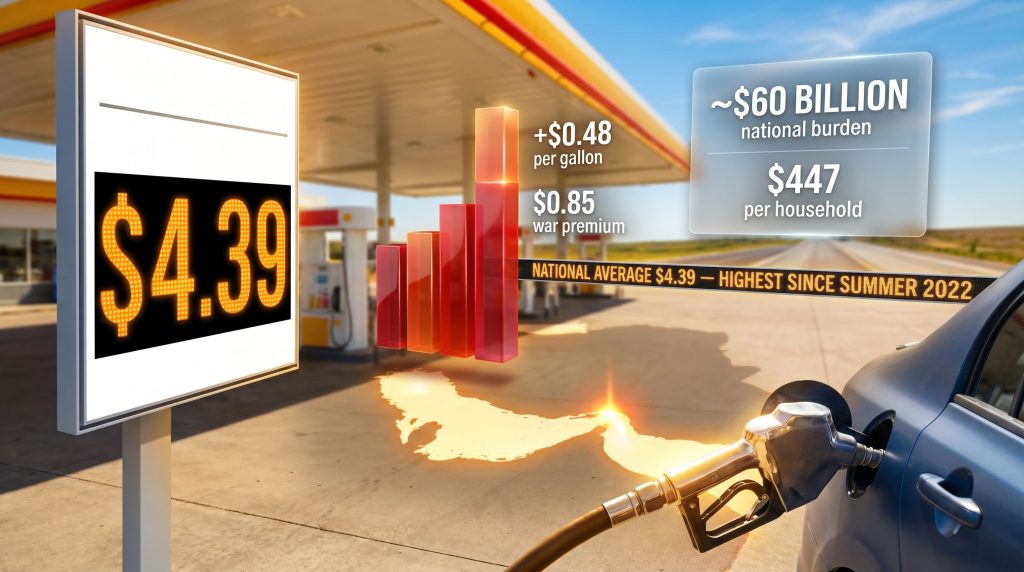
The speed with which conflict-driven crude price movements translated into retail gasoline prices was striking. According to reporting on the economic impact, within the first week of the US-Iran conflict beginning in late February, the national average price of gasoline rose by approximately 48 cents per gallon, a transmission rate that reflects how efficiently modern energy markets price new information.
By the time the conflict had run its initial course through the market, the national average reached $4.39 per gallon, a level not recorded since the summer of 2022, when post-pandemic demand recovery and the Russia-Ukraine conflict created a similarly disruptive global energy environment.
The War Premium: Quantifying What Conflict Adds to Every Gallon
Separating the conflict-related price increase from broader market movements requires modelling what prices would have looked like in the absence of hostilities. The oil price shock dynamics observed here are consistent with historical conflict-driven price events. Based on available analysis, the figures are significant:
| Metric | Observed Figure |
|---|---|
| Gasoline price increase in Week 1 | +$0.48 per gallon |
| National average peak price | $4.39 per gallon |
| Estimated average war-related premium | ~$0.85 per gallon |
| Peak war premium vs. no-conflict baseline | >$1.15 per gallon |
| Last comparable price level | Summer 2022 |
This war premium is not abstract. It is a real cost added to every litre of petrol purchased, every diesel delivery fuelling a freight truck, and every jet fuel uplift filling a commercial aircraft.
The Household Cost of War: $447 and Climbing
Breaking Down What American Families Have Already Absorbed
Analysis from Moody's Analytics calculated that across petrol, diesel, and jet fuel price increases over the first three months of the conflict, the average US household absorbed an additional $447.19 in energy expenditure. Scaled across the country, this translates into a cumulative national burden approaching $60 billion in additional consumer spending diverted to energy costs.
These figures capture only direct fuel costs. They do not include the secondary price effects flowing through freight, food logistics, and aviation, all of which have also risen in response to higher energy input costs.
The Scenario That Economists Fear Most
Mark Zandi, Chief Economist at Moody's Analytics, has communicated publicly that if the conflict continues without resolution, financially stretched consumers will have progressively less capacity to sustain their current spending patterns, creating a feedback loop that threatens broader economic stability beyond just energy affordability.
The arithmetic behind that concern is straightforward. If energy prices remain at elevated conflict-related levels through February 2027, the cumulative additional cost per household could approach $2,000. For a family already navigating elevated grocery prices, higher mortgage rates, and compressed wage growth, that figure represents a material compression of discretionary spending power.
| Scenario | Estimated Household Impact |
|---|---|
| Three-month conflict period | ~$447 additional energy cost |
| Conflict persisting to February 2027 | ~$2,000 per household |
| National aggregate burden (3-month period) | ~$60 billion |
The Ripple Effects: When Fuel Costs Become an Inflation Multiplier
How Energy Prices Spread Through the Entire Economy
Gasoline prices are visible and politically salient, but they represent only the front edge of a much broader inflationary wave driven by energy cost increases. The trucking and freight logistics sector is particularly exposed, as diesel costs constitute one of its largest operating expenses. When diesel becomes significantly more expensive, every product transported by road becomes more expensive to deliver, and those costs are passed downstream to retailers and ultimately to consumers.
The cascading effects include:
- Food and grocery prices: Higher transport and agricultural input costs flow through to supermarket shelves
- Airfares: Jet fuel typically accounts for 20–30% of an airline's operating costs, meaning elevated energy prices directly compress airline margins or increase ticket prices
- Manufacturing costs: Energy-intensive industries face rising input costs that feed into the price of consumer goods
- Utility bills: Natural gas prices, which often move in sympathy with oil markets during supply disruptions, affect home heating and electricity generation costs
Measurable Shifts in American Consumer Behaviour
Survey data collected since the conflict-driven price surge shows that a meaningful share of the American population has already begun modifying its behaviour in direct response to elevated fuel costs. The reported changes include reductions in discretionary driving, revisions to holiday and travel plans, and cutbacks on non-essential spending. This behavioural compression, if it deepens, becomes its own economic risk factor, dampening consumer spending that accounts for roughly 70% of US GDP.
Who Pays the Most When Gas Prices Spike
The Regressive Economics of Fuel Price Shocks
Energy price shocks are not experienced equally across income groups. Lower-income households allocate a significantly higher proportion of their after-tax income to transportation fuel than wealthier households, meaning the same nominal dollar increase in gasoline prices represents a far larger proportional burden for those least able to absorb it.
Geography compounds this inequality. Rural Americans, who typically have no viable alternative to private vehicle use for commuting and essential errands, face both higher average driving distances and limited access to public transportation substitutes. Urban consumers, while not immune, have greater access to mass transit, cycling infrastructure, and shorter commutes that can partially offset fuel cost increases.
Commuter-dependent workers in industries such as construction, healthcare, and logistics face an additional hidden cost: their employment often requires travelling to fixed physical locations with no remote-work alternative, making fuel cost reductions through behavioural adaptation much harder to achieve.
The next major ASX story will hit our subscribers first
Historical Precedent: Wars, Embargoes, and the Persistent Vulnerability of US Energy Consumers
A Pattern That Repeats Across Decades
The relationship between Middle East geopolitical disruption and US energy prices has a long and consistent history. Indeed, the geopolitical oil price pressures of today mirror patterns stretching back decades:
- The 1973 Arab Oil Embargo triggered the first modern energy crisis, quadrupling crude prices and introducing fuel rationing to American consumers for the first time
- The 1990–91 Gulf War produced an immediate crude price spike when Iraq invaded Kuwait, briefly pushing oil to levels that rattled global markets before coalition intervention restored supply confidence
- The 2022 Russia-Ukraine conflict triggered a surge in global energy prices that pushed US gasoline to record highs, demonstrating that disruptions outside the Middle East can produce identical market dynamics
Each of these episodes reinforces the same structural lesson: the US cannot achieve true retail fuel price independence while oil remains a globally traded, fungible commodity priced on international benchmarks.
The Strategic Petroleum Reserve: A Tool With Defined Limits
The US Strategic Petroleum Reserve (SPR) holds several hundred million barrels of crude and has been deployed in past conflicts and supply disruptions to dampen price spikes. However, the SPR is most effective as a short-duration bridge, capable of temporarily relieving acute supply shortfalls but unable to offset a sustained geopolitical premium embedded in global crude pricing over months or years. A prolonged conflict scenario is precisely the environment where its limitations become most apparent.
Policy Responses and the Longer-Term Energy Question
OPEC+ Dynamics and the Question of Spare Capacity
One of the critical variables in determining how long the war premium persists is whether other major producers move to fill any supply gap created by Hormuz disruptions. OPEC's market influence remains a decisive factor here. Saudi Arabia and the UAE, both OPEC+ members with meaningful spare capacity, face competing incentives: higher prices benefit their fiscal positions, but sustained high prices risk accelerating the energy transition and destroying long-term demand. How this calculus plays out significantly influences the trajectory of the conflict premium.
Does Geopolitical Energy Shock Accelerate the Case for Renewables?
Every major energy price shock in history has prompted renewed interest in reducing dependence on fossil fuel supply chains. The current conflict is no different. Consequently, the energy transition case becomes far more compelling during periods of prolonged conflict-driven price disruption. Domestically generated renewable electricity, by definition, carries no exposure to Hormuz shipping risk or Middle Eastern geopolitical premiums. The economic argument for accelerating electrification of transport, in particular, becomes more compelling when gasoline consumers are absorbing close to a dollar per gallon in war-related premium costs.
Frequently Asked Questions: Iran War and US Gas Prices
Does the US Import Oil From Iran?
The US does not meaningfully import Iranian crude, but this is largely irrelevant to the Iran war impact on US gas prices. Because crude oil trades on globally integrated markets, any reduction in Iranian supply or credible threat to Hormuz shipping pushes up benchmark prices worldwide. US refiners pay those benchmark prices regardless of where specific barrels originate.
How Much Has the Conflict Added to the Price of a Gallon of Gas?
The conflict has added approximately $0.85 per gallon on average, with peak premiums exceeding $1.15 per gallon compared to a modelled no-conflict baseline. For further context, independent estimates of the conflict's fuel price effects corroborate these figures and offer additional modelling detail.
How Quickly Do Middle East Conflicts Feed Into US Pump Prices?
Transmission is rapid. In this conflict, the national average rose by approximately 48 cents per gallon within the first week, reflecting how quickly crude futures markets reprice geopolitical risk and how efficiently that pricing flows through the refining and retail supply chain.
What Would Prolonged Conflict Mean for Average Households?
If energy prices remain elevated at current levels through early 2027, the average household faces close to $2,000 in cumulative additional energy costs, with broader macroeconomic risks tied to consumer spending contraction following from that burden.
Are Goods Beyond Gasoline Becoming More Expensive?
Yes. Diesel price increases raise costs throughout road freight and logistics networks. Jet fuel increases feed directly into airfare pricing. These secondary effects mean the Iran war impact on US gas prices and the broader economy extends well beyond the forecourt into groceries, consumer goods, and travel costs across the board.
Disclaimer: This article contains forward-looking projections and economic modelling estimates sourced from third-party analysts, including Moody's Analytics. These projections are subject to significant uncertainty and should not be interpreted as guaranteed outcomes. Energy market conditions can change rapidly in response to geopolitical developments, OPEC+ decisions, and other factors beyond current visibility.
Want to Stay Ahead of the Commodity Shifts Driving the Next Big Discovery?
When geopolitical shocks ripple through energy and commodity markets, the investors who act fastest on emerging opportunities gain the greatest advantage — Discovery Alert's proprietary Discovery IQ model delivers real-time alerts on significant ASX mineral discoveries, turning complex market signals into actionable insights the moment they hit the exchange. Explore how historic discoveries have generated substantial returns on Discovery Alert's discoveries page, and begin your 14-day free trial today to position yourself ahead of the market.