June 6, 2026
The Aluminium Supply Map Is Fracturing at Every Level of the Value Chain
Commodity markets rarely shift through a single dramatic event. More often, structural realignments accumulate quietly across multiple layers of the supply chain until the weight of convergent pressures becomes impossible to ignore. That is precisely the dynamic now unfolding across global aluminium markets. From the bauxite pits of West Africa to the smelting halls of northern France, the aluminium supply map change is experiencing simultaneous disruption at every stage of production, a development with profound implications for traders, manufacturers, and long-term investors alike.
Understanding where this reconfiguration leads requires examining not just individual news events, but the deeper geological, geopolitical, and financial forces pulling the industry in fundamentally new directions.
When big ASX news breaks, our subscribers know first
Why China's Production Ceiling Is a Turning Point for Global Supply
For more than two decades, China functioned as the world's primary engine of aluminium supply growth. That era is effectively over. Chinese primary aluminium production has reached the country's longstanding regulatory ceiling of 45 million tonnes per annum, a policy-driven cap designed to manage energy consumption and environmental impact domestically.
Rather than expanding primary output, China's industrial demand shifts have prompted Chinese producers to increasingly pivot toward secondary, or recycled, aluminium, while selectively importing Russian primary metal to satisfy residual internal demand gaps. This strategic pivot means that global markets can no longer rely on Chinese incremental output to absorb demand growth or offset disruptions elsewhere.
The removal of the world's largest producer as a swing supplier is arguably the single most consequential structural shift underpinning every other development currently reshaping the aluminium supply map change. Buyers across Asia, Europe, and North America are now competing for a fundamentally tighter pool of available primary metal from non-Chinese sources, a dynamic that amplifies the impact of every additional supply-side constraint emerging elsewhere in the value chain.
Guinea's Proposed Bauxite Export Cap: The Most Upstream Constraint of All
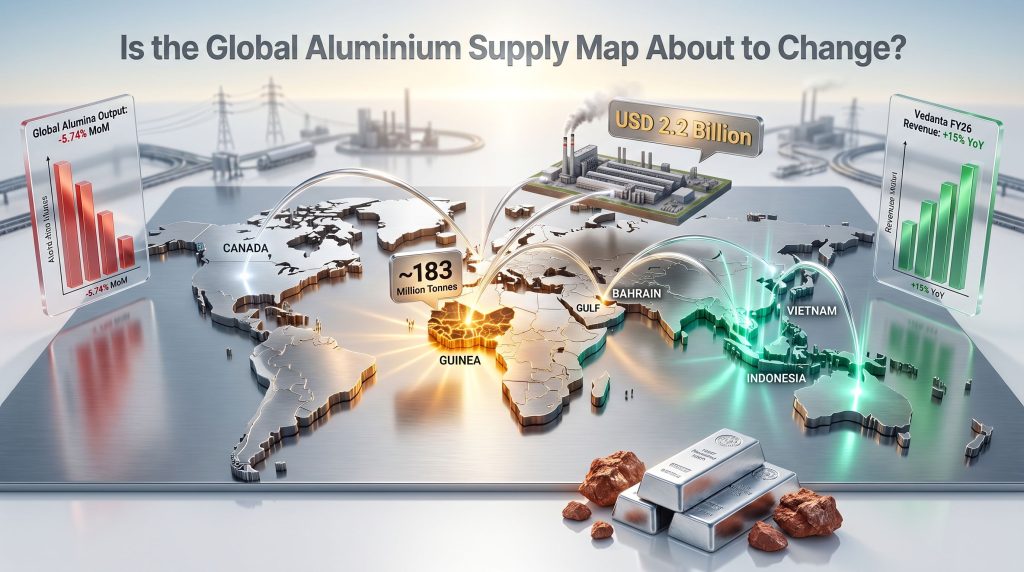
At the very foundation of aluminium production sits bauxite, and nowhere is the aluminium supply map under greater pressure than at this earliest extraction stage. Guinea, which holds approximately 7.4 billion tonnes of bauxite reserves representing the largest national reserve base on Earth, exported close to 183 million tonnes in 2025, making it the dominant supplier in global bauxite production by a considerable margin.
Proposed export reforms are expected to introduce an annual cap of approximately 150 million tonnes, which would effectively remove around 33 million tonnes from global supply each year. The rationale is straightforward: a surge in bauxite export volumes has pushed global spot prices sharply lower, while rising freight costs have simultaneously compressed the value realised per tonne. Guinea appears to be shifting its strategic posture from volume maximisation toward price preservation, a transition with significant consequences for the entire aluminium value chain.
Quantifying the Potential Supply Gap
| Metric | Figure |
|---|---|
| Guinea's 2025 bauxite exports | ~183 million tonnes |
| Proposed annual export cap | ~150 million tonnes |
| Estimated market volume removed | ~33 million tonnes |
| Guinea's total known reserves | ~7.4 billion tonnes |
No single alternative bauxite supplier can absorb a shortfall of this magnitude in the near term. This means a Guinea export cap would most likely produce a sustained structural deficit rather than a short-lived price spike, with bauxite and alumina prices experiencing prolonged upward pressure until alternative supply sources can be developed and commissioned.
Who Steps Into the Gap?
Several producing nations are positioned to capture market share should Guinea's cap be enforced:
-
Jamaica: The Jamaica Bauxite Institute (JBI) is urging the protection of bauxite-bearing land from unauthorised occupation following output disruptions caused by Hurricane Melissa in October 2025. Jamaica is actively seeking to deepen its national production footprint precisely as Guinea uncertainty creates an opening.
-
India: Domestic bauxite output reached approximately 25 million tonnes in 2025, up from 24 million tonnes the prior year. Simultaneously, imports surged to nearly 4.9 million tonnes from 4.1 million tonnes, representing year-on-year import growth of approximately 20 per cent. India's dual-track approach of expanding both domestic mining and import capacity positions it as a critical swing player.
-
Indonesia: Emerging as the most significant new primary aluminium growth hub outside China, with Chinese-backed capital potentially adding close to 3 million tonnes of primary output capacity between 2025 and 2030.
The bauxite supply question deserves particular attention from a geological perspective. Bauxite quality varies considerably by origin. Guinea's deposits are known for high gibbsite content and relatively low reactive silica, making them highly efficient for the Bayer alumina refining process. Replacement tonnes from alternative sources may not carry identical processing economics, meaning a Guinea shortfall could increase refinery operating costs even before the price impact of physical scarcity is considered.
The Alumina Production Shortfall: A Mid-Chain Vulnerability Deepening
Sitting between bauxite mining and primary smelting, alumina refining is the often-overlooked middle link of the aluminium value chain. Yet it is here that one of the most immediate supply vulnerabilities is materialising.
Global alumina production in April 2026 reached 11.92 million tonnes, representing a month-on-month decline of 5.74 per cent from 12.65 million tonnes in March 2026. On a year-on-year basis, output fell 2.59 per cent from 12.24 million tonnes recorded in April 2025. The cumulative production gap has been estimated at approximately 730,000 tonnes, a volume large enough to meaningfully tighten primary aluminium smelter feedstock availability.
Pipeline projects are expected to offset only around 25 per cent of this gap in 2026. Commissioning delays and ramp-up constraints mean that more substantial contributions from new refinery capacity are largely deferred to 2027 and beyond, leaving the market exposed to feedstock shortfalls in the interim.
Vietnam's USD 4.4 Billion Integrated Ambition
One of the most strategically significant new alumina development programmes is unfolding in Southeast Asia. Vietnamese industrial conglomerate THACO has unveiled a slate of proposed mining and processing projects in Lam Dong Province valued at approximately USD 4.4 billion, targeting full vertical integration from upstream ore extraction through downstream aluminium manufacturing.
Vietnam is also commissioning its first aluminium electrolysis plant in Q2 2026, covering approximately 129 hectares with total investment exceeding VND 18 trillion (USD 720 million). Initial annual production capacity stands at 150,000 tonnes of primary aluminium. The facility represents the completion of Vietnam's fully integrated bauxite to alumina to primary aluminium industrial chain, a milestone that positions the country as a meaningful new participant in regional aluminium supply rather than simply a raw material exporter.
The Aughinish Alumina Geopolitical Flashpoint
Europe's alumina supply picture carries its own layer of complexity. Ireland-based Aughinish Alumina exported over 80 per cent of its alumina production to Russia during the first quarter of 2026. Irish exports to Russia grew approximately 55 per cent between 2021 and 2025, rising from EUR 539 million to EUR 836 million over that period.
The European Commission opted against imposing sanctions on Aughinish at the present time, citing concerns that restrictions could further destabilise an already constrained European aluminium supply chain. Irish authorities are simultaneously conducting a formal review of Aughinish's export data after questions were raised regarding the accuracy of reported shipment volumes.
This situation illustrates a tension that is unlikely to resolve quickly. European policymakers are being forced to weigh geopolitical sanctions objectives against tangible aluminium supply security concerns, and for now, supply security is winning the argument. This dynamic reveals how structurally dependent parts of Europe's industrial base remain on flows that carry significant geopolitical risk.
Furthermore, European aluminium's innovation pathways toward climate neutrality are adding another layer of complexity to continental supply planning, as decarbonisation targets intersect with existing trade dependencies.
Alba's USD 2.2 Billion Acquisition: Gulf Capital Reshapes European Smelting
Perhaps the most consequential single corporate development reshaping the aluminium supply map is Aluminium Bahrain's (Alba) acquisition of Aluminium Dunkerque, the largest primary aluminium smelter in the European Union, in a transaction valued at USD 2.2 billion.
The deal involves a consortium structure with American Industrial Partners, the current owner, and Bpifrance acquiring a minority stake alongside Alba. The transaction has received EU approval, though it remains subject to final regulatory clearances.
The strategic logic is compelling on multiple levels. Alba is constructing a global low-carbon aluminium platform, and acquiring the EU's largest primary smelter places the company directly within the orbit of the EU's evolving Carbon Border Adjustment Mechanism (CBAM). As CBAM progressively raises the cost of carbon-intensive aluminium imports into Europe, producers with lower emissions intensity gain a structural pricing advantage. Gulf-based producers benefit from relatively low-cost energy inputs that support competitive emissions profiles compared with coal-intensive production elsewhere.
This transaction signals a broader trend: Gulf-based aluminium producers are actively expanding geographic footprints into carbon-sensitive Western markets, seeking to capture CBAM-related competitive advantages before the mechanism reaches full implementation.
Rio Tinto's Capacity Signals and North American Trade Recovery
Rio Tinto aluminium operations in New Zealand reported a net profit of USD 176 million in 2025, supported by higher aluminium sales revenue and increased output at the Tiwai Point smelter. The company is evaluating a partial restart of Line 4 at New Zealand Aluminium Smelter, a potline that has been idle since 2020. A restart decision would represent a meaningful capacity addition signal from one of the world's largest integrated aluminium producers.
On the North American front, Rio Tinto's Canadian aluminium exports to the United States have recovered to approximately 80 per cent of North American sales volumes. Strong US demand, tight regional supply, and elevated Midwest premiums have collectively absorbed tariff-related cost pressures, reinforcing Canada's enduring strategic role as the primary external aluminium supplier to the American market.
The next major ASX story will hit our subscribers first
North American Tariff Architecture: A Permanently Altered Trade Landscape
Formal review discussions under the United States-Mexico-Canada Agreement (USMCA) are underway amid persistent tariff pressure on aluminium, steel, and derivative products. Negotiations initially expected to conclude by July 1 have been extended through the week of July 20, reflecting the complexity of reconciling domestic production interests with deeply integrated cross-border supply chains.
The impact of US aluminium tariffs has been significant, with US Trade Representative Jamieson Greer indicating that tariffs are likely to remain in place as long as the United States maintains a trade deficit with major trading partners, creating a structurally persistent cost burden for aluminium importers rather than a temporary negotiating tool.
Mexico's aerospace manufacturing sector, a significant consumer of aluminium sheet and extrusions, faces dual pressure from input cost inflation and market access uncertainty as USMCA renegotiations proceed. Canada, however, has announced plans to extend steel and aluminium tariff-rate quotas for an additional year. Under the extended framework, imports from non-CUSMA countries exceeding quota thresholds will continue to face a 50 per cent tariff, with Canada's steel tariff-rate quotas proposed to remain in effect until June 27, 2027.
Japan's Gulf Supply Dependency: An Underappreciated Structural Vulnerability
Japan has historically sourced approximately 20 per cent of its raw aluminium imports from Gulf producers including the UAE and Saudi Arabia, attracted by the region's low electricity costs and large-scale smelting capacity. Escalating Middle East geopolitical tensions are now disrupting this supply corridor, creating upward price pressure in the Japanese market.
This vulnerability has been consistently underappreciated in regional supply planning. Japan's aluminium import diversification challenge is structurally difficult: Gulf producers offer a combination of scale, cost competitiveness, and product quality that few alternative suppliers can replicate at equivalent volume. The disruption is accelerating pressure on Japanese buyers to develop alternative sourcing relationships, a process that will take years rather than months to fully execute.
Vedanta's Record FY26 Performance: India's Aluminium Scale-Up Signal
Vedanta Limited delivered its strongest-ever financial result in FY26, with aluminium serving as a primary earnings driver alongside Oil and Gas and Power segments.
| Financial Metric | FY26 Result | Year-on-Year Change |
|---|---|---|
| Annual Revenue | INR 1,740.75 billion (USD 18.27 billion) | +15% |
| EBITDA | INR 559.76 billion (USD 5.87 billion) | +29% |
| Profit After Tax | INR 250.96 billion (USD 2.63 billion) | +22% |
Beyond the headline financials, Vedanta's logistics investment activity provides important signals about anticipated production scale-up. Vedanta Aluminium awarded a contract worth INR 285.8 million (USD 3 million) to Texmaco Rail and Engineering for the supply of one BTAP alumina transportation rake and brake van. This follows an earlier contract valued at INR 571.5 million (USD 6 million) covering two BTAP rakes and two BVCM units.
BTAP wagons are bulk commodity rail wagons specifically designed for alumina powder transport, and systematic investment in this logistics infrastructure typically precedes significant production volume increases. India's positioning as both a growing domestic producer and an expanding alumina importer places it as one of the most strategically significant swing players in the post-Guinea-cap aluminium supply equation. In addition, among the major aluminium producers globally, India's accelerating scale-up represents one of the most consequential shifts reshaping the aluminium supply map change through the remainder of this decade.
Four Scenarios for the Aluminium Supply Map Through 2030
The structural forces now in motion will play out across multiple plausible pathways. Investors and industrial buyers should consequently consider the following scenario framework:
Scenario 1: Guinea Cap Triggers Sustained Bauxite Deficit
A 150 MTPA export ceiling removes roughly 33 million tonnes annually, creating prolonged price support for bauxite and alumina. Beneficiaries include Jamaica, India, and Indonesia as alternative supply sources gain market share. Smelters dependent on imported raw materials face rising production cost bases.
Scenario 2: Southeast Asia Emerges as the New Primary Aluminium Growth Corridor
Vietnam's integrated bauxite-to-aluminium chain and Indonesian capacity expansion backed by Chinese capital position the region as the most dynamic new supply corridor through 2030. This shift introduces a new geopolitical dimension: Chinese industrial capital embedded in Southeast Asian production assets, creating strategic complexity for Western buyers seeking to diversify away from Chinese supply dependency.
Scenario 3: Europe Deepens Import Dependency as CBAM Reshapes Trade Economics
High energy costs continue suppressing domestic European primary production. Alba's acquisition of Aluminium Dunkerque introduces Gulf capital into EU smelting, potentially aligning European supply with lower-carbon Gulf production economics. CBAM progressively raises the cost of carbon-intensive imports, favouring producers with demonstrably lower emissions intensity profiles. Furthermore, industry-wide innovations in aluminium production are expected to accelerate this transition toward cleaner, more competitive European supply chains.
Scenario 4: North American Supply Resilience Built on Canadian Aluminium and Recycling Expansion
The US strategy of securing Canadian primary aluminium as a transitional supply bridge while expanding domestic recycling and remelt capacity continues. Elevated Midwest premiums persist as tight regional supply and tariff barriers sustain a structurally higher domestic price floor, incentivising further investment in regional production capacity.
Five Structural Shifts Every Aluminium Market Participant Should Understand
The following forces are collectively redefining the global aluminium supply map change, and none is likely to reverse in the near term:
-
China's production ceiling removes the world's largest producer as an incremental supply growth engine, fundamentally altering the global supply-demand balance at the primary level.
-
Guinea's proposed export cap introduces a potential 33-million-tonne annual bauxite shortfall that no single alternative supplier can immediately absorb, with quality differentials between Guinea ore and alternative sources adding a processing cost dimension beyond simple volume replacement.
-
Southeast Asia's integrated rise, led by Vietnam and Indonesia, represents the most significant new primary aluminium supply corridor to emerge in over a decade, with Chinese capital playing a central enabling role.
-
Corporate consolidation, most visibly through Alba's acquisition of Aluminium Dunkerque, is concentrating smelting assets under fewer, strategically positioned operators with cross-regional ambitions and explicit low-carbon platform objectives.
-
Tariff architecture across North America and the EU's advancing CBAM are permanently altering trade economics, favouring low-carbon, regionally proximate supply over lowest-cost global sourcing and reshaping long-established trade flows in ways that are unlikely to fully reverse even if specific tariff measures are eventually modified.
This article is intended for informational purposes only and does not constitute financial or investment advice. Forecasts, projections, and scenario analyses involve inherent uncertainty and should not be relied upon as predictive of future market outcomes. Readers should conduct their own independent research before making any investment or commercial decisions.
Want to Capitalise on the Commodity Disruptions Reshaping Global Supply Chains?
Discovery Alert's proprietary Discovery IQ model scans the ASX in real time, delivering instant notifications when significant mineral discoveries — including those tied to bauxite, alumina, and aluminium value chain commodities — are announced, turning complex geological data into actionable investment insights. Explore historic discovery returns on Discovery Alert's dedicated discoveries page and begin your 14-day free trial to position yourself ahead of the market.