June 6, 2026
When Freight Economics Gave Way to Geopolitical Risk Pricing
Physical commodity premiums have always told stories that headline prices cannot. While the London Metal Exchange base price captures broad supply-demand sentiment, it is the physical delivery premium that reveals what buyers actually face when they need metal in hand, at port, on time. For decades, the Japan Main Port aluminium premium operated as a relatively stable signal within this framework, moving in measured increments driven by ocean freight rates, regional inventory levels, and the seasonal rhythms of Japanese industrial demand.
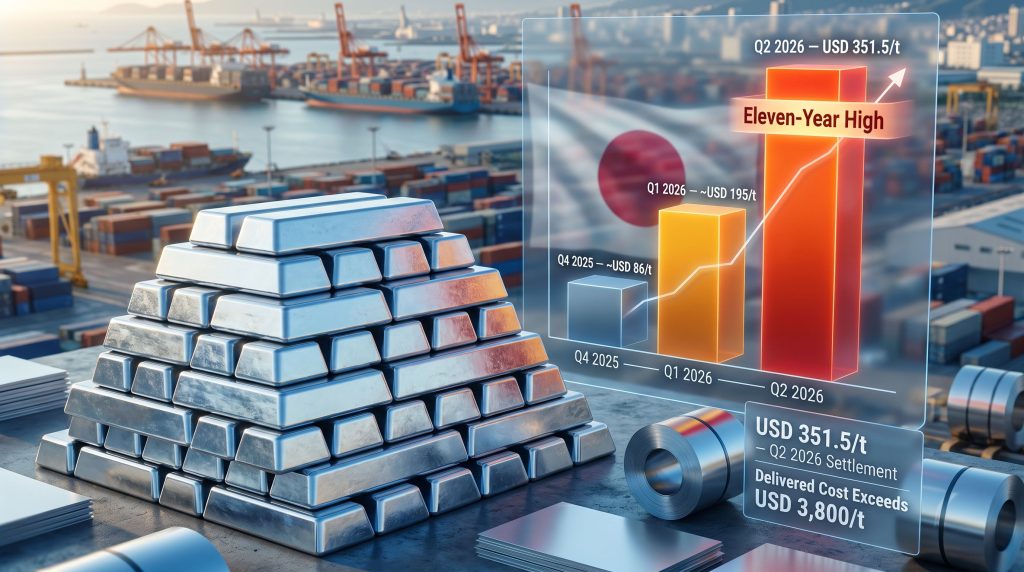
What has unfolded between Q4 2025 and Q2 2026 is something categorically different. The Japan aluminium premium spike from USD 86 per tonne to USD 351.5 per tonne within six months has not merely reset a price benchmark. It has fundamentally altered what that benchmark measures and what it means for every aluminium buyer across the Asia-Pacific region.
When big ASX news breaks, our subscribers know first
The Japan Main Port Premium: Architecture of a Benchmark
To understand why the current escalation carries such systemic weight, it helps to understand how the Japan Main Port (JMP) premium actually functions within global aluminium trade. Unlike exchange-traded prices, which are set by financial markets, the JMP premium is negotiated directly between Japanese buyers and international producers on a quarterly basis. These bilateral negotiations produce a settlement figure that is added to the prevailing LME aluminium price to determine the total delivered cost of physical metal at Japan's main import ports.
Japan holds a structural position as Asia's largest primary aluminium importer, and this scale gives its quarterly settlement an outsized gravitational pull across the region. South Korean manufacturers, Taiwanese fabricators, and Southeast Asian downstream processors all reference JMP settlements when pricing their own procurement contracts. The benchmark does not merely reflect Japanese market conditions; it anchors physical pricing architecture across the entire Indo-Pacific supply chain.
Historically, the variables feeding into JMP negotiations were relatively tractable. For instance, the key factors included:
- Ocean freight costs between producing regions and Japanese ports
- LME-held warehouse inventory levels and their implied forward availability
- Regional demand conditions from Japan's automotive, packaging, and construction sectors
- Producer capacity utilisation and any near-term production disruptions
In a functioning market with balanced supply, these factors produced premiums that moved gradually and predictably. The 2026 cycle has broken that pattern decisively.
A Six-Month Premium Escalation With No Modern Parallel
The quarter-by-quarter trajectory of the Japan aluminium premium spike is stark when presented in sequence.
| Quarter | Settlement (USD/t) | Quarter-on-Quarter Change |
|---|---|---|
| Q4 2025 | ~USD 86/t | Baseline |
| Q1 2026 | ~USD 195/t | +127% |
| Q2 2026 | USD 350-353/t (avg. USD 351.5/t) | +80% |
During Q4 2025, Japanese buyers settled well below producer opening offers of USD 95 to USD 110 per tonne, retaining meaningful negotiating leverage in a softer demand environment. The Q1 2026 inflection was jarring by any measure: producers opened between USD 190 and USD 225 per tonne, and settlements landed at USD 195 per tonne, representing a 127% quarter-on-quarter surge. Physical supply tightness had already begun embedding itself into negotiated outcomes.
The Q2 2026 negotiations, covering April-June shipments, began in February with producer guidance in the USD 220 to USD 250 per tonne range. Within weeks, that ceiling was rendered obsolete. Rio Tinto revised its offer to USD 350 per tonne by mid-March, effectively resetting price expectations across the Asia-Pacific market. Final settlements averaged USD 351.5 per tonne, with four contracts closing at USD 350 per tonne covering 10,000 tonnes per month and five contracts settling at USD 353 per tonne covering an additional 5,000 tonnes monthly.
The Q2 2026 settlement of USD 351.5 per tonne represents the highest JMP premium recorded since the approximately USD 380 per tonne peak in 2015, making it an eleven-year high that has materially reset physical price expectations across Asia.
The compressed timeline of the final escalation, where premiums jumped roughly 79% in the final weeks of March alone, reflects a market responding to real-time structural disruption rather than the gradual demand-cycle adjustments that have historically governed quarterly negotiations.
The Structural Forces Converging Behind the Spike
Supply-Side Compression and LME Inventory Depletion
Global primary aluminium smelting output has faced curtailment pressures across multiple producing regions simultaneously. When available tonnage for spot and contract markets contracts, buyers competing for physical metal drive premiums higher regardless of LME price levels. Compounding this, LME warehouse inventory drawdowns have created forward supply anxiety among physical buyers who cannot rely on exchange-held stocks as a buffer.
The mechanics here are important: LME warehouse inventories serve as a market of last resort for physical buyers. When those stocks decline materially, buyers lose their optionality and become more dependent on producer contract negotiations, which shifts bargaining leverage decisively toward sellers.
The Western Premium Diversion Effect
One of the less widely understood dynamics driving the Japan aluminium premium spike is the structural diversion of physical metal flows toward Western markets. When Midwest premiums in North America and Rotterdam premiums in Europe remain elevated, international producers rationally optimise their shipment routing toward those higher-netback destinations. The broader aluminium tariffs impact on global trade flows has further accelerated this diversion dynamic.
This is not a trivial effect. Every tonne directed toward Rotterdam or the US Gulf Coast is a tonne not available for quarterly contract negotiations in Tokyo or Osaka. The volume reduction in Pacific Basin supply directly amplifies upward pressure on JMP settlements. Buyers in Japan cannot simply substitute with metal intended for other markets; the physical logistics of primary aluminium trade make rapid reallocation difficult and expensive.
Freight, Insurance, and Logistics Cost Inflation
Rising ocean freight rates and tighter vessel availability have increased the landed cost of imported primary aluminium independent of any supply-demand dynamic. Marine insurance cost escalation, linked to geopolitical disruptions affecting key shipping routes, has added a structural floor beneath physical premiums that did not exist in prior cycles. Port congestion at major transit nodes extends effective lead times, reducing supply flexibility and forcing buyers to secure metal further in advance at higher cost.
Geopolitical Risk: The New Premium Component
Perhaps the most structurally significant development in the 2026 JMP premium cycle is the explicit pricing of geopolitical risk into quarterly settlements. Trade policy uncertainty, sanctions exposure on key aluminium-producing nations, and supply-chain resilience mandates from industrial buyers have all introduced a risk premium component that has no meaningful historical precedent in JMP negotiations.
Beyond geopolitical factors, carbon-linked procurement requirements and ESG compliance costs are adding measurable pricing complexity to physical aluminium contracts. Buyers with carbon footprint commitments cannot simply source from the lowest-cost producer; they must assess embodied carbon, certify sourcing chains, and in some cases pay a premium for lower-carbon metal. This ESG layer is additive to every other premium driver currently active in the market.
The 2026 premium spike is not a single-cause event. It reflects the simultaneous convergence of supply scarcity, logistics inflation, Western market diversion, geopolitical risk repricing, and carbon-linked procurement complexity into a single quarterly settlement mechanism.
How Japan's Premium Cascades Across Asia-Pacific Markets
The downstream consequences of the JMP benchmark reset extend well beyond Japan's borders. At Q2 2026 settlement levels, delivered aluminium costs in Japan have exceeded USD 3,800 per tonne, a figure that creates direct input cost pressure for manufacturers across multiple industrial sectors. Furthermore, shifts in China metals demand are adding additional complexity to regional supply flows, as Chinese domestic consumption patterns influence the availability of metal for other Asian buyers.
The sector-by-sector impact breaks down as follows:
- Automotive manufacturing: Electric vehicle platforms carry significantly higher aluminium content than traditional internal combustion vehicles, meaning EV manufacturers face disproportionate exposure to premium escalation
- Construction and infrastructure: Extrusion and flat-rolled product pricing flows directly from primary metal availability, pushing costs into project budgets that were locked before the Q2 reset
- Packaging and consumer goods: Aluminium can sheet and foil producers face upstream cost pressure that is difficult to absorb without passing costs through to brand owners
- Aerospace and defence: Long-cycle procurement structures provide partial short-term insulation, but contract renegotiation risk intensifies as legacy agreements expire
Because Japanese quarterly settlements serve as the regional reference point, higher JMP premiums cascade through South Korean, Taiwanese, and Southeast Asian procurement contracts with a lag of one to two quarters. A USD 260 per tonne increase in the benchmark has compounding consequences for every downstream buyer referencing it.
The 2026 Cycle in Historical Context
Three distinct premium cycles offer useful reference points for evaluating where the current escalation sits and where it might be headed.
| Cycle | Peak Premium (USD/t) | Primary Driver | Duration |
|---|---|---|---|
| 2015 | ~USD 380/t | LME warehouse reform, financing unwind | 2-3 quarters |
| 2021-2022 | USD 170-230/t | Post-pandemic demand surge, logistics disruption | 4-6 quarters |
| 2026 | USD 351.5/t (Q2, ongoing) | Supply diversion, geopolitical risk, inventory scarcity | Ongoing |
The 2015 cycle was driven primarily by structural changes to LME warehousing rules that unwound large aluminium financing trades, releasing and then reabsorbing physical inventory in ways that distorted premium signals. The 2021-2022 cycle reflected post-pandemic demand recovery colliding with supply chain fragmentation. Neither cycle embedded geopolitical risk pricing or ESG procurement complexity as structural premium components.
The 2026 cycle is therefore structurally distinct from both predecessors, and this distinction has direct implications for how long elevated premiums might persist. Leading aluminium mining companies are closely monitoring these dynamics as they reassess their own long-term supply and pricing strategies.
The next major ASX story will hit our subscribers first
Structural Reset or Temporary Disruption?
The Case for Sustained Elevation
Several factors argue against a rapid return to sub-USD 200 per tonne settlements:
- Western market premium differentials that incentivise supply diversion are unlikely to reverse without significant new Pacific Basin smelting capacity additions
- Geopolitical risk components embedded in premium negotiations reflect durable policy uncertainties rather than episodic disruptions
- ESG and carbon-linked procurement mandates are intensifying across Japanese industrial buyers, adding permanent cost layers that previous premium cycles never incorporated
- The negotiating psychology of quarterly markets means that once a higher settlement level is established, it creates an anchor for subsequent negotiations that is difficult to pull lower
The Case for Moderation
Counterarguments for some premium easing include:
- New primary smelting capacity in the Middle East and parts of Southeast Asia could increase Pacific Basin metal availability over a 12-24 month horizon
- Demand softening among price-sensitive Asian buyers could erode seller leverage in future quarterly negotiations
- Normalisation of ocean freight rates and marine insurance costs would reduce the logistics cost floor beneath premiums
- A rebalancing of Western market premiums could reduce the diversion incentive and redirect tonnage back toward Asia
The balance of structural evidence suggests that while some moderation from Q2 2026 peak levels is plausible over subsequent quarters, a return to the sub-USD 100 per tonne settlements of Q4 2025 is highly improbable without a fundamental and sustained shift in global supply-demand dynamics.
Buyer Response Strategies Under Premium Pressure
Industrial buyers across Asia are not passive in the face of elevated premiums. Several strategic responses are already observable in the market:
- Accelerating secondary and recycled aluminium sourcing to reduce dependency on high-premium primary metal imports
- Diversifying supplier relationships beyond traditional Pacific Basin producers to access metal from emerging supply regions
- Increasing use of financial hedging instruments, including LME futures and options, to manage forward price exposure
- Engaging in longer-term offtake agreements with producers to reduce quarterly renegotiation risk and lock in more predictable delivered cost structures
- Investing in scrap collection infrastructure and remelt capacity to reduce primary metal intensity in finished products
The scrap and secondary aluminium angle deserves particular attention. As JMP premiums remain structurally elevated, the economics of secondary metal recovery improve substantially. This creates a longer-term feedback mechanism that could partially moderate primary demand and, with it, some of the negotiating leverage currently held by primary producers. In addition, strategic partnerships such as the recent Alcoa joint venture signal how major producers are repositioning themselves within a structurally tighter market environment.
Consequently, the EU metals action plan represents another dimension of this structural shift, as Western policy frameworks aimed at securing domestic metal supply further influence the global flows underpinning Japan's premium dynamics.
Frequently Asked Questions: Japan Aluminium Premium Spike
What is the Japan Main Port aluminium premium?
The JMP premium is a quarterly-negotiated surcharge paid by Japanese buyers above the LME base aluminium price. It covers the physical cost of delivering primary aluminium to Japan's main ports and reflects freight economics, logistics costs, supply availability, and increasingly, geopolitical risk factors.
Why did the Japan aluminium premium spike so sharply in 2026?
The Q2 2026 settlement of USD 351.5 per tonne resulted from the simultaneous convergence of global supply tightness, LME inventory drawdowns, elevated Western market premiums diverting metal away from Asia, rising freight and insurance costs, and the repricing of geopolitical supply-chain risk into quarterly contract negotiations.
How does a higher JMP premium affect other Asian markets?
Because Japan is Asia's largest primary aluminium importer, its quarterly settlements function as a regional pricing anchor. Higher JMP premiums cascade through procurement contracts across South Korea, Taiwan, and Southeast Asia, raising delivered costs for downstream manufacturers throughout the region with a lag of one to two quarters.
Is the current premium level sustainable?
At USD 351.5 per tonne, Q2 2026 represents an eleven-year high. Sustained elevation depends on whether supply diversion toward Western markets continues, whether new Pacific Basin smelting capacity materialises, and whether the geopolitical risk factors now embedded in premiums persist or ease over the medium term.
When was the last time Japan's aluminium premium was this high?
The Q2 2026 average settlement of USD 351.5 per tonne is the highest recorded since approximately USD 380 per tonne in 2015, representing an eleven-year premium peak.
This article is intended for informational purposes only and does not constitute financial or investment advice. Premium forecasts and market trajectory assessments involve inherent uncertainty. Readers should conduct independent research and consult qualified advisors before making procurement or investment decisions based on aluminium market dynamics.
Want to Stay Ahead of the Next Major Commodity Market Shift?
Discovery Alert's proprietary Discovery IQ model delivers real-time alerts on significant ASX mineral discoveries, instantly translating complex commodity market signals into actionable investment insights for traders and long-term investors alike — explore how historic discoveries have generated substantial returns and begin your 14-day free trial at Discovery Alert to position yourself ahead of the market.