June 6, 2026
The Quiet Scramble for Bauxite: Why Supply Chain Anxiety Is Rewriting Mineral Diplomacy
Across the global manufacturing landscape, a fundamental shift is underway. Economies that once treated aluminium as a commodity input are now treating its upstream supply chain as a strategic liability. Bauxite, the ore from which alumina and ultimately aluminium are refined, has moved from the margins of trade policy to its centre. The reason is straightforward: the technologies defining the next industrial era, including electric vehicles, aerospace composites, defence platforms, and renewable energy infrastructure, all share an insatiable appetite for aluminium and the raw materials that feed its production.
Against this backdrop, Venezuela's bauxite reserves draw India's attention in ways that would have seemed improbable a decade ago. A bilateral meeting in New Delhi between Prime Minister Narendra Modi and Venezuelan Acting President Delcy Rodríguez brought mineral cooperation onto the diplomatic agenda. Rudrendra Tandon, Secretary (East) at India's Ministry of External Affairs, confirmed that discussions ranged across the broader mining sector, encompassing critical minerals and natural resources beyond Venezuela's well-documented oil wealth.
This engagement is not a bilateral oddity. It is a data point in a much larger pattern of resource diplomacy being conducted by mineral-hungry economies seeking to diversify supply before scarcity becomes crisis.
When big ASX news breaks, our subscribers know first
Venezuela's Bauxite Endowment: Vast, Underestimated, and Largely Untouched
Venezuela's position in the global bauxite hierarchy is rarely discussed with the depth it deserves. While Guinea, Australia, and Brazil dominate market conversations — accounting for much of global bauxite production — Venezuela's geological endowment tells a compelling story of its own.
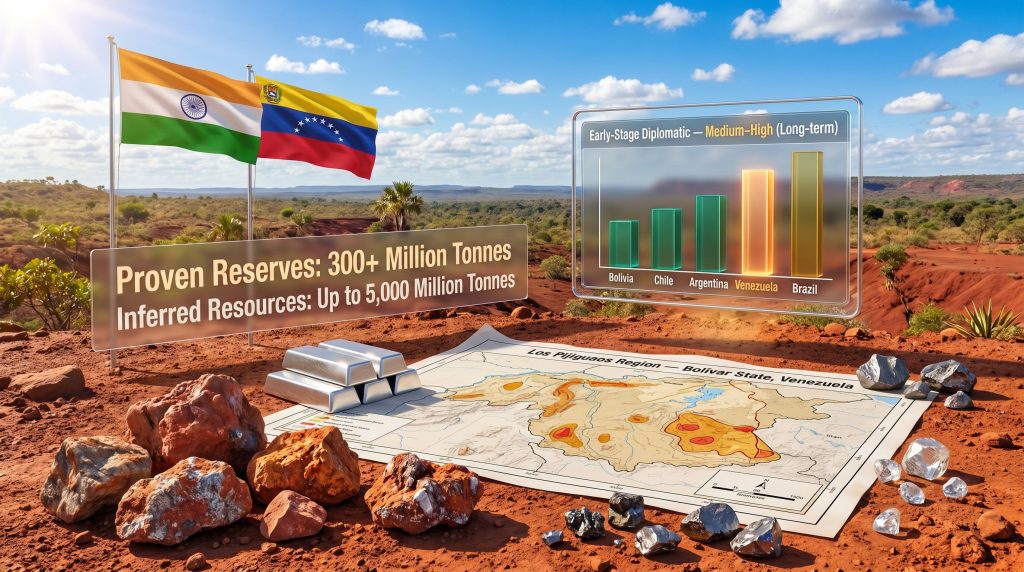
The Los Pijiguaos deposit in Bolívar State represents one of Latin America's most significant single-site bauxite accumulations. Broader estimates for Venezuela's national resource base are substantial:
| Metric | Estimate |
|---|---|
| Total Bauxite Resources | ~3.48 billion tonnes |
| Proven Reserves | 300+ million tonnes |
| Inferred Resources | Up to 5,000 million tonnes |
| Primary Deposit Regions | Bolívar State, Amazonas State, Los Pijiguaos |
| Currently Operational Bauxite Mines | 1 (active) |
The distinction between proven reserves and inferred resources is critical for investors and policymakers to understand. Proven reserves are quantities that have been confirmed through drilling, sampling, and geological modelling with a high degree of confidence. Inferred resources, by contrast, represent geological estimates extrapolated from limited data, carrying far greater uncertainty.
The gap between Venezuela's 300 million tonne proven figure and the 5,000 million tonne inferred estimate is not a minor rounding issue. It reflects decades of inadequate exploration investment and the absence of international-standard geological surveying across large portions of the country's mineral-bearing terrain.
This distinction matters enormously for any entity considering a supply partnership. Venezuela's bauxite story is one of potential, not yet of confirmed commercial throughput at scale.
Bauxite Quality and Its Industrial Implications
Beyond tonnage, bauxite quality is a decisive factor in its commercial value. The primary measure is the available alumina content, expressed as a percentage of aluminium oxide (Al₂O₃), alongside the ratios of reactive silica and iron oxide impurities.
Venezuelan bauxite from the Los Pijiguaos region is generally classified as a gibbsitic bauxite, meaning the aluminium hydroxide mineral gibbsite dominates the ore's aluminium-bearing phases. This mineralogy is considered favourable for processing because gibbsite dissolves readily under lower-temperature Bayer Process conditions, reducing the energy intensity of alumina refining compared to boehmitic or diasporic bauxites found in other regions.
For India, which operates significant alumina refinery capacity and is expanding it further, access to gibbsitic bauxite with manageable impurity profiles would represent a meaningful processing advantage — not merely a raw tonnage gain.
The Orinoco Mining Arc: A Multi-Commodity Corridor Still Waiting for Its Moment
Venezuela's mineral wealth extends far beyond bauxite. The Orinoco Mining Arc, a resource corridor spanning roughly 112,000 square kilometres in the country's southern interior, contains commercially identified deposits across an unusually diverse range of commodities:
- Gold: Concentrated in the Guayana Shield, with Venezuela holding some of the largest certified gold reserves in South America
- Diamonds: Present in the Guaniamo region, with gem-quality stones recorded historically
- Iron Ore: The Guayana region hosts major iron ore deposits directly relevant to steel-intensive economies
- Copper and Nickel: Present but less systematically quantified
- Coltan: Southern Venezuela hosts deposits believed to be among the more significant in Latin America
- Rare Earth Elements: Identified but minimally explored, representing a long-term frontier rather than a near-term opportunity
The Arc's sheer mineral diversity makes it theoretically attractive to an economy like India's, which requires inputs across steel, electronics, energy, and defence simultaneously. However, in practice, the Arc has been plagued by governance challenges, environmental controversies, artisanal mining conflicts, and inadequate infrastructure — all of which have suppressed formal large-scale development. According to industry analysts, Venezuela would require approximately $50 billion to meaningfully revive its mining sector.
India's Structural Demand Problem: Why Diversification Cannot Wait
India's appetite for critical minerals is expanding at a pace that existing supply agreements cannot comfortably meet. The country's industrial ambitions span:
- Electric vehicle manufacturing requiring aluminium for lightweight body structures, battery enclosures, and thermal management systems
- Renewable energy infrastructure consuming aluminium in solar frames, wind turbine nacelles, and transmission cabling
- Semiconductor and electronics production demanding tantalum, niobium, and rare earth elements
- Aerospace and defence platforms requiring high-purity aluminium alloys and specialty metals
- Infrastructure expansion consuming steel reinforced by niobium-enhanced alloys
India's current bauxite position is not without domestic resources. The country holds significant reserves, primarily in Odisha, Jharkhand, and Gujarat. However, domestic bauxite quality varies considerably, and India's alumina refining and aluminium smelting capacity is growing at a rate that increasingly outpaces comfortable domestic supply margins. Furthermore, overseas sourcing is therefore a structural necessity, not merely a diplomatic preference.
Khanij Bidesh India Limited (KABIL), the state-backed vehicle established specifically to acquire critical mineral assets abroad, has been active across Latin America, Africa, and Australia. Its engagement with Venezuela would represent an expansion of its operational theatre into one of the hemisphere's most complex but resource-abundant jurisdictions. India's overseas mineral strategy provides a useful template for how such engagement might be structured.
India's Latin America Mineral Engagement: Where Venezuela Sits
| Country | Key Mineral | India's Engagement Stage | Strategic Priority |
|---|---|---|---|
| Bolivia | Lithium | Active (KABIL) | High |
| Chile | Lithium, Copper | Active | High |
| Argentina | Lithium | Active (KABIL) | High |
| Venezuela | Bauxite, Coltan, Iron Ore | Early-Stage Diplomatic | Medium-High (Long-term) |
| Brazil | Iron Ore, Rare Earths | Established Trade | Medium |
Former Institute of Social Sciences Director Ash Narain Roy has noted that India's deepening engagement with Latin American economies over the past decade has been increasingly mineral-driven, pointing to the Lithium Triangle nations of Bolivia, Chile, and Argentina as the clearest examples of how resource endowments have reshaped bilateral relationships.
Roy has further observed that Venezuela may not simply be seeking commodity buyers but rather partners capable of contributing development expertise, processing technology, and infrastructure capital. This framing is significant: it positions India not as a purchaser of raw ore but as a potential co-developer — a structurally more durable and strategically advantageous arrangement.
Coltan: The Hidden Critical Mineral Opportunity Inside Venezuela's Portfolio
While bauxite commands the headline attention, Venezuela's coltan deposits may represent the higher-value strategic opportunity for India's technology and defence manufacturing sectors.
Coltan is the informal name for columbite-tantalite, a metallic ore containing two distinct critical metals:
- Tantalum: Used in capacitors for smartphones, laptops, and telecommunications equipment; also essential in medical implants, aerospace electronics, and defence guidance systems. Tantalum capacitors are preferred in high-reliability applications because they deliver high capacitance in compact form factors with exceptional temperature stability.
- Niobium: Used predominantly as an alloying element in high-strength low-alloy (HSLA) steel, improving strength without adding weight. It is also critical in aircraft engine components, superconducting magnets, and advanced energy infrastructure.
Venezuela's coltan deposits are concentrated in the southern regions of the country, in proximity to the Orinoco Mining Arc's other mineral endowments. The Democratic Republic of Congo and Rwanda currently dominate global coltan supply, creating a geographic concentration risk that mirrors the rare earth supply chain's dependence on China. India's push into semiconductor fabrication under national industrial policy makes tantalum supply security a genuine priority, not a theoretical one.
"Any economy serious about building a domestic semiconductor or advanced electronics manufacturing capability must eventually confront the question of tantalum supply. Venezuela's coltan reserves, if confirmed and developed, could represent one of the few Western Hemisphere alternatives to Congo-dominated supply chains."
The Real Barriers: Why Venezuela's Resource Potential Remains Theoretical
The structural case for India-Venezuela mineral cooperation is compelling in principle. The practical barriers, however, are equally formidable.
| Risk Category | Severity | Mitigation Pathway |
|---|---|---|
| U.S. Sanctions Exposure | High | Structured sovereign-to-sovereign agreements |
| Infrastructure Deficits | High | Phased investment with infrastructure co-development |
| Governance Uncertainty | Medium-High | Multilateral frameworks, KABIL oversight |
| Geological Uncertainty | Medium | Independent geological surveys pre-commitment |
| Single Operational Bauxite Mine | High | Long-term development pipeline, not spot supply |
The sanctions dimension deserves particular attention. U.S.-led sanctions on Venezuela have materially constrained the country's ability to attract foreign capital, access international financial systems, and import the technology required for large-scale mine development. Any Indian commercial entity operating in Venezuela would need to navigate this landscape carefully, potentially through sovereign-level bilateral frameworks that create sufficient legal insulation for investment activities.
Infrastructure deficits compound the challenge considerably. Venezuela's mineral-producing regions in Bolívar and Amazonas states are separated from coastal export infrastructure by vast distances and inadequate road and rail networks. Any development partnership would consequently require significant capital allocation to logistics infrastructure before a single tonne of ore could reach export-ready condition.
The geological gap between inferred resources and proven reserves is perhaps the most technically significant barrier. No credible investment decision can be made on inferred resource estimates alone. Independent geological surveys using modern drilling programmes, geochemical sampling, and resource classification methodologies consistent with JORC or NI 43-101 standards would be a prerequisite for any serious commitment of capital.
The next major ASX story will hit our subscribers first
Rare Earths and Gallium: The Long-Term Wildcards
Venezuela's rare earth potential is genuinely underexplored. The Guayana Shield, which underlies much of the country's mineral-bearing terrain, is geologically analogous to the Brazilian Shield, which hosts significant rare earth mineralisation. However, systematic exploration for rare earth elements in Venezuela has been minimal, meaning that resource estimates carry an exceptionally high degree of uncertainty.
A less commonly discussed dimension of the bauxite-alumina value chain is its potential to yield critical by-products during processing. Gallium, a metal with extraordinary importance in semiconductors, LED technology, and solar cells, is extracted commercially as a by-product of alumina refining from certain bauxite feedstocks. The gallium supply risks arising from China's dominant position in global production have been scrambling Western and allied economies to find alternatives. Venezuelan bauxite's gallium content has not been publicly quantified in detail, but the mineralogical context suggests it warrants investigation as part of any feasibility assessment.
Similarly, scandium, a rare metal used to produce aluminium-scandium alloys with significantly enhanced strength and corrosion resistance, is sometimes present in bauxite residues from the Bayer Process. Scandium-aluminium alloys are of considerable interest to aerospace and defence manufacturers seeking weight reduction without sacrificing structural integrity.
These by-product opportunities do not alter the fundamental economics of a bauxite development project, but they could provide meaningful supplementary revenue streams that improve the commercial viability of what would otherwise be a long-dated, capital-intensive investment.
What a Credible India-Venezuela Mineral Cooperation Framework Would Require
For the diplomatic discussions signalled by the Modi-Rodríguez meeting to translate into substantive economic outcomes, a structured pathway would need to include several sequential components:
- Formalisation of a bilateral mineral cooperation agreement establishing legal frameworks for joint exploration, data sharing, and investment protection
- Independent geological survey commissioning to bring Venezuela's bauxite and coltan resource estimates to investment-grade classification standards
- KABIL operational establishment in Venezuela, creating a permanent institutional presence capable of managing project pipeline development
- Infrastructure co-investment planning, including port access, inland logistics corridors, and processing facility siting studies
- Phased investment commitments beginning with exploration and survey activities before committing capital to mine development or processing infrastructure
- Engagement with multilateral risk-mitigation instruments to partially de-risk early-stage investment in a sanctions-exposed jurisdiction
India's experience in other challenging mineral jurisdictions, including parts of Sub-Saharan Africa and Central Asia, provides a practical template. The common thread in successful engagements has been patience with the development timeline, rigorous upfront geological and legal due diligence, and structuring investments through sovereign channels that provide protection unavailable to purely commercial entities.
It is also worth noting the broader competitive landscape. The leading bauxite mines globally are heavily concentrated in Guinea, Australia, and China, reinforcing why Venezuela's underdeveloped reserves present a genuine strategic opportunity for nations seeking supply chain diversification. In addition, the top aluminium miners are already manoeuvring to secure long-term feedstock agreements, which further underscores the urgency behind India's diplomatic outreach. Wood Mackenzie analysis suggests that while Venezuela's aluminium industry revival is plausible, it would require sustained investment and favourable geopolitical conditions over many years.
Frequently Asked Questions: India, Venezuela, and the Bauxite Opportunity
Why is Venezuela's bauxite significant for India's manufacturing ambitions?
India's aluminium-intensive sectors, spanning electric vehicles, aerospace, defence, and renewable energy, require reliable long-term bauxite supply. Venezuela's multi-billion-tonne resource base, particularly the gibbsitic deposits in the Los Pijiguaos region that process efficiently under standard Bayer conditions, represents a meaningful diversification option as domestic supply margins tighten.
What is the difference between Venezuela's proven reserves and inferred resources?
Proven reserves of over 300 million tonnes have been confirmed through rigorous geological investigation. Inferred resources of up to 5,000 million tonnes represent geological extrapolations based on limited data and carry substantial uncertainty. Investment decisions require proven or probable reserve classifications, not inferred estimates.
What is the Orinoco Mining Arc and why does it matter?
The Orinoco Mining Arc is a 112,000 square kilometre resource corridor in southern Venezuela containing identified deposits of gold, diamonds, iron ore, copper, coltan, and bauxite. It is one of Latin America's most mineral-dense geological zones but remains largely undeveloped due to infrastructure deficits, governance challenges, and limited foreign investment.
What is KABIL and what role would it play in Venezuela?
Khanij Bidesh India Limited is India's state-backed overseas mineral acquisition body. Its mandate covers securing critical mineral assets across Latin America, Africa, and Australia to support India's long-term industrial supply chains. Venezuela would represent a new operational frontier for KABIL, requiring a phased engagement strategy given the jurisdiction's complexity.
What makes coltan strategically important beyond bauxite?
Coltan contains tantalum, essential for semiconductor capacitors, defence electronics, and medical devices, and niobium, critical for high-strength steel alloys and aircraft engines. As India builds domestic semiconductor and advanced manufacturing capabilities, securing tantalum supply from sources outside the Congo-dominated global market becomes a genuine industrial priority.
Is Venezuela's rare earth potential commercially viable in the near term?
No. Venezuela's rare earth deposits are real but minimally explored. Commercial development would require a decade-long investment horizon encompassing exploration, resource definition, feasibility assessment, and infrastructure development. This is consequently a long-term strategic consideration rather than a near-term supply solution.
The Strategic Verdict: Potential Is Real, But the Timeline Is Long
Venezuela's bauxite reserves draw India's attention for reasons that reflect a legitimate strategic calculus, not diplomatic theatre. The resource endowment is genuine, the mineral diversity is remarkable, and the alignment with India's manufacturing demand trajectory is clear.
What tempers the immediate excitement, however, is an equally clear-eyed assessment of the operational reality. Venezuela currently operates a single active bauxite mine. Its infrastructure is inadequate for large-scale export. Its governance frameworks present material risks. Its inferred resource estimates vastly exceed its commercially verified reserves. And its sanctions exposure creates legal and financial complexity that purely commercial engagement cannot resolve.
The opportunity is therefore best understood as a long-cycle strategic positioning exercise rather than a near-term supply solution. For India, the appropriate response is not urgency but architecture: building the bilateral frameworks, conducting the geological due diligence, and establishing the institutional presence that would position Indian companies to act decisively if and when Venezuela's mineral sector conditions improve.
The diplomatic signal has been sent. Converting it into commercial reality will require patience, capital discipline, and a tolerance for jurisdictional complexity that few mineral partnerships demand so comprehensively.
Disclaimer: This article contains forward-looking analysis, scenario projections, and assessments of geological and geopolitical risk. Such content involves inherent uncertainty and should not be construed as investment advice. Resource estimates, particularly inferred resource classifications, are subject to significant revision as exploration data matures. Readers should conduct independent due diligence before drawing investment conclusions from any information contained herein.
Want To Track ASX Mineral Discoveries With Strategic Commodity Potential?
Discovery Alert's proprietary Discovery IQ model delivers real-time alerts the moment significant ASX mineral discoveries are announced, transforming complex geological and commodity data into clear, actionable insights for investors at every level. Explore how historic discoveries have generated substantial returns by visiting Discovery Alert's dedicated discoveries page, and begin your 14-day free trial today to position yourself ahead of the broader market.