June 6, 2026
When Chokepoints Become Flashpoints: Understanding the OPEC Output Crisis of 2026
Global energy markets have always been hostage to geography. The world's most critical oil supply arteries run through some of its most politically volatile regions, and when those corridors come under stress, the consequences ripple across every economy on the planet. The events unfolding across the Middle East in 2026 have brought this structural vulnerability into sharp relief, with OPEC output plunges by 1.22 million barrels a day producing what analysts are describing as the most significant involuntary supply disruption in OPEC's modern history.
When big ASX news breaks, our subscribers know first
The Scale of the Collapse: Numbers That Define a Crisis
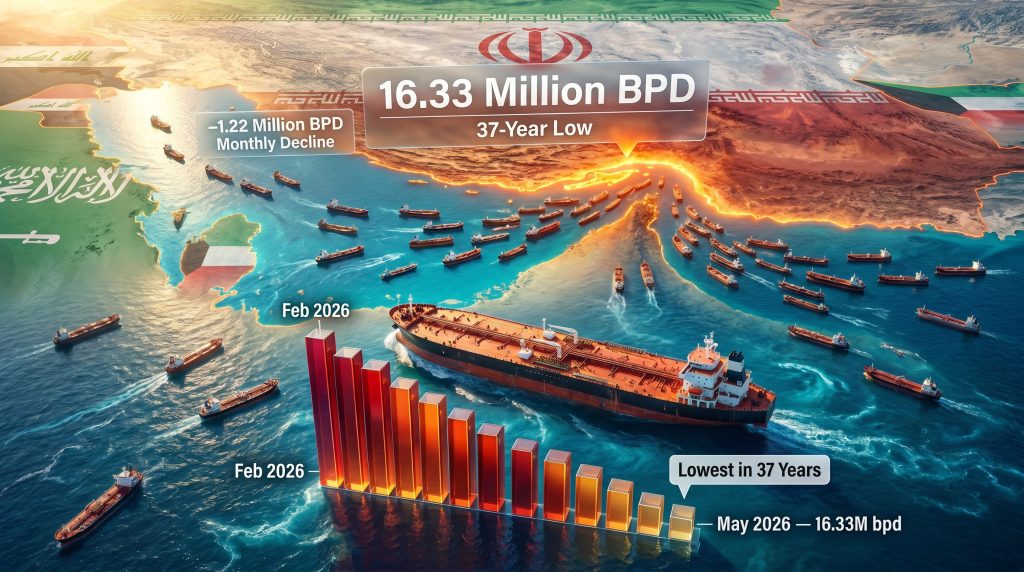
The headline figure demands attention: OPEC output plunges by 1.22 million barrels a day in May 2026, dragging the group's collective production to just 16.33 million barrels per day. That is the lowest recorded output level across OPEC's 11 current members in at least 37 years, according to Bloomberg survey data.
To understand why this figure carries such weight, it is important to distinguish between different types of production declines:
- Voluntary quota cuts (such as the OPEC+ coordinated reductions of 2020) are negotiated, planned, and reversible through diplomatic agreement
- Involuntary supply destruction driven by conflict, infrastructure damage, or enforced blockades operates on an entirely different dynamic, with recovery timelines that cannot be determined through a ministerial meeting
The May 2026 decline falls firmly into the second category. This is not a cartel managing production to defend a price floor. This is an organisation losing output it cannot recover at will.
| Metric | Value |
|---|---|
| OPEC 11-Member Output (May 2026) | 16.33 million barrels per day |
| Monthly Production Decline | 1.22 million barrels per day |
| Iran's Contribution to Decline | ~710,000 bpd (more than 50% of total drop) |
| Iran's Current Output Level | 2.34 million bpd (5-year low) |
| Historical Benchmark | Lowest OPEC output in at least 37 years |
| US-Redirected Commercial Vessels | 127 vessels (US Central Command data) |
| Global Supply Loss Since February 2026 | ~12.8 million bpd (IEA estimate) |
| Global Output Decline in April 2026 | 1.8 million bpd (IEA) |
Iran at the Centre of the Storm
Iran's production collapse accounts for more than half of OPEC's total monthly loss, making it the single most consequential variable in the current supply equation. Output from the country fell by approximately 710,000 barrels per day to reach 2.34 million barrels per day, the lowest figure recorded in five years.
The mechanism driving this decline is not geological depletion or infrastructure deterioration in the conventional sense. It is the direct consequence of a US naval blockade imposed on Iranian ports in mid-April 2026. US Central Command has confirmed that American forces redirected 127 commercial vessels to enforce restrictions on all maritime traffic entering and exiting Iranian ports. The operational breadth of that enforcement action is remarkable and explains why the production impact materialised so rapidly.
A blockade of this nature does not merely suppress exports. It disrupts the entire upstream operational cycle, including the delivery of equipment, chemicals, and spare parts that sustain production continuity at the wellhead level. Iran's oil fields, many of which are mature reservoirs requiring ongoing injection and maintenance programmes, are particularly vulnerable to operational interruptions of this kind. Furthermore, OPEC's market influence in stabilising global supply has consequently been significantly undermined by this enforced production deterioration.
When access to ports is severed, the production consequences extend well beyond export revenue. The entire logistical supply chain that keeps wells producing begins to degrade, meaning output losses can compound over time even without direct infrastructure damage.
The Strait of Hormuz: A Chokepoint Under Real Pressure
The Strait of Hormuz has long been described in theoretical terms as a potential flashpoint. In 2026, that theoretical risk became operational reality. Military conflict involving a US-Israeli alliance and Iran has substantially restricted passage through the waterway, which historically has facilitated the transit of approximately 20% of all globally traded oil.
The consequences for Persian Gulf producers have been severe and wide-ranging:
- Saudi Arabia has been forced to reduce production volumes that cannot be exported through alternative routes at scale
- Iraq relies heavily on Persian Gulf export terminals for the majority of its crude shipments
- Kuwait faces similar export route dependencies through Gulf terminals
- The UAE, prior to its OPEC departure, managed partial exposure through the Fujairah export corridor on the Gulf of Oman
Saudi Arabia does operate the East-West Pipeline, known as Petroline, which provides a bypass route from its Eastern Province fields to the Red Sea port of Yanbu. At full capacity, this infrastructure can transport approximately 5 million barrels per day, offering a partial but not complete alternative to Strait-dependent export routes. Oman's Muscat-Sohar corridor also provides limited alternative routing capacity. However, neither infrastructure solution can fully compensate for a sustained Strait disruption at the scale currently being experienced.
The UAE's Departure: An Institutional Fracture
One of the less-discussed but structurally significant developments embedded within this crisis is the UAE's formal exit from OPEC in May 2026, ending approximately six decades of membership. The Bloomberg survey data underlying the 16.33 million bpd figure explicitly excludes UAE production, making direct historical comparisons more complex.
The UAE's departure reflects tensions that have been building within the cartel for years. Disputes over quota allocations, production baseline calculations, and the strategic autonomy needed to attract long-term investment have created friction that predates the current conflict. The geopolitical stress of active regional warfare appears to have accelerated a decision that was already being considered on economic grounds.
For OPEC as an institution, the exit of a member with production capacity exceeding 3 million barrels per day at peak output represents a meaningful reduction in collective bargaining power, even as the organisation's output data is being recalibrated to reflect its new membership composition.
Historical Context: Benchmarking Against Prior Supply Shocks
The last time OPEC output was at comparable levels was the late 1980s, a period bookended by the tail end of the Iran-Iraq War and the lead-up to the Gulf War. That era was characterised by a different kind of production collapse: one shaped by direct infrastructure destruction, the deliberate burning of Kuwaiti oil fields, and the temporary removal of Iraqi and Kuwaiti supply from global markets during the 1990-1991 Gulf conflict.
The current situation bears some structural similarities but differs in a critical respect. The 1990-1991 Gulf War supply shock was ultimately resolved through military intervention, with production recovery following a relatively clear geopolitical timeline. The 2026 disruption involves a more complex web of naval enforcement mechanisms, ongoing conflict dynamics, and institutional fractures within OPEC itself that do not map onto a simple resolution pathway.
It is also worth distinguishing the current crisis from the 2020 COVID-era OPEC+ response, when the alliance negotiated voluntary production cuts of approximately 9.7 million barrels per day to manage a demand collapse. That agreement, however painful, was a coordinated policy decision with mechanisms for unwinding built into its architecture. The present supply loss, however, is being imposed by external forces, not managed from within. The complex interplay of oil prices and geopolitics has rarely been more starkly illustrated than in this environment.
The next major ASX story will hit our subscribers first
IEA Data: The Bigger Picture Behind OPEC's Numbers
OPEC's 1.22 million bpd monthly decline, significant as it is, represents only one component of a broader global supply deterioration. The International Energy Agency has reported that global oil production fell by 1.8 million barrels per day in April 2026 alone, with cumulative supply losses since February 2026 reaching an estimated 12.8 million barrels per day across all producers.
This broader context is essential for understanding the true scale of the oil market disruption. Non-OPEC producers, including US shale operators, face genuine constraints in responding to a gap of this magnitude:
- Lead times for new US shale completions typically run three to six months from investment decision to first production
- Infrastructure bottlenecks in pipeline takeaway capacity limit how quickly Permian Basin production can be scaled
- Capital allocation cycles in publicly traded oil companies are increasingly governed by shareholder return commitments rather than production maximisation
- Pricing signals must persist for sufficient duration before operators commit to elevated capital expenditure programmes
Russia, the other major non-OPEC producer with significant swing capacity, faces its own production constraints related to sanctions-related equipment shortages and the redirection of export flows following the 2022 conflict with Ukraine.
Three Scenarios for Resolution: Timelines and Market Implications
How this crisis resolves will determine energy market conditions for years to come. Three distinct trajectories are plausible, each carrying materially different implications for prices, investment, and the broader energy transition.
Scenario 1: Rapid De-escalation (3 to 6 Month Resolution)
A diplomatic ceasefire enabling partial Strait of Hormuz reopening, combined with incremental sanctions relief, could allow Iranian production to begin recovering toward its pre-blockade capacity. Saudi, Iraqi, and Kuwaiti output would normalise as export route access improved. Oil prices would likely retrace from crisis premiums toward a supply-demand equilibrium reflecting underlying fundamentals.
Scenario 2: Prolonged Conflict Stalemate (6 to 18 Months)
Sustained production losses across multiple OPEC members would force continuous drawdowns of strategic petroleum reserves held by the US and IEA member nations. The cumulative reserve release capacity of IEA members is substantial but finite, estimated at around 1.5 billion barrels in combined strategic stocks. Prolonged deployment would progressively erode this buffer, placing sustained upward pressure on spot prices and potentially triggering demand destruction in price-sensitive emerging market economies.
Scenario 3: Permanent Geopolitical Realignment (18 Months or Beyond)
A scenario in which the Strait of Hormuz remains functionally impaired over the long term would catalyse fundamental infrastructure investment in alternative export corridors, accelerate energy security diversification strategies among major importers, and potentially reshape the institutional architecture of global oil trade. This scenario would also likely accelerate renewable energy investment in import-dependent economies, mirroring the policy responses that followed the 1973 Arab Oil Embargo.
Major Importer Exposure: India, China, and Europe
The supply shock carries asymmetric risks for different consuming regions based on their specific import dependencies and strategic reserve positions.
India sources a substantial proportion of its crude oil requirements from Persian Gulf producers, with Iraqi and Saudi grades dominating refinery feedstock procurement. Indian refiners are structurally configured for medium-sour crudes of the type produced in the Gulf region, meaning substitution with Atlantic Basin or Latin American grades involves both logistical and refinery configuration challenges.
China maintains long-term supply agreements with multiple Middle Eastern producers but also has significant spot market exposure. Beijing's strategic petroleum reserve capacity provides a meaningful buffer, but the scale of China's daily consumption means even modest disruption timelines consume reserve capacity rapidly.
Europe faces the additional complexity of navigating simultaneous constraints on both Middle Eastern and Russian supply, a combination that has been driving accelerated investment in LNG import terminal capacity and renewable energy generation since 2022.
The Energy Transition Paradox
Geopolitically-induced oil scarcity creates a genuine paradox for the clean energy transition. On one hand, sustained high oil prices improve the relative economics of renewable energy, electric vehicles, and alternative fuels, accelerating adoption decisions in price-sensitive sectors. On the other hand, energy transition pressures frequently see policy attention and capital redirected toward short-term supply adequacy rather than long-term decarbonisation during emergencies.
Historical evidence from the post-1973 period suggests that the long-term effect of severe supply shocks is to accelerate structural energy diversification, even if the immediate policy response is dominated by emergency supply measures. France's nuclear programme, Japan's aggressive efficiency standards, and Denmark's wind energy leadership all trace meaningful portions of their origins to the policy responses triggered by the 1970s oil crises.
Whether the 2026 disruption produces a similar catalytic effect will depend significantly on the duration of the crisis and the political economy of energy investment in the world's major consuming nations. In addition, OPEC demand forecasts for the coming quarters are expected to be revised substantially downward as the full impact of the disruption is assessed.
Key Metrics Summary
| Category | Detail |
|---|---|
| OPEC Output Drop | 1.22 million bpd month-on-month |
| Primary Driver | US blockade of Iran + Strait of Hormuz disruption |
| Iran's Output | 2.34 million bpd (5-year low) |
| Iranian Decline | ~710,000 bpd (over 50% of total OPEC loss) |
| Vessels Redirected | 127 (US Central Command enforcement) |
| Global IEA Supply Loss (since Feb 2026) | ~12.8 million bpd cumulative |
| OPEC Institutional Change | UAE departed after ~60 years of membership |
| Historical Comparison | Output not seen this low since the late 1980s |
Furthermore, according to OilPrice.com, the broader production decline across OPEC reflects a structural deterioration that extends well beyond a single month's data, reinforcing the severity of what markets are now confronting.
Disclaimer: This article contains forward-looking analysis and scenario projections based on publicly available data and historical energy market precedents. Figures cited from IEA and Bloomberg survey data reflect estimates as of early June 2026. Energy market conditions are subject to rapid change based on geopolitical developments. Nothing in this article constitutes financial or investment advice. Readers should conduct independent research before making any investment or commercial decisions.
Want To Stay Ahead of Market-Moving Commodity Discoveries?
Discovery Alert's proprietary Discovery IQ model scans ASX announcements in real time, instantly identifying significant mineral discoveries and translating complex data into actionable investment insights — ensuring subscribers are positioned ahead of the broader market. Explore historic discoveries and their extraordinary returns, or start your 14-day free trial today to gain an immediate market-leading edge.